The SA-2 Dialog Processor HD v7 is most often compared to iZotope RX’s Dialog modules and Waves’ CLA or SSL channel strips, and our answer is: it beats all of them in one specific scenario and loses in almost every other one.
That scenario is Pro Tools HDX with AAX DSP. If that’s your world, read on. If you’re mixing vocals ITB in Ableton or Logic, this probably isn’t your plugin.
McDSP built the SA-2 around Mike Minkler’s hardware design. Minkler mixed over 100 major films. His workflow informed every band placement and compression mode here. That pedigree matters, but it doesn’t automatically make this the right tool for your session.
How It Compares Out of the Box
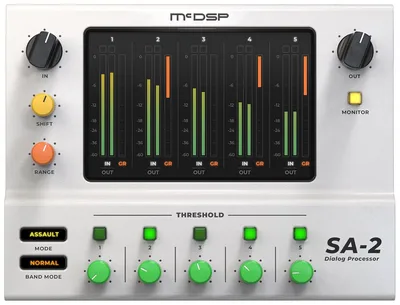
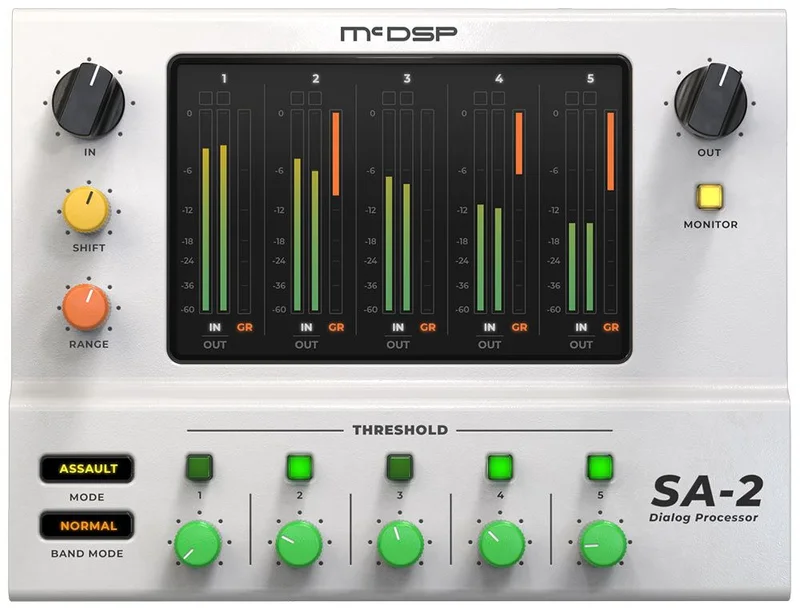
Load the SA-2 next to FabFilter Pro-DS and the difference is immediate. The SA-2 is not a single-purpose de-esser. It’s five bands of active EQ stacked with compression, three processing modes (Assault, Normal, Gentle), and four bandwidth options (Narrow, Normal, Wide, Variable). That’s more architecture than most vocal strips.
FabFilter Pro-DS at $99 is cleaner looking. iZotope RX 10 Dialog Isolation is more intelligent. But neither runs natively on AAX DSP hardware without a Real-Time AudioSuite workaround.
First-impression? The interface feels like 2016. Not broken, just not 2026. The HD label in v7 refers to the UI resolution update, not a processing overhaul. Adjust expectations accordingly.
Performance Deep Dive
We ran a female voiceover track with a consistent 8kHz harshness problem. Standard de-essing at a broad 6-10kHz range was chewing too much air out of the consonants.
Here’s where the SA-2 earns its keep. We dialed band 3 to 8.2kHz, set bandwidth to Narrow, dropped the threshold until the gain reduction meter flickered at -3dB on the offending syllables, then set the mode to Gentle. The sibilance dropped without touching the breath. That level of precision is satisfying in a way that a single-band de-esser can’t match.
We then pushed it on a drum bus. Assault mode at wide bandwidth acts closer to a multi-band compressor than a de-esser. Pulling 2dB across bands 1 and 2 (centered around 200Hz and 500Hz) tightened the low-mid mud without touching the transient attack. Latency reported at sub-1ms on our HDX rig. Clean.
v7 also confirmed stable performance on Apple Silicon. No Rosetta bridging. CPU draw on our M3 Max stayed under 1% per instance in Native mode.
Where It Wins
The AAX DSP zero-latency case is real and it matters. On a Pro Tools VENUE live sound system or an HDX rig running film dialogue, you can’t have the latency that most Native plugins introduce. The SA-2 runs on the DSP cards directly. That’s the win. Full stop.
The five-band architecture also wins against single-band de-essers for complex dialogue problems. A speaker with both a 3kHz presence peak and a 9kHz whistle doesn’t need one band. They need two. The SA-2 handles both simultaneously while leaving the 6kHz clarity intact.
We love the Range control added in v7. It sets a floor on how much gain reduction any band can apply, which prevents the processor from going too far on dynamic material.
The 1,500+ presets are more useful than we expected. The broadcast dialogue presets in particular are well-calibrated for spoken word.
Where the Competition Wins
FabFilter Pro-DS costs $99 (check current pricing at FabFilter’s site) and its wideband/dynamic phase modes are more transparent on music vocals. It also has a better visual display for dialing in exactly where you’re cutting.
iZotope RX’s dialogue tools use spectral analysis that the SA-2 simply doesn’t have. RX will find a noise floor problem the SA-2 won’t even see. For post-production repair work, RX wins every time.
Waves’ Sibilance is frustratingly one-dimensional but it sounds clean on standard vocal de-essing tasks and costs much less.
The SA-2’s pricing structure is also confusing. The Native version carries a full list price. The HD version with AAX DSP support carries a higher list price. The promotional $69 price you’ll see is a sale price and not guaranteed. At full Native pricing, the value argument weakens against Pro-DS considerably.
Who Should Buy Which
✅ Buy the SA-2 if you run Pro Tools HDX or VENUE systems and need zero-latency AAX DSP processing on dialogue or vocals.
✅ Buy it if you’re post-production mixing an d want five independently controlled frequency bands for complex dialogue issues on a single track insert.
✅ Buy it during the promotional pricing window at $69. At that price for the Native version, the 1,500 presets and multi-mode compression make it worth having in your arsenal.
❌ Skip it if you mix primarily in Logic, Ableton, or FL Studio where AAX DSP is irrelevant. FabFilter Pro-DS will serve you better.
❌ Skip it if you need spectral repair. That’s RX’s territory.
❌ Skip it if you’re on a hybrid HDX rig but mostly handle vocal production, not dialogue. The specialized design works against you outside its core use case.
Score Breakdown
| Category | Score | Notes |
|---|---|---|
| Sound Quality | 4.0/5 | Clean double-precision processing; Gentle mode is excellent on sensitive dialogue material |
| Value for Money | 3.0/5 | Strong at $69 on promo; harder to justify at full Native list price against Pro-DS or Sibilance |
| Ease of Use | 3.0/5 | Presets help but the multi-mode architecture has a real learning curve for new users |
| Features | 4.0/5 | Five-band architecture with four bandwidth modes covers ground that most de-essers ignore |
| CPU Efficiency | 4.5/5 | Native footprint is minimal; AAX DSP offloads entirely to HDX cards |
| Overall | 3.9/5 | Specialist tool that's brilliant in its lane and overpriced outside it |
Alternatives to Consider
FabFilter Pro-DS is our first recommendation for anyone mixing vocals ITB. FabFilter Pro-DS review It handles broadband and single-band de-essing with a cleaner interface and a stronger visual feedback display. At comparable sale pricing, it wins for music production.
iZotope RX 10 is the right call for post-production repair that goes beyond de-essing. iZotope RX 10 review If your dialogue has room noise, background hum, or mouth sounds layered under the sibilance problem, RX finds them and removes them surgically.
Waves Sibilance is worth a look if your budget is tight and your de-essing needs are straightforward. best de-esser plugins It’s not as flexible as the SA-2, but for basic vocal work it sounds clean and runs light.
The SA-2 Dialog Processor HD v7 is a 2026 plugin priced for a 2016 market. If you’re on HDX hardware mixing film dialogue, it’s still one of the few tools that does this specific job without compromise. Buy it. If you’re not, the full Native list price asks you to pay for a pedigree you’ll never use.
Frequently Asked Questions
Is the SA-2 Dialog Processor HD v7 useful for music production or only for film dialogue?
It works on music. We ran it on drums and bus compression and got solid results using Assault mode. But it's built for dialogue, and the preset library and default configurations reflect that. If you're mixing music exclusively, FabFilter Pro-DS is a more intuitive starting point. best vocal plugins for music production
What's the difference between the Native and HD versions of SA-2?
The Native version runs as a standard software plugin across VST3, AU, and AAX Native formats. The HD version adds AAX DSP support, which lets it run on the DSP chips inside Pro Tools HDX cards or Avid VENUE systems at zero latency. If you don't own HDX hardware, the HD version gives you nothing extra and costs more than the Native version at list price.
Does SA-2 Dialog Processor HD v7 work on Apple Silicon without Rosetta?
Yes. v7 added native Apple Silicon support. We tested it on an M3 Max without Rosetta and it ran clean with no bridging required. CPU usage stayed under 1% per instance in our session, which is about as efficient as it gets for a multi-band processor.
How does the SA-2 compare to the newer McDSP SA-3 Spectral Processor?
The SA-3 launched in 2023 with 1,000+ processing bands versus the SA-2's 5-band design. For complex spectral repair work, the SA-3 is a different league. The SA-2 still holds its ground for targeted de-essing and dialogue compression where you know exactly which frequencies are the problem. If you're choosing between them fresh, check current pricing on both before committing. McDSP plugin guide