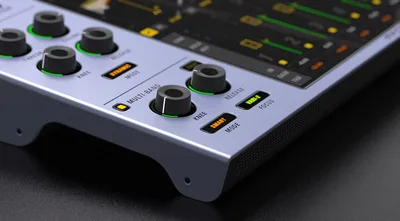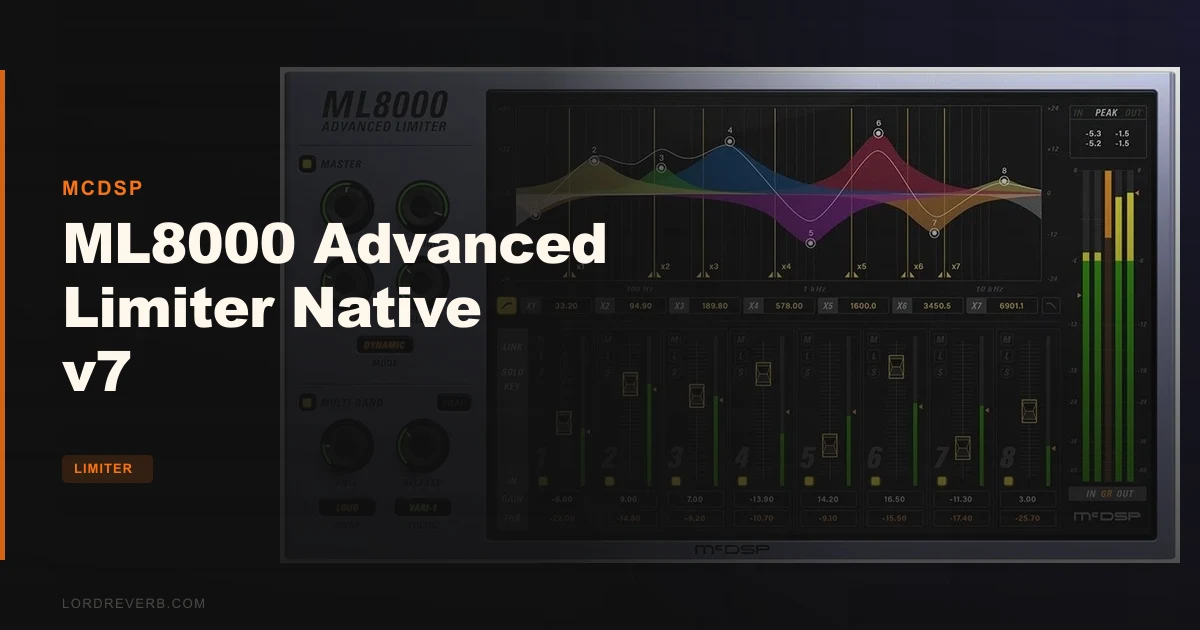
Here's the mastering problem nobody talks about honestly: a single wideband limiter on your master bus is making decisions with no frequency intelligence. It catches a rogue sub transient at -0.3 dBFS and clamps the whole mix for it. Your vocals duck. Your snare loses body. The mix you spent 40 hours on gets compressed into something that sounds like it was mixed underwater. The ML8000 Advanced Limiter Native v7 from McDSP exists specifically to solve that. It's a dual-stage limiter built for mastering engineers and serious mix engineers who need multi-band peak control that doesn't destroy everything around the problem frequency. If you're still using a single-stage brick-wall limiter on your final bus and wondering why your masters sound smaller than your references, this is worth your attention.
The Exact Problem It's Designed to Fix
Wideband limiters are blunt instruments. They don't know the difference between a sub kick that's clipping and a vocal that's just sitting loud. They react to the loudest signal in the full-frequency content and apply gain reduction everywhere.
The ML8000 splits that job into two independent stages. The first stage, the Multi-band Limiter, uses 8 bands of active processing for superior phase response over traditional crossover-based processing. That's the key distinction. Traditional crossover-based multi-band processing introduces phase shift at the crossover points. You fix a 60Hz problem and smear the transient relationship between the kick and the bass. The ML8000's active processing approach avoids that.
The second stage, the Master Limiter, is a precise recreation of the patented ML4000 limiter algorithm, right down to the limiter modes. The Master Limiter also includes filter design enhancements to further reduce peak distortion.
Together, you get surgical band-level control followed by a final catch-all ceiling. It's a smarter signal chain. Full stop.
How It Actually Performs in the Session
We ran a dense electronic master through the ML8000. Sub content was triggering gain reduction at around -2.5 dB on a wideband limiter, and the high-mids were getting sucked down with it every time the kick hit. Annoying. We moved to the ML8000, isolated band 1 (sub/low) to handle the offending frequency range, set its threshold to catch peaks above -1 dBFS, and left bands 3 through 8 with far more headroom.
The kick stopped pulling the vocal back. The stereo image stayed wide. The Master Limiter handled the final 0.3 dB of ceiling work cleanly.
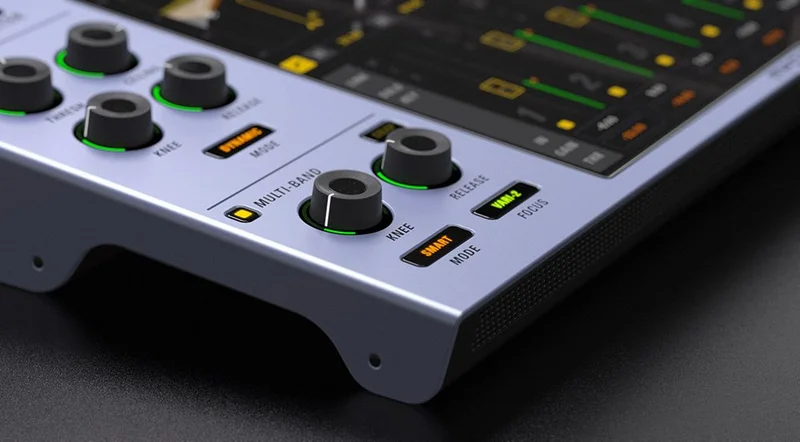
Each band has its own gain and threshold (output ceiling) control. Additional overall band controls include release time and limiter modes, calibrated similarly to the modes of the original highly acclaimed McDSP ML4000 limiter. Each band gives you up to ±24 dB of gain, which is far more range than you'd ever need for standard mastering but useful when using the plugin as a corrective tool on buses mid-mix.
An additional focus mode provides subtle articulation changes in how each band tracks and limits the incoming signal. We used focus mode on a drum bus where we needed a fast attack on the transient without the release smearing into the body of the snare. Satisfying result. The snare crack stayed intact. The tail tightened without sounding pumped.
The ML8000's 8 bands are easily controlled from the response plot, large gain faders beneath, and convenient threshold markers aligned to each band's input meter. Text readouts can be adjusted from the keyboard, or controlled with mouse movement. Any number of bands can be linked to another band, and each band can be solo'd or have its key input monitored. The band-link feature saved us real time when we needed matched behavior across a stereo pair of buses.
Zero-latency algorithms are confirmed and working. We tested it inserted on a vocal chain during a tracking session in Logic Pro. No compensation needed. No pre-delay drift. That's not always a given with multi-band limiters, which often require look-ahead buffering that introduces latency you have to manually compensate for in other tracks.
Strengths and Weaknesses
The dual-stage architecture is genuinely clever. Most multi-band limiters stop at the multi-band stage. Bolting the ML4000-derived Master Limiter onto the back end means you're not relying on 8 bands to cleanly catch every stray peak. That second stage is a safety net with real pedigree behind it.
We love the band-linking and the solo/key monitoring per band. Diagnosing which frequency band is doing the heavy work takes seconds instead of minutes.
Here's what we wish was better: the UI. It works. It's readable. But next to FabFilter Pro-L2's gain reduction display or the SSL X-Limit's clean metering, the ML8000 feels like it's running on 2016 energy. The gain reduction visualization per band doesn't communicate as fast as it should at mix speed. You have to look harder than you want to.
The iLok requirement is a friction point we can't ignore. In 2026, requiring an iLok dongle or an active iLok Cloud session for a $129 plugin is a workflow tax that many producers just won't pay. McDSP plugins require an iLok2 or iLok3 USB Smart Key, or an iLok License Manager account and iLok Cloud for activation. If your internet goes down during a session, that's a real problem.
VST is gone. As of v7.0, VST is no longer supported. VST versions of v6 McDSP plugins will no longer be updated and will be uninstalled. If you're on a Windows rig that relies on VST exclusively, you need to check your DAW's VST3 support before purchasing.
Is the Price Worth It?
At $129, the ML8000 Native v7 sits in the same range as FabFilter Pro-L2 and Waves' heavier mastering tools. It undercuts Pro-L2 by a meaningful margin. For a dual-stage, 8-band mastering limiter with a pedigree algorithm in stage two, that's a fair ask.
Each McDSP v7 plugin contains two activations per authorization. Two machines covered. That's standard and reasonable.
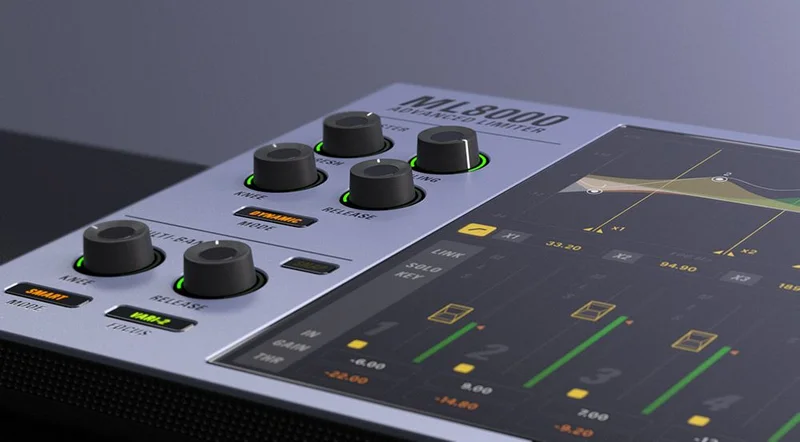
The preset library is large. 1,500+ presets land with v7. For producers who want a starting point rather than dialing in every band from scratch, that library pays for itself in saved time. We'd still buy this ourselves at this price, but only if the iLok requirement doesn't break your workflow.
Who Should (and Shouldn't) Buy This
- ✅ Buy if you're mastering dense, transient-heavy mixes where a single wideband limiter keeps dragging down your highs every time the kick hits
- ✅ Buy if you're already in the McDSP ecosystem and want consistent limiter behavior across your signal chain, from tracking to mastering
- ✅ Buy if you need a zero-latency multi-band limiter you can use during live tracking sessions in Pro Tools, Logic Pro, or LUNA without manual delay compensation
- ❌ Skip if you hate iLok and won't budge on that. The cloud session option helps, but the requirement still stands
- ❌ Skip if your Windows setup is VST-only. VST3 is the minimum now, and not every older DAW installation handles that cleanly
- ❌ Skip if you're a bedroom producer doing straightforward pop or lo-fi music. A single-stage limiter like the Waves L2 Ultramaximizer will handle 90% of what you need for a third of the complexity
Score Breakdown
| Category | Score | Notes |
|---|---|---|
| Sound Quality | 4.5/5 | Active 8-band processing preserves phase integrity in a way crossover-based rivals don't; ML4000 Master Limiter stage adds proven transparency |
| Value for Money | 4.0/5 | $129 undercuts Pro-L2 by a meaningful margin for arguably more architecture; iLok friction costs a half point |
| Ease of Use | 3.5/5 | Band linking and solo monitoring are excellent; gain reduction visualization needs a UI overhaul to compete in 2026 |
| Features | 4.0/5 | Dual-stage processing, ±24 dB per band, focus mode, zero-latency algorithms, and 1,500+ presets is a strong feature set |
| CPU Efficiency | 4.0/5 | Dual-stage architecture runs at medium CPU cost; lighter than you'd expect for 8 active bands |
| Overall | 4.1/5 | A technically superior multi-band limiter held back only by an aging UI and an iLok requirement that feels out of step with 2026 |
Alternatives Worth Considering
FabFilter Pro-L2: The default comparison. It is pricier and single-stage rather than dual, but the gain reduction display and the per-algorithm character controls are cleaner to work with at speed. If UI clarity matters more to you than dual-stage architecture, Pro-L2 wins. Check our SSL LMC+ review for a simpler limiting perspective if you're working mainly on drum buses.
Waves L2 Ultramaximizer: Cheaper, simpler, single-band. No multi-band intelligence. But if your mixes are clean and you're just catching final peaks, the L2 Ultramaximizer does it with zero fuss and no iLok. Underrated for its age.
Fuse Audio Labs VCL-515: Not a mastering limiter, but if you're chasing the ML8000 on individual tracks and buses, the VCL-515 Vari Mu Limiter gives you a very different, more colored approach at a fraction of the price. Worth knowing about if your limiting goal is character rather than transparency.
Final Word
The ML8000 Advanced Limiter Native v7 is the right answer to a very specific and real mastering problem. It's not for everyone. It's for engineers who've spent time cursing at a wideband limiter for collapsing a mix every time the low end peaks.
The dual-stage architecture, the 8-band active processing, and the ML4000-derived Master Limiter stage give you more intelligent peak control than anything single-stage at this price. The zero-latency algorithms are genuine, not marketing. The 1,500+ presets are actually useful as starting points.
But the UI is showing its age, and iLok in 2026 is a legitimate reason to pass. If neither of those is a problem for you, $129 is money well spent. If you are the kind of producer who wants clean activation and a modern interface above all else, Pro-L2 earns its higher price.
Buy the ML8000 if you master for a living and your wideband limiter keeps lying to you. Skip it if your workflow can't accommodate iLok or if your DAW doesn't support VST3.
Frequently Asked Questions
What's the difference between the ML8000 Native v7 and the ML8000 HD v7?
The Native v7 at $129 runs as an AAX Native, AU, or VST3 plugin on your computer's CPU. The HD version is built for Pro Tools HDX systems and supports AAX DSP processing on Avid's dedicated DSP hardware, which offloads processing from your CPU. If you're not running an HDX system, the Native version is what you want. The HD version also lists at a higher price, so check McDSP's site for current HD pricing before assuming you need it.
Does the ML8000 v7 require an iLok dongle?
McDSP plugins require an iLok2 or iLok3 USB Smart Key, or a free iLok License Manager account and iLok Cloud session for authorization. You don't have to own the physical dongle if you're comfortable using iLok Cloud, but you do need an active internet connection to open a Cloud session. If you're working offline frequently, budget for a physical iLok key.
Is the ML8000 v7 compatible with Apple Silicon Macs?
McDSP plugins are optimized for Apple Silicon and the latest Intel processors, and run natively on M1 Apple Silicon processors. No Rosetta 2 translation needed. macOS 10.13 (High Sierra) is the minimum, and compatibility runs through current macOS versions. Windows 64-bit users are also covered on Windows 7, 8, and 10.
Can I use the ML8000 on individual tracks as well as the master bus?
Yes, and we'd encourage it. The 8-band architecture works well on drum buses to tighten individual frequency ranges without clamping the whole signal. It's also effective on bass tracks where sub content varies wildly between notes. The zero-latency algorithms mean you can insert it anywhere in the signal chain without introducing timing issues relative to other tracks. Just watch your CPU on dense sessions: 8 bands of active processing per instance adds up across many tracks.