KHORDS by Loopmasters Plugins is a sample-based virtual instrument built specifically for generating complex chord textures in the style of 90s dance music, and it does that one thing well enough to be worth talking about in 2026.
We loaded it on a Tuesday afternoon trying to sketch a jungle break arrangement. We had a bass loop sitting at 170 BPM and nothing to put behind it. We scrolled to the Strings folder, landed on a preset called something close to a lush minor seventh voicing, hit C on the keyboard, and had a workable chord stab inside eight seconds.
That moment is both the best and most honest summary of what KHORDS delivers. It's fast. It's flavourful. It's also not trying to be anything else. If you're a jungle, DnB, house, or old-school garage producer and you need chord textures that sound like they came off a '94 white label, this is built for you. If you want deep modulation, sample import, or AI-driven chord suggestions, you're in the wrong room.
What It Actually Is (and What It Isn't)
KHORDS is a chord sampler. Not a chord generator, not a harmony plugin, not an AI tool. It plays back pre-sampled chord voicings across eight source categories: Guitar, Keyboard, Percussive, String, Synth, Vocal, Wind, and Brass.
The library contains 315 samples at around 400MB total. Two sample layers stack for each chord hit, which is how it gets that slightly thick, vintage density. You're not building chords from scratch. You're triggering chord samples that someone else recorded.
That's not a criticism. That's the design. KHORDS is deliberately not for producers who want to construct their own voicings or import their own samples. It's for producers who want to grab a chord sound and get back to the arrangement.
It won't replace Scaler 3 review for theory-based composition. It won't compete with a full ROMpler for breadth. Know what you're buying.
Living With It
Setup is painless. It's 64-bit only, VST/AU, and the 400MB install takes about three minutes on a standard connection. Expansion pack compatibility requires version 1.0.4 or higher, so update immediately if you're on anything older.
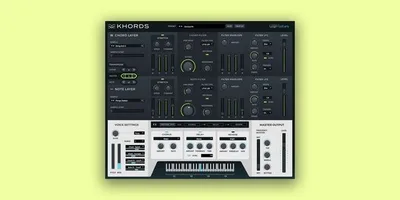
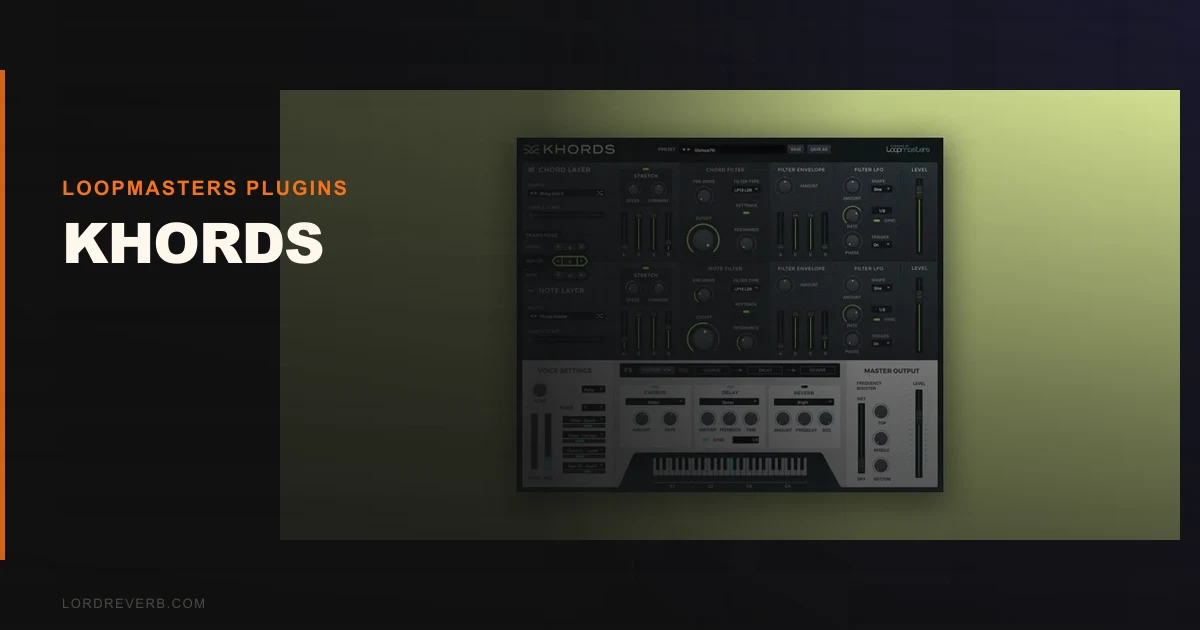
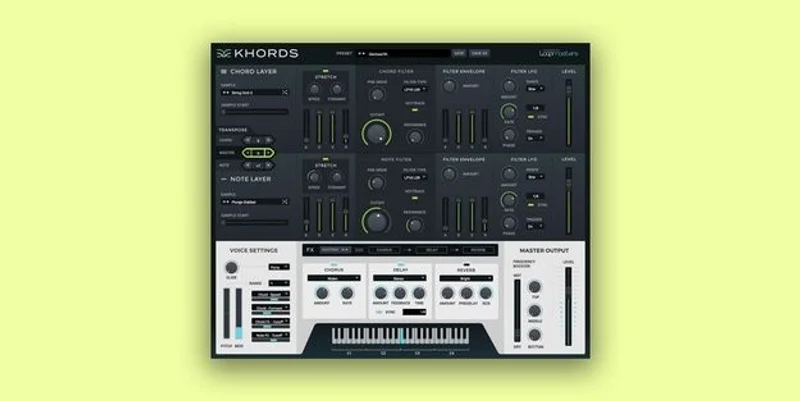
The interface is one page. Everything's visible at once: the sample browser, the two-layer engine, amp and filter ADSR, an LFO, 12 filter types, and the FX rack. No tabbing between screens. No hidden menus that take a week to find.
The four mod wheel assignments are where we spent the most time. You can map the wheel to filter cutoff, reverb mix, pitch, and one other parameter simultaneously. Live, this is satisfying. We ran a chord stab through one of the six reverb modes, mapped the wheel to reverb mix, and swept it in as the drop built. It felt like playing, not programming.
The 550 presets are sorted logically. We worked through maybe 80 of them in a single session without getting bored. The Vocal and Wind categories are the most distinctive. The Synth folder is the most immediately useful for anything dance-adjacent.
Quirk we hit: CPU usage is light, but loading certain preset combinations with reverb and the longer delay types pushed latency in a way we didn't expect at our standard buffer. Bump your buffer to 256 samples if you're layering multiple instances.
The Trade-Offs
The no-sample-import limitation is where this plugin either works for you or it doesn't. If you love the 90s dance sound baked into that 400MB library, you'll never notice the ceiling. If you want to load your own chops, KHORDS will frustrate you. There's no workaround.
The modulation options are thin for 2026. One LFO. No mod matrix. No MIDI learn beyond what's hardwired. Compared to anything built in the last four years, that's a meaningful gap.
What you get in exchange is speed. We've used chord plugins that take 20 minutes to dial in a single patch. KHORDS takes 20 seconds. If you're the kind of producer who loses ideas while fiddling with menus, that trade is worth making.
The FX section punches above its weight. Three delay types (standard, ping pong, and a diffused one that sounds close to a tape-style slap) plus six reverb modes cover most of what you'd need without reaching for a send. We ran the chorus on a keyboard preset and got that thick, slightly woozy 90s feel without touching a separate plugin.
The price is $79 at retail. Bundled with Loopcloud, the combined value is listed at a higher price. For what it does in its lane, that's fair. Not cheap, but fair.
Against the Field
In 2026, KHORDS has real competition it didn't face at launch.
Scaler 3 review beats it on theory, composition tools, and modulation depth. If you want to actually learn harmony while you produce, Scaler wins.
LANDR Composer and Melody Sauce 3 both use AI suggestion engines that generate chord progressions in your project key in real time. They're more forward-looking tools for pop and contemporary production. KHORDS doesn't try to do that.
Where KHORDS still wins in 2026 is texture. The sampled two-layer approach produces chord sounds that software-generated harmony tools don't replicate. If you need something that sounds like it was lifted from a 1994 hardcore rave tape, none of the AI tools touch it.
Check our best chord plugins roundup for a full side-by-side.
The Real Verdict
KHORDS is a love letter to 90s dance music that hasn't aged badly so much as it's stayed exactly where it started. For jungle and DnB producers, that's a feature. For everyone else, it might be a ceiling.
We'd buy it if our work lives in that era. We'd skip it if we needed a modern chord workflow or wanted to grow beyond the library.
It's not wrong. It's just specific. Buy specific when specific is what you need.
Score Breakdown
| Category | Score | Notes |
|---|---|---|
| Sound Quality | 4.0/5 | Two-layer sampled chords carry genuine 90s dance texture that synth generators don't match |
| Value for Money | 3.5/5 | Fair for what it does; feels steep if you only use 20% of the library |
| Ease of Use | 4.5/5 | Single-page UI, 550 presets, four mod wheel assignments: it's immediately playable |
| Features | 3.0/5 | No sample import, thin mod routing, and no updates in years drag this score down |
| CPU Efficiency | 4.0/5 | Light footprint; buffer watch needed only when stacking heavy FX |
| Overall | 3.8/5 | Brilliant in its lane, frustrating outside it |
Alternatives to Consider
Scaler 3 is the obvious upgrade if you want theory-driven composition alongside your chord triggering. It's deeper, more teachable, and more future-proof. See our Scaler 3 full review.
Arturia Analog Lab V covers huge ground for keyboard and synth chord textures with far more modulation depth. If the Synth and Keyboard folders in KHORDS are what you use most, Analog Lab is worth a look. Check our Arturia Analog Lab V review.
Loopcloud itself is worth considering as an alternative route. If you're already paying for a Loopcloud subscription, you're pulling from a much wider sample pool than KHORDS' 400MB library. See our Loopcloud review for whether the subscription makes more sense than the plugin alone.
If KHORDS' 90s flavour is exactly what you need and the price works for your budget, buy it without hesitation. If you're unsure whether you'll stay in that lane, try Loopcloud first. You might already have what you're looking for.
Frequently Asked Questions
Does KHORDS work with modern DAWs in 2026?
Yes, it runs as a VST or AU plugin on 64-bit Mac and Windows systems. We didn't encounter compatibility issues in Ableton Live 12 or Logic Pro. Make sure you're on version 1.0.4 or higher, especially if you plan to use expansion packs.
Can you import your own samples into KHORDS?
No. This is a hard limitation and one of the most common complaints about the plugin. You're working entirely within the 400MB library of 315 samples. If custom sample import matters to you, KHORDS isn't the right tool.
How does KHORDS compare to Scaler 3 for chord production?
They're solving different problems. KHORDS gives you sampled chord textures fast, with a strong 90s dance identity. Scaler 3 generates and suggests chord progressions from any root or scale with far more musical theory built in. If you want to learn harmony or work in contemporary pop, Scaler wins. If you want that old-school stab sound immediately, KHORDS wins.
Is KHORDS worth buying in 2026 when AI chord tools exist?
For producers working in jungle, DnB, house, and 90s-style garage, yes. The two-layer sampling approach produces textures that AI chord generators don't replicate. For everyone else, the lack of updates and thin modulation routing make it harder to recommend at full price. Watch for bundle deals with Loopcloud where the effective cost drops considerably.