Bass Master by Loopmasters Plugins is a sample-based bass synthesizer that earns its price tag, but only if you know what kind of producer you are before you buy it.
Here's the session that clarified everything for us. We were building a Tech House track, 127 BPM, and the low end was a mess. The kick was fighting a synth bass we'd spent 40 minutes shaping in a general-purpose synth. Nothing was locking in. We loaded Bass Master as an experiment, pulled up a preset called Deep Roller, dialled the Sub layer down 3dB, added a touch of the Type 2 distortion, and that was it. The low end sat. First try. Under three minutes.
That moment is the whole case for Bass Master. It's not the deepest instrument on the market. It's the fastest route to a bass sound that works.
It's built for electronic producers: Drum and Bass writers, Tech House and Techno producers, anyone who needs a committed, genre-ready bass without stopping the session to rebuild a patch from scratch.
First Impressions: Tight, Focused, Slightly Sparse
The download is 230MB. That's small enough to feel almost suspicious for a sample-based synth in 2026.
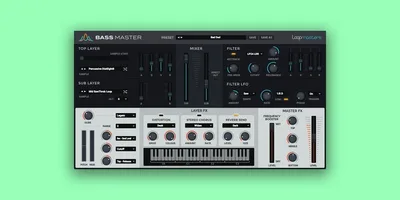
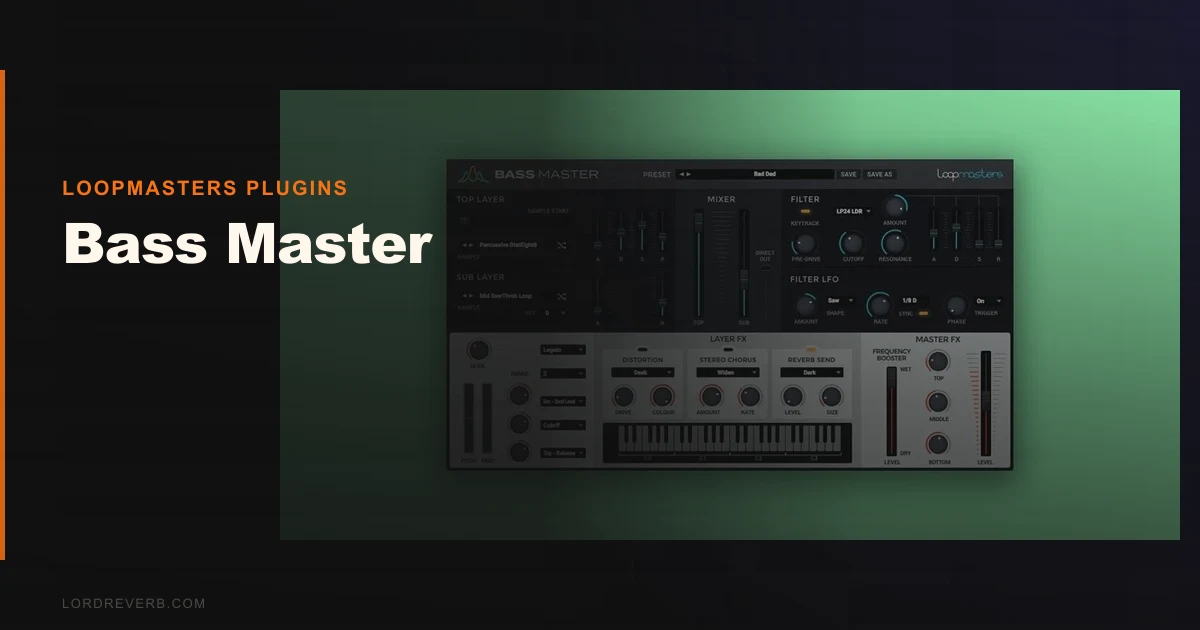
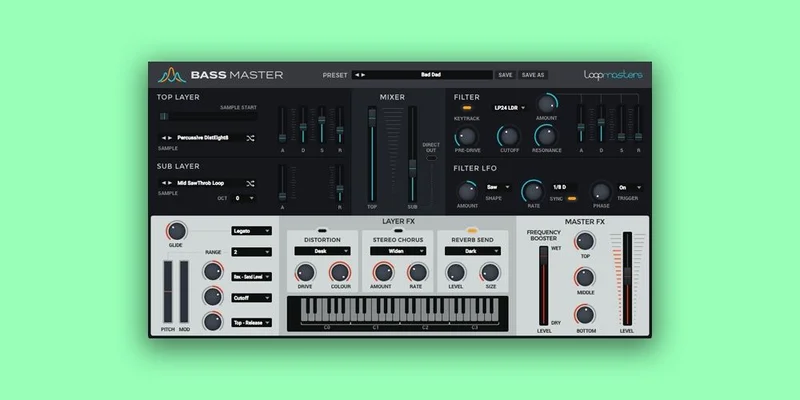
Installation is clean and straightforward: 64-bit AU and VST for Mac and PC, no activation headaches that we ran into. The interface loads looking more like a hardware unit than a software synth. Two layers, Top and Sub, sit clearly labelled side by side. The filter section is immediately visible. You're not hunting for things.
What's missing is any sense of visual excitement. This is a utilitarian UI, and we mean that neutrally. It tells you what you need to know and nothing else. If you're used to the animated layouts of newer instruments, Bass Master will feel deliberately plain. That plainness is part of the philosophy, which we'll get to.
Getting It Into a Real Workflow
Bass Master is monophonic only. One note at a time. If you design your bass lines to include stacked chord clusters, you'll hit this wall immediately. That's a deliberate call from Loopmasters, and for most electronic bass work it's the right one.
Portamento runs up to 10 seconds, which is longer than we'd use in most situations, but having that full range available is satisfying for slow modular-style glides on ambient or experimental tracks. Pitch bend covers 1 to 12 semitones, enough for expressive sub drops.
The 350-plus presets are organised well enough to browse without a manual. We loaded 20 in the first five minutes. Most sat reasonably well without EQ. A handful needed a high-pass filter at around 40Hz to clean up room interference at low monitoring volumes, but that's a room issue, not a plugin issue.
One real friction point: there's no tagging or genre filtering for presets. Browsing is linear. For a plugin marketed at producers across multiple electronic subgenres, that's annoying. You're scrolling through everything to find your Drum and Bass reese or your Tech House pluck.
We'd recommend pairing it with a purpose-built expansion if you're working in a specific subgenre and want curated results faster.
What Bass Master Is Genuinely Good At
The waveform library is the core strength. 217 waveforms split across six categories: High, Mid, Low, Percussive, Simple, and Sub. Stacking the Top and Sub layers produces up to 50,000 possible waveform combinations. We ran through several dozen manually and landed on five or six combinations we'd use again in real sessions.
The filter section is where Bass Master earns serious credit. Thirteen filter types, with a Ladder mode that adds genuine harmonic saturation when driven. We pushed the pre-filter overdrive into the mid-range of its travel on a reese-style patch and got a gritty, frequency-rich sound without touching any of the distortion effects. That's the right order of operations: drive into the filter, shape the overtones, then decide if you need more from the distortion block.
Speaking of distortion: five types are on board, and Type 3 is our pick for anything needing aggressive mid presence. Four chorus types and three reverb types round out the effects. These are tools for finishing a sound, not for building character from scratch, but they're usable.
CPU load stayed light throughout our sessions. We ran eight instances across a dense session on an M2 MacBook Pro and saw no meaningful performance hit. We can't give you a precise percentage without metering software in isolation, but subjectively it behaves far lighter than polyphonic alternatives with similar feature counts.
The Rough Edges
No AAX support. Full stop. If you work in Pro Tools, Bass Master doesn't exist for you unless you're running a VST bridge, which we wouldn't recommend for production-critical plugins. This is a significant omission in 2026.
macOS compatibility has a history here. Big Sur caused issues in 2021, and we couldn't find clear post-2024 confirmation of full stability on current macOS versions beyond our own M2 testing. If you're on an Intel Mac with a recent OS, verify compatibility before buying.
The effects section is thin for sound designers who want to go deep. Three reverb types sounds reasonable, but all three are basic. No parameter depth. If your reverb needs are anything beyond a simple tail length adjustment, you'll be routing out to a dedicated reverb anyway. We usually do. That's fine. Just know it going in.
Compared to BeatSurfing LOW, which gives you more modulation routing and polyphonic capability, Bass Master is noticeably constrained as a sound design environment. That's the trade you're making for speed and simplicity.
Who Bass Master Is Really For
Three clear yes-es and three clear no-s:
- ✅ Buy if you produce Tech House, Techno, or Drum and Bass and need fast, reliable bass sounds that sit without hours of EQ work.
- ✅ Buy if you're intermediate-level and want to learn bass sound design without drowning in modulation matrices.
- ✅ Buy if you already have a general-purpose synth like Serum or Massive and want a dedicated bass tool that handles the basics faster.
- ❌ Skip if you use Pro Tools. No AAX means no Bass Master, cleanly.
- ❌ Skip if you want polyphonic bass textures or complex layered pad-bass hybrids. The monophonic architecture stops you there.
- ❌ Skip if you're an advanced sound designer looking for deep modulation routing. This won't satisfy that need.
If you're weighing up whether to spend more or less, Harrison Consoles Bass Flow is worth comparing at a very different price point before you commit.
Score Breakdown
| Category | Score | Notes |
|---|---|---|
| Sound Quality | 4.0/5 | Presets sit well in mixes fast; limited ceiling for custom sound design |
| Value for Money | 4.0/5 | The launch price is a fair deal but the standard price is harder to justify against broader synths. |
| Ease of Use | 4.5/5 | Focused layout means zero learning curve for the core functions |
| Features | 3.5/5 | 217 waveforms and 13 filters impress; effects and routing are thin |
| CPU Efficiency | 4.5/5 | Runs light; no measurable drag on M2 with 8 instances |
| Overall | 4.1/5 | Brilliant for fast electronic bass work; wrong tool for Pro Tools users or deep sound designers |
Alternatives Worth Considering
BeatSurfing LOW: More modulation depth, polyphonic capability, and a broader sound design environment. We reviewed it here: LOW Review. It takes longer to learn but rewards the investment if you push bass sounds hard.
Bogren Digital BassKnob STD: A completely different approach, built around amp simulation rather than sample-based synthesis. Better for live bass tracks or anything needing Ampeg-style character. See our BassKnob STD review for a full comparison.
Loopcloud Bass Music Adrenaline Expansion: Not a synth, but if you're after genre-ready bass loops to sit alongside or instead of Bass Master's synthesized sounds, the Bass Music Adrenaline drum expansion fills a related gap in a different way.
The Verdict
Bass Master has a standard price and a lower launch price. For a producer who works in electronic genres and loses hours digging through general-purpose synths for a workable bass tone, that's a genuinely good investment.
For Pro Tools users, advanced sound designers, or anyone needing polyphony: it's the wrong tool. Don't buy a specialized instrument and then resent it for not being a general one.
The best thing we can say about Bass Master is that it solved a real problem in under three minutes. Most plugins can't do that. At that speed, you get real value for your money.
Just check your DAW's format support before you click purchase. Finding out there's no AAX after the fact is a frustrating way to spend a Tuesday.
Frequently Asked Questions
Does Bass Master work with Pro Tools?
No. Bass Master is available in VST and AU formats only, both 64-bit. There is no AAX version available. Pro Tools users will need a VST bridge workaround, which we wouldn't recommend for production-critical instruments. Check the manufacturer's site for any format updates since our 2026 testing.
How many sounds can you actually make with Bass Master?
The 217 waveforms across two layers (Top and Sub) produce up to 50,000 possible waveform combination pairs before you touch filtering or modulation. Add 13 filter types, 5 distortion types, 4 chorus types, and 3 reverb types on top of that. The practical ceiling for a monophonic bass synth is genuinely high. The 350-plus presets are a useful starting point, not a limitation.
Is Bass Master good for Drum and Bass production specifically?
Yes. The reese-style patches in the preset library are workable straight out of the box, and the pre-filter overdrive into the Ladder filter mode is exactly the right signal chain for classic DnB bass tones. You'll get more mileage from it in DnB than in genres requiring complex polyphonic bass textures. The monophonic architecture suits the genre.
What are the macOS compatibility issues with Bass Master?
Compatibility problems were reported following the macOS Big Sur update in 2021. Our testing on an M2 MacBook Pro in 2026 ran without issues, but Intel Mac users on more recent macOS versions should verify current compatibility with Loopmasters Plugins directly before purchasing. We'd recommend checking their support documentation or forum activity for the most current status.