
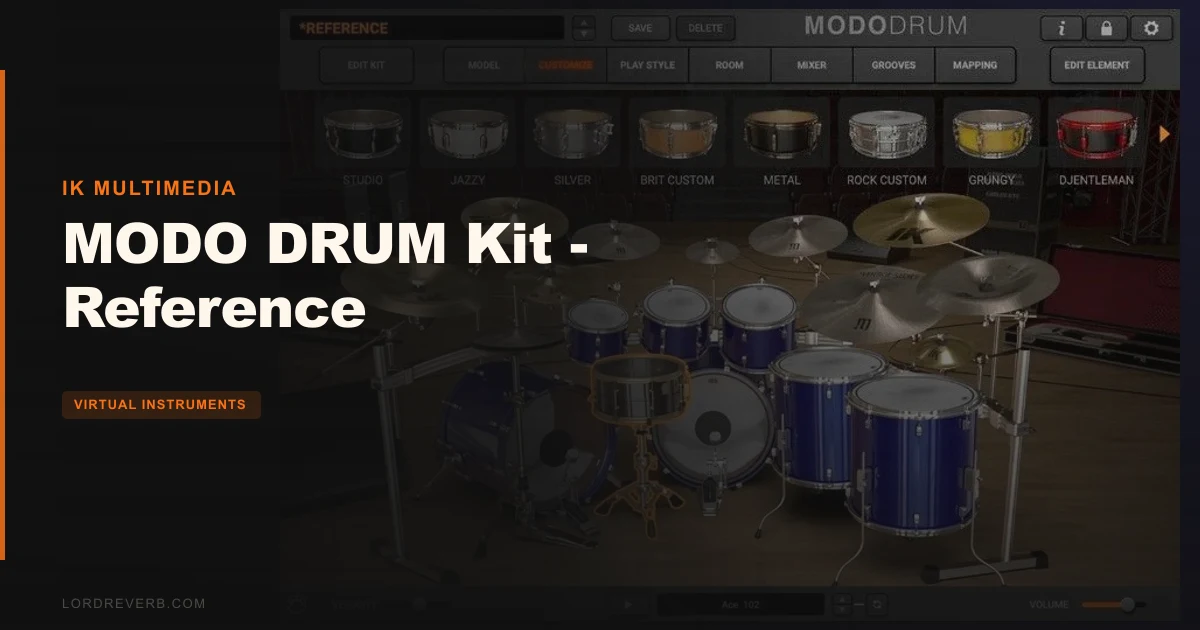
The MODO DRUM Kit - Reference review verdict is a split decision: this is a genuinely interesting physical-modeling drum instrument that rewards patience, but it will frustrate you before it satisfies you.
Picture this: you're 40 minutes into a pop session. The arrangement is locked, the synths sit right, and then the drums land like cardboard. You reach for something with more character than a basic sample pack. MODO DRUM Kit - Reference, at $49.99, is exactly the kind of tool that looks like the answer. Whether it actually is depends entirely on how much time you're willing to spend inside it before your mix sounds the way you hear it.
Quick verdict: MODO DRUM Kit - Reference scores 3.3 out of 5. The physical-modeling engine gives you drum control that the developer says purely sample-based programs can't match, and the Omar Hakim-modeled mahogany kit is a genuinely clever starting point. But the UI is sluggish, the room sound can kill transients, and out-of-the-box results aren't competitive with Toontrack Superior Drummer or Addictive Drums. Buy it if you love dialing things in. Skip it if you need something that sounds great on track one, bar one.
What's In The Kit
The Reference kit is modeled after Omar Hakim's actual Pearl drum kit. The configuration is specific: a 24" x 18" bass drum, toms at 10" x 8", 12" x 9", and 13" x 10", floor toms at 16" x 16" and 18" x 16", and a 14" x 6.5" snare. Shell material is mahogany with mahogany interior plies and maple outer plies.
Controls include tuning, snare tension, stick type selection, and how the drummer plays. The instrument offers up to 22 drum channel strips and 9 convolution reverb room simulations. Install size is around 8GB.
The full MODO DRUM version behind it contains 75 drums, 42 cymbals, and 1,400+ MIDI groove presets. This kit is one piece of that larger ecosystem.
Where It Fits In Your Workflow
You'd load it like any virtual drum instrument, on a MIDI track. It offers up to 22 drum channel strips, so individual drums can be mixed separately.
The 1,400+ MIDI grooves mean you're not starting from scratch rhythmically. Drag a groove in, adjust the kit parameters, build from there. Owners report patch loading is fast, which helps keep a session moving.
Where the workflow stalls is customization. Owners are clear: you will need to spend time inside the parameters before the kit sounds competitive. If your session has three hours left and the drums need to be done in 20 minutes, this is the wrong tool. Plan for iteration. The convolution reverb rooms are onboard, but the room sound can blunt transients in ways that may not suit your mix.
What It's Genuinely Good At
The physical-modeling engine is the real argument for this instrument. You can tune every drum, adjust the snare tension precisely, change stick type, and shape how the drummer attacks the kit. That's a different kind of control than flipping through velocity layers in a sample library.
The developer positions it for mainstream pop in the vein of Sting and Madonna, and for artists like Daft Punk. Owners who put in the customization time report they successfully reach the sounds they're after for specific genres.
Owners report fast patch loading, and 1,400+ MIDI grooves is a big collection to build drum tracks from.
Up to 22 drum channel strips give you room to mix individual drums separately.
The Rough Edges
The UI delay is annoying. Owners report considerable lag on button clicks and kit loading. When you're mid-session trying to A/B a snare tuning, waiting on the interface to catch up is genuinely frustrating. That kind of friction compounds fast.
Users report stability complaints including crashes, and combined with the UI lag that's a lot of friction in a session.
The cymbals are samples, not synthesized. Owners specifically flag them as lacking next to Superior Drummer 3. In an instrument built around physical modeling, that feels like a gap.
One user reports kits sounding too processed, with scooped mids even raw. There are no ADSR or pitch envelope controls despite the depth elsewhere in the parameter set. And the overhead track and room ambience get flagged as inconsistent depending on which kick you're using. That's a lot of rough edges for one instrument.
Who This Is Really For
- ✅ Buy if you want physical-modeling control over drum tuning and playing style and you're willing to spend sessions dialing it in.
- ✅ Buy if you're producing mainstream pop and want a kit modeled after Omar Hakim's actual Pearl kit, with a large MIDI groove library.
- ✅ Buy if you want up to 22 drum channel strips to mix individual drums separately.
- ❌ Skip if you need polished out-of-the-box results. Superior Drummer and Addictive Drums both land closer to ready without customization overhead.
- ❌ Skip if your system or session demands stability. Crash reports are real.
- ❌ Skip if cymbal realism matters to your mix. Owners report the sampled cymbals lack spectacle next to Superior Drummer 3.
Specs & Technical Details
| Developer | IK Multimedia |
| Price | $49.99 |
| Plugin Format | N/A |
| OS Support | N/A |
| Activation | N/A |
| CPU Usage | N/A |
| Trial Available | N/A |
| Version Reviewed | N/A |
Score Breakdown
| Category | Score | Notes |
|---|---|---|
| Sound Quality | 3.5/5 | Physical modeling shines on drums; sampled cymbals and scooped-mid character let it down |
| Value for Money | 3.5/5 | At $49.99 it's interesting, but the customization time cost is real |
| Ease of Use | 2.5/5 | UI lag and no ADSR controls make a deep instrument harder to navigate than it should be |
| Features | 3.5/5 | 1,400+ grooves, 22 channels and physical-modeling control are strong; cymbal engine is the weak link |
| CPU Efficiency | N/A | No CPU data available |
| Overall | 3.3/5 | A clever instrument that asks more of you than the alternatives owners compare it to |
Alternatives to Consider
Toontrack Superior Drummer is the one owners compare it to for sounding better out of the box, without the customization overhead. They also find its cymbals more spectacular.
Addictive Drums is the other name that comes up: it sounds better out of the box, and some users describe it as the better overall fit.
Slate Digital's drum instruments also get mentioned as more polished out of the box. If your priority is the best virtual drum plugins for producers, Slate belongs on your shortlist before MODO DRUM if ease-of-use matters to you.
None of these give you the same physical-modeling drum control MODO DRUM does. That's the genuine trade-off: if parameter depth is your priority, MODO DRUM is the more interesting instrument. If your session time is tight, one of the above will get you to a good sound faster.
At $49.99, MODO DRUM Kit - Reference earns its place for a specific kind of producer. You love having real control over how a kit behaves, you're not in a hurry, and you're willing to treat it as a long-term dialing-in project. If that's your situation, it'll pay off. If you're the kind of producer who needs a drum sound locked in before your engineer calls, send them Addictive Drums instead. This one asks for your patience upfront and doesn't always give it back on your timeline.
Related reviews: CINEDREAM
Frequently Asked Questions
Is MODO DRUM Kit - Reference good out of the box?
Honestly, not compared to its main competitors. Owners consistently report that the kit requires meaningful customization before it sits well in a mix. If you're comparing it to Superior Drummer or Addictive Drums on a first listen, expect to feel underwhelmed. The physical-modeling engine rewards time investment, but it doesn't hand you a polished sound immediately.
What drum kit is the Reference kit modeled after?
It's modeled after Omar Hakim's actual Pearl drum kit. The shell material is mahogany with mahogany interior plies and maple outer plies. The configuration includes a 24" x 18" bass drum, three mounted toms, two floor toms, and a 14" x 6.5" snare. IK Multimedia positions it for mainstream pop and similar genres.
How does MODO DRUM Kit - Reference compare to Superior Drummer 3?
Superior Drummer 3 sounds more polished without customization, and owners specifically prefer its cymbal realism. MODO DRUM's physical-modeling engine gives you more control over how the drums physically behave: tuning, snare tension, stick type and drummer playing style. If control depth matters more to you than immediate out-of-the-box results, MODO DRUM is the more interesting instrument. If you need results fast, Toontrack Superior Drummer 3 review is the safer call.