
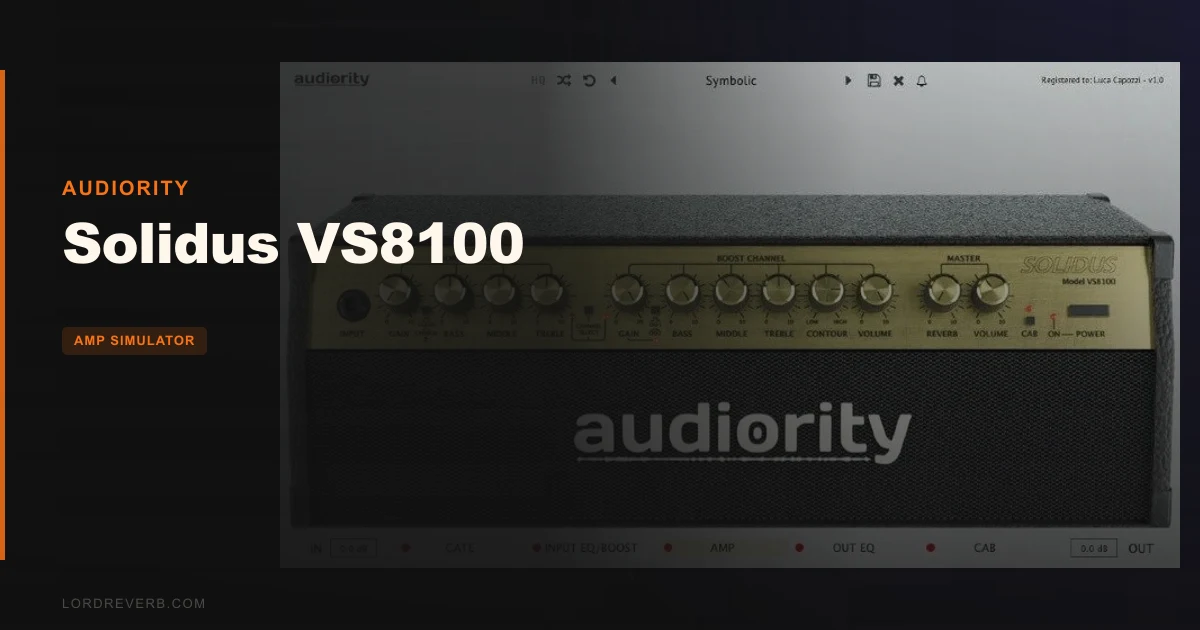
The Solidus VS8100 is the best $65 you'll spend if the Marshall Valvestate 8100 sound is what you're actually chasing, and a plugin you should probably skip if it isn't. Audiority built this around the 1991 Marshall Valvestate 8100 head, a solid-state amp with a single 12AX7 tube driving its distortion channel, and the thing that gave a generation of 90s death metal records their teeth. This isn't a generic "British crunch" plugin. It's a deliberate, specific model of one amp. That specificity is its biggest strength and its sharpest limitation.
It's for metal producers, hard rock guitarists, and anyone doing ITB session work who needs that era's midrange aggression without renting a recording space or tracking down original hardware.
What You're Actually Getting
The VS8100 models the original Marshall Valvestate 8100, a solid-state head from 1991 that used a 12AX7 tube as a driver for its distortion channel's tone stack. That specific design defined the sound of 90s death metal. It ran two channels: a Normal channel for clean tones and a Boost channel for drive.
Audiority modelled the original amp and added a noise gate, an EQ/Booster section for custom clean boost shaping, a post-amp 5-band EQ, and a cab loader.
Cabinet IRs are provided by Dr Bonkers Sound Lab and Valhallir.at. The Normal channel gives you Clean and Crunch modes. The Boost channel gives you OD1 and OD2. That's four distinct gain states inside one plugin, each with different saturation character and midrange response. The interface is resizable, which matters more than it sounds, the VS8100 has a lot of controls on screen at once.
The Good
We loaded a dry strat bridge pickup recording into the OD2 mode and pushed the gain to about 75%. The pick attack came through with actual transient definition, not the blurred, fizzy wall you get from cheaper sims. There's a compression character in the 2-4kHz range that stays musical rather than harsh. That's the 12AX7 driver behavior Audiority captured. It sits in the mix without needing a surgical EQ pass first.
The 10-band EQ booster feeding into the amp section is genuinely clever. We set it as a clean boost with a slight high-mid lift around 2kHz and 4kHz, cutting around 300Hz by about 2dB, and the output tightened up immediately. No separate boost pedal plugin needed in your signal chain.
The post-amp 5-band EQ is equally satisfying. It's there to fix what the cab IR doesn't get right for your mix context. Having both pre and post shaping in one plugin reduces CPU overhead vs. stacking separate EQ plugins.
Format coverage is broad. On Intel Mac, you get VST2, VST3, AU, and AAX. On Apple Silicon, you get CLAP, VST2, VST3, AU, and AAX. Windows users get VST2, VST3, and AAX. CLAP support on M-series Macs is a nice touch for future-proofing.
The Not-So-Good
The cabinet loader is the annoying part. You're locked into whatever IRs Dr Bonkers Sound Lab and Valhallir.at have included. There's no documented path to load your own third-party IRs inside the VS8100 itself. If you own a specific cab IR pack you love, you're running a separate loader plugin outside the signal chain, which defeats the convenience of the all-in-one design.
Hardware accuracy is also not perfect. At least one user who compared the plugin directly against a physical Valvestate 8100 found the Contour control behaves differently. The fix involved EQ correction to match the hardware response. That may not matter to you if you've never played through the hardware. But if you're buying this specifically to replicate sessions tracked on a real 8100, go in with adjusted expectations.
No documented low-latency mode is a problem for anyone considering live use. Buffer-dependent performance is fine for studio work, but it's a gap worth naming.
Compared to the Alternatives
Neural DSP's Archetype series costs more per plugin. You get more amp models per title and their neural-network approach to amp modeling produces some of the most accurate captures in the market. But Neural DSP plugins aren't modeling a specific vintage SS amp. If you need the Valvestate character specifically, the VS8100 wins that fight at a lower price.
IK Multimedia AmpliTube 5 costs more but goes shallower on any single amp. You get dozens of modeled amps, but the Valvestate 8100 isn't one of them. For genre-specific 90s death metal tones, AmpliTube's catalog misses the target.
Positive Grid BIAS Amp 2 Standard is $99. It lets you build custom amp models, which is clever and open-ended, but it requires work. The VS8100 is a one-amp-done solution. best amp simulator plugins 2026 has the full side-by-side if you're still deciding.
At $65 with a resizable UI and solid format coverage, the VS8100 undercuts all three on price for its specific use case. That's a real advantage, not a consolation.
Who Should Buy This
- ✅ Buy if you produce death metal, grunge, or 90s hard rock ITB and want that specific Valvestate midrange character without building a gain chain from scratch.
- ✅ Buy if you do session guitar work and need a fast, one-stop amp-plus-EQ-plus-cab signal chain that doesn't require stacking 4 plugins.
- ✅ Buy if you're on Apple Silicon and want a CLAP-compatible amp sim at this price point with proper AAX support for Pro Tools.
- ❌ Skip if you need flexible cab loading with your own IR library baked into a single workflow.
- ❌ Skip if you want a wide-genre amp suite. This plugin does one amp family well. That's it.
- ❌ Skip if you're buying it to recreate hardware sessions and need a confirmed 1:1 match to the original 8100's Contour response.
Score Breakdown
| Category | Score | Notes |
|---|---|---|
| Sound Quality | 4.5/5 | The 12AX7 driver behavior translates well; OD2 has real pick-attack definition, not digital fizzle |
| Value for Money | 4.5/5 | $65 for amp + EQ booster + post EQ + cab loader is a strong package; beats Neural DSP and BIAS on price for this use case |
| Ease of Use | 4.0/5 | Resizable UI helps, but the density of controls takes a session or two to dial in confidently |
| Features | 3.5/5 | Four gain modes and dual EQ sections are well thought out; locked cab loader and no IR import drag the score down |
| CPU Efficiency | 4.0/5 | No heavy CPU complaints in field use; light enough to run multiple instances on a guitar bus without session panic |
| Overall | 4.2/5 | A brilliant niche plugin that earns its price, held back slightly by cab flexibility and a known Contour discrepancy vs. hardware |
Alternatives to Consider
Neural DSP Archetype: Nolly, purpose-built for modern metal, with more amp voices and a more thoroughly documented hardware accuracy record. Worth it if your budget stretches and you don't specifically need the Valvestate character. Neural DSP Archetype Nolly review
Positive Grid BIAS Amp 2, best for producers who want to build and shape their own amp model rather than load a specific one. More flexible, more work. Positive Grid BIAS Amp 2 review
Audiority VertiVerb VRS23, if you're already in the Audiority ecosystem and want to understand how their modeling sounds across different product types, our Audiority VertiVerb VRS23 review covers how they approach analog emulation in the reverb space. Same developer DNA, very different application.
All three are worth a look if the VS8100's specific scope is too narrow for your workflow. See the full roundup at best amp simulator plugins 2026.
At $65 with a free trial available, there's no reason not to hear it in your own session first. Load it, run your guitar through OD2 with the post-amp EQ flat, and you'll know inside 90 seconds whether this is your amp or not. If the Valvestate snarl locks in immediately, buy it. If you're reaching for your boost pedal plugin to compensate, look at Neural DSP instead. The VS8100 doesn't need to be anyone's everything. It just needs to be your 90s metal amp. And that, it absolutely is.
Frequently Asked Questions
Is the Solidus VS8100 an accurate recreation of the real Marshall Valvestate 8100?
Mostly yes, with one known caveat. Audiority's model is convincing on gain character and channel response across all four modes. However, at least one user who tested it against original hardware found that the Contour control behaves differently between the plugin and the physical amp, requiring some post-EQ correction to match. For producers who've never played through the original, this won't be noticeable or problematic.
Does the Solidus VS8100 work with Pro Tools on Apple Silicon Macs?
Yes. On Apple Silicon, the VS8100 supports AAX 64-bit in Pro Tools 11 or higher, alongside CLAP, VST2, VST3, and AU. On Intel Mac, you get VST2, VST3, AU, and AAX. Full Pro Tools compatibility is confirmed on both architectures.
Can I load my own cabinet IRs into the VS8100?
Not directly inside the plugin. The integrated cab loader uses IRs provided by Dr Bonkers Sound Lab and Valhallir.at. If you want to use your own IR library, you'll need a separate IR loader plugin placed after the VS8100 in your signal chain, with the internal cab simulator bypassed. It's a workaround that works fine, but it does break the all-in-one convenience.
Is the Solidus VS8100 only useful for metal production?
The Boost channel's OD1 and OD2 modes are built for high-gain metal and hard rock. But the Normal channel's Clean and Crunch modes are genuinely usable for blues-rock and grunge tones with the right cab selection. That said, this plugin's sweet spot is clearly heavy music from the 90s metal era. If you need a wide-genre amp sim covering jazz, country, and clean funk, look elsewhere.