
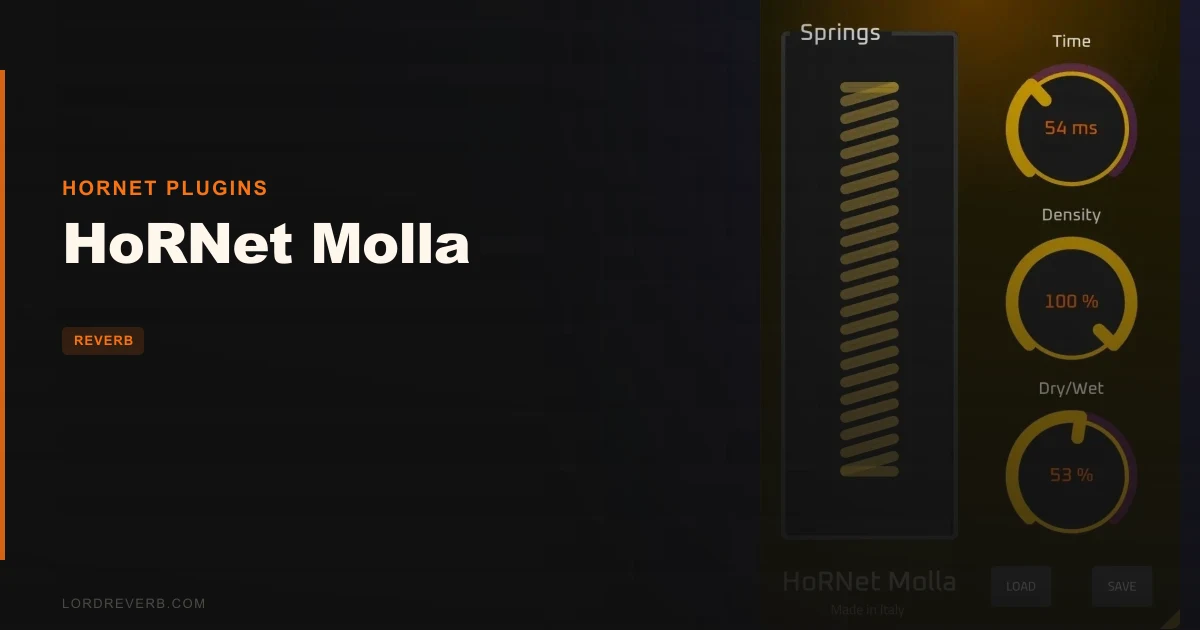
HoRNet Molla is the best free spring reverb plugin available right now, and it earns that without much competition having to show up. It's built for guitarists and synth-lead producers who want instant, characterful spring tone without opening their wallet or reading a manual. It does fewer things than every paid spring reverb on the market. The things it does, it does right.
This is a stripped-down, zero-cost plugin with no copy protection, no subscription, and no catch. If spring reverb sits anywhere in your signal chain, you need this downloaded before you finish this article.
What You're Actually Getting
HoRNet Molla is a free, physically modeled spring reverb plugin that shares its core algorithm with HoRNet SpringVerb, the paid flagship in the same product line. That's not marketing copy. It means the reverb character you're hearing is derived from the same research.
Molla gives you a carefully selected set of parameters without overcomplicating the workflow. The intrinsic vibration time shapes the decay of the spring, from short snappy reverbs that add subtle body, all the way to long, cavernous tails.
The Density control is the plugin's most expressive feature. At 100%, the reverb mimics a smoother, more natural decay. As you reduce Density toward 0%, the sound becomes more metallic, brittle, and lo-fi, emphasizing the resonant artifacts of the springs.
A wet/dry blend control lets you mix the dry signal with the reverberated one precisely. This is useful for parallel processing or for adding just a touch of ambiance without losing clarity in the source.
When audio is sent into the plugin, a virtual spring lights up in response, giving you a visual cue of when and how the reverb is being triggered. Satisfying detail. Small, but clever.
The Good
We ran a palm-muted electric guitar through Molla at a decay time of around 60%, then sat back and listened. The attack stayed tight. The tail spread with that characteristic wobbly, metallic signature that springs do better than any hall algorithm. No flutter artifacts. No buildup in the 400Hz range that muddies the low-mids. It just sat right.
The Density knob is where this plugin earns its keep. We pushed it down to around 15% on a mono synth lead. The result was a brittle, resonant smear behind each note that sounded genuinely lo-fi, like the spring tank on a 1960s home organ. That kind of texture costs money elsewhere. Here it's free.
No DRM. None. Despite being completely free, Molla isn't a "lite" plugin in the traditional sense. It offers access to rich, algorithmically modeled reverb built from serious audio engineering research. You download it, you install it, you use it. We love that.
The technical spec list includes physically modeled spring behavior, a resizable interface with hardware acceleration, Apple Silicon native support, 64-bit processing on Mac and Windows, and support for AU, VST, VST3, and AAX formats. Internally it runs at 4x oversampling.
CPU draw is light. We ran 12 simultaneous instances across a session with no throttling on an M2 MacBook Pro. That's the kind of performance that makes you keep the plugin on even when you're not sure you need it yet. For a deeper look at how spring reverb plugins compare in CPU, our full reverb guide breaks it down further.
The Not-So-Good
One spring model. That's the ceiling. We love what that single model sounds like, but the moment you want a brighter, thinner tank tone or a longer three-spring setup like a Fender reverb unit, Molla can't get you there. You'll hit the wall fast if spring variety is the goal.
There's no pre-delay. Annoying. For mixing vocals or anything rhythmic where you need 15-25ms of separation between the dry source and the reverb onset, you're adding a dedicated delay plugin in front of Molla. That's an extra step in your signal chain that paid spring plugins handle natively.
No onboard EQ either. If the tail is too bright or too dark for your source, you're again reaching for another plugin. The wet/dry knob and the density control are genuinely expressive, but the signal chain stays outside Molla's control.
We also wish the wet knob had a display readout in percentage. The visual feedback from the animated spring is fun, but you can't recall a session and know you were at exactly 35% wet without mousing over the knob. Small, but frustrating over many sessions.
Compared to the Alternatives
The closest free competitor is BPB Dirty Spring, which adds a tone control and a drive knob. That gives it more character shaping at the cost of a slightly less convincing physical model. If you want grit baked in, BPB wins. If you want a cleaner, more accurate spring tone you can dirty yourself with Density, Molla wins.
Safari Audio's Rhino is a paid option worth mentioning. Our Rhino Reverb review covers it in detail, but the short version: Rhino adds three spring models, pre-delay, and EQ bands for a modest price. If you're mixing full records and spring reverb is a tool you reach for weekly, that's the upgrade path. Molla isn't embarrassed by the comparison, but it can't match the feature count.
For something weirder and less spring-specific, Safari Audio Hippie Elephant is worth a look. Our Hippie Elephant review walks through why it beats several priced competitors on unusual reverb territory, though it's a different beast entirely.
HoRNet's own SpringVerb is available at a low price. It adds multiple spring models, more physical parameters, and the same algorithm with more controls exposed. If Molla hooks you, that's the natural upgrade. Use the code 10ALLMOLLA for 10% off the bundle if you decide to step up.
Who Should Download This
- ✅ Download if you want a characterful spring reverb on guitar or synth leads with zero budget
- ✅ Download if you're into lo-fi, dub, surf, or psychedelic sounds and want that metallic tail without paying for it
- ✅ Download if you need a lightweight reverb that runs on Apple Silicon natively without any activation headaches
- ❌ Skip if you need multiple spring models or tonal variety for professional mix sessions
- ❌ Skip if pre-delay and onboard EQ are non-negotiable parts of your reverb workflow
- ❌ Skip if you're planning to use it as a primary reverb on complex mix buses; it's built for individual sources, not full-mix glue
Score Breakdown
| Category | Score | Notes |
|---|---|---|
| Sound Quality | 4.0/5 | Convincing physical model, single spring limits tonal range |
| Value for Money | 5.0/5 | Free with no DRM, impossible to argue with |
| Ease of Use | 4.5/5 | Three knobs, done; no manual required |
| Features | 3.0/5 | Density is brilliant, but no pre-delay or EQ stings at any price |
| CPU Efficiency | 4.5/5 | Ran 12 instances without throttling on M2 MacBook Pro |
| Overall | 4.1/5 | The best free spring reverb available; earns its slot in any session |
Alternatives to Consider
HoRNet SpringVerb: The natural upgrade from Molla. Multiple spring models, more physical parameters, same core algorithm. If you're using Molla on every session, just buy this. Check the best reverb plugins guide for context on where it sits in the wider market.
Safari Audio Rhino: A paid spring plugin with three tank models, pre-delay, and EQ shaping. Our Rhino Reverb review explains why it's worth the spend for professional mixing use. Not a replacement for Molla if your budget is zero, but the next stop if you get serious about spring.
Apogee Clearmountain's Spaces: Not a spring specialist, but if you're chasing vintage character across multiple reverb types, our Clearmountain's Spaces review covers a plugin that covers a lot more sonic ground for a very different price point.
Molla is free. Download it now, stack it on your guitar bus, dial Density to 30%, set decay to around 50%, and get on with the record. If you need more than that, the upgrade path to SpringVerb is one of the most honest upgrade propositions in the plugin market. That's the only caveat: producers who build careers around spring reverb will hit the ceiling fast. Everyone else? There's no reason this isn't already in your DAW.
Frequently Asked Questions
Is HoRNet Molla really completely free?
Yes. Molla is free and has no copy protection, no iLok, no registration wall, and no subscription. You download it through Plugin Boutique, install it, and it works. There's no hidden "pro version" of the same plugin, the paid upgrade path is a separate product entirely, HoRNet SpringVerb.
What's the difference between HoRNet Molla and HoRNet SpringVerb?
Both use the same core physical modeling algorithm. SpringVerb exposes more of the engine: multiple spring models, more control over the physical behavior of the tank, and additional parameters for shaping the reverb character. Molla gives you the same quality algorithm with three controls and one spring model. Think of it as the algorithm on a budget interface, not a dumbed-down version of the algorithm itself. SpringVerb is available at a low price.
What does the Density knob actually do?
Density controls how closely packed the reverb reflections are inside the spring simulation. At 100%, the decay is smoother and closer to a conventional reverb tail. As you reduce it toward 0%, the spring's metallic resonance and separation between reflections become more audible, giving the reverb a brittle, lo-fi, gritty character. It's the single most creative control in the plugin and the main reason to try it even if you already own a spring reverb.
Does HoRNet Molla work natively on Apple Silicon Macs?
Yes, with one exception. Molla runs natively on Apple Silicon in AU, VST, and VST3 formats. The AAX version for Pro Tools does not have native Apple Silicon support and runs under Rosetta 2 on M-series Macs. For Logic Pro, Ableton, and most other DAWs on M1/M2/M3 hardware, you'll get full native performance.