GForce's Prophet~5 makes one central claim: that it's the most authentic Prophet~5 experience available in software. That claim holds up in meaningful ways, and falls apart in a few that will genuinely annoy you.
At $79.99, this is not an impulse purchase. It's a carefully built emulation developed in direct partnership with Sequential, stacked with features the hardware never had. But "authentic" turns out to mean something complicated here. The tone is real. The workflow reproduction is spotty. And the preset library may send you on a cleanup mission the moment you load it.
Quick verdict: If you're chasing the warm, slightly unpredictable character of a classic polysynth for pads, leads, and harmonic texture, the Prophet~5 at $79.99 has the core sound nailed and then some. If you need a plug-and-play workhorse with factory patches you can drop straight into a session, this is the wrong tool. Score: 3.5/5. Best for producers who already know what a Prophet should sound like and want to build patches from scratch.
What GForce Is Actually Promising
The marketing language centres on three things: tone, response, and musicality. GForce says this plugin delivers the immediacy of the original instrument, preserves its character across all three hardware revisions, and gives you everything the hardware had, plus more.
The "plus more" part is real. Dual-layer architecture, X-Modifiers, per-layer arpeggiators, MPE compatibility. None of that existed on the original Prophet~5. So the pitch isn't a straight replica promise. It's "here's the soul of the instrument, now grown up."
What they don't say out loud: accuracy in modelling has limits, and those limits are audible in specific, documented ways. Worth knowing before you spend.
Where the Prophet~5 Genuinely Delivers
Three Revisions, Three Personalities
This is the part that matters most. The Rev1 and Rev2 models run SSM filter and envelope characteristics. The Rev3 uses Curtis filter and envelope behaviour. These aren't cosmetic differences.
Switch from Rev1 to Rev3 on a sustained pad and the filter attack tightens noticeably. Owners describe the core sound as warmer and more analogish than what competitors offer, and there's a specific harmonic quality that sits in a mix without fighting for space. That's not marketing. That's what multiple users independently report: the Prophet integrates more naturally than modern synths, leaving room for other instruments across the frequency range.
If you've struggled to get a polysynth pad to coexist with a lead or a vocal, load this and choose Rev2 to access that mid-range warmth. That mid-range warmth distributes harmonic information in a way that many brighter emulations don't.
The X-Modifiers Section
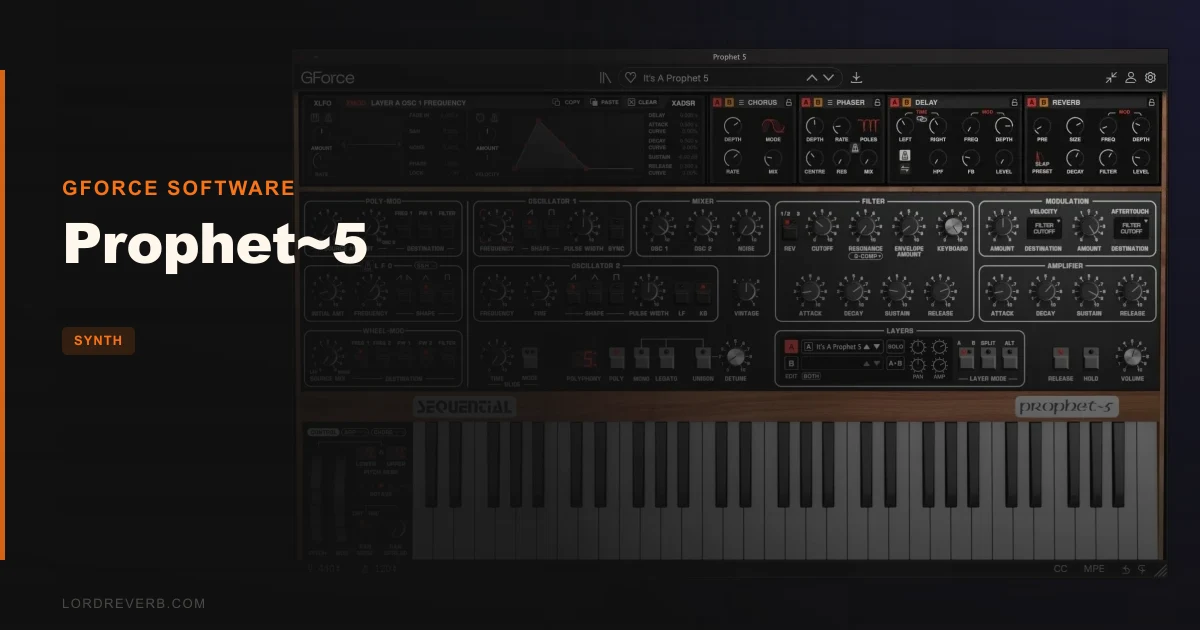
This is where the plugin earns serious respect. Dedicated envelopes and LFOs assignable to almost every parameter goes well beyond what the original hardware offered, and owners report being genuinely surprised by the depth once they're inside it.
You're not just modulating filter cutoff and pitch. You can assign modulation to effects parameters, to envelope times, to oscillator character settings. Stack an LFO on the reverb mix while a separate envelope opens the filter and you get movement that feels alive rather than mechanical.
That's a clever piece of design. The hardware cult will complain it's not "pure." They're missing the point.
Dual Layer Architecture
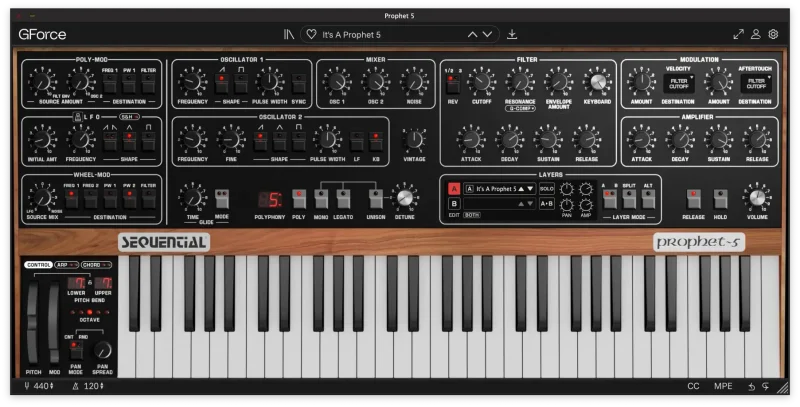
Layer, Split, and Alternate modes with up to 10 voices per layer. Split mode lets you keyboard-split two independent patches. Alternate mode cycles voices between layers, so you can get call-and-response textures from a single MIDI source. Each layer has its own independent arpeggiator and chord mode.
This is where the Prophet~5 plugin becomes something the hardware never was. You're essentially running two separate synths from one interface. Lead on the top split, evolving pad underneath, each with its own effects chain and modulation path.
Set up a split at C3, put a Rev1 string pad on the bottom and a Rev3 lead on top. Add a bit of phaser to the pad layer. That's a complete performance tool inside one plugin.
461 Presets and the Original 38
The inclusion of the original 38 factory presets from 1978 is satisfying in a historical-document kind of way. Scroll past the modern library, find them, and you hear exactly what players had access to in the late seventies. It's a useful reference point for understanding what the hardware actually sounded like out of the box.
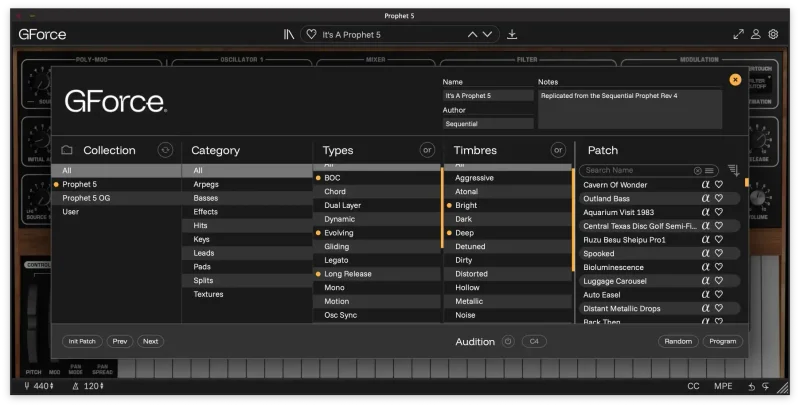
The patch browser has tagging and search, which makes navigation manageable given the size of the library. That said, you'll need to build a "cleaned" subfolder of your own pretty quickly. More on that shortly.
Where the Claim Falls Apart
The Tuning Problem Is Real
Oscillator tuning variability is the most common complaint from owners, and it's frustrating because it's partly a feature and partly a failure. The vintage control is meant to simulate the natural drift of hardware oscillators. The problem: even with vintage minimized, some voices sit up to 10 cents out of tune relative to others.
10 cents is not subtle. On a sustained chord, that's the difference between lush and genuinely uncomfortable. In a dense mix it might wash out, but on exposed pads or any sustained harmonic content, you'll hear it.
The hardware drifted too. But you could retune the hardware. The plugin's vintage control doesn't give you enough range to dial this fully out. That's a real limit, not a stylistic choice.
Poly-Mod Accuracy Issues
Owners and forum users have documented a specific problem: the Poly-Mod section doesn't behave accurately when Oscillator 2 is not in low mode. The reported behaviour doesn't match any of the three hardware revisions. That's a modelling error, not a creative decision.
If you're using Poly-Mod heavily for filter sweeps or FM-style effects, test this in your project before committing. Some workflows won't hit this at all. Others will hit it constantly.
The Preset Library Needs Work
Over 460 presets sounds like a lot. In practice, the library skews heavily toward experimental sounds. If you need bread-and-butter patches for a pop session, a soul record, or a film cue, you'll scroll past a lot of motion and noise before finding something immediately usable.
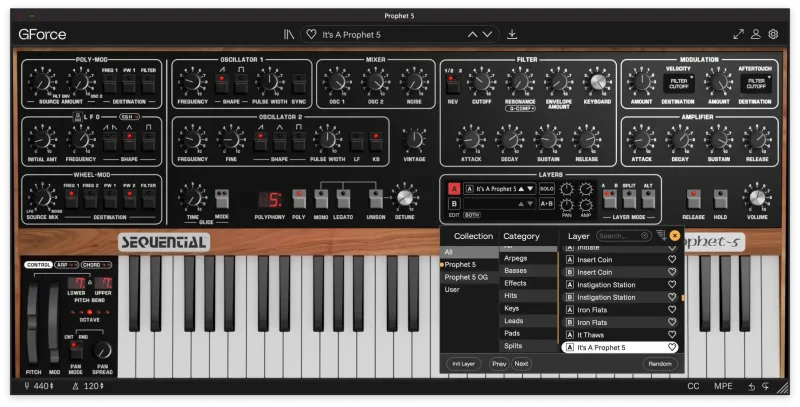
Worse: there's no global FX disable. Load a preset, want to hear the raw synthesis without reverb and chorus smearing everything? You're disabling effects per slot, manually, every time. That's annoying. It slows down A/B comparisons between patches and makes evaluating the core sound significantly harder.
The effects lock buttons on the AU version compound this. Owners report they don't preserve settings when switching presets. If you're in Logic Pro, that's worth flagging as a known bug before building a session around it.
Logic Pro Bug: OSC 2 Fine Drift
The OSC 2 Fine setting reverts to 0 cents when you reopen a Logic Pro project. That's not a small thing. If your patch depends on a specific detuning between oscillators for its character, that character is gone when you come back the next day. Manual preset save and reload is the workaround. It works. But it's the kind of thing that shouldn't be a workaround.
Interface Readability
The interface is fully resizable and high-resolution, which is appreciated. But reviewers consistently flag arpeggiator and chord control text as difficult to read, and effects graphics also suffer from limited visibility.
Who Should Buy This and Who Should Not
If you're a sound designer building pads, evolving textures, and layered polysynth chords from scratch, this gives you extraordinary depth. The three revision models, the X-Modifiers section, the dual-layer architecture, and the genuine warmth of the core oscillators make it a genuinely powerful toolkit at $79.99.
If you work fast, depend on factory patches, or need a Prophet sound you can drop into sessions without cleanup, this will slow you down. The experimental preset library, the absent global FX bypass, and the AU bugs make it a friction machine when speed is what you need.
MPE users will love this. The comprehensive MPE compatibility combined with the modulation depth means expressive controllers get a lot out of the plugin's range.
Producers who need something that just works out of the box? Look at the alternatives below first.
Specs & Technical Details
| Developer | GForce Software |
| Price | $79.99 |
| Plugin Format | N/A |
| OS Support | N/A |
| Activation | N/A |
| CPU Usage | N/A |
| Trial Available | N/A |
| Version Reviewed | N/A |
Score Breakdown
| Category | Score | Notes |
|---|---|---|
| Sound Quality | 4.5/5 | Three revision models sound genuinely distinct, and owners confirm the warmth and harmonic placement are real |
| Value for Money | 3.5/5 | Deep feature set at the price point, but known bugs and preset cleanup overhead take some of the shine off |
| Ease of Use | 2.5/5 | Interface readability issues, no global FX bypass, AU preset lock bug, and Logic OSC drift make this more work than it should be |
| Features | 4.0/5 | X-Modifiers, dual layers, three revisions, MPE, 460+ presets. The hardware never had this range |
| CPU Efficiency | N/A/5 | N/A |
| Overall | 3.5/5 | Brilliant core sound and serious depth, held back by fixable bugs and a preset library that needs curation |
Alternatives to Consider
u-he Repro-5 is a mature alternative with comparable tonal qualities and similar workflow advantages. If you want something with a longer track record and a more settled codebase, Repro-5 is worth comparing directly before committing.
Softube Model 80 is in the conversation too. Some users specifically report it nails the raw Prophet sound more convincingly than other software options. If the core oscillator tone is your primary concern and the layering features aren't important to you, check Model 80 before you decide.
The Verdict
The Prophet~5 plugin does something real with the core sound. The three revision models, the X-Modifiers, and the dual-layer architecture give producers a polysynth tool that's genuinely hard to match for warmth and harmonic depth.
But real workflow problems exist and owners have documented them clearly: tuning variability you can't fully dial out, a Poly-Mod section that misbehaves in a specific but common scenario, and an AU preset lock bug that's frustrating in Logic Pro.
At $79.99, this is worth buying if you're a sound designer who builds patches and doesn't mind doing preset curation work. It's the wrong purchase if you need a quick-load, production-ready factory library and a stable AU experience in Logic today.
The hardware's soul is in here. Getting to it takes more elbow work than it should.
Related reviews: SkyDust 3D Educational Version Review 2026 · Blocks Primes
Frequently Asked Questions
Is the GForce Prophet~5 officially licensed by Sequential?
Yes. GForce developed the Prophet~5 plugin in direct partnership with Sequential, the company founded by Dave Smith that owns the Prophet~5 name and heritage. That partnership is documented and shapes the accuracy goals of the emulation.
What's the difference between the Rev1, Rev2, and Rev3 models?
Rev1 and Rev2 use SSM filter and envelope characteristics, which tend toward a slightly rounder, warmer response. Rev3 uses Curtis filter and envelope behaviour, which is typically tighter in the attack and slightly brighter in the top end. Owners report these are audibly distinct, not cosmetic labels.
Does the Prophet~5 plugin work with MPE controllers?
Yes. MPE compatibility is fully supported, and the plugin's deep modulation architecture through the X-Modifiers section makes it a strong pairing for expressive controllers. Per-note pitch bend, pressure, and slide can feed into the modulation paths.
Is the OSC 2 Fine bug in Logic Pro still present?
Owners have reported that the OSC 2 Fine setting reverts to 0 cents when reopening a Logic Pro project. The workaround is saving your patch as a preset after dialling in your OSC 2 Fine value and reloading manually.
How many presets does the GForce Prophet~5 include?
The plugin ships with over 460 presets, including the original 38 factory patches from 1978. The patch browser includes tagging and search functionality to help with navigation. Be aware that owners report the library leans toward experimental sounds rather than immediately production-ready patches, so plan on doing some curation work upfront.