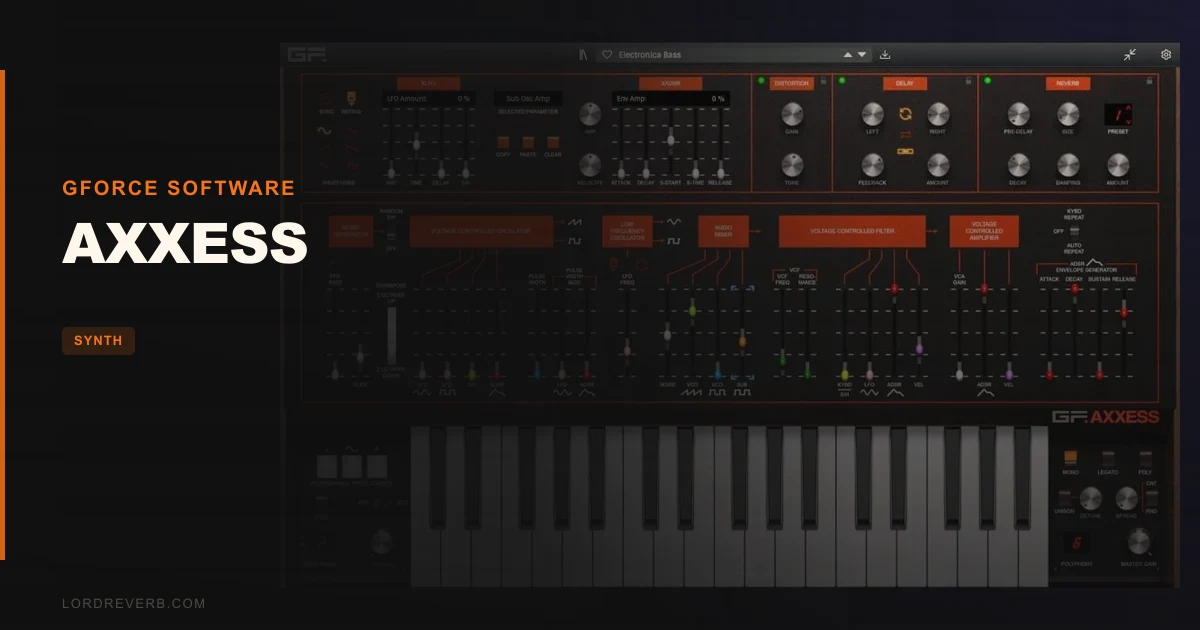
AXXESS is a mostly positive story with one catch you need to hear first: it ships with only six voices of polyphony. That's not a typo. If you're building dense, layered synth pads or stacking chords in a big cinematic arrangement, six voices will run out faster than you expect. For bass lines, mono leads, arpeggiated sequences, and tight electronic grooves, it's a non-issue. But know what you're buying before you commit $79.99 to it.
Quick verdict: AXXESS earns a 4.1 out of 5. It's a punchy, fat-sounding emulation of the 1975 ARP AXXE with a sub-oscillator, solid built-in effects, and over 350 presets that give you an immediate working library. The GUI is genuinely frustrating in places, and the polyphony ceiling is real. But for bass-forward electronic production, Synthpop, and cinematic work, it's a satisfying and well-priced tool at $79.99.
The Catch Up Front
Six voices. That's the ceiling. Not sixteen, not thirty-two. Six. GForce's own Oddity3 runs sixteen voices, so if you're already in the GForce family and you're eyeing AXXESS as an upgrade for polyphonic work, it's actually a step down in that specific regard.
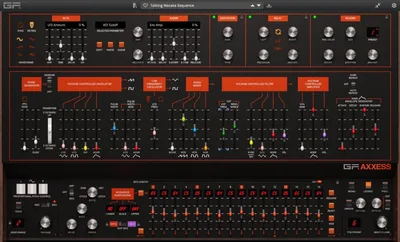
The other catch is the interface. Owners have described it as eye-wateringly bad. Knob markers are hard to see against the panel background. The skeuomorphic fonts are small and fuzzy on standard displays. If you're working on a single monitor at any normal viewing distance, you will squint. The UI is fully scalable, which helps, but it shouldn't need to be a workaround for a legibility problem that shouldn't exist.
Then there's the reverb bleed. Switching patches mid-session can let the current reverb tail carry into the next preset. Annoying. It's the kind of thing you notice immediately in a live performance context or when auditioning sounds fast. Work around it by leaving a short gap between preset switches, but again: a workaround shouldn't be needed.
New users get limited beginner guidance. If you're new to monosynth architecture, AXXESS has a learning curve that the preset browser softens but doesn't eliminate.
What You Get If You Clear It
AXXESS is GForce's emulation of the 1975 ARP AXXE, a single-oscillator monosynth that was punchy, direct, and brilliant for bass and lead work. The plugin keeps that DNA and adds modern utility around it.
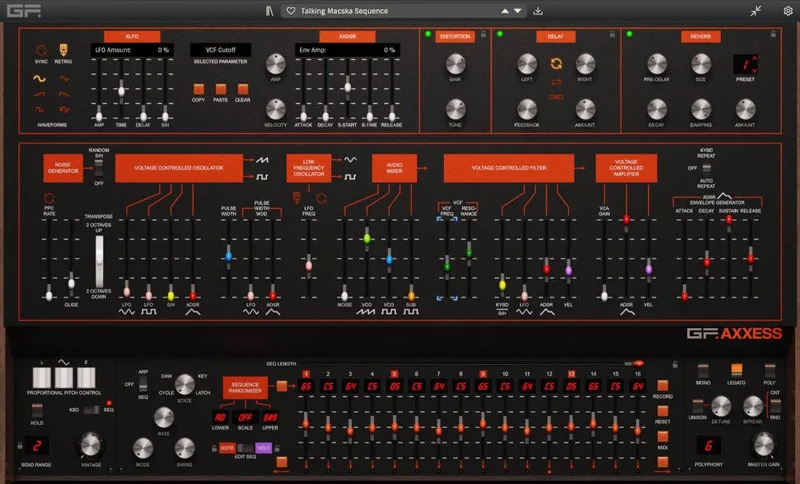
At the core you get the oscillator with a new sub-oscillator added below it, giving the low end extra weight. There are four playback modes: Unison, Monophonic, Monophonic Legato, and Polyphonic. Unison stacks the voices for that wide, dense lead sound. Legato keeps the filter envelope from retriggering on tied notes, which is where expressive bass playing lives.
The modulation system is called X-Modifiers. Each modifier carries its own independent LFO and Envelope. That's not a simple mod matrix: you can set up independent modulation paths without routing conflicts slowing you down.
Effects on board: distortion, analogue stereo delay, and matrix reverb. Add an arpeggiator and a 16-step sequencer, and AXXESS is a self-contained instrument, not a bare oscillator waiting for your DAW's effects chain. Pan spread rounds it out for stereo placement. Velocity hits both the filter and the VCA, so playing feel translates into sound.
The Oscillator and Sub: Where the Fat Sound Lives
The original ARP AXXE was a single-oscillator synth. That simplicity was also its strength: every sound had a clear, uncluttered character. GForce keeps that, then adds the sub-oscillator underneath.
Push the sub in your bass patch and the fundamental drops hard. Owners describe the overall sound as "very analogish and fat," and the sub is a big part of why. It's not a separate oscillator with its own pitch controls: it sits a fixed octave below the main oscillator, reinforcing the bottom without cluttering the harmonic structure.
You're making a kick-adjacent bass line? The sub makes the low-end relationship between your kick and bass something you can feel, not just measure. Set your main oscillator to a square wave and bring the sub in at about 60-70% of the main level. That's where the weight is without losing the attack of the top end.
The filter emulation is where reviewers have been specific and positive. The filter character of the original ARP AXXE was distinctive: a little dirty in self-oscillation, firm at the low end, and slightly unpredictable in a good way. Reviewers report that GForce's filter emulation captures this with excellent character. Push the resonance and you'll hear it thin out in a way that sounds right, not digital.
The Vintage knob is a nice touch. It introduces analogue imperfections: subtle pitch drift, slight filter inconsistencies, the kind of behaviour that makes a synth sound like it has a personality rather than a CPU. Use it sparingly and your patches sound organic. Crank it and things get pleasantly unstable.
The Playback Modes and What Each One Is Actually For
Four modes. They're not interchangeable, and choosing the wrong one ruins a patch before you've touched a knob.
Monophonic is the baseline. One note at a time, envelope retriggered on every new keypress. Tight, punchy, predictable. Works best for fast bass lines where each note needs a clean attack transient.
Monophonic Legato changes the envelope behaviour. Hold a note and play another while it's still down: the filter and amp envelopes don't retrigger. The pitch glides or steps depending on your portamento setting. This is where AXXESS sounds most like a real monosynth being played expressively. Use it for lead lines where you want the connected, slightly fluid feel of a synth player rather than a sequenced machine.
Polyphonic unlocks up to six simultaneous voices. Six is enough for a standard triad with some doubling, or a four-note chord. It's not enough for dense orchestral voicings or wide pad stacking. Know that going in.
Unison stacks all available voices onto single notes for maximum width and thickness. This is the big lead sound GForce talks about. Set the pan spread alongside it and a Unison lead sits wide in the stereo field. Watch your headroom: Unison with high pan spread and reverb can hit the bus hard.
X-Modifiers: Modulation That Doesn't Fight You
This is genuinely one of the stronger design choices in AXXESS. Most monosynth emulations give you a mod wheel routed to one or two destinations, maybe a single LFO with a handful of targets. X-Modifiers go further.
Each X-Modifier has its own independent LFO and its own Envelope. That means you can have one modifier applying a slow, wide vibrato to pitch while another applies a faster, tighter tremolo to the VCA, all without those two modulation paths fighting for shared resources.
For electronica and synthpop, this is where AXXESS earns its reputation for producing complex sounds quickly. You're not menu-diving through a matrix. The controls are direct and the results are immediate. Owners specifically praise the modulation options as plentiful and easy to use, which is a combination you don't always get.
The independent LFO per modifier also means you can sync one LFO to your DAW's tempo for rhythmic filter movement while leaving another LFO free-running for organic variation. That combination, in a bass patch, creates movement that sits in the mix rather than sitting on top of it.
Velocity-to-filter and velocity-to-VCA add a playing dimension that software synths sometimes forget. Play softly and the filter closes a little, the volume drops naturally. Dig in and the sound opens up. It makes AXXESS responsive to MIDI velocity curves in a way that rewards programming a proper MIDI part rather than drawing flat velocities in a piano roll.
The Arpeggiator and Sequencer
The arpeggiator is standard but does its job. Hold a chord and it steps through the notes in the order, range, and speed you set. For synthpop and dance production this is an immediate starting point: load a punchy preset, set the arp to two or three octaves, sync to tempo, done.
The sequencer is 16 steps. That's a deliberate simplicity. You're not building complex polyrhythmic patterns here. What you are doing is locking in a repeating melodic cell that doesn't require MIDI note data from your DAW. For producers who want to play a sound live and let the sequencer drive the pitch pattern, it works cleanly.
GForce describes it as super fun, and owners seem to agree. "Instantly rewarding" appears in user feedback more than once. The sequencer combined with the arpeggiator and the X-Modifiers means you can get a fully animated, moving sound without touching your DAW's piano roll.
Don't expect a modular-style step sequencer with per-step modulation amounts or probability settings. It's a 16-step pitch sequencer. It's good at what it does and nothing more than that.
Effects: Distortion, Delay, and That Reverb Problem
Three on-board effects: distortion, analogue stereo delay, and matrix reverb. For a synth in this category and at this price, that's a useful set. The key thing to understand is that these effects colour the presets significantly. Owners note that the effects make a big difference to how varied the sound palette feels.
The distortion adds harmonic saturation to the top end. Push it into a bass preset and the upper harmonics get gritty, which helps the bass cut through a dense mix without having to boost high frequencies with an EQ. It's not a fuzz pedal: it's a tonal tool.
The analogue stereo delay is tempo-syncable and places AXXESS sounds in a space that feels analogue rather than digital. Short delays on leads create a doubling effect. Longer delays with high feedback can turn a sequenced pattern into something that feels almost generative.
The matrix reverb is where the complaint lives. It sounds good. The problem is patch-switching: the reverb tail from one preset bleeds into the next. In a studio session where you're auditioning sounds, this is frustrating. You can hear the ghost of the previous patch for a second or two after switching. In a live context it's worse. GForce needs to address this.
If you're building a track and committing patches rather than browsing in real time, the bleed is less of a problem. Still worth knowing.
The Preset Library: 350+ Sounds and the Designers Behind Them
Three hundred and fifty presets is a serious library for a synth at this price. The designers are Zardonic, GEOsynths, and Christian Lafitte. These aren't names chosen for marketing. Zardonic is a producer known for aggressive electronic music. GEOsynths and Christian Lafitte have strong reputations in the sound design community.
Users report the presets as punchy, clear, and excellent. That's a different word than "numerous," which is what most synths claim. Punchy and clear means the presets are ready to sit in a mix without requiring five minutes of EQ correction first.
Some users note that not all bass presets work for their specific context. That's honest and expected: 350 presets will include some that fit your music and some that don't. The preset browser has extensive tagging, sorting, and search, which means you can filter by genre or instrument type rather than scrolling through all 350.
The tagging system is genuinely useful. AXXESS targets Electronica, Cinematic, Synthpop, Dance, Ambient, Rock, Prog Rock, and Hip Hop. The presets are tagged accordingly, so if you're building a Hip Hop track and you want to skip the Prog Rock leads, you can. That's the kind of practical browser design that saves time in a session.
The GUI: Honest Assessment
Let's not soften this. The GUI has real problems. Knob markers are hard to see. The skeuomorphic fonts are small and fuzzy. Some owners have called it eye-wateringly bad, which is harsh but not entirely unfair.
The fully scalable UI is the escape hatch. Scale it up and the legibility improves. On a large monitor at a comfortable viewing distance, it becomes workable. On a laptop screen or a second monitor at a distance, it stays awkward.
This matters because you will be adjusting knobs while listening. If you can't immediately see where a knob is set without leaning forward, your workflow slows. The Vintage knob, the filter cutoff and resonance, the envelope parameters: these should be readable at a glance.
It's worth saying clearly: the GUI ugliness doesn't affect the sound. It affects your ability to edit quickly. For preset-heavy users who aren't deep-editing, it's less of a problem. For tweakers who want to dial in every parameter by sight, it's a frustration you'll face every session.
Where It Shines
Bass. That's the short answer. GForce calls it a master at bass, and the user reports back that up. The filter character, the sub-oscillator, the Monophonic Legato mode, the distortion: every part of AXXESS's design points toward fat, punchy low-end work.
You're producing a Synthpop track and you need a bass line that sits under driving chords without turning muddy? Load a bass preset, switch to Monophonic Legato, set portamento to a short time, and let the velocity-to-filter mapping add the dynamic feel. That's where AXXESS is brilliant.
Leads are a close second. Unison mode with pan spread produces the kind of big lead sound that fills the top of a mix. The X-Modifiers let you add pitch vibrato and filter movement without the lead sounding sterile. Electronica and cinematic scoring both benefit from this.
The arpeggiator and sequencer make AXXESS genuinely useful in a live or improvisational context. You're sketching a track idea and you want to lock in a rhythmic synth part while you work on arrangement elsewhere. Set the sequencer, leave it running, and AXXESS handles itself.
At $79.99, with 350 presets and a built-in effects chain, the value proposition is solid for the genres it targets.
Against the Field
The direct comparison is GForce's own Oddity3. That's a dual-oscillator ARP Odyssey emulation with sixteen voices of polyphony. If you need polyphonic ARP sounds with more harmonic complexity, Oddity3 is the better tool. It's also the more expensive one. AXXESS makes sense when you're after the simpler, bass-forward AXXE character and you don't need a full Odyssey architecture.
For vintage monosynth emulations more broadly, the Arturia SEM V offers a different flavour: the Oberheim character versus the ARP character. The SEM V has a different filter topology (state-variable versus the ARP's ladder-adjacent design) and a different aesthetic entirely. AXXESS wins on the raw, punchy bass character. SEM V wins on warmth and versatility.
AudioThing's SX1000 is another vintage Italian synth emulation that competes in this space. SX1000 has a different source sound but overlaps in the bass and lead territory. Worth auditioning both if the vintage mono category is where you're shopping.
For sequencer-driven electronic production, Arturia MiniFreak V goes further with its modulation and sequencing depth. But MiniFreak V doesn't have the same analogue warmth focus that AXXESS brings. Different tools for different jobs.
Who Should Buy This
- ✅ Buy if you produce Synthpop, Dance, Electronica, or Hip Hop and need a punchy, fat bass and lead synth with 350 ready-to-use presets.
- ✅ Buy if you want an ARP AXXE character in your DAW with modern additions (sub-oscillator, effects, modulation) and you don't need more than six voices.
- ✅ Buy if you want a self-contained instrument with built-in arpeggiator, sequencer, and effects, and you'd rather spend your time making music than building a signal chain.
- ❌ Skip if you need more than six voices for dense polyphonic pads or orchestral-style chord work.
- ❌ Skip if a difficult-to-read GUI will genuinely slow your workflow and you're unwilling to scale the UI as a workaround.
- ❌ Skip if you're new to synthesis and expect built-in guidance: AXXESS assumes you know the basics and doesn't hold your hand.
Specs & Technical Details
| Developer | GForce Software |
| Price | $79.99 |
| Plugin Format | VST / VST3 / AAX / AU (Standalone available on both platforms) |
| OS Support | Mac (macOS 10.13+, Intel and Apple Silicon Native) / Windows (Windows 7+) |
| Activation | N/A |
| CPU Usage | N/A |
| Trial Available | N/A |
| Version Reviewed | N/A |
| Polyphony | 6 voices |
| Presets | 350+ |
| Playback Modes | Unison / Monophonic / Monophonic Legato / Polyphonic |
Score Breakdown
| Category | Score | Notes |
|---|---|---|
| Sound Quality | 4.5/5 | Fat, analogish filter character with a convincing sub-oscillator and strong filter emulation |
| Value for Money | 4.0/5 | 350+ presets, effects, and arpeggiator at this price is a fair deal for the target genres |
| Ease of Use | 3.5/5 | GUI legibility is a real friction point; preset browser and modulation are otherwise intuitive |
| Features | 4.0/5 | Sub-oscillator, X-Modifiers, effects chain, sequencer, and arpeggiator cover the bases well |
| CPU Efficiency | 4.0/5 | Minimum specs suggest a light-to-moderate load; no CPU complaints in owner reports |
| Overall | 4.1/5 | A punchy, fat vintage monosynth emulation let down slightly by its GUI and polyphony ceiling |
Alternatives to Consider
GForce's own Oddity3 is the first place to look if AXXESS's polyphony ceiling bothers you. Sixteen voices, dual oscillators, the full ARP Odyssey architecture. It costs more, but if you need polyphonic ARP character rather than monosynth focus, it's the right move. AXXESS and Oddity3 aren't competing: they're siblings with different jobs, as GForce itself says.
Arturia SEM V gives you Oberheim character in a similar vintage price bracket. The filter is a state-variable design rather than the ARP-style filter in AXXESS. Warmer in the upper mids and a different kind of character for pads and leads. If ARP is specifically what you're after, SEM V won't scratch that itch. If you just want a great vintage mono emulation and the brand doesn't matter, it's worth hearing.
AudioThing SX1000 covers similar ground with an Italian vintage flavour. The overlap is real in the bass and mono lead territory. Owners of both might find they reach for AXXESS for punchy electronic bass and SX1000 for something slightly different in character, but if you're buying one, compare both demos carefully before deciding.
For something with more modulation depth and sequencing power at the cost of vintage character, Arturia MiniFreak V is a different kind of instrument. More complex to learn, more adventurous in sound design, less focused on that specific warm, fat analogue bass. Know what you're optimising for and the choice gets easier.
If sample-based sound design interests you alongside synthesis, Chromaphone 3 sound banks covers acoustic synthesis territory that AXXESS doesn't touch at all. Different category, but worth knowing exists in your toolkit.
The Verdict
AXXESS is a love it or leave it synth based almost entirely on what you produce.
If bass lines, punchy mono leads, arpeggiated sequences, and the specific character of an ARP filter are what you need, this is a satisfying instrument. The 350 presets from genuine sound designers mean you can open AXXESS and have something usable in a track within minutes. The sub-oscillator adds genuine weight. The X-Modifiers reward the time you put into programming. The effects are good enough to leave on.
The GUI is ugly. That's just true. Knob markers are hard to read, the fonts are small and fuzzy, and while the UI is scalable, that's a workaround for a problem that shouldn't exist in a plugin at $79.99. It doesn't affect the sound, but it will affect how quickly you can edit.
Six voices is a ceiling you'll notice eventually. Not every day, not in every genre, but when you hit it, you'll wish it was higher. Pad-heavy work and dense chord arrangements belong elsewhere.
And the reverb bleed between patches? Still annoying. Still here in the report. Still needs fixing.
Buy it for the bass. Buy it for the leads. Buy it because a 1975 ARP AXXE with a sub-oscillator, a sequencer, and 350 presets at $79.99 is a ridiculous amount of synth for the money. Just don't buy it expecting a twelve-voice pad machine or a GUI that rewards squinting.
If the six-voice limit sounds like your problem, go straight to Oddity3. If you want the AXXE character without those constraints showing up at the worst moment, AXXESS will earn its place in your plugin folder.
Frequently Asked Questions
Is AXXESS suitable for beginners?
AXXESS is rewarding quickly because of its preset library, but the underlying architecture is a traditional subtractive monosynth without tutorial guidance built in. If you know what a filter envelope does and how LFOs work, you'll be fine. If you're brand new to synthesis, the learning curve is real and AXXESS doesn't flatten it for you. Starting with presets and adjusting one control at a time is the practical approach.
How does AXXESS compare to Oddity3 from GForce?
They're different instruments. AXXESS emulates the 1975 ARP AXXE: single oscillator, bass-focused, six voices. Oddity3 emulates the ARP Odyssey with dual oscillators and sixteen voices. Oddity3 is more complex, more polyphonic, and more expensive. GForce describes them as siblings. Buy AXXESS for bass and mono leads; consider Oddity3 when you need polyphonic ARP character and more harmonic range.
Does AXXESS work on Apple Silicon Macs?
Yes. AXXESS is Apple Silicon Native, so it runs natively on M-series Macs without Rosetta translation. It also supports Intel Macs running macOS 10.13 or above. On the Windows side, it requires a 2GHz CPU with 2GB RAM and Windows 7 or above, which is a low bar.
What genres work best with AXXESS?
GForce targets Electronica, Cinematic, Synthpop, Dance, Ambient, Rock, Prog Rock, and Hip Hop. In practice, the synth is most at home in anything that needs fat bass lines, punchy mono leads, and ARP-style filter movement. Ambient and Cinematic work is possible but six-voice polyphony limits thick pad territory. Hip Hop and Dance production are sweet spots.
Can you use AXXESS without a DAW?
Yes. AXXESS ships as a Standalone Application on both Mac and Windows, so you can run it independently without opening your DAW. This is useful for auditioning sounds, practicing with the arpeggiator and sequencer, or performing live without a host application. Plugin formats include VST, VST3, AAX, and AU (Mac only for AU), covering every major DAW on both platforms.