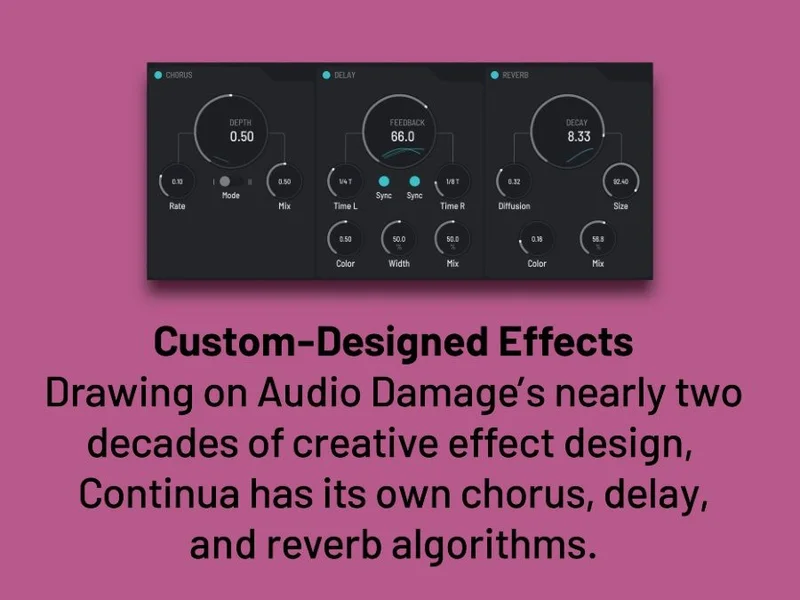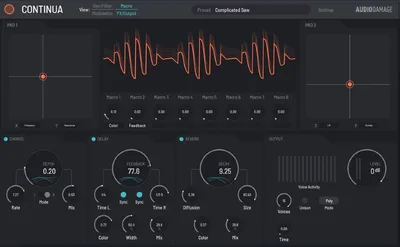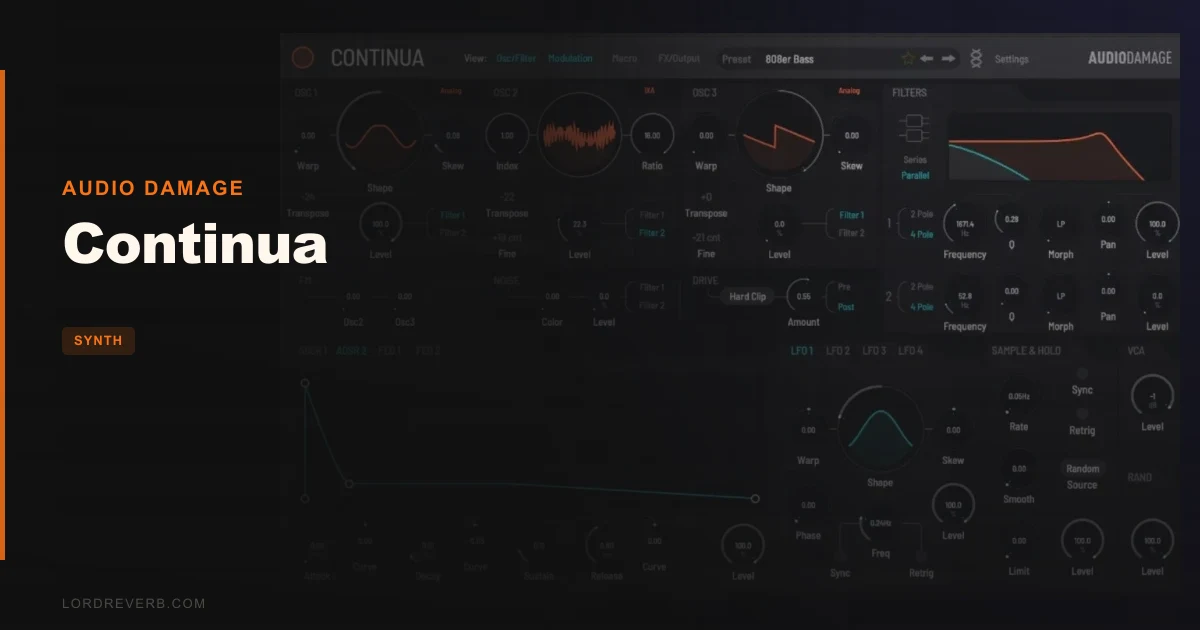
Continua by Audio Damage is a virtual analogue synthesizer that rewards patient, modulation-heavy sound design but will frustrate you if you want instant analogue warmth or punchy filter bass.
Picture this: it's late, you've been chasing a pad sound for twenty minutes, and every synth in your session sounds too static. You want something that breathes, shifts, and morphs without you automating every parameter by hand. That's the exact moment Continua makes sense.
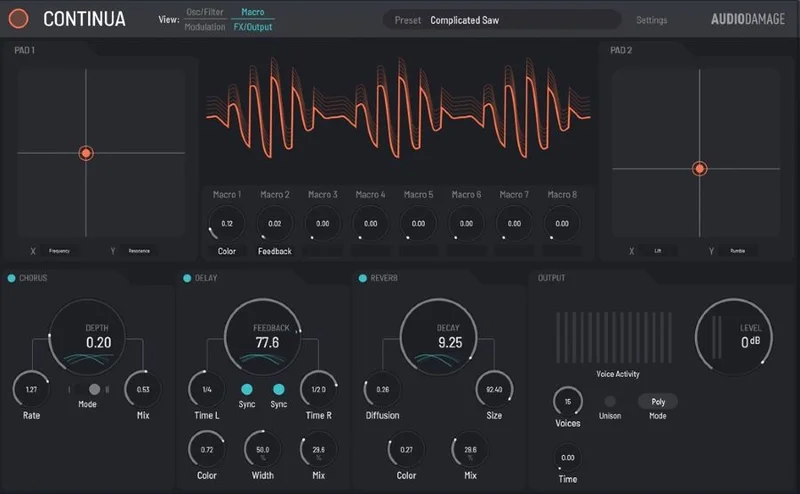
If you're building a Reese bass or a detuned supersaw lead that needs to punch through a drop, you'll be disappointed. Owners report the filter resonance is weak and the base oscillators don't have much inherent character. That's not a dealbreaker for everyone, but you should know it going in.
What's Inside Continua
Three continuously morphable oscillators sit at the core, each with warp, shape, and skew controls. Version 1.2 added Additive mode, which stacks 64 sine waves with per-harmonic amplitude control, plus Supersaw mode (five detuned sawtooths), Supersquare mode, and IXA mode combining phase modulation with waveshaping.
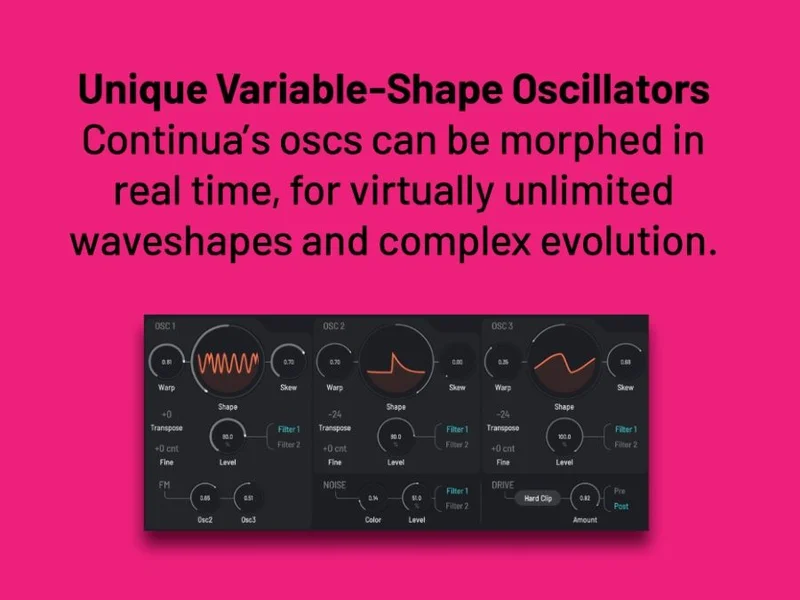
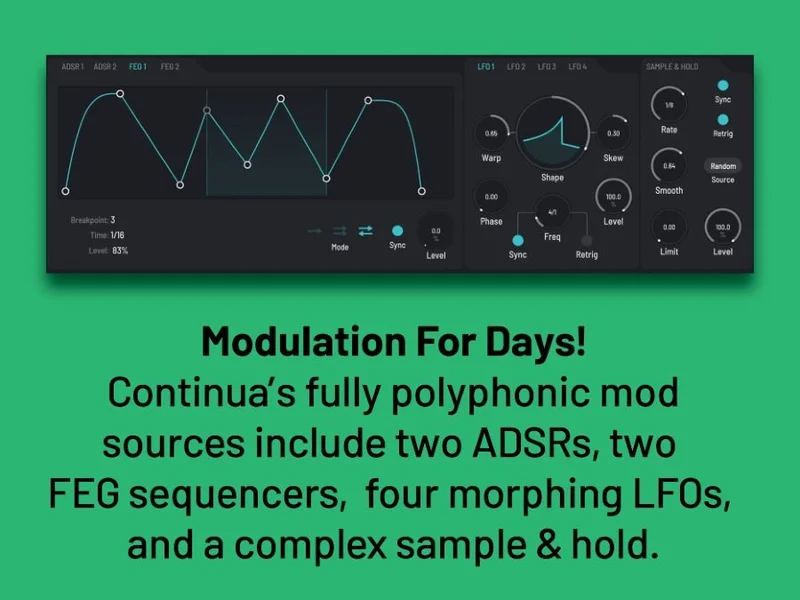
Two morphing filters transition from lowpass through bandpass and highpass to notch, in 2-pole and 4-pole configurations. A noise source with colour control feeds into the signal chain alongside four Flexible LFOs, two ADSR envelopes with curve control, and two Flexible Envelope Generators supporting up to 99 steps with arbitrary loop points.
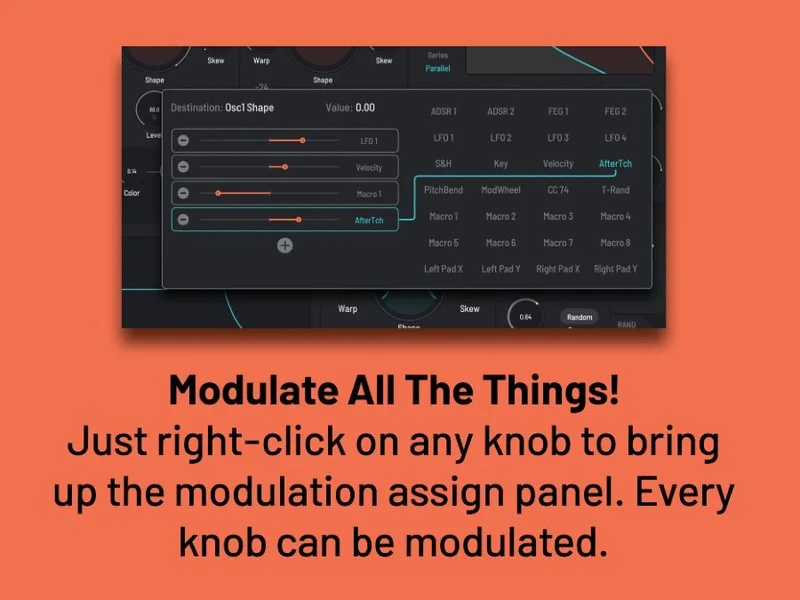
Sample and Hold can target noise or modulation sources at musical division rates, with a built-in walk effect. Every knob is a modulation destination via right-click. The synth runs 15 polyphonic voices on desktop, 6 on iOS. Full MPE support and TUN file import for microtonal retuning are included.
Where It Fits In Your Workflow
Continua lives on the atmospheric and experimental end of your instrument roster. Think evolving pad layers, textural beds under a mix, expressive leads on a Linnstrument or Roli Seaboard. It's not a workhorse synth you reach for when you need a quick pluck or a growling bassline.
The Flexible Envelope Generators can be assigned to oscillator morph and filter position simultaneously via the modulation matrix. Let those 99-step envelopes run on loop with offset timing. That's where Continua does things other synths genuinely can't match without serious macro programming.
The arpeggiator in v1.2 adds Brownian motion and probabilistic rests alongside standard ascending and descending patterns, with dotted and triplet timing. Pair that with the Sample and Hold smoothing control feeding an LFO rate and you can generate sequences that feel alive without touching automation. It rewards exploratory workflow more than precision production.
One real limit to plan around: GUI animation runs heavy on Mac. Owners report roughly 50% of a CPU core just on rendering. That's annoying on a laptop session where every percentage matters.
What It's Genuinely Good At
The morphable oscillators are the clever part. You're not choosing between waveforms on a switch. You're sweeping through them continuously, and assigning an LFO to that morph position produces movement that feels organic rather than stepped.
Owners specifically praise the bass patches for monophonic legato and glide behaviour. If you play Continua live with glide dialled in on a single voice, the pitch slides feel smooth and intentional in a way that suits melodic bass playing more than sub-pounding drops.
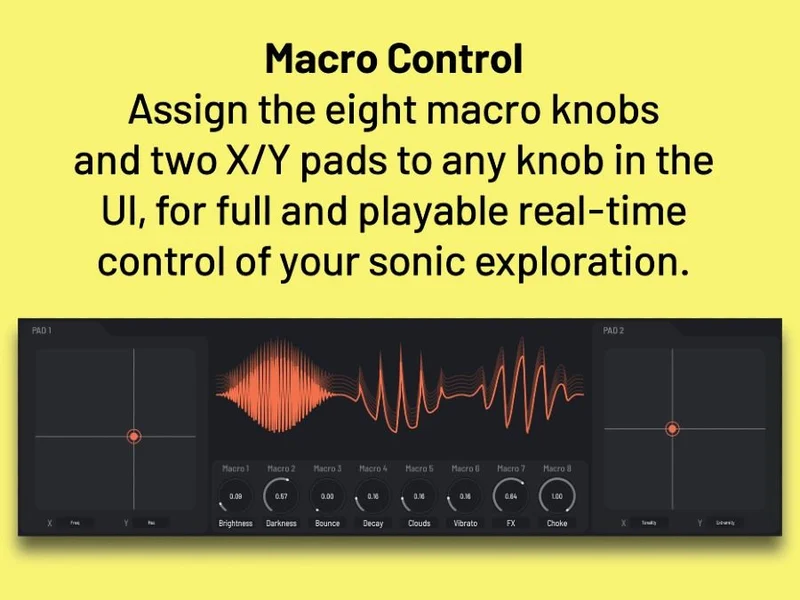
MPE performance is a genuine strength. Per-note pressure, pitch bend, and modulation work cleanly across Linnstrument, Roli Seaboard, Haken Continuum, Madrona Labs Soundplane, and Sensel Morph. The per-instance pitch bend range and aftertouch smoothing settings make it genuinely usable on hardware that's notoriously finicky with software synths.
The Genetics panel in v1.2 is a satisfying way to break out of patch ruts. You toggle which parameter categories mutate, audition the result before committing, and branch from patches you actually like rather than rolling dice on everything at once. It's the kind of feature you'll love once you find a sound worth exploring further.
Factory presets from Red Means Recording, Glitch Machines, and Sonalsystem are a reliable starting point and a fair representation of the synth's real strengths: complex, modern, atmospheric.
The Rough Edges
The filter resonance is genuinely weak. Owners report this consistently, and Audio Damage has updated the synth without fully resolving it. If you push the filter into self-oscillation territory expecting screaming resonant peaks, you'll hit a ceiling. Bass-driven sounds and aggressive leads feel held back by this.
The mod matrix is powerful on paper. 99-step envelopes, four LFOs, Sample and Hold, and every knob as a destination sounds brilliant. In practice, owners describe the assignment workflow as cumbersome. Navigating Continua's modulation routing takes more effort than the depth justifies.
Audio-rate modulation is technically possible but owners report it's unpredictable. No detune controls in unison mode is a frustrating omission for anyone layering voices. And iOS users report occasional audio crackling, so treat the mobile version as secondary.
The base oscillators sound precise and digital. That's a design choice, not a defect, but it means Continua won't save you if you need character baked into the raw tone.
Who This Is Really For
- ✅ Buy if you build atmospheric pads, evolving textures, or experimental sound design where morphing and modulation depth matter more than raw filter character.
- ✅ Buy if you play an MPE controller and want a synth with genuine per-instance control over pitch bend range and aftertouch smoothing.
- ✅ Buy if you work in alternative tunings and need TUN file support with a properly resizable GUI that holds up on Hi-DPI displays.
- ❌ Skip if you need punchy, resonant filter bass or leads. The filter ceiling will frustrate you.
- ❌ Skip if you're on a MacBook and already watching CPU. The GUI rendering hit is real and not optional.
- ❌ Skip if you want immediate analogue warmth with minimal modulation setup. Continua rewards patience, not speed.
Specs & Technical Details
| Developer | Audio Damage |
| Price | $79 |
| Plugin Format | N/A |
| OS Support | Mac / Windows / iOS |
| Activation | N/A |
| CPU Usage | Heavy (GUI animation alone uses ~50% of one CPU core on MacBook) |
| Trial Available | N/A |
| Version Reviewed | 1.2 |
| Polyphony | 15 voices (desktop) / 6 voices (iOS) |
| MPE Support | Yes |
| Microtonal Support | Yes (TUN file format) |
Score Breakdown
| Category | Score | Notes |
|---|---|---|
| Sound Quality | 3.5/5 | Precise and digital with genuinely strong morphing motion; weak filter resonance holds it back |
| Value for Money | 3.5/5 | Competitive for the feature depth if evolving textures are your target genre |
| Ease of Use | 3.0/5 | Cumbersome mod matrix and high CPU rendering cost work against an otherwise capable interface |
| Features | 4.0/5 | Additive, Supersaw, IXA, 99-step FEGs, Genetics panel, and full MPE is a strong feature set |
| CPU Efficiency | 2.5/5 | GUI animation alone consumes roughly 50% of a CPU core; that's a real problem on laptops |
| Overall | 3.5/5 | A deep, rewarding tool for specific work; genuinely wrong choice for others |
Alternatives to Consider
Owners who want more filter character and analogue warmth consistently mention Diva. Diva is noted by users as sounding better than Continua for classic analogue emulation, and its filter models have the resonance and self-oscillation behaviour Continua's filters lack. If bass and lead sounds are your priority, Diva is the stronger pick.
Dune gets the same comparison from users who want rich harmonic density and punchy filter response. If your workflow is more dance-focused and you need presets that work straight out of the browser, Dune is worth looking at before committing to Continua.
Pigments comes up specifically around interface. Users comparing the two point to Pigments' modulation routing as significantly more intuitive than Continua's. If the mod matrix depth appeals but you hate hunting through menus to make assignments, Pigments gives you comparable modulation ambition in a workflow that's easier to move fast in.
| Synth | Strongest Point | Weakest Point Versus Continua | Win Condition |
|---|---|---|---|
| Continua | Continuous oscillator morphing, MPE support, Genetics panel | Weak filter resonance, heavy GUI CPU cost | Atmospheric sound design and MPE performance |
| Diva | Analogue filter character and resonance (owners note it sounds better) | Less modulation depth per owners' comparisons | Classic analogue bass and lead sounds |
| Pigments | Superior interface per owners who've compared both | Not cited as better-sounding for morphing textures | Deep modulation with faster workflow |
The Verdict
Continua is a synth with a very clear personality and an equally clear blind spot. Build a slowly shifting pad layer, route a 99-step FEG into oscillator morph and filter position, play it live on a Roli Seaboard with per-note pressure shaping the LFO depth: that's where it shines without argument.
Ask it to anchor a track with a filter-heavy bassline or a resonant lead and it will let you down. The filter ceiling is real. The mod matrix takes work to navigate. And on a MacBook, the GUI rendering cost is the kind of thing you'll notice exactly when you can't afford to.
If atmospheric sound design and MPE expression are central to what you make, Continua is underrated and worth every cent. If they're not, the money spends better elsewhere.
Frequently Asked Questions
Does Continua support MPE controllers like the Roli Seaboard?
Yes. Continua has full MPE support covering per-note pressure, pitch bend, and modulation. It works with Linnstrument, Roli Seaboard, Haken Continuum, Madrona Labs Soundplane, and Sensel Morph. Each instance has its own MPE mode, aftertouch smoothing, and pitch bend range settings so you can dial in behaviour per patch.
Can Continua handle alternative tunings and microtonality?
Yes. Continua supports TUN file import, which covers a wide range of alternative intonations and temperaments. The global tuning offset defaults to A=440 but can be adjusted per instance. It's one of the more complete microtonal setups available in a synth at this price point.
Is the Continua iOS version the same as the desktop version?
The iOS version runs the same synthesis engine but is limited to 6 polyphonic voices per instance compared to 15 on desktop. iOS users have also reported occasional audio crackling. It's usable, but treat it as a secondary version rather than a full replacement for the desktop plugin if stability matters to your workflow.