DSK Darkness Theory 3 is a free PC VST synth built for dark, atmospheric, and horror-oriented soundtrack work, and if you're the producer staring at a half-finished underscore at midnight wondering why every pad in your library sounds too clean and cheerful, this is the plugin you should download first.
It's a specialist tool. Not a workhorse. Not a Swiss Army knife. You load it when you need dread on a budget, and it delivers that more reliably than anything else sitting in the free tier.
Who is it for? Composers working on horror games, scary short films, eerie ambient tracks, or any project where "pleasant" is the wrong word. If you make pop or hip-hop, close this tab.
What's Inside the Plugin
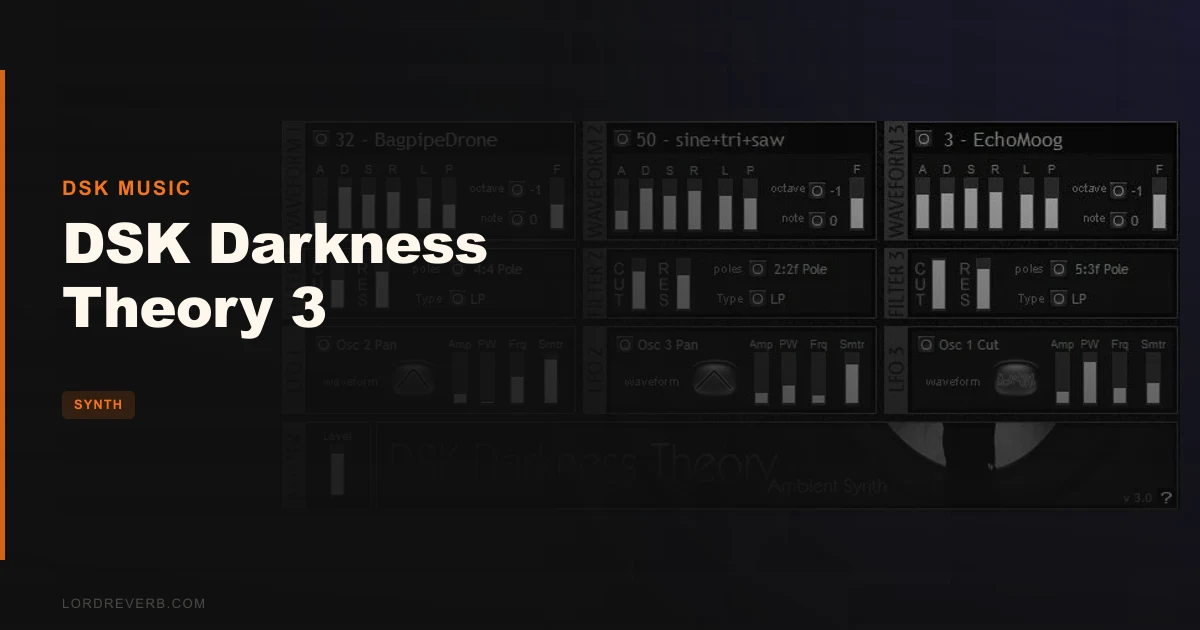
You get 3 oscillators, each with access to 72 waveforms. That's a real number, not filler: 72 waveforms means you can drift far from the default drone before you even touch an LFO.
Each oscillator has an octave selector and pan control. There's a micro-detuner for spreading the sound wide, and an amplitude envelope for shaping attack and decay. Three HP/LP filters with advanced pole settings let you carve the texture aggressively or just trim the low end.
Three LFOs with output routing. MIDI automation support. Velocity response. And 32 presets to get you started. The whole thing weighs in at 4.51 MB. That's lighter than most plugin installers.
Where It Fits In Your Workflow
Picture this: you've got a scene cue that needs to breathe. Not a stab, not a hit. A slow-moving, uneasy pad that sits under dialogue and makes the listener's skin crawl without them knowing why. That's where Darkness Theory 3 earns its place.
You'd slot it on a dedicated synth track, layer it under your main melodic element, and use the micro-detuner to widen it without adding a second instance. Route an LFO to the filter cutoff and let the HP/LP poles do the movement work. Adjust the amplitude envelope over time if the cue needs to swell.
It runs as a PC VST only, so Mac users are out. Owners report it runs cleanly on Quad Core systems and plays well with the main DAWs. If you use LMMS, slow down: rapid instrument switching reportedly causes crashes, so treat it as a dedicated track you set and leave alone.
What It's Genuinely Good At
The sound design workflow is satisfying in a low-friction way. Owners say editing is self-explanatory, which matters when there's no manual to lean on. You pull a preset, swap waveforms on oscillator 2, dial the filter down, and you've got something that doesn't sound like the preset at all. That's the design doing its job.
Seventy-two waveforms is the real selling point. Most free synths give you 8 to 12 and call it a day. Having 72 per oscillator means the difference between three oscillators sounding similar and three oscillators creating an entirely different texture when layered.
Owners describe the sound quality as solid. For horror and dark ambient work, that's enough. You're not using this on a lead vocal or a snappy snare. You're burying it in reverb and letting it haunt the background, and it's brilliant at that specific job.
DSK Chaos Theory, which the developer also makes, can be combined with Darkness Theory 3 to create different wave shapes. If you're already using one, picking up the other costs you nothing but a small download.
The Rough Edges
No manual. That's an annoying omission even for a free plugin. You'll figure it out because the layout is reported to be self-explanatory, but there will be a moment where you're unsure what a routing option actually does and you'll wish someone had written it down.
The stability complaints are harder to dismiss. CPU spikes and freezing are frustrating when you're mid-session. Crashes in LMMS when switching fast are a real workflow killer if that's your DAW. You're not losing work if you hit save obsessively, but it shouldn't be a thing.
Version 3 sounding softer than the original is a legitimate complaint. If you loved the aggressive edge of the earlier release, you'll notice the difference. Some owners hate it. Others don't mind. Worth knowing before you build a project around the tone you're expecting.
Who This Is Really For
- ✅ Buy if you score horror, dark ambient, or eerie film cues and want a free atmospheric pad synth that doesn't need half a day to learn.
- ✅ Buy if you're building a free plugin toolkit and want something with genuine sound design depth without touching your budget.
- ✅ Buy if you already use DSK Chaos Theory and want a companion synth from the same developer that pairs well for layering.
- ❌ Skip if you use LMMS as your primary DAW and switch instruments constantly during sessions. The crash risk is real.
- ❌ Skip if you need a manual or guided learning path. There isn't one, and the hands-on-only approach will frustrate you.
- ❌ Skip if you're on Mac. PC VST only, full stop.
Specs & Technical Details
| Developer | DSK Music |
| Price | Free |
| Plugin Format | VST (.dll) |
| OS Support | Windows only |
| Activation | N/A |
| CPU Usage | Reported clean on Quad Core; spikes noted by some users |
| Trial Available | N/A (free download) |
| Version Reviewed | 3 |
Score Breakdown
| Category | Score | Notes |
|---|---|---|
| Sound Quality | 3.5/5 | Solid for atmospheric dark work; softer than v1 which divides opinions |
| Value for Money | 5.0/5 | It's free. Hard to argue with that. |
| Ease of Use | 3.0/5 | Layout is self-explanatory but zero documentation is a real gap |
| Features | 4.0/5 | 72 waveforms, 3 LFOs with routing, and 3 filters is strong for a free synth |
| CPU Efficiency | 3.0/5 | Fine on Quad Core most of the time; spikes and freezes reported under load |
| Overall | 3.5/5 | A clever, focused freeware synth that earns its place in the horror and dark ambient toolkit |
Alternatives to Consider
The only alternative worth naming is DSK Chaos Theory, which pairs directly with Darkness Theory 3. If you want different wave shapes or a complementary texture, that's the obvious next download. Both are free, both are from DSK Music, and owners specifically recommend combining them.
Beyond that, the dark atmospheric free synth space is worth exploring on your own terms. What Darkness Theory 3 offers in waveform count and filter depth is hard to match at zero cost, which is why it stays in a lot of composers' racks even when they have paid alternatives available.
If stability is your priority, consider saving up for a paid dark synth with active developer support and a manual. Free tools like this one come with a support ceiling: when something breaks, you're largely on your own.
Our Take
Darkness Theory 3 is the underrated corner of your plugin folder that earns its keep every time you need a cue to feel unsettling. It costs nothing, it asks for a Quad Core and a Windows machine, and it delivers a sound palette that takes real session time to exhaust.
It's not perfect. The LMMS users know the frustration better than anyone. And if you grew up on version 1, the softer character of version 3 might feel like something was taken from you.
But for what it is, where it sits, and what it charges: free is a very easy yes. Just don't expect a safety net when things get weird.
Frequently Asked Questions
Is DSK Darkness Theory 3 really free?
Yes. DSK Music distributes it as a free download with no cost attached. There's no paid tier, no feature unlock, and no watermark on your audio. You download the .dll, drop it in your VST folder, and it's ready to use.
Does DSK Darkness Theory 3 work on Mac?
No. It's a PC VST plugin supplied as a .dll file. Mac users have no supported path to run it natively. If you're on Mac, you'd need to look elsewhere for a dark atmospheric synth.
Why does DSK Darkness Theory 3 crash in LMMS?
Users report crashes when rapidly changing instruments or switching patches too fast in LMMS. The most practical fix is to treat each instance as a dedicated, static track rather than swapping it out mid-session. Slow, deliberate instrument loading seems to keep it stable.
How does DSK Darkness Theory 3 compare to DSK Chaos Theory?
They're complementary rather than competing. Owners and the developer both suggest running them together to create different wave shapes and layered textures. If you use one, downloading the other costs you nothing and opens up more sonic territory in your dark ambient signal chain.