
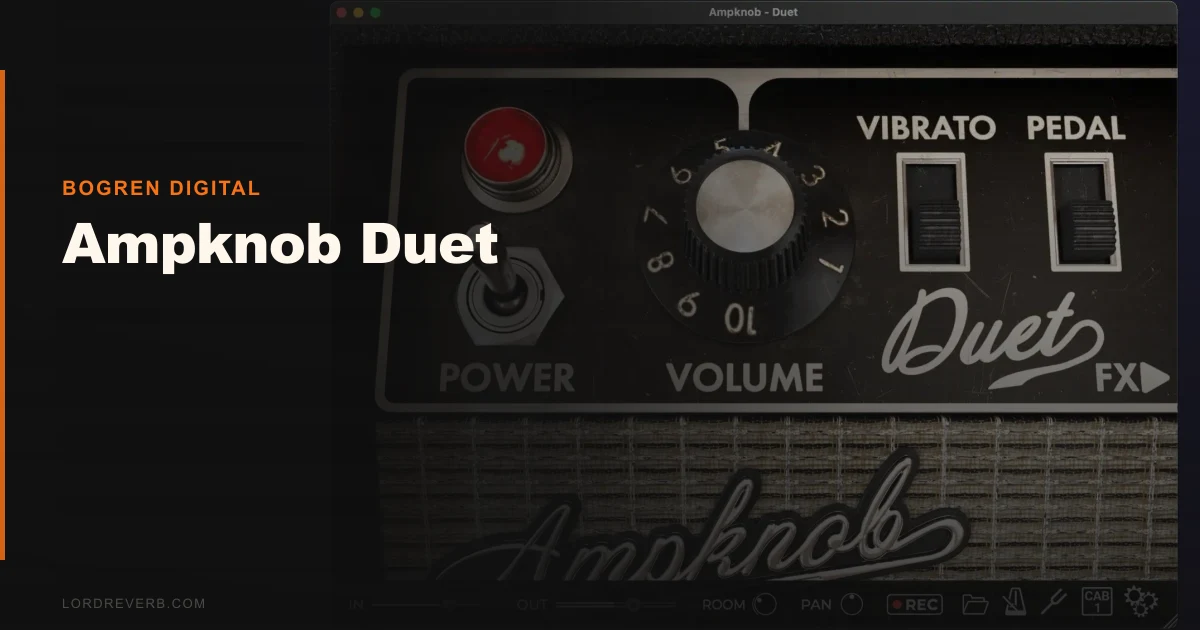
The Ampknob Duet is a $49 clean amp simulator from Bogren Digital that earns its price on tone alone, and if you need a pedal-platform plugin that doesn't fight your signal chain, this is the one to load first.
Jens Bogren built the Duet around one idea: load it, play, and have a finished sound. That's not marketing copy. We tested it against our usual workflow of stacking three or four plugins to get a usable clean tone, and the Duet legitimately short-circuited that process. One plugin. Done.
The $49 price sits at the low end of the serious amp sim market. A 20% introductory discount is currently running, and bundling with any other Ampknob title brings the per-plugin cost down further: three plugins for $98. That math works.
This review is for producers and guitarists who want a convincing clean amp tone in the box without spending an afternoon tweaking IR loaders. It's also for anyone building a pedalboard signal chain inside their DAW.
What You're Actually Getting
The Duet models a 1960s-style clean amplifier. Think the kind of headroom that lets a Stratocaster cut through without the signal hardening and compressing under your fingers. The IRDX speaker dynamics technology is Bogren Digital's proprietary system for replicating how a real speaker cabinet behaves as volume increases and playing dynamics shift.
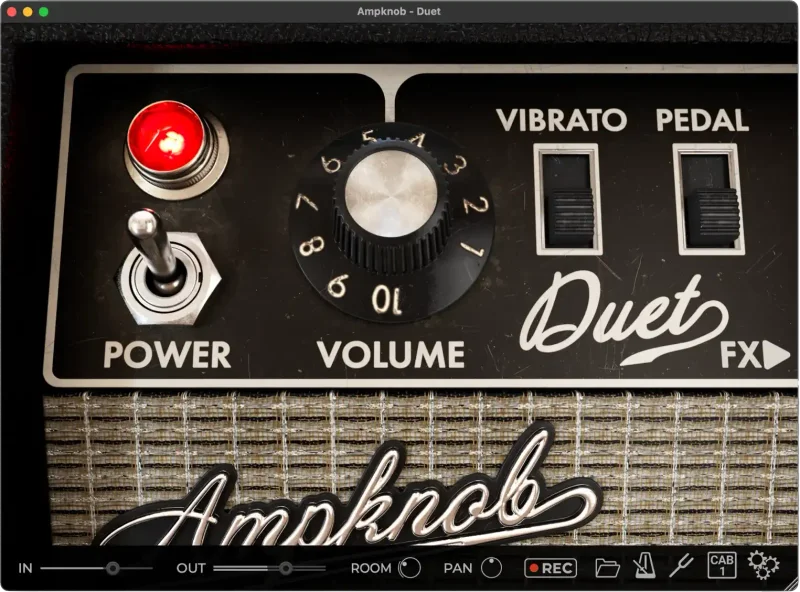
You get three cabinet options: the matched cabinet voiced for the amp model, plus two alternative voicings with different frequency characters. Built-in effects include spring reverb, a tube-bias-inspired tremolo, and a Room control that blends spatial ambience into the signal.
It runs as VST3, AU, AAX, and Standalone on both macOS and Windows. The standalone mode is genuinely useful for live practice. No dongle, no iLok dependency mentioned in the current spec sheet.
The Good
We dropped the Duet onto a clean guitar track that had been sitting half-finished for two weeks. The previous setup: a free IR loader, a third-party cabinet IR, and a vintage EQ emulation to pull out the harshness. Three plugins, fifteen minutes of tweaking, still not right.
We swapped all of that for the Duet. Loaded the matched cabinet. Hit play. The tone sat in the mix immediately, with detail in the upper mids around 3kHz that made chord voicings readable without sounding brittle. That was satisfying in the way that good gear should be satisfying: it just worked.
The spring reverb adds a convincing slapback quality at short decay settings. We ran it against a hardware spring tank reference on a surf-style guitar part, and while the Duet doesn't perfectly replicate the mechanical droop of a real spring, it gets close enough that you'd have to be looking for the difference.
The tremolo is the standout effect for us. The tube-bias character means the effect doesn't chop the signal like an LFO. It breathes. We set the rate at a slow 2Hz, pushed the depth to about 60%, and it felt like a vintage amp pulsing rather than a gate opening and closing. That's a real distinction.
The Room control is a clever addition for producers working ITB who want the amp to sound placed in a space rather than pasted onto a track. Small amounts, under 30%, add dimension without sounding like a separate reverb plugin is running.
The Not-So-Good
The biggest frustration: you cannot push the Duet into controlled breakup. The clean tone philosophy is the whole product. If you want grit, you're reaching for a pedal plugin before the Duet in your signal chain. That's not a flaw in isolation. It's a design choice. But it means this plugin has a ceiling.
Three cabinet options is underwhelming. Competitors running IR-based cabinets let you load any IR file you want. The Duet's three voicings are good, but you're locked to them. If none of the three fits your source guitar or song context, you're stuck.
The CPU load situation is annoying. Bogren Digital doesn't publish benchmark data. We ran the plugin in Logic Pro on an M3 MacBook Pro and didn't hit any performance issues, but we can't give you a number. In 2026, not publishing CPU load data is a decision that reads as avoiding a comparison.
No trial version is currently listed on the product page. $49 is not a huge risk, but a demo would remove the friction entirely.
Compared to the Alternatives
The Nembrini Audio BG Extasy Clean is the closest competitor in this price range. It runs around the same price point, has more exposed controls, and lets you dial in gain staging more precisely. If you want hands-on tweakability, that's the better tool. If you want to load and record, the Duet wins.
The LePou Amp Suite is free and covers a wide range of amp characters, but the clean tones require IR loading and some setup time. The Duet beats it on out-of-the-box usability by a wide margin. LePou wins on cost and flexibility.
Neural DSP's Archetype series starts around $99 per plugin and delivers more complete amp ecosystems with dist
ortion, clean, and extensive effects. The Duet doesn’t try to compete there. It’s a specialist tool at half the price of a generalist.
For $49, the Duet occupies a specific slot: premium clean tone, minimal setup, built-in effects. Nothing else in this price range packages those three things together this cleanly.
Who Should Buy This
✅ Buy if you record clean guitar parts regularly and lose time dialing in usable tones from scratch.
✅ Buy if you're building a virtual pedalboard rig and need a clean amp platform that won't colour your pedal plugins.
✅ Buy if you produce jazz, surf, blues, or indie and need the 1960s clean amp character without owning a vintage amp or a good room to mic it in.
❌ Skip if you need amp overdrive and breakup built into the same plugin. The Duet won't give you that.
❌ Skip if IR flexibility matters to you. Three cabinets is not enough for producers who swap IRs constantly.
❌ Skip if you're on a tight CPU budget and need documented benchmarks before committing. That data isn't available yet.
Score Breakdown
| Category | Score | Notes |
|---|---|---|
| Sound Quality | 4.5/5 | The IRDX speaker dynamics and pre-engineered tone are the real deal; the spring reverb and tremolo are better than most bundled effects |
| Value for Money | 4.0/5 | $49 for this quality of clean tone is genuinely strong value; the bundle pricing makes it better |
| Ease of Use | 4.5/5 | Loads ready to use; the Room control and built-in effects keep the interface uncluttered |
| Features | 3.5/5 | Three cabinets and no gain staging flexibility hold it back; the effects suite is well-chosen but limited |
| CPU Efficiency | 3.0/5 | No published benchmarks; performed fine on M3 hardware but we can't rate what we can't measure |
| Overall | 4.2/5 | A specialist clean amp plugin that does its one job better than most competitors at this price |
Alternatives to Consider
Nembrini Audio BG Extasy Clean: More exposed controls, better for producers who want hands-on gain staging. Check the manufacturer's site for current pricing. Read our Nembrini Audio roundup
LePou Amp Suite: Free, flexible, covers more amp characters, but requires an IR loader and more setup time. The Duet beats it on immediacy. LePou Amp Suite full review
Neural DSP Archetype series: More complete amp ecosystems with distortion and clean channels, extensive effects, around $99 per plugin. Worth it if you want one plugin to cover all your amp needs. Best Neural DSP plugins
The Duet is $49 and does one thing well. Load it if that thing is clean tone. Load something else if it isn't.
We'd buy this again. We wouldn't recommend it to someone who needs overdrive, and we'd warn anyone on a CPU-limited machine to test carefully since the benchmark data simply doesn't exist yet. But for a clean pedal platform that sounds finished the moment it loads, there's nothing in this price range we'd reach for first.
Frequently Asked Questions
What amp does the Ampknob Duet model?
Bogren Digital describes the Duet as inspired by a 1960s clean amplifier character, prioritising headroom and clarity over colour. The company doesn't name a specific amp model. The tone leans toward the crystalline, low-compression clean that players associate with vintage American and British clean channels from that era.
Can you use the Ampknob Duet as a pedal platform?
Yes, and this is one of its strongest use cases. Place it after your fuzz, overdrive, compression, or clean boost plugins in your signal chain and it behaves like a clean amp responding to whatever hits it. Because the Duet doesn't add its own distortion or colouration, your pedal plugins' character comes through clearly. It's a good pairing with fuzz plugins that can get congested through amp sims with heavier mid-range voicings.
Does the Ampknob Duet work with third-party impulse responses?
No. The Duet's three cabinet options are fixed within the plugin. There's no IR loader built in, and the plugin doesn't accept third-party IR files. If you need IR flexibility, you'd need a separate IR loader plugin in your signal chain after the Duet's preamp stage, which somewhat defeats the simplicity the plugin is designed around.
Is the Ampknob Duet worth buying at full price without a trial?
At $49, the financial risk is low relative to what you get. The 20% introductory discount currently running brings it closer to $39. If the clean-platform use case fits your workflow, the price is easy to justify. If you're uncertain, watch Bogren Digital's own demo content carefully before buying, since no official trial is currently available.