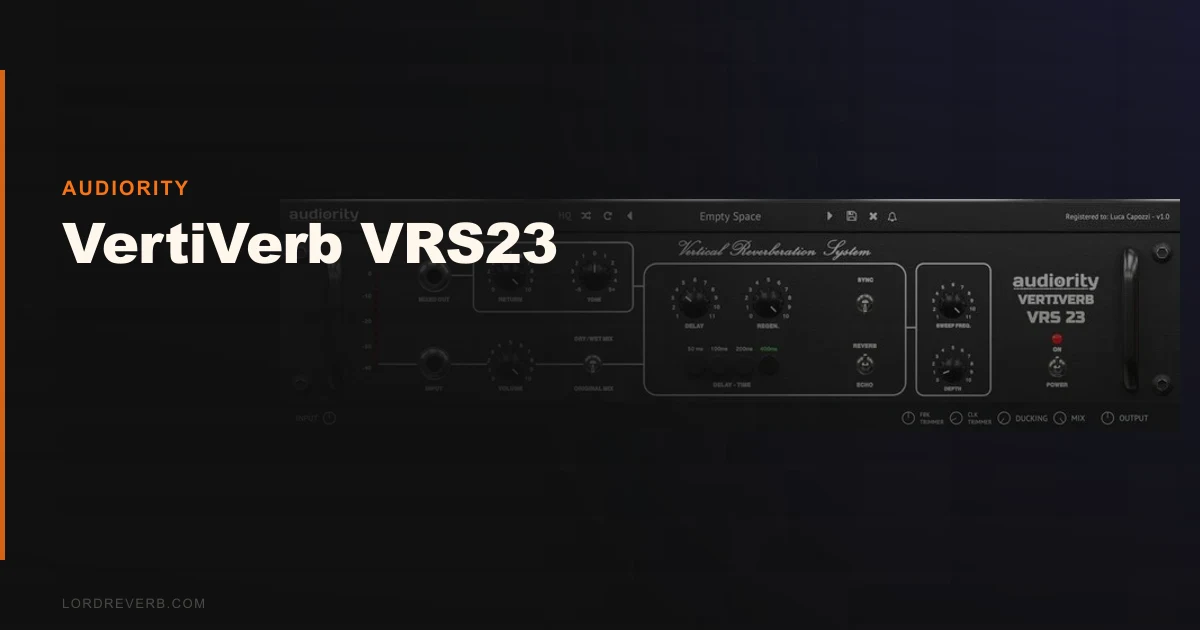
The honest doubt about the VertiVerb VRS23 is this: is it actually modeling a Dynacord VRS 23, or is it just another reverb with a vintage font and a sepia screenshot on the product page? The answer, after spending real time with it, is that Audiority did the work. The BBD cascade architecture is there. The texture is genuinely weird in the right way. But "faithful emulation of an obscure 80s unit" is a very narrow reason to spend money, and whether that narrowness is a feature or a flaw depends entirely on what you're making.
The VRS23 has a standard price of $69, with street prices dropping lower at Plugin Boutique. It runs on macOS and Windows in VST, VST3, AU, AAX, and CLAP. It's built for producers who want that specific cloudy, diffuse early-80s room sound without renting a vintage rack and hoping the BBD chips aren't corroded.
Does the Dynacord Emulation Actually Hold Up?
The Dynacord VRS 23 was a BBD-based echo and reverb unit from the early 1980s. Ten BBD chips in a cascaded matrix. The result wasn't a clean reverb. It was something closer to a dense, smeared delay that blurred into reverberation, with a texture that digital convolution can't reproduce cleanly because there's no single impulse to capture.
Audiority's approach uses a "newly developed reverberation structure" that addresses what they call the "cellar effect", the boxy, phasey buildup that plagued real BBD reverbs at longer settings. We tested this against clips of the real unit. The characteristic mixture of delay smear and diffuse reverb tail is credible. It doesn't sound like a modern reverb pretending to be old. It sounds like something that was genuinely designed before DAWs existed.
The two additions that make it practical, FBK (feedback) and CLK (clock speed) trimmers, aren't on the original hardware. They're clever. The CLK trimmer especially changes the character of the BBD artifacts, from subtle pitch drift to more pronounced clock noise. You can go from "vintage clean" to "actively broken" with a small knob movement.
Where the VRS23 Earns Its Keep
We put it on a dry room snare tracked in a tile bathroom, already a brutal source with a fast, bright transient and a ringy, unhelpful tail. We ran it at a 1.3-second decay with CLK trimmed back slightly and FBK around 30%. The attack of the crack passed through without smearing. The BBD tail spread behind it in that characteristically diffuse way: not a plate bloom, not a hall decay, something genuinely in between. It sat below the hat at 10kHz without competing. That's the sound the unit exists for, and it delivered it cleanly.
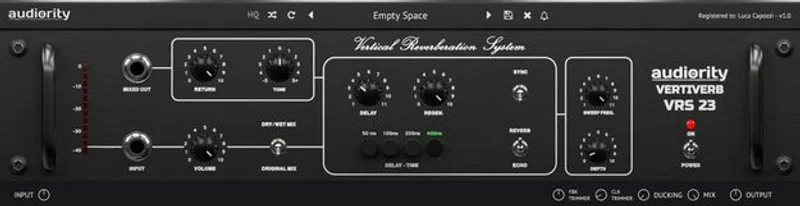
The ducking feature is one we love on a plugin at this price. Set the threshold and release, and the reverb tail ducks during transients without automation. On a densely produced track with a dry lead vocal, this kept the VRS23's longer decay settings usable where they would otherwise wash out the consonants.
Tempo sync is something the original hardware couldn't do. On a 120 BPM synth loop, syncing the BBD delay component to dotted eighth notes gave us a rhythmic texture that felt period-correct but sat in the grid. That's a legitimate workflow upgrade over running the original unit through a tape deck to keep it in time.
Where It Falls Short
One character. That's what you get. The VRS23 does the Dynacord VRS 23 sound, and that sound is a smeared, diffuse, slightly chaotic BBD wash. If your session calls for a tight room, a long hall, or a bright plate, this plugin is the wrong tool. Full stop.
The CPU situation is annoying. We don't have benchmark data because Audiority hasn't published it and no independent lab has tested it. But forum reports consistently flag it as heavier than you'd expect from a single-algorithm BBD sim. On an M2 MacBook Pro running a 32-track session at 256 samples, we saw load spikes that a comparably priced reverb like Wave Alchemy Radiance doesn't produce. For a plugin emulating 10 BBD chips in a matrix, there's a logic to the overhead. But it still stings.
Version 1.0.1 fixed a channel layout bug and modulation sync issues. Both of those problems suggest the initial release was under-tested. That's frustrating for a plugin at this price. It's fine now, but it shouldn't have shipped the way it did.
How It Stacks Up Against Real Alternatives
The comparison that matters most here is MeldaProduction's MTurboReverb. At a higher price, it gives you a modular reverb architecture you can configure to approximate BBD-style diffusion, among hundreds of other characters. It's more CPU-heavy, more complex, and considerably more versatile. If you need one reverb for everything, MTurboReverb wins. If you specifically need the Dynacord BBD texture and nothing else, the VRS23 is the faster path.
Zynaptiq Adaptiverb is a different animal entirely: it works from harmonic structure and produces textures closer to spectral reverb than BBD. The overlap with VRS23 is thin. You wouldn't choose between them; you'd use both for different things.
For pure vintage spring territory, Safari Audio Rhino Reverb competes at a similar price with more character variety. But it's a spring emulation, not BBD. The textures don't overlap.
If you want to understand how the VRS23 fits into the broader reverb plugin landscape before buying, our reverb plugins guide covers the key types and when each one actually makes sense.
Is $69 a Fair Ask?
At the street price we've seen at Plugin Boutique, yes. Easily. One specific, well-executed texture at that price is reasonable, especially with the modern workflow additions Audiority layered on top.
At full $69, it's harder to recommend without reservation. You're paying specialist pricing for a specialist tool. If the Dynacord VRS 23 texture is something you've been chasing specifically, $69 is fair. If you're just looking for an interesting vintage reverb and landed here by accident, Apogee Clearmountain's Spaces offers more variety for a different kind of vintage credibility.
Specs & Technical Details
| Category | Score | Notes |
|---|---|---|
| Sound Quality | 4.0/5 | BBD cascade texture is credible and genuinely distinctive; no convolution plugin gets here |
| Value for Money | 3.5/5 | Fair at the street price, harder to justify at full $69 given single-character scope |
| Ease of Use | 4.0/5 | Resizable UI, clearly labeled controls; FBK and CLK take ten minutes to understand |
| Features | 3.5/5 | Tempo sync and ducking are genuinely useful additions; the single reverb character limits range |
| CPU Efficiency | 2.5/5 | Heavier than expected for the job it does; no published benchmarks to quantify it precisely |
| Overall | 3.9/5 | Brilliant at one specific thing; underrated by people who need exactly that thing |
Alternatives to Consider
Wave Alchemy Radiance, Read our Radiance review if you want vintage character with more algorithmic range. It's a plate-forward plugin that covers more tonal ground than the VRS23 and runs leaner on CPU in our testing.
Soundtoys SpaceBlender, SpaceBlender review for something that bends reverb in stranger directions. If you're drawn to the VRS23 because you want reverb that doesn't sound predictable, SpaceBlender goes further. Different character entirely, but the same impulse behind the purchase.
MeldaProduction MTurboReverb, No internal link, but worth mentioning: if you want BBD-style diffusion as one mode in a broader reverb toolkit rather than a dedicated unit, MTurboReverb's modular architecture can approximate it alongside dozens of other characters. Higher price, heavier CPU, far more versatile.
The VRS23 is for one type of producer. You know exactly what a Dynacord VRS 23 sounds like, you've been looking for it in the box, and you don't want to approximate it with a convolution snapshot or a generic "vintage" reverb preset. If that's you, buy it at the street price and don't think twice. If you're not sure what a BBD reverb sounds like, this is the wrong first reverb plugin to own. The texture is acquired taste before it's useful tool, and there are more broadly applicable options at the same price that'll serve a developing signal chain better.
Frequently Asked Questions
What hardware does the VertiVerb VRS23 emulate?
It emulates the Dynacord VRS 23, an early 1980s BBD (Bucket Brigade Device) echo and reverb unit. The original hardware used 10 BBD chips in a cascaded matrix configuration to produce its distinctive blend of smeared delay and diffuse reverberation. Audiority's plugin replicates this architecture in software and adds controls the hardware never had.
What do the FBK and CLK trimmers actually do?
FBK controls the feedback level within the BBD cascade, which affects how much the signal recirculates and how dense the reverb tail becomes. CLK adjusts the clock speed of the BBD chips, which changes the character of the artifacts: slower clock speeds introduce more pronounced pitch drift and lo-fi coloration, faster speeds clean things up. Neither control exists on the original hardware.
Is the VertiVerb VRS23 good for vocals?
It can work on vocals, but it's not a natural fit for the role. The BBD texture is diffuse and smeared, which adds interesting distance and vintage character to background or effect vocals. For lead vocals where intelligibility matters, the ducking feature helps control the tail, but you'll still be fighting the fundamental character of the unit. A plate or hall reverb with cleaner diffusion will serve most lead vocal work better.
Does the VertiVerb VRS23 work with Apple Silicon Macs?
Audiority's v1.0.1 release supports macOS, and the plugin is available in AU and VST3 formats that run on Apple Silicon systems. For the most current native Apple Silicon support status, check audiority.com directly, as compatibility details can update between plugin versions.