
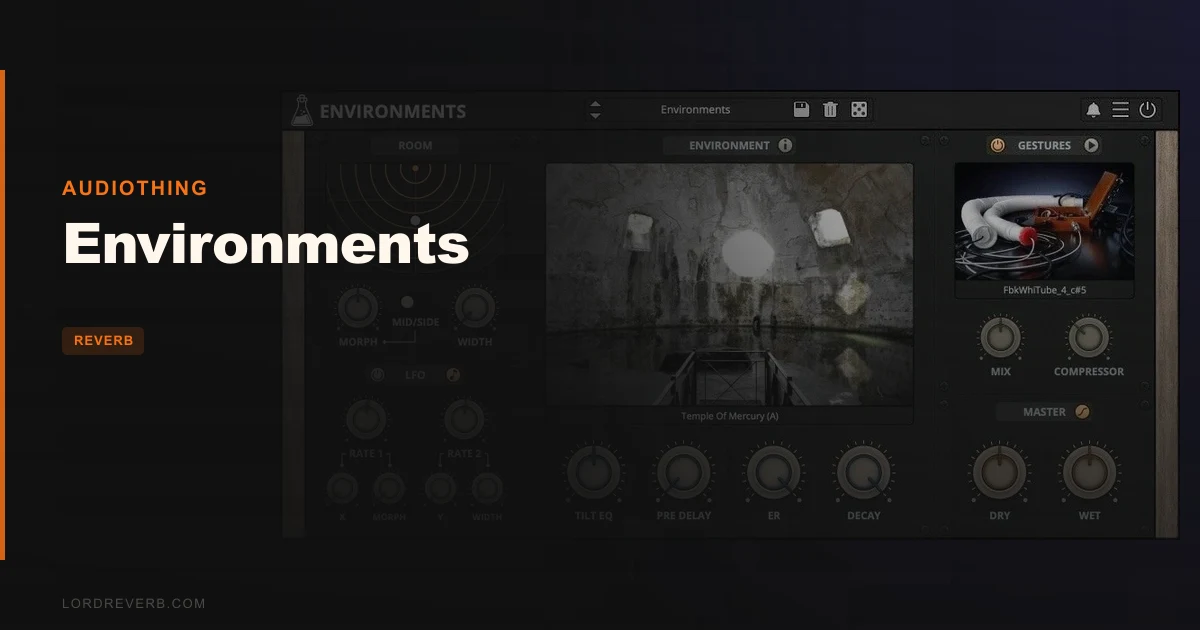
AudioThing Environments is a convolution reverb plugin built around three real architectural spaces, a 1st-century Roman dome, a massive ancient cistern, and a 19th-century Neoclassical water reservoir, and it's one of the most sonically honest reverbs we've tested at the $69 price point. It's built for ambient, cinematic, and experimental producers who want acoustic character that no algorithm can synthesise from scratch.
We had it loaded on a drone session at around 2 a.m. A single sustaining cello note fed through the Piscina Mirabilis at position 2, decay pushed long. What came back wasn't a clean tail. It was a cathedral breathing. The low-mids swelled between roughly 200Hz and 400Hz in a way that felt architectural, like the room was made of stone because it literally was. That's not a preset. That's a cistern built to hold 12,600 cubic metres of water.
If you need a workhorse reverb for every session, look at something else. If you want a specific kind of impossible-to-fake spatial depth, keep reading.
An Instrument Built From Places, Not Algorithms
Environments isn't a traditional reverb in the plug-in-and-forget sense. It's built from real places with unique sonic identities, turning reverberation into something living and explorable rather than fixed and static. The environment itself becomes a musical instrument.
At the heart of it is a complex convolution engine that combines multiple impulse responses with different characteristics, giving each space depth and a more lifelike presence. That's the key word: multiple IRs per space, not a single static snapshot.
The feature set includes 3 environments with 2 positions each, a Room Simulator, two LFOs, a Gestures Loader, a preset system with randomizer, and Brightness and Contrast controls. It runs on VST2, VST3, AU, AAX, and CLAP formats across Mac, Windows, and Ubuntu.
What it's not: a mixing utility. Don't buy this expecting to dial in a tight plate on a snare or a quick small room for a rock vocal. That's not the job. The spaces here are enormous, historically significant, and deliberately unusual. Wrong tool = wrong result.
Living With It: Three Spaces, Six Positions, Infinite Patience Required
The three spaces are the Temple of Mercury, the Piscina Mirabilis, and the Cisternone. Each has two selectable positions. Six total starting points. That sounds thin on paper, and honestly, it sometimes is.
The Temple of Mercury, located in Baia near Naples, is a 1st-century BC Roman thermal hall famously known as "The Echo Temple." Its exceptional acoustics come from a perfect hemispherical shape, even a whisper on one side can be heard clearly on the other, sounds bouncing off the curved walls and creating a haunting atmosphere. You hear this immediately. A short percussive hit becomes spectral. Satisfying in a way we didn't expect from a plugin at $69.
The Piscina Mirabilis measures 72m in length, 25m in width, and 15m in height, with a capacity of approximately 12,600 cubic metres. It served as the terminal reservoir for the Aqua Augusta aqueduct, supplying the Imperial Roman Navy at nearby Misenum. That physical scale is audible. Low frequencies bloom below 120Hz in a way that forces you to high-pass your source material aggressively, 80Hz or lower, or your mix turns to mud inside seconds.
The Gestures layer is where things get weird and brilliant. Gestures adds an extra convolution layer built from sounds gathered during the exploration of each place, using resonant objects, actions, and feedback-driven gestures captured on site. This layer introduces the possibility of shaping the space in real time, with sonic bands that continuously evolve and are never exactly the same, driven by subtle and unpredictable feedback variations.
We ran a sparse synth pad through Gestures at around 40% mix and watched the spectrum analyser. Every 8-12 bars, the upper partials shifted. Nothing repeated exactly. That kind of slow, organic modulation over minutes rather than beats is what ambient music actually needs, and it's baked in here without needing a separate modulator in your signal chain.
The two LFOs work on the room parameters and can be set to move glacially, we're talking mod depths that take 16+ bars to complete a cycle. Through the Room section, you can move within each captured environment and reshape its character, while modulation adds further motion and subtle variation over time. It's not hands-off: you'll want to spend real time dialling those LFO rates. The presets are a useful starting point, but the randomiser is more fun than it is practical.
One annoying quirk: the Gestures loader takes a few seconds to respond when switching between gesture sets. On a low-latency session with live input monitoring, that pause is frustrating enough to disrupt flow. Not a dealbreaker, but worth knowing before your first live performance use.
The Trade-Offs
The core tension with Environments is depth vs. breadth. The three acoustic spaces are genuinely extraordinary. These are not ordinary rooms, but remarkable architectural environments chosen for their exceptional acoustics, historical character, and sonic individuality. We believe that completely. But six positions across three environments is a limited palette for $69 when convolution plugins like Liquidsonics' Reverberate 3 ship with hundreds of IRs.
You're paying for curation and context, not quantity. That's a legitimate artistic choice. It's just not the right choice for every producer.
The convolution architecture also means latency. You can't use this on a real-time signal chain during tracking unless your buffer is set low and your CPU can handle it. We tested at 128 samples: audible but workable. At 64 samples: fine, light CPU load. This isn't a CPU-hungry plugin. It runs lean.
The system requirement is modest: 2GHz CPU and 4GB RAM on either Windows 7-11 or macOS 10.13 through macOS 26. CLAP support is genuinely useful, and Universal 2 Binary on Mac keeps Apple Silicon users happy without Rosetta overhead.
The Brightness and Contrast controls are a clever shortcut for EQ-shaping the tail without opening a separate equaliser. Brightness rolls off the high-frequency content of the reverb above a fixed shelf point; Contrast affects the density gradient of early vs. late reflections. It's not surgical, but it means you can get the Piscina Mirabilis sitting in a busier mix without a separate EQ plugin burning CPU on your reverb bus.
Against the Field
For architectural convolution specifically, the closest competition is Numeric Audio's Altiverb 7 and Impulse Record's IR libraries. Altiverb has a far larger IR library and better space-browsing UI, but it costs significantly more. Environments wins on depth of modulation and the Gestures layer. Altiverb wins on pure IR variety.
For ambient-first reverb in the same price bracket, check out our take on Sonible pure:verb, which handles dense pad stacks with less low-end buildup. Pure:verb is algorithmic, not convolution, which means it's more flexible for mix-utility duties but less authentic in the acoustic-space sense.
For weird, experimental reverb character, Safari Audio's Hippie Elephant goes further down the sonic rabbit hole and costs less. Hippie Elephant wins for pure strangeness. Environments wins for structural credibility: the spaces here are documentable historical architecture, not invented rooms.
If you want a more traditional reverb to round out your signal chain, Apogee Clearmountain's Spaces handles studio-standard ambience. Different job entirely.
For budget producers building an ambient workflow, Vital's free tier covers evolving pads and complex LFO modulation. Pair it with Environments on a dedicated reverb bus send and you've got a hybrid workflow that punches well above its cost. Environments doesn't need to be your only tool. It's a specialist layer, not a foundation.
The Real Verdict
We'd buy Environments at $69. It does something no free option or stock reverb can do: it puts provably real, historically significant acoustic spaces in your signal chain with living modulation baked in.
Skip it if you need a Swiss-army reverb for everyday sessions. Six positions is a short menu. Skip it if you track live in real-time with monitoring sensitivity, because convolution latency will frustrate you.
Buy it if ambient, cinematic, or experimental music is your primary output. For producers building a complete reverb toolkit, this belongs on the specialist shelf alongside your algorithmic workhorse, not replacing it.
Score Breakdown
| Category | Score | Notes |
|---|---|---|
| Sound Quality | 4.5/5 | Real architecture captured with multi-IR depth; genuinely hard to replicate |
| Value for Money | 4.0/5 | $69 is fair for this concept, but only 6 positions total keeps it from a higher score |
| Ease of Use | 4.0/5 | Clean UI; Gestures loader delay is annoying on first encounters |
| Features | 3.5/5 | Two LFOs and Gestures layer are clever, but the environment count is thin |
| CPU Efficiency | 4.5/5 | Runs lean even at 64-sample buffers; no complaints |
| Overall | 4.2/5 | A specialist tool that earns its keep in the right workflow |
Alternatives to Consider
Liquidsonics Reverberate 3, If you want convolution with hundreds of IR slots and deep morphing controls, Reverberate 3 is the go-to. More flexible, less curated. The current price is shown in the buy box on this page.
Sonible pure:verb, Algorithmic, mix-friendly, great for dense material where architectural reverb would swamp the low end. Read our full pure:verb review for the detailed breakdown.
Safari Audio Hippie Elephant, Cheaper, stranger, more experimental. Our Hippie Elephant review explains exactly where it wins. Less historically grounded, more sonically unpredictable.
Apogee Clearmountain's Spaces, For studio-standard reverb on everyday mix duties. See our Clearmountain's Spaces review if your priority is a professional mix workhorse rather than a spatial instrument.
Environments sits in a category with almost no direct competition at $69. That's the honest case for it. If the three spaces resonate with the music you make, there's nothing else quite like this in the plugin world at this price.
Buy it for the Piscina Mirabilis alone. Stay for the Gestures.
Frequently Asked Questions
Is Environments good for everyday mixing tasks like drums and vocals?
Not really. Environments is built around three large, historically significant architectural spaces with very long, complex tails. It suits ambient pads, drones, cinematic elements, and experimental sound design. For tight drum rooms, plate reverb on vocals, or quick mix utility, you'll want an algorithmic reverb alongside it. Think of Environments as a specialist layer on a dedicated send bus, not a session-to-session workhorse.
How many reverb spaces does Environments include?
Three environments: the Temple of Mercury (a 1st-century Roman dome near Naples), the Piscina Mirabilis (a massive Roman cistern in Bacoli), and the Cisternone of Livorno (a 19th-century Neoclassical water reservoir). Each has two selectable positions, giving six total starting points. The Gestures layer adds further variation within each environment, making each instance of the plugin sonically non-identical.
Does Environments work on Apple Silicon Macs without Rosetta?
Yes. AudioThing built Environments as a Universal 2 Binary, so it runs natively on Apple Silicon without Rosetta 2 translation. It supports macOS 10.13 through macOS 26 and is available in AU, VST2, VST3, AAX, and CLAP formats. CPU load at native ARM performance is light.
Can I try Environments before buying?
Yes, a free trial is available directly through the AudioThing website and via Plugin Boutique. Activation uses an AudioThing account with either an online login or an offline license file. We'd strongly recommend using the trial on a real session with your own source material before committing, since the plugin's value depends heavily on whether its specific spaces suit what you make.