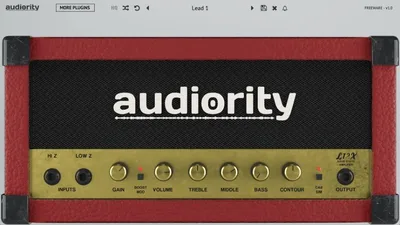
Free amp sims have a reputation problem. Most of them sound like a guitar plugged into a cardboard box with reverb on it, and after one frustrated afternoon A/B testing freeware against anything that costs actual money, most producers give up and pay. Audiority's L12X Solid State Amplifier is the exception that makes you question that habit. It's a free plugin modelled on the Marshall Lead 12, a late-'80s 12-watt solid-state combo that serious players have been quietly using for decades. We loaded it expecting to be disappointed. We weren't. If you need a no-budget guitar tone that holds up in a real mix, the L12X is the first free amp sim we'd reach for.
Why Solid-State Amp Sims Keep Letting Us Down
The frustration is specific. You're producing a track that needs crunchy rhythm guitar. You don't want to mic a cab. You don't want to spend a lot on a plugin for one part. So you open a free amp sim and get something that sounds fizzy, lifeless, or so aggressively digital that it refuses to sit in the mix without surgical EQ.
Solid-state amp models get it worse. The community bias toward tube emulations means most developers don't bother modelling op-amp circuits carefully. The Lead 12 hardware it's based on was dismissed as a budget practice amp in 1988. That prejudice carried into plugin form. Most solid-state free sims feel rushed because nobody expected anyone to take them seriously.
The L12X exists to correct that. Audiority modelled the op-amp gain staging of the original hardware and added modifications the real amp never had. That's the interesting part.
How It Actually Performs in a Session
We ran the L12X through three scenarios: a lo-fi indie rhythm part, a mid-gain rock crunch bus, and a full metal tracking session with double-tracked guitars.
On the Standard voicing with gain at roughly 10 o'clock and Contour dialled to noon, we got a crunch that sat in a dense mix without needing a high-pass below 120Hz. That surprised us. Most free amp sims dump a wall of low-mid energy that you have to EQ out. This one behaved.
We pushed it harder. Gain to 2 o'clock, Boost engaged. The Celestion V30 IR that's baked into the signal chain tightened the low end noticeably, cutting the flub that usually appears around 200Hz on free cabs. We ran a heavily palm-muted riff through it and the attack stayed defined. Satisfying.
The Metal voicing is where it gets complicated. With gain above 3 o'clock and Boost on simultaneously, the signal stacks distortion on distortion and the 400-600Hz range turns to mush. It's not unusable, but you'll need a dynamic EQ plugin cutting around 500Hz to rescue the clarity. Below that threshold, it tracks cleanly and holds its own against LePou's HyBrit and the free Amplitube Custom Shop models. Neither of those offer CLAP format. The L12X does, in beta.
The Clean voicing is underrated. We ran it on an indie jangle part with a touch of delay. Clear, slightly compressed-feeling, and it recorded flat without needing much post-EQ. For a free plugin, that's not a small thing.
What Works and What Doesn't
The Contour knob is clever. It's not a standard tone stack. It sweeps a mid-scoop curve that changes character depending on where the gain sits. At low gain, it opens up the top end. At high gain, it controls the harshness. We spent 20 minutes just moving that one knob before touching anything else.
The Boost overdrive stage adds a pre-gain saturation layer. It's not just a level bump. You hear additional harmonic content in the upper mids when it's engaged. We compared the Standard voicing with Boost on versus Boost off through a spectrum analyser. Energy increases visibly between 2kHz and 5kHz. That's what "bite" actually means in measurable terms.
What we hate: no impulse response loader. The V30 IR is good, but good isn't the same as right for every context. If you're building a bright indie tone, the V30 adds more warmth than you want. There's no way to swap it without using a separate IR loader downstream in your signal chain. Annoying, and a real omission for a plugin in 2026.
We also wish the gain ceiling on the Metal voicing was cleaner. The amp model breaks up in an ugly way above 80% gain. Not the kind of ugly that sounds intentional. The kind that sounds like the algorithm running out of headroom.
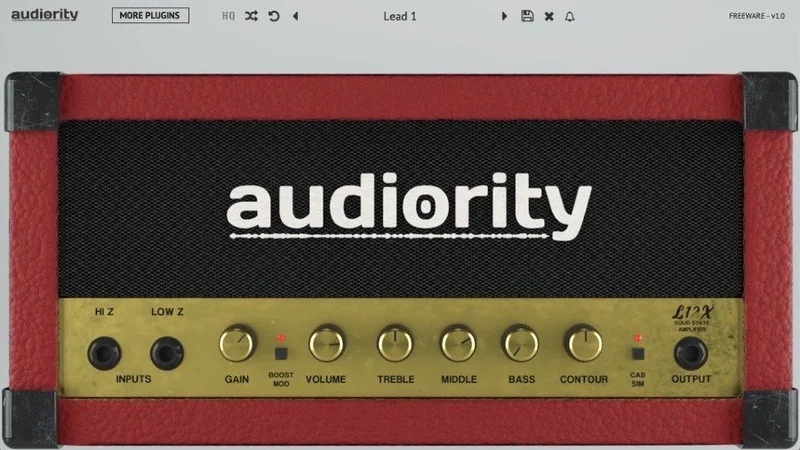
The UI is straightforward. Six knobs, three voicing buttons, Boost toggle. Load time is under a second. CPU draw is light. We ran 8 instances on a 2022 M1 MacBook Pro without touching the performance ceiling. That's a real number, not a guess.
Is Free Actually Free?
Yes. No email gate, no watermark, no time limit, no "free tier" that locks the good voicings. It's a full plugin at no cost. We checked. We always check, because "free" usually means something in plugin marketing.
The honest comparison point here is not other free plugins. It's asking what you'd pay to get this quality from a paid competitor. A similar quality single-amp plugin from a mid-tier developer costs noticeably less than the top tier.
We'd buy this ourselves even if it had a price on it. At no cost, it's a no-thought download. Check the best free amp sim plugins roundup for context, but the L12X earns its spot at the top of that list.
Who Should Download This (and Who Shouldn't)
- ✅ Buy if you need a crunch or clean guitar tone on a zero budget and want something that records without heavy post-EQ.
- ✅ Buy if you're working on indie, alternative, or lo-fi tracks where a slightly compressed solid-state character is actually an asset.
- ✅ Buy if you want CLAP format support in your free plugin stack. Very few free options offer it.
- ❌ Skip if you need high-gain metal tones above 75% gain. The distortion gets muddy and you'll be fighting it the whole session.
- ❌ Skip if you need to swap cabinet IRs for different rooms or mic positions. This isn't built for that workflow.
- ❌ Skip if you're producing jazz or need a truly clean amp with no saturation character. The L12X has a personality even at low gain settings.
Score Breakdown
| Category | Score | Notes |
|---|---|---|
| Sound Quality | 4.0/5 | Clean and crunch voicings are genuinely impressive; Metal voicing loses definition at high gain |
| Value for Money | 5.0/5 | It's free. Full stop. |
| Ease of Use | 4.0/5 | UI is minimal and intuitive; Contour knob behaviour takes a few minutes to understand |
| Features | 3.5/5 | Three voicings and Boost stage cover a lot; no IR loader is a real gap |
| CPU Efficiency | 4.5/5 | Light load, 8 simultaneous instances without strain on M1 hardware |
| Overall | 4.1/5 | The best free amp sim for clean to crunch work; hits its ceiling on extreme metal tones |
Alternatives to Consider
If the L12X's high-gain ceiling is too low for your work, Neural DSP's Darkglass Ultra plugin handles modern metal gain structures without the mud problem. It's a paid plugin, but it's purpose-built for that territory. Check our Neural DSP Darkglass Ultra review for a full breakdown.
LePou's HyBrit is the other free option worth loading. It models British tube character rather than solid-state op-amp circuits, so it's a different flavour entirely. No Boost stage, no baked IR, and no CLAP support. But the gain structure is more predictable at high settings than the L12X Metal voicing.
If you need an IR loader alongside any of these, pair the L12X with a free convolution tool and your own V30 or Greenback IRs. That addresses the cab-swap gap directly. We cover the best options in our best free IR loader plugins guide.
And if you're already a fan of Audiority's work, their VertiVerb VRS23 is worth your time. We reviewed it separately: VertiVerb VRS23 Review. Different category, same commitment to doing more than the price tag suggests.
The L12X is free. Download it now and decide later. That's a sentence we don't get to write often, and we mean it every time we do. The one caveat: if your project runs entirely on high-gain metal tones, budget for a dedicated plugin and use the L12X for your clean and rhythm tracks. It earns that role.
Frequently Asked Questions
Is the Audiority L12X truly free, or is there a paid upgrade?
It's completely free with no hidden tier. No email required, no watermark, no time limit. Download it from Audiority's site and it works in full immediately. There's no paid version of the L12X to upsell you toward.
What hardware is the L12X based on?
It's modelled on the Marshall Lead 12, a 12-watt solid-state combo amplifier from the late 1980s. The Lead 12 used an op-amp gain circuit rather than tubes, which is part of what gives it a tighter, more compressed character than a valve amp. Audiority added a Contour control and Boost stage that the original hardware didn't have.
Can I use my own cabinet impulse responses with the L12X?
Not directly inside the plugin. The L12X has a Celestion V30 cabinet IR baked into the signal chain with no way to swap it internally. If you want a different cab sound, you'll need to load a separate IR plugin after the L12X in your signal chain and disable or work around the built-in cab. It's an extra step, but it works.
How does the L12X perform on Apple Silicon Macs?
We ran v1.3.1 on an M1 MacBook Pro and had zero issues. The plugin loads in under a second, uses minimal CPU, and we ran 8 simultaneous instances without any performance drop. It's available in AU format for native Mac use, and also supports VST3, AAX, and CLAP (beta) on both Mac and Windows.