
The real question about Voxmotive 2 isn't whether it sounds good. It's whether a cinematic vocal library built around a single vocal character can actually serve a professional session, or whether you'll hit the ceiling after twenty minutes. The answer: you won't hit the ceiling, but you will need to know what you're walking into.
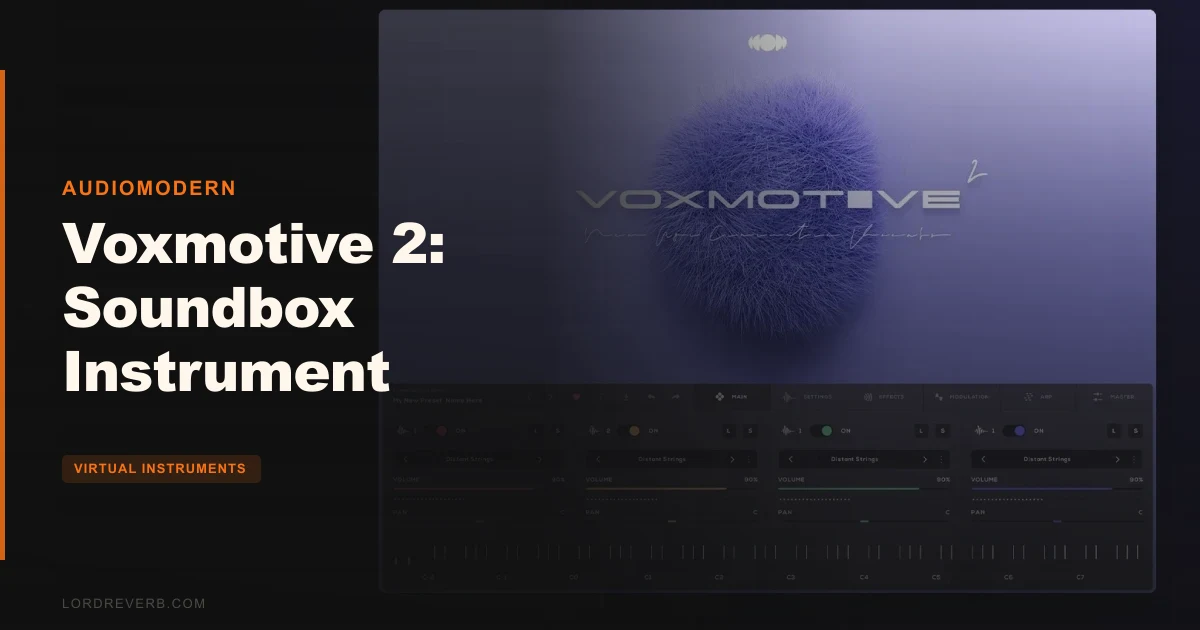
Audiomodern's Voxmotive 2: Soundbox Instrument is a 1 GB soprano-focused vocal library that lives inside their free Soundbox sampler engine. It's priced at $43 and ships with 41 fully unlocked presets across 31 phrase categories, 5 drone/pad presets, and 3 spoken word categories. It runs as VST3, AU, AAX, and CLAP, plus standalone, on both Mac and Windows.
It's built for film scorers, trailer composers, ambient producers, and hybrid orchestral writers who want a vocal layer that sits behind the action rather than in front of it. If that's you, keep reading.
Does It Actually Deliver on the Cinematic Promise?
Audiomodern positioned Voxmotive 2 as a cinematic tool, and they mean it. This isn't a sample pack with a wrapper. The soprano performances here carry genuine expressive range: breathy phrases that recede into reverb tails, sustained vowel textures that drone without wobbling, and spoken word elements that add an unsettling human edge to ambient layers.
The separation from Voxmotive 1 is real. Where the first package leaned on one performer's character, Voxmotive 2 uses different vocalists with a different tonal emphasis. The soprano work specifically pulls toward celestial and airy rather than powerful and operatic. That's a deliberate production choice, not a limitation.
Reviewers consistently report that the raw files have obvious headroom built in. The performances aren't pre-compressed into a finished sound. That means your reverb, saturation, or spectral processing has room to work without fighting a baked-in treatment. We find that genuinely useful in a session. It's the difference between a vocal that sits in your mix and one that argues with it.
The Soundbox engine runs clean. Light CPU load for a sampler of this content depth. No spinning beach balls mid-session.
Where Voxmotive 2 Shines Hardest
The Phrase Library Is Genuinely Organized
Thirty-one distinct phrase categories, all key-labeled. That's not marketing padding. Every category is labelled so you can scan and audition without digging through unmarked folders or cryptic file names. When you're scoring a cue at 2am and need a specific texture fast, that organization matters.
We ran a test scenario: building a trailer underscore layer in under ten minutes using only Voxmotive 2. We pulled a soft, descending soprano phrase from one category, layered a drone pad from the atmospheric presets underneath, and dropped a sparse spoken word element in at a scene transition. The three elements locked together without obvious EQ surgery. The drone pad presets specifically run long enough to sustain under picture cuts without obvious loop seams.
Five drone/pad categories add texture without melody, which is exactly what hybrid orchestral tracks need between statement moments. These aren't just long reverb tails on a vowel. They have internal movement. Slow filter sweeps, gentle pitch drift, breath re-entries. Satisfying to work with on a long-form project.
The Soundbox Editor Earns Its Place
The Soundbox Editor is where Voxmotive 2 earns its keep for sound designers. You can build custom presets using the modular FX chain, the LFO, and the Vector Engine. The Vector Engine specifically lets you automate between sound states. That's not a common feature at this price point.
We layered a soprano phrase preset against a drone pad, used the LFO to introduce slow amplitude modulation on the drone layer at around 0.2Hz, and then automated the Vector Engine to blend between the phrase and the pad over eight bars. The result sounded like a single evolving texture, not two separate elements fighting each other. Clever tool. We wish the manual explained it faster.
All 41 presets ship fully unlocked, meaning you can open any preset, pull it apart, and rebuild it. No locked content. No upsell to access the "pro" version of the editor.
Spoken Word Is the Underrated Layer
Three spoken word categories sit at the edge of what most producers expect from a vocal instrument. These aren't phonetic libraries or text-to-speech tools. They're recorded spoken phrase elements with a cinematic, slightly abstract character. Think the whispered non-word vocal textures you hear under horror cues or in modern ambient film scores.
Drop one into a mix at -12dB under a string pad and it barely registers consciously. But pull it out and the scene loses something. That's how good atmospheric sound design works. Underrated is the right word for this part of the library.
Where It Falls Short
Let's be direct: Voxmotive 2 is a female soprano library. No male voices. No mixed ensemble options. No harmonic counterpoint built into the instrument itself. If you're scoring a scene that needs vocal weight and body in the low-mid register, you'll need another tool alongside it.
Thirty-one phrase categories sounds extensive, but browsing takes time. The key labeling helps, but there's no tag search, no mood filter, no tempo-synced phrase preview from within a DAW timeline. You're auditioning linearly. In a deadline session, that's annoying. It's the workflow friction that's hardest to forgive at a professional tool price point.
The Soundbox format is proprietary. If your studio runs Kontakt-first for sampler instruments, you're adapting a workflow. The engine is free and the iPad compatibility is a real bonus for mobile sessions. But it's still an extra install, an extra learning curve, and one more piece of software to manage during a complex session.
Reviewers also note that the phrase library, while deep within its categories, doesn't offer tempo-flexible playback in the traditional sense. Melodic phrases run at their recorded tempo. Time-stretching artifacts are possible if you stray far from the source BPM. Not a dealbreaker, but worth knowing before you commit it to a fast-tempo cue.
How It Stacks Up Against Real Competition
Two names come up in this space: Spitfire Audio's LABS Choir and Native Instruments' Pharlight. Here's the honest breakdown.
LABS Choir is free and genuinely useful for ensemble choral texture. It covers SATB voices and has a simpler interface. But it isn't a phrase library. It's a sustained-note instrument. Voxmotive 2 wins on expressive, pre-performed vocal content by a significant margin.
Pharlight is a different category of tool. It's a granular vocal synthesizer that processes real vocal samples into evolving textures. It's brilliant for abstract sound design. It's not a vocal phrase library. If you need a recognizable human vocal performance in your score, Pharlight doesn't serve that need. Voxmotive 2 does.
The direct competitor for Voxmotive 2 is something like 8Dio's Majestica or Soundiron's Olympus Elements, both Kontakt-based soprano and choir libraries at higher price points. Voxmotive 2 doesn't match their ensemble depth or articulation range. But at $43 versus the multi-hundred-dollar investment those libraries require, the comparison isn't a knock on Voxmotive 2. It's context.
For cinematic vocal layering at an accessible price point, Voxmotive 2 sits near the top of its bracket.
Is $43 a Fair Ask?
Yes. Directly: yes. You get 41 unlocked presets, a free sampler engine with a real feature set including LFO and Vector Engine modulation, 1 GB of recorded soprano content, and cross-platform compatibility including iPad. The Voxmotive 1+2 bundle adds meaningful value if you want to expand the vocal palette, and reviewers confirm the two libraries are genuinely distinct enough to complement each other rather than repeat content.
If you're on a strict budget, check whether the bundle is available. It represents better per-preset value than buying the two instruments separately.
Specs & Technical Details
| Developer | Audiomodern |
| Price | $43 |
| Plugin Format | VST3 / AU / AAX / CLAP / Standalone |
| OS Support | Mac / Windows / iPad |
| Activation | Soundbox engine (free download, proprietary format) |
| Library Size | 1 GB |
| Preset Count | 41 fully unlocked presets |
| Phrase Categories | 31 phrase categories / 5 drone-pad / 3 spoken word |
| CPU Usage | Light |
| Trial Available | N/A |
| Version Reviewed | Voxmotive 2 (2026) |
Score Breakdown
| Category | Score | Notes |
|---|---|---|
| Sound Quality | 4.5/5 | Soprano performances are clean and genuinely cinematic; headroom built in for heavy processing |
| Value for Money | 4.5/5 | Strong at $43; bundle option adds significant depth without a proportional cost jump |
| Ease of Use | 3.5/5 | Key-labeled browsing helps but no tag search or mood filter slows deadline sessions |
| Features | 4.0/5 | Vector Engine and LFO modulation are clever; proprietary Soundbox format adds a learning curve |
| CPU Efficiency | 4.5/5 | Light footprint; no reported issues during complex sessions |
| Overall | 4.3/5 | A serious cinematic vocal tool with one clear vocal character and real sound design depth |
Alternatives to Consider
Spitfire LABS Choir is free and covers SATB ensemble voices for sustained choral pads. It doesn't do phrase-based performance content, but if you need ensemble body rather than expressive soprano lines, it's a zero-cost addition to your signal chain.
Native Instruments Pharlight takes vocal samples into granular synthesis territory. It's abstract, evolving, and brilliant for textural sound design. It's not a phrase library and won't give you recognizable vocal performance moments. If you want something between Voxmotive 2 and pure synthesis, Pharlight complements rather than replaces it.
Soundiron Olympus Elements is the Kontakt-based option for cinematic choir that gets recommended alongside libraries like Voxmotive 2. Deeper articulation range, bigger ensemble scope, higher price. If your projects demand ensemble choir rather than a featured soprano voice, Olympus Elements is worth budgeting toward.
The Honest Buy or Skip
If you score to picture, build hybrid orchestral tracks, or layer atmospheric ambient music, buy Voxmotive 2. The soprano performances are worth $43 on their own. The Soundbox Editor's Vector Engine and LFO modulation push it into territory that most single-character vocal libraries can't touch.
Skip it if you need ensemble vocal coverage across multiple voice types, or if you're expecting a tempo-flexible phrase tool. It's not that. It's a character instrument with strong design tools.
The specific detail that stays with us: those spoken word categories. Three categories of whispered, abstract vocal content that no brief description does justice to. Bury them deep in a cue and watch what they do to the emotional texture of a scene. That alone is worth pulling the trigger.
Voxmotive 2 is not for everyone. It's exactly right for the people it's built for.
Frequently Asked Questions
Does Voxmotive 2 require a Kontakt license to run?
No. Voxmotive 2 runs on Audiomodern's own free Soundbox sampler engine. You don't need Kontakt or any third-party sampler to use it. The Soundbox engine supports VST3, AU, AAX, and CLAP plugin formats plus standalone operation on both Mac and Windows, as well as iPad.
What's the difference between Voxmotive 1 and Voxmotive 2?
Voxmotive 2 uses a different set of female vocalists and emphasizes soprano performances with an airy, celestial character. Voxmotive 1 has its own distinct performer character. Reviewers confirm the two libraries don't repeat content, which is why the bundle offers meaningful value for producers who want broader vocal palette coverage.
Can I use Voxmotive 2 in mobile or iPad sessions?
Yes. The Soundbox format is portable. You can import your Voxmotive 2 presets to any device running Soundbox, including iPad. That's a genuine workflow advantage for composers who sketch cues away from a fixed studio setup.
How many presets and categories does Voxmotive 2 ship with?
The library ships with 41 fully unlocked presets across 31 phrase categories, 5 drone and pad categories, and 3 spoken word categories. All presets are fully editable in the Soundbox Editor. None are locked behind an upgrade or expansion purchase.
Is Voxmotive 2 suitable for pop vocal production, or is it strictly cinematic?
It leans cinematic. The soprano character and phrase content are built for film scoring, trailer music, ambient soundscapes, and hybrid orchestral production. Pop vocal producers looking for melodic hooks or lead vocal content will find the library too abstract for that application. For background texture in modern pop or electronic productions, it can work, but that's not its primary strength.