If you're building a slow-burn soul groove or a smoky late-night jazz bed, Lounge Lizard EP-5 is a strong pick, but whether it's right for you depends on how much you care about the first five seconds of a preset.
It's a modeled electric piano with two engines, one for tine-based sounds and one for reed-based sounds. It costs $199.
That's a fair ask for a plugin that loads instantly and barely touches your CPU. It's also a fair ask for one that has a few rough edges owners keep running into.
Who is it for? Producers who play their parts, care about feel, and want an electric piano they can leave open in a big session. Who isn't it for? Anyone who wants a library to sound finished the moment a preset loads.
Where It Belongs
Think neo-soul, lo-fi hip-hop, jazz trio demos, and anything where the keys sit under a vocal and breathe.
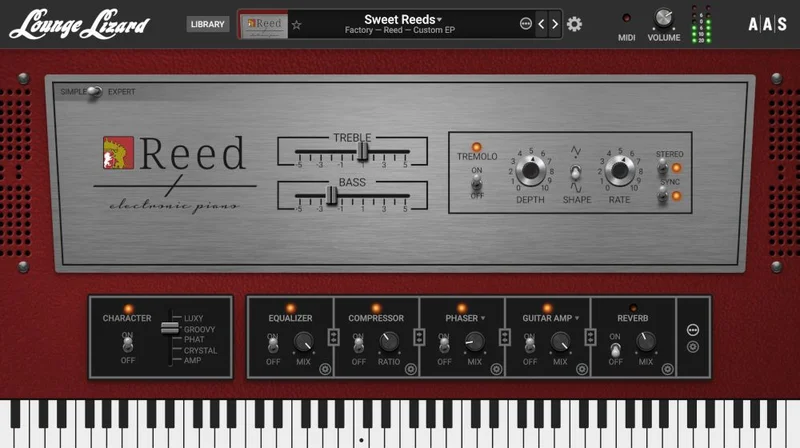
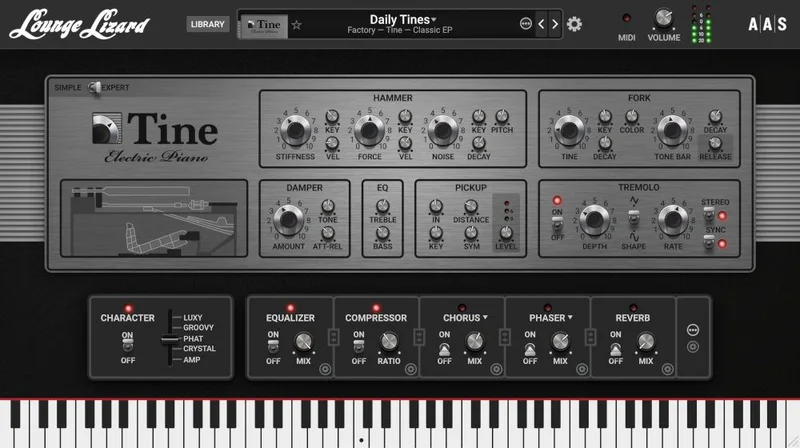
The physical modeling core gives you control over hammer, tine or reed, pickup and damper noise. That's the stuff that makes a part feel played instead of programmed.
Owners describe an organic response to subtle playing and a smooth move between melodic and percussive playing without excessive thump. If you comp chords softly and then dig in for a fill, that's the scenario it was built for.
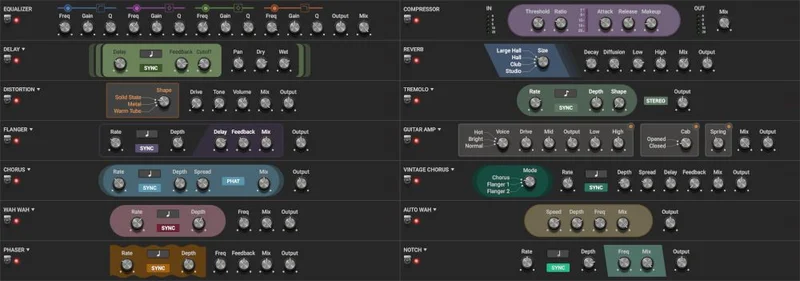
The onboard rack covers the usual suspects: Phaser, Chorus, Tremolo, Wah-Wah, Delay, Reverb, Compressor, Distortion, Flanger, Multi-band Equalizer, Notch, Auto-Wah, plus a Guitar Amplifier that's new this version. You can get a finished-sounding part without opening a single third-party effect.
Where It Doesn't
Skip it if you want one plugin to cover every keyboard on the planet. It does electric pianos, not grands, not upright, not a Wurlitzer-meets-orchestra layer cake.
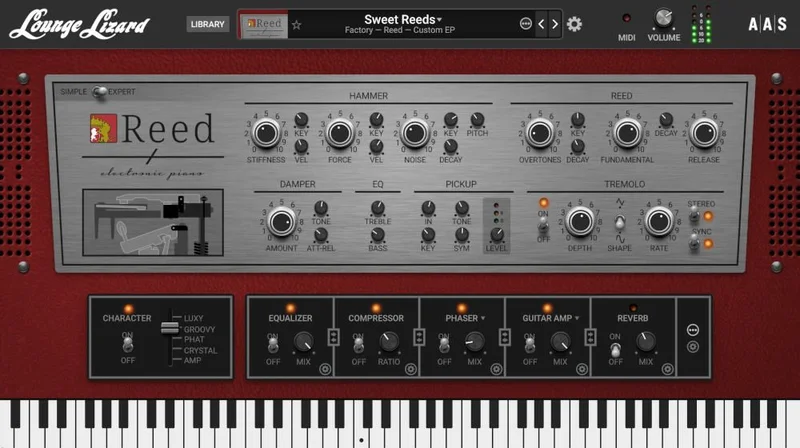
It's also a poor fit for fast, hands-off production. One reviewer found the basic presets sounding artificial and unconvincing compared to a hardware Rhodes. That's a real complaint, and it hits hardest if you scroll presets instead of shaping a sound.
The Outside the Box library is a mixed bag too. Owners call it experimental with uncertain utility. Treat it as a curiosity shelf, not a workhorse.
And if your tracks depend on a velocity curve you can bend to taste, the lack of a visible curve option will annoy you.
How To Use It Well
Play it, don't paste it. Drag a MIDI part in and quantize everything flat, and you'll flatten the exact thing this plugin is good at.
Picture a chord progression for a bridge. Record it live, keep the velocities uneven, and let the soft notes stay soft. If the dynamics feel off, check your controller's own velocity curve first, since the plugin doesn't show you one.
The character slider is the quick tonal lever owners like. It shifts the tone without wrecking the core sound. The character slider may produce audible clicks even when disabled, so automate it carefully and bounce a test pass before you commit.
Sync the effects to your DAW tempo for tremolo and delay, so the movement locks to the groove. If the tremolo shape sounds backwards to you, you're not imagining it. Tremolo shapes can appear switched.
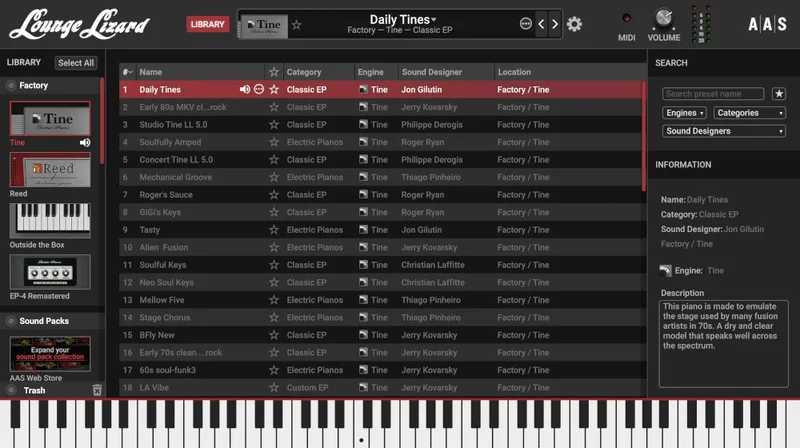
Use the built-in software keyboard to audition sounds when your controller isn't plugged in.
Against the Field
Keyscape is the sample-based heavyweight. It uses 80GB of disk, while this installs in under 33 MB. If you want recorded-instrument realism and have the drive space, Keyscape wins on that front.
Pianoteq is the other modeled approach. It's the closest philosophical match, since both skip big sample libraries for physical modeling.
Acousticsamples V-tines and V-reeds, and Korg EP-1, mix modeling with samples. That hybrid route may suit you better if the pure-model sound feels thin to your ears.
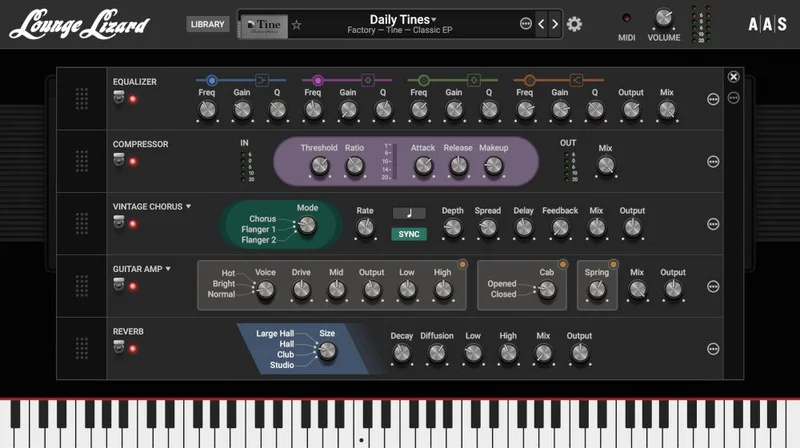
Lounge Lizard wins on footprint and playability. It loses where you want that instant, finished hardware-clone impression.
The Verdict
Buy it if you play your parts, work in big sessions, and want a light electric piano that responds to touch. Wait or look elsewhere if you scroll presets for a ready-made sound, or need an engine switch without reloading patches.
At $199, it's a good fit for players and a questionable one for preset-hunters. We'd give the player a green light and the preset-hunter a firm "listen first."
The Player
You comp, you dig in, you ride dynamics. Buy it.
The Preset Scroller
You want finished tones on click one. Wait, and audition carefully, since some basic presets sound artificial.
The Big-Session Producer
You run dozens of tracks and watch your CPU. Buy it. Under 256 MB of RAM per instance and instant loading are a real perk.
The Sound-Design Tinkerer
You want to reshape hammer, tine and damper noise. Buy it, but expect to hit the engine-switch limit.
Specs & Technical Details
| Spec | Detail |
|---|---|
| Developer | Applied Acoustics Systems |
| Price | $199 |
| Plugin Format | VST2 / VST3 / AU / AAX Native / NKS / Standalone |
| OS Support | Mac (macOS 10.13 or later, 64-bit) / Windows (Windows 10 64-bit or later) |
| Activation | N/A |
| CPU Usage | Light |
| Trial Available | N/A |
| Version Reviewed | EP-5 |
Score Breakdown
| Category | Score | Notes |
|---|---|---|
| Sound Quality | 3.5/5 | Expressive and organic to play, but some basic presets sound artificial |
| Value for Money | 3.5/5 | Tiny footprint and low CPU, offset by rough edges |
| Ease of Use | 3.5/5 | Dedicated GUI per engine, but no engine switching without a preset change |
| Features | 3.5/5 | Deep effects rack and microtuning, no velocity curve view |
| CPU Efficiency | 4.5/5 | Under 256 MB of RAM per instance and instant loading |
| Overall | 3.5/5 | A light, playable electric piano with real quirks |
Alternatives to Consider
If you want recorded realism and have the disk space, look at Keyscape.
For a modeled rival with a different philosophy, check Pianoteq.
If you like this developer's approach but want sound-bank add-ons, see our take on the EP-4 expansion.
For another Applied Acoustics sound bank, see Chromaphone 3.
Buy It If You Play, Skip It If You Scroll
At $199, Lounge Lizard EP-5 rewards hands on keys and punishes impatience. If you play your parts and run big sessions, it earns its slot. If you want a finished sound on preset one and a velocity curve you can bend, look elsewhere. The best take we can give you: it's an instrument, not a shortcut.
Frequently Asked Questions
Does Lounge Lizard EP-5 work as a standalone instrument?
Yes. It ships with a standalone version alongside the plugin formats, and it includes a software keyboard so you can play sounds without a controller. That's handy for quick auditioning.
Is Lounge Lizard EP-5 heavy on CPU?
No. Owners report instant loading and a very low CPU footprint, even in large sessions. It installs in less than 33 MB and uses less than 256 MB of RAM per instance.
Can I switch between tine and reed engines in one preset?
Not directly. Users report you have to load a different preset to change between the tine and reed models, which can interrupt your flow when you're comparing tones.