
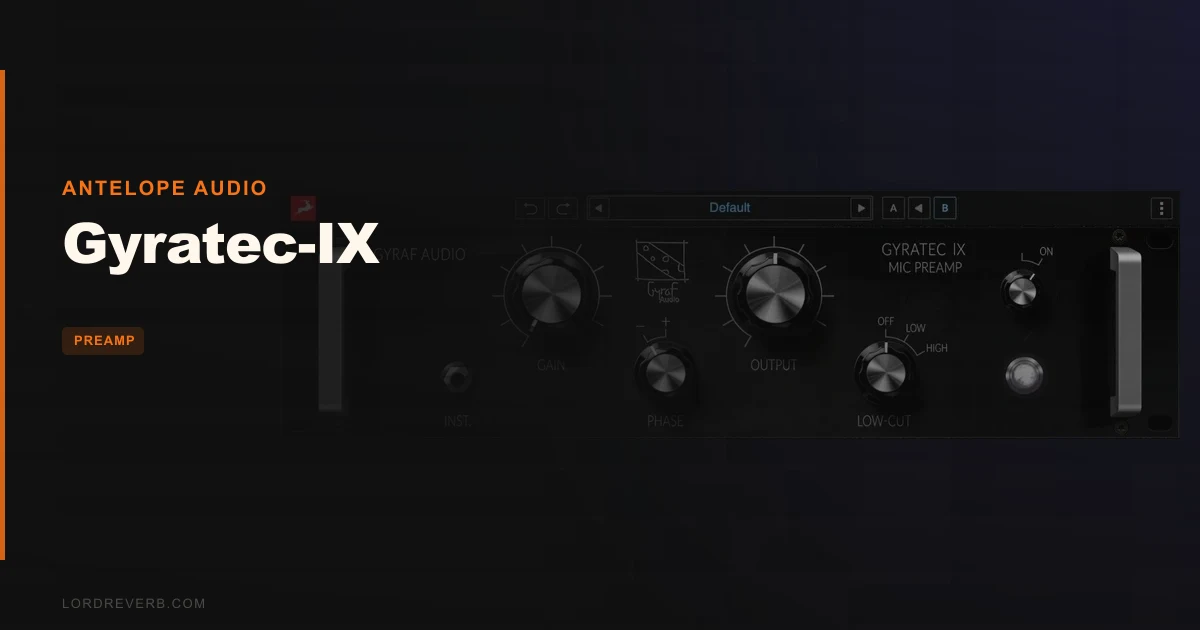
Gyratec-IX adds “flawless analog amplification to any sound source”, and for the most part that claim holds up, with one nagging bug attached. At $99, it’s a tube preamp emulation for producers who’d rather not buy the hardware original. It suits you if you want a simple saturation tool for tracking and mixing.
The bug is the catch. Owners report a gain knob that goes dormant, which is a rough fault on a plugin whose whole personality lives in that control.
So is it worth the money? That depends on whether you want one specific tube flavour or a Swiss Army knife. We’ll get into it.
The Claim: Flawless Analog Amplification on Anything
Antelope Audio says Gyratec-IX faithfully recreates the analog-only signal path of its hardware original. That original is a two-channel, all-tube, high-gain, transformer-balanced microphone preamp.
The developer also calls it extremely versatile, easy to master, and massive-sounding. That’s a lot of promises for one plugin.
The plugin itself is a variable-gain input tube feeding an SRPP output stage. You get input and output level switches, a high pass filter, and a phase reverse switch.
What Holds Up: Saturation You Can Dial In
The core idea works. Raise the gain, pull the output level down, and you get harmonic saturation. Leave the gain at minimum and you get no saturation at all.
That two-way behaviour is the most useful thing here. Owners describe the result as rich, warm harmonics, which fits how a tube stage behaves when you drive it hard.
Picture a thin vocal take that sits flat against your backing track. Push the input gain, trim the output so your levels don’t jump, and the voice gains weight without a boost in volume. That’s the trick.
The layout is clean. You won’t hunt through menus, and balancing input against output is quick. We love that. Too many preamp plugins bury the one control you want.
It also works while tracking or during mixing, and it runs in any DAW or interface. On Synergy Core hardware, the real-time version has no perceptible latency.
What Doesn't: The Dormant Knob and the Fine Print
The dormant gain control knob is the headline problem. Owners report the bug, and we can’t tell you how often it bites. We don’t know the cause or whether it’s fixed.
It’s annoying in a plugin built around one gain stage. If you buy it, test the knob first, before you commit to a session.
The “extremely versatile” claim is also a stretch. This is a tube preamp. It adds warmth and weight, and that’s the job. It won’t reshape a sound the way a multi-mode tool does.
Then there’s the hardware tie-in. True zero-latency operation outside your DAW needs a Synergy Core device. Without one, you’re on the native plugin only.
System needs are modest but real: Windows 10/11 (64-bit) with 8 GB RAM minimum and 16 GB recommended, or macOS. Your CPU needs to be an Intel Core i3 or AMD Ryzen 1000 at minimum.
Is $99 Good Value? The Money Question
At $99, you’re paying for one well-defined tube character. You aren’t paying for a toolbox.
If you already own a saturation plugin you like, this probably duplicates it. A free or cheaper saturator will cover plain warmth for most people.
Paying makes sense when you want the specific SRPP tube sound from the hardware original, with a clean layout and a high pass filter built in. It also makes sense if you already own Synergy Core gear and want the real-time version.
There’s a second route. Gyratec-IX is part of a collection of 75+ Antelope Native Plugins available through an Antelope Cosmos subscription. If you’d use plenty of those, the subscription could beat buying one plugin outright.
What’s missing at this price? A guarantee that the gain knob behaves. That bug costs it points on value.
Who It Suits
Buy it if you track vocals or instruments and want tube weight before the signal hits your DAW’s mix. Buy it if you like simple controls and fast decisions.
Skip it if you need one plugin to do everything. Skip it if you can’t tolerate a possible gain control bug mid-session.
Own an Antelope interface with Synergy Core? You get the zero-latency version, which is the best way to use this.
On a modest laptop, check the spec first. 8 GB of RAM is the floor, and 16 GB is the comfortable number.
The Verdict
Gyratec-IX is a good tube preamp emulation held back by a reported gain knob bug. The warmth is real and the layout is a pleasure.
Is it a must-buy at $99? No. It’s a solid pick if you want this exact flavour, and a pass if you only want generic warmth.
Specs & Technical Details
| Spec | Detail |
|---|---|
| Developer | Antelope Audio |
| Price | $99 |
| Plugin Format | N/A |
| OS Support | Mac / Windows 10/11 (64-bit) |
| Activation | N/A |
| CPU Usage | N/A (Intel Core i3 or AMD Ryzen 1000 minimum) |
| Trial Available | N/A |
| Version Reviewed | N/A |
Score Breakdown
| Category | Score | Notes |
|---|---|---|
| Sound Quality | 4.0/5 | Owners report rich, warm harmonics, with a clean option at minimum gain |
| Value for Money | 3.5/5 | One tube flavour for $99, with a reported knob bug |
| Ease of Use | 4.5/5 | Straightforward, user-friendly layout |
| Features | 3.5/5 | Level switches, high pass filter and phase reverse, but narrow in scope |
| CPU Efficiency | N/A | No usage figures available; minimum system specs only |
| Overall | 3.8/5 | Good tube character held back by a reported gain knob bug |
Buy It or Skip It?
Buy Gyratec-IX at $99 if you want hardware-flavoured tube saturation and you’ll test that gain knob early. Skip it if you want a do-everything processor, or if a free saturator already gives you the warmth you need.
It’s wrong for anyone who can’t risk a dormant control mid-session. Check the knob before you trust it on a deadline.
Related reviews: APX 351 Review
Frequently Asked Questions
Does Gyratec-IX need Antelope hardware?
No. The native plugin runs on Mac or PC with no extra hardware. The Synergy Core Real-Time version needs a compatible Synergy Core device and runs with no perceptible latency.
Can Gyratec-IX run clean with no saturation?
Yes. Keep the gain at minimum and it adds no harmonic saturation. Raise the gain and lower the output level to bring in warm harmonics.
What are the system requirements for Gyratec-IX?
You need Windows 10/11 (64-bit) with 8 GB RAM minimum (16 GB recommended), or macOS. The minimum CPU is an Intel Core i3 or AMD Ryzen 1000.