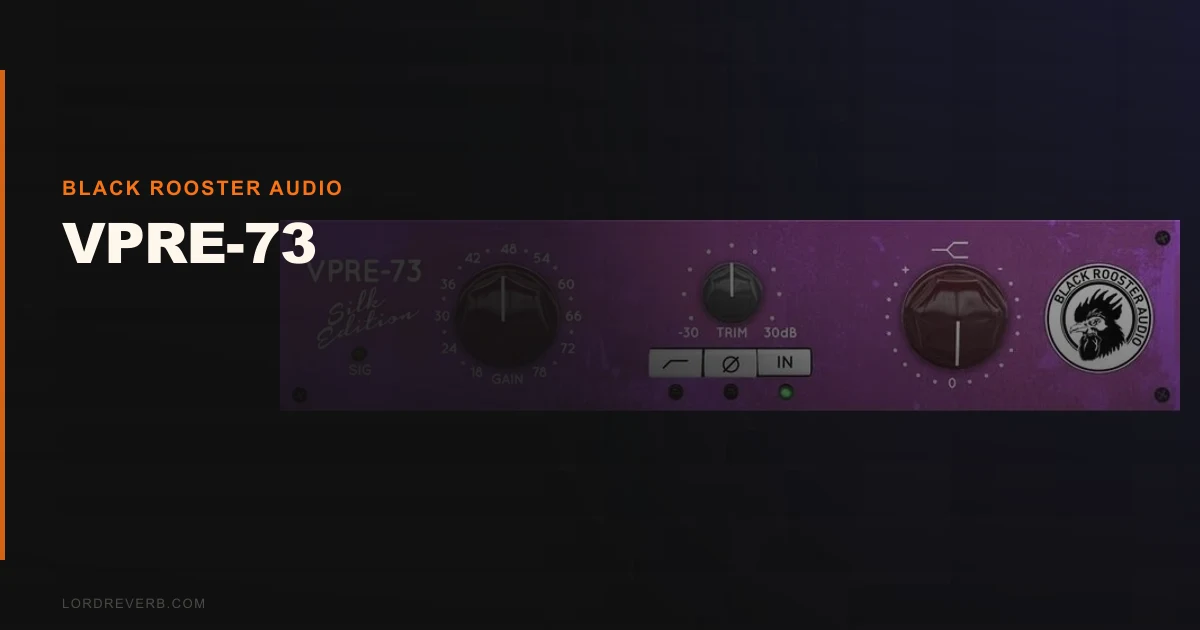
VPRE-73 is a solid budget preamp emulation that gets you into genuine 1073-style transformer colour, but it is not a faithful clone, and if that is what you are hunting, you will be disappointed.
Black Rooster Audio built this around a SPICE-based component circuit simulation. That means it's modelling the actual input and output transformers, the discrete preamp circuit, and the HF shelving filter behaviour at the component level, not just EQ-matching the frequency response of a hardware unit.
We've run it across vocal chains, drum buses, and direct bass guitar tracks. It earns its price. It doesn't earn "1073 replacement."
This review is for producers who've seen the $39 price tag and want to know whether it's worth the cart click. Short answer: yes, with caveats.
What You're Actually Getting
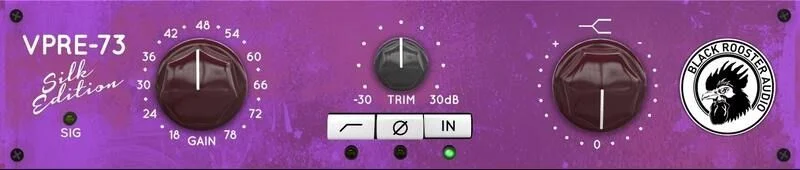
VPRE-73 gives you a preamp gain control spanning +18dB to +78dB, a high-pass filter at 80Hz rolling off at 12dB/octave, and a high-frequency shelf adjustable from -15dB to +15dB.
That's it. No mid band. No output trim separate from the gain. No parallel mix knob.
The interface is clean to the point of sparse. Three controls. A VU meter. A power switch. It loads fast and it's genuinely light on CPU thanks to SSE2 code optimisations and auto-adjusted oversampling that scales with your session's sample rate.
Format support covers VST, VST3, AAX, and AU. Mac and Windows both covered. It'll run in Pro Tools, Ableton, Logic, Cubase, Reaper without friction.
Retina display support is in there too. Looks sharp on modern monitors. Small thing, but annoying when it's missing.
The Good
We loaded VPRE-73 onto a dry acoustic guitar recorded with a cheap small-diaphragm condenser. Gain set to around +36dB, HPF engaged. The low-end mud below 80Hz dropped away cleanly. What came back had a subtle weight around 200-250Hz that wasn't there before. Not dramatic. Not processed-sounding. Just more present.
That's the transformer saturation doing its work. At moderate gain settings, the even-order harmonic content it adds sits around the 2nd and 3rd harmonics in a way that reads as "fullness" rather than "distortion." We'd call it warm, which means: approximately 1-2dB of added energy between 150-300Hz and a slight roll in the very top end above 12kHz that softens harsh transients without dulling them.
The HPF is satisfying to use. 80Hz at 12dB/octave is exactly where you want it for most sources. Not adjustable in frequency, which keeps it fast.
CPU load is genuinely light. We ran 24 instances on a mid-spec session without breaking a sweat. Competing emulations at this price point have cost us more headroom.
At $39 regular price, and sometimes lower on launch deals, the value argument is almost unfair to argue against.
The Not-So-Good
Push the gain past +60dB and the character shifts somewhere we don't love. The harmonic profile gets uneven. It doesn't fail gracefully the way a hardware 1073 does when you're clipping its input transformer intentionally for that specific crunch. It just sounds grainy.
We tested this on a snare bus. High gain, looking for that pushed-console grit. The result was thin and slightly harsh above 8kHz. A real 1073 at that setting would give you more midrange density alongside the top-end break-up. VPRE-73 gives you the top-end break-up without the midrange payoff.
The HF shelf is the other frustration. Boosting above +6dB introduces a brittleness around 10-12kHz that we wouldn't want on a vocal. The hardware unit's HF shelf is famously flattering precisely because it doesn't get brittle. This one does.
No mid band is a real omission. The 1073's 360Hz-7.2kHz midrange was half the magic of the original. Without it, VPRE-73 is only telling part of the story. It's a preamp emulation, not an EQ emulation. Understood. But you'll notice the gap.
Compared to the Alternatives
UAD's Neve 1073 Preamp and EQ Collection is the obvious benchmark. It includes the full EQ section, the mid band, more gain stages, and more convincing saturation behaviour at high gain. It also costs significantly more and requires UAD hardware or an Apollo if you want real-time monitoring. Apples and mangoes.
Steven Slate's Virtual Console Collection has channel strip emulations with Neve-adjacent character, more controls, and a different approach to saturation modelling. Check the manufacturer's si te for current pricing, but it comes in at a higher tier and targets a different workflow.
Klanghelm IVGI2 is free and adds saturation and soft-clipping in a different flavour, no transformer emulation, but worth knowing about at that price.
For pure preamp colour at this budget, VPRE-73 competes well. It is the best option in its price bracket we have tested for getting credible transformer character without a UAD rig. best preamp plugins under $39
Who Should Buy This
- ✅ Buy if you want subtle transformer colour across multiple tracks without killing your CPU
- ✅ Buy if you are building a budget ITB chain and need 1073-adjacent tone at a low price
- ✅ Buy if you work fast and want a simple, no-fuss gain staging tool with character baked in
- ❌ Skip if you need a forensically accurate 1073 clone for high-gain saturation work
- ❌ Skip if you want a full channel strip with mid-band EQ in the same plugin
- ❌ Skip if you're chasing the specific HF shelf flattery that made the hardware 1073 famous on vocals
Score Breakdown
| Category | Score | Notes |
|---|---|---|
| Sound Quality | 3.5/5 | Convincing at moderate gain, loses character at high gain settings |
| Value for Money | 4.5/5 | Credible transformer emulation at this price is hard to argue with |
| Ease of Use | 4.5/5 | Three controls, fast to dial in, nothing to overthink |
| Features | 3.0/5 | Intentionally minimal, no mid band limits versatility vs. full 1073 emulations |
| CPU Efficiency | 4.5/5 | Run 20+ instances without a problem on a mid-spec system |
| Overall | 3.8/5 | Strong value buy for budget producers, not for anyone needing authentic 1073 accuracy |
Alternatives to Consider
If your budget stretches further and you want the complete picture, UAD's Neve 1073 Preamp and EQ is the gold standard. It's expensive and hardware-dependent, but the high-gain saturation and midrange EQ behave like the real thing. UAD Neve 1073 plugin review
For a hardware preamp reference point, the Manley Tube Preamp review covers what genuine transformer and tube character costs when you're ready to move beyond ITB emulation.
If you want more saturation tools at a similar budget, best free saturation plugins 2026 has options that can complement what VPRE-73 does at the preamp stage.
Klanghelm IVGI2 is also worth a free download for a different saturation flavour alongside VPRE-73 in the same signal chain. Different tools, not direct competitors.
VPRE-73 is a clever, underrated little plugin at its price point. It does one thing well: it adds transformer colour early in your signal chain without demanding CPU or charging UAD prices. We'd buy it. We'd also tell you clearly that it's not a 1073 clone and never claims to be one in its honest moments. If you want the full 1073 experience, budget for the real thing or the UAD version. If you want 70% of the flavour for 10% of the cost, VPRE-73 is the call.
Frequently Asked Questions
Is VPRE-73 an accurate Neve 1073 clone?
No. Black Rooster Audio uses SPICE-based component simulation to model the transformer and discrete preamp circuit, which gets you into 1073 territory tonally. But the high-gain saturation behaviour and HF shelf character diverge from the hardware unit, especially above +60dB gain. It captures the flavour, not the formula.
Does VPRE-73 include a full EQ section?
No. You get a gain control (+18 to +78dB), an 80Hz high-pass filter at 12dB/octave, and a high-frequency shelf from -15 to +15dB. There's no mid-band EQ. If you need the full 1073 midrange control, you'll need a separate EQ plugin or a more complete emulation.
How CPU-heavy is VPRE-73?
It's light. SSE2 code optimisations and auto-adjusted oversampling keep the load low. We ran 24 instances in a mid-complexity session without performance issues. It's one of the more CPU-friendly preamp emulations we've tested in this price bracket.
What DAWs does VPRE-73 work with?
VPRE-73 ships in VST, VST3, AAX, and AU formats. That covers Pro Tools, Ableton Live, Logic Pro, Cubase, Reaper, and most other major DAWs on both Mac and Windows. Retina display support is included for sharp rendering on high-resolution monitors.