
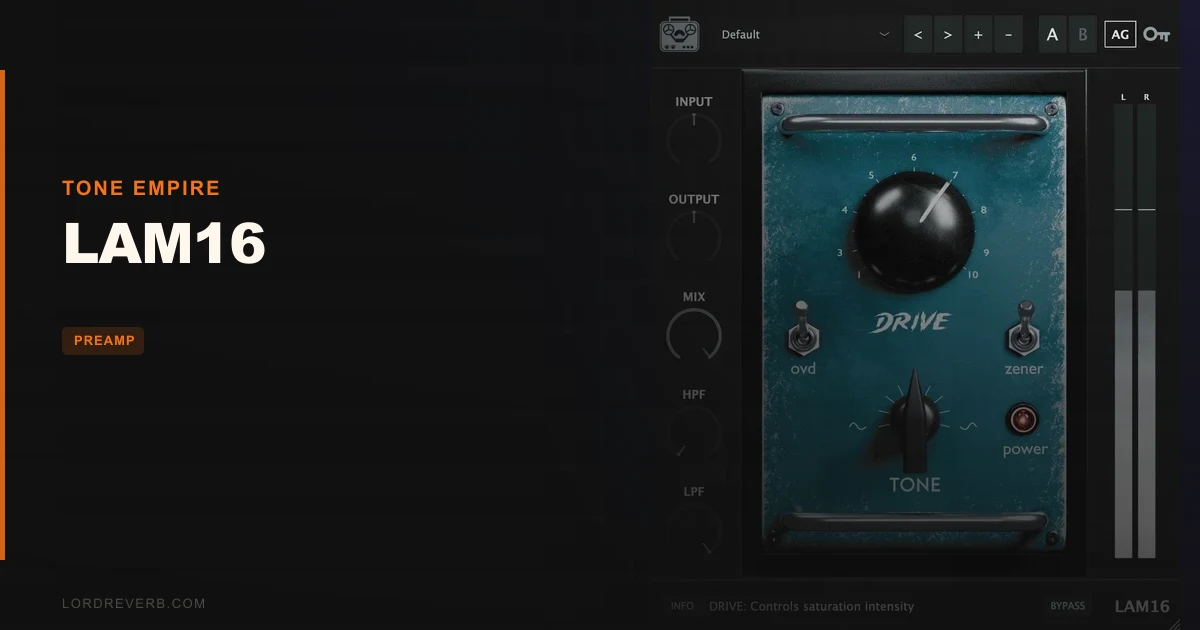
If you're comparing the LAM16 to Waves Greg Wells Mix Centric, here's where this review lands: LAM16 sounds better and gives you more control, but it ships with two bugs that'll make you question whether it's finished. At $19, that tension is exactly what we need to work through.
The LAM16 is Tone Empire's neural model of the Langevin AM16, a Class-A, transformer-balanced, discrete transistor preamp that Capitol Records reportedly leaned on heavily during the 1960s and 70s. The plugin runs its modeling engine at 96kHz and auto-upsamples 48kHz sessions 2x, so you're getting full-resolution character regardless of your project sample rate.
Who's it for? Producers and mix engineers who want that open, slightly heavy analog preamp sound baked into their tracks. People who work in the box and miss the feeling of real iron. And anyone willing to manage a couple of quirks in exchange for vintage weight at $19.
How It Compares Out of the Box
LAM16 is a preamp emulation with Zener Diode Mode for harmonic distortion, transformer character on both input and output, and a 96kHz neural model underneath. While some plugins take a broad-strokes approach to coloration, LAM16 is narrower in concept but more specific in what it does.
Out of the box, LAM16 has a wider frequency response and more perceptible top-end air. Owners describe it as warm with real weight below 200Hz, but not dark. The high end stays present. Push the drive and the top end turns gritty before the low-mids thicken up.
First impression: LAM16 sounds like the more capable plugin. The bugs are where it falls short of that promise.
Performance Deep Dive
The 96kHz neural modeling is doing real work here. The plugin targets intermodulation distortion, frequency-dependent saturation, and dynamic response. That's not marketing language for "we added some harmonic content." Those are the three things that make analog gear sound different from clean digital gain, and the LAM16 addresses each one in its model.
Auto-oversampling is a smart implementation. If your session runs at 48kHz, the plugin upsamples internally 2x without you touching a setting. That matters because neural models trained at 96kHz can alias badly at lower rates. Tone Empire handles it quietly. That's a clever design decision.
The Zener Diode Mode is where the character shifts hard. Put it on a drum bus, push the drive past halfway, and the transients go from smooth and punchy to gritty and thick. It works well as a pre-amp overdrive stage before guitar amp sims too. Owners report shaping tone effectively that way, and it tracks. That's a legitimate second use case beyond mix bus coloring.
Now the frustrating part. The mix knob should let you do parallel blending. It doesn't work correctly. Turn it toward dry and distortion artifacts appear instead of a clean dry signal. That's not a limitation. That's a malfunction. And auto-gain adds peaks even when you switch it off. You'll need to trim output gain manually almost every time you place it.
Where It Wins
When you're printing a vocal chain and you want that open, airy Capitol Records preamp sound, LAM16 delivers it without the high-frequency harshness that cheaper saturation plugins introduce. The transformer-balanced input and output modeling keeps the character balanced across the spectrum. It doesn't just add harmonic content in the midrange and call it analog.
Push it on a snare bus and increase the drive until you feel it compress slightly. That's where the fast, punchy transient response becomes satisfying. The LAM16 doesn't smear the attack the way some tube-modeled plugins do. It sharpens the initial hit while adding weight underneath.
And at $19, the neural model quality sits above its price bracket.
Where the Competition Wins
If your workflow depends on parallel saturation, where you blend a heavily driven signal back against the dry to taste, LAM16's broken mix knob forces you to set up a manual parallel chain in your DAW instead.
The auto-gain issue also means LAM16 isn't a drop-in insert on a busy session. You'll need to listen for unexpected peaks and adjust. Owners describe it as manageable on the mix bus with modest compensation, but that's not the same as it working correctly out of the box.
Who Should Buy Which
- ✅ Buy LAM16 if you want Capitol Records-era preamp character and you're willing to manage the mix knob issue manually
- ✅ Buy LAM16 if you use amp sims and want an overdrive stage that shapes tone before the cab
- ✅ Buy LAM16 if your sessions run at 48kHz and you want 96kHz neural model quality without manual oversampling setup
- ❌ Skip LAM16 if you rely on parallel blending workflows. The mix knob isn't safe to use
- ❌ Skip LAM16 if you're dropping it on dozens of tracks and can't afford to watch for gain spikes from a misbehaving auto-gain
- ❌ Skip LAM16 if you hate managing workarounds. Waves Greg Wells Mix Centric is reported as a finished, stable product with fewer workflow issues.
Specs & Technical Details
| Developer | Tone Empire |
| Price | $19 |
| Plugin Format | VST3 / AU / AAX |
| OS Support | macOS / Windows |
| Activation | Online activation required; 3 activations included |
| CPU Usage | N/A |
| Trial Available | N/A |
| Version Reviewed | N/A |
Score Breakdown
| Category | Score | Notes |
|---|---|---|
| Sound Quality | 4.5/5 | 96kHz neural model delivers convincing transformer-balanced Class-A character |
| Value for Money | 4.0/5 | Neural model quality sits above its price point, but bugs reduce what you're actually getting |
| Ease of Use | 2.5/5 | Broken mix knob and misbehaving auto-gain demand manual workarounds every session |
| Features | 3.5/5 | Zener Diode Mode and auto-oversampling are genuinely useful; feature set is otherwise lean |
| CPU Efficiency | N/A | Not enough data to score |
| Overall | 3.5/5 | Sounds brilliant for the price, but ships with workflow-breaking bugs that haven't been fixed |
Alternatives to Consider
Waves Greg Wells Mix Centric, if you want a one-knob color tool that works reliably in a mix bus or parallel chain without managing gain spikes. It's a broader, less specific sound than the LAM16, and owners report it as a finished, stable product. Less character, fewer headaches.
Frequently Asked Questions
What is the LAM16 plugin based on?
LAM16 is a neural model of the Langevin AM16, a Class-A, transformer-balanced, discrete transistor preamp designed by John Hall. The developer says it was Capitol Records' in-house secret during the 1960s and 70s, used on countless major recordings. The plugin recreates the circuit topology including transformer-balanced input and output.
Does LAM16 work at 48kHz sample rates?
Yes. The plugin includes intelligent auto-oversampling that kicks in automatically when your session runs below 96kHz. At 48kHz, it upsamples internally 2x to give the neural model its full 96kHz resolution. You don't need to change any settings for this to happen.
Is the LAM16 mix knob actually broken?
Multiple owners report that it behaves unexpectedly. Rather than blending the processed signal cleanly with the dry, turning the knob toward dry introduces distortion artifacts. This makes in-plugin parallel blending unreliable. The workaround is setting up a manual parallel chain in your DAW and running the plugin at full wet. Annoying, but it works.
How many computers can I install LAM16 on?
The plugin comes with 3 activations. Online activation is required for the initial setup, though owners report it may work offline after the first activation. If you work across multiple machines, 3 activations can go quickly, so plan accordingly before you use them all on the same computer.