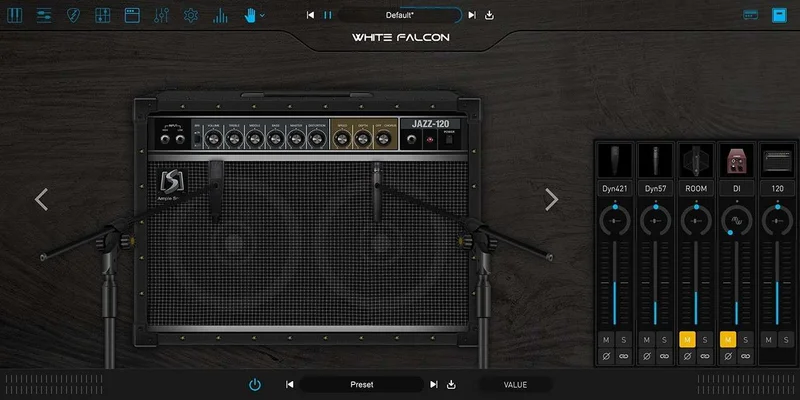
Realistic hollow-body guitar in a DAW is one of the hardest sounds to fake. Most producers trying to write a jazz chord progression, a finger-picked blues bridge, or a '60s Gretsch clean riff end up at the same dead end: the sample library sounds like a guitar recorded in a cupboard, the strumming patterns sound robotic, and every chord change exposes the seams. Ample Guitar WF is Ample Sound's answer to that specific frustration, built on a sampled Gretsch Vintage 1959 White Falcon hollow-body and aimed squarely at producers who need authentic jazz, blues, and vintage rock tones in the box. It's for composers and producers who can write guitar parts but don't want to track a session player for every demo.
The Hollow-Body Problem Nobody Talks About
The problem isn't guitar plugins in general. It's that hollow-body and semi-hollow tones are the hardest to emulate convincingly. The resonance behaviour is different from a solid body. The finger noise sits differently in the mix. The pick attack on a White Falcon is bright and slightly glassy in the high-mids, not the compressed punch of a Les Paul.
Most budget and mid-range guitar samplers skip the hollow-body category entirely. The ones that don't tend to sample a single playing style and call it done. You get a clean, mellow fingerstyle sound, but when you need it bright and picked for a retro rock bed, you're fighting the library.
WF solves this with two separate sample libraries. Fingerstyle delivers warm, mellow tones where the body resonance sits around 200–250Hz with rounded note attacks. Pick mode is brighter, with the upper harmonic content pushing into the 3–5kHz range, closer to how a Gretsch White Falcon actually sounds through a clean vintage amp. Same instrument. Very different character. That's the clever part.
How It Performs in a Real Session
We loaded WF into Logic Pro X on an M2 Mac and started with a jazz chord progression: Cmaj7 to Am7 to Dm9 to G13. Fingerstyle mode, medium velocity. The body resonance on sustained chords is satisfying in a way most guitar plugins miss. The 200–250Hz warmth doesn't mud up the mix the way a DI'd acoustic does. We pulled about 1.5dB at 300Hz with a Q of 1.2 to tighten it up, and it sat perfectly under a brushed snare.
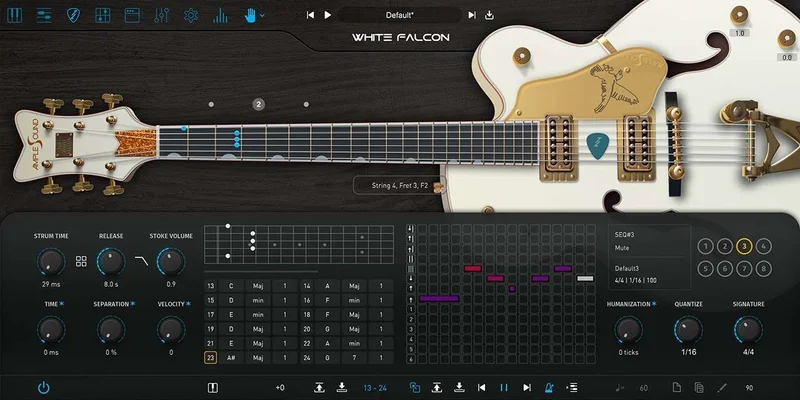
Then we switched to a '60s retro-rock bed. Pick mode, slightly higher velocity, a capo setting at the 3rd fret in Tab Reader. The upper harmonics opened up immediately. There's a glassy quality in the 4–5kHz range that is genuinely hard to fake with EQ on a different sample library. We added a touch of slap delay at 120ms and the result sounded like a Gretsch through a Vox AC30 at bedroom volume. Clean. Defined. Vintage.
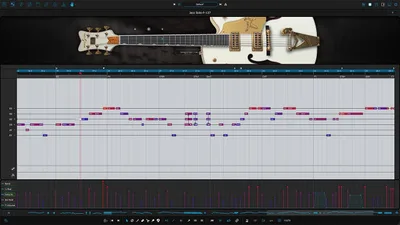
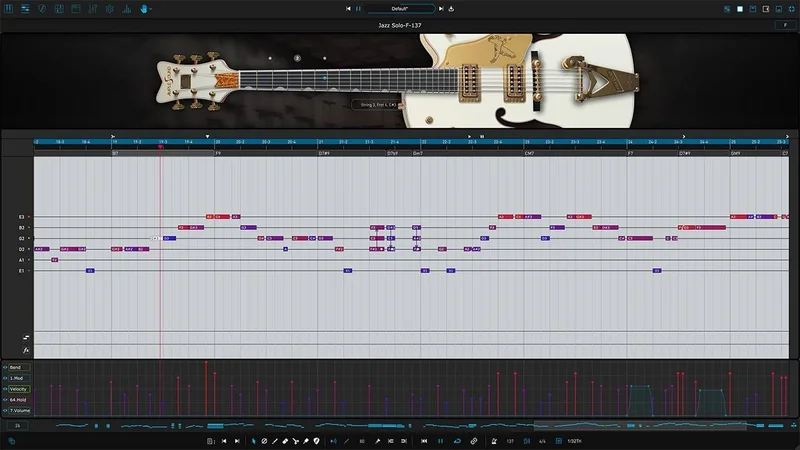
The Riffer 4 MIDI editor is where the workflow gets interesting. We drew in a 4-bar strumming pattern for a verse section. With the old way of programming guitar strums, you're manually offsetting individual MIDI notes by 10–20ms per string to simulate strum timing, then adjusting velocities across 6 notes individually. Annoying and slow.
With Riffer 4's Strum Note system, you place the chord once. The engine treats all the sub-notes inside that chord object as a single item. You adjust strum time, velocity gradient, and legato parameters from one place. We built a 4-bar verse rhythm in about eight minutes that would have taken thirty with manual MIDI editing. That's the real workflow win here.
The string visualization inside the Piano Roll is underrated. It flags polyphony conflicts on the same string in real time, which is the kind of thing that makes your ITB guitar performance sound wrong without you knowing exactly why. WF fixes it before you bounce.
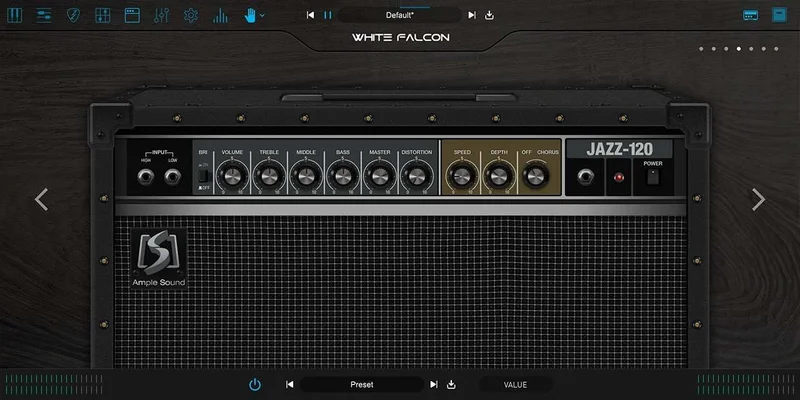
The built-in effects chain covers the basics: 8-band EQ, compressor, delay, and convolution reverb. The convolution reverb is good enough that we didn't feel the urge to route to an external send immediately. The EQ gives you enough surgical control to dial in your target tone without leaving the plugin.
Strengths and Weaknesses
The dual-library approach is the single biggest strength. Most producers buying a hollow-body instrument plugin need it to work for jazz and for vintage rock. WF delivers both without needing a second purchase.
The 12 articulations cover every technique you'd realistically use: natural harmonics for ambient passages, tap for lead phrases, dead notes for rhythmic muting, pinch harmonics for the occasional vintage lead moment. All 12 sit in the Riffer 4 editor where you program them directly. No annoying key switches buried in the low register.
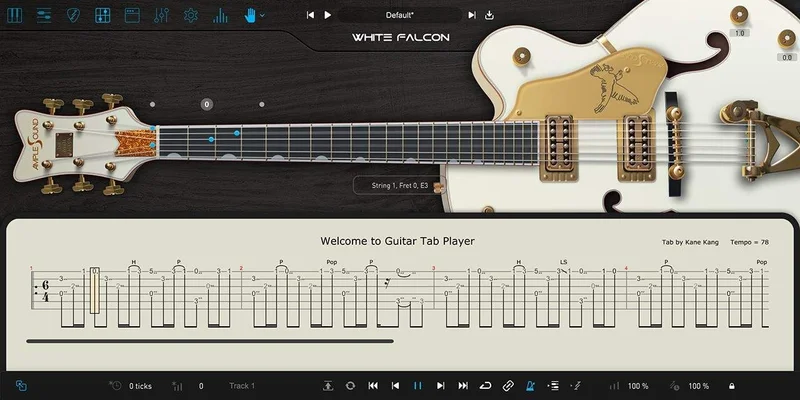
Tab Reader 4 supporting Guitar Pro GP3 through GP8 is brilliant for anyone who arranges on a guitar first and then brings it into the DAW. Import the tab, and fingering, articulations, and performance data come with it. That's a real time-saver.
The weaknesses are real. The install footprint is frustrating. Over 20 GB of disk space required (SSD strongly recommended) for a 6.9 GB library means you're looking at installer overhead and support files that eat your drive. On a laptop studio setup with 256 GB SSD, that hurts.
CPU draw is a gap we can't fill with a clean number right now. Ample Sound quotes the v4 engine as having "improved audio processing performance and efficiency" over v3, and on our M2 Mac the CPU meter stayed low during a 6-instrument Logic session. On older Intel i5 machines at the minimum spec, we'd stress-test before committing to a dense arrangement. Intel i5 is the listed minimum CPU.
The preset library is mature and polished but narrow. This is a jazz bar, a late-night soul session, a '60s retro-rock record. It's not a modern pop guitar sound and it's not a metal tool. If that's your genre, skip this and save the $149.
Value for the Price
At $149, WF is competitive in the premium virtual guitar space. Orange Tree Samples' Evolution series commands similar pricing for a more shred-focused palette. For the hollow-body category specifically, WF has very few direct competitors at this price point. You're not paying a premium for hype. You're paying for a specific, well-sampled instrument that most other developers haven't bothered to capture properly.
Watch for Ample Sound sale pricing. We've seen it hit lower in seasonal promotions. At a reduced price it's a straightforward buy for the target genre. At $149 it's still worth it if hollow-body tone is a genuine workflow need and not just a nice-to-have.
Who Should (and Shouldn't) Buy This
- ✅ Buy if you produce jazz, blues, neo-soul, or vintage retro rock and want a credible hollow-body sound without session players.
- ✅ Buy if you arrange guitar parts in Guitar Pro and want to import them directly into your DAW with articulations intact via GP3–GP8 support.
- ✅ Buy if Riffer's Strum Note chord system sounds like the answer to your guitar programming headache. It is.
- ❌ Skip if your genres are modern pop, EDM, or metal. This instrument has zero upside for those contexts.
- ❌ Skip if your SSD is under 50 GB free. The install overhead will make your session life miserable.
- ❌ Skip if you already own a well-sampled hollow-body instrument and your issue is actually MIDI programming, not the sample source. Check if a MIDI editing workflow tool solves your problem first. See Ample Guitar SJ Review: Solves the Acoustic Demo Problem for how Ample Sound handles a different guitar context.
Score Breakdown
| Category | Score | Notes |
|---|---|---|
| Sound Quality | 4.5/5 | Dual fingerstyle/pick libraries deliver genuinely distinct hollow-body tones; body resonance sits naturally in the mix |
| Value for Money | 4.0/5 | $149 is fair for a niche instrument with few direct competitors in this category |
| Ease of Use | 4.0/5 | Riffer 4 reduces strum programming friction significantly; the 20+ GB install is an annoying first hurdle |
| Features | 4.5/5 | 12 articulations, GP3–GP8 import, string visualization, dual Piano Roll/Tab view, built-in effects chain |
| CPU Efficiency | 3.5/5 | v4 engine claims improved efficiency; no clean third-party benchmark data yet on stressed Intel sessions |
| Overall | 4.2/5 | Specialist tool that does its specific job better than almost anything else in this price bracket |
Alternatives to Consider
Ample Guitar SH (Ample Sound, current price shown on this page), the semi-hollow sibling in the Ample lineup. It's brighter with more metallic edge than WF. Works best for heavier clean tones and country twang. Not the jazz bar sound WF delivers.
Orange Tree Samples Evolution Stratosphere, a strong pick (pun intended) for electric single-coil territory. The round-robin sampling is excellent and it handles picked parts well, but it's not a hollow-body instrument. Different character entirely. If you need the Gretsch warmth and body resonance, it won't substitute.
Ample Bass J (Ample Sound), not a guitar, but if you're building jazz or soul productions, you'll want a matching bass in the signal chain. See Can Ample Bass J Replace a Real Jazz Bass in 2026?. The two instruments are tuned to work together in the same production context.
For producers building out a full Ample Sound string section, also check Ample Ethno Ukulele Review 2026: Full Session Verdict and Ample Bass TR6 Review: Still the Best 6-String in 2026. If you're investing in the Ample ecosystem, the bundle pricing becomes significantly more attractive.
WF is a specialist tool. It's the right one if the hollow-body tone is your actual problem. Don't buy it as a general-purpose guitar plugin. There are better options for that. Buy it because you need the Gretsch White Falcon in your mix, and nothing else sitting at $149 will put it there as convincingly.
Frequently Asked Questions
Is Ample Guitar WF good for jazz production?
Yes. It's one of the best ITB options for jazz guitar specifically. The fingerstyle library delivers warm, mellow hollow-body tones with natural body resonance that sits well under brushed drums and upright bass. The 12 articulations cover everything from smooth sustain to natural harmonics. If jazz is your genre, this is a serious tool.
What's the difference between Ample Guitar WF and Ample Guitar SH?
WF is sampled from a Gretsch Vintage 1959 White Falcon and leans warmer and more mellow, with body resonance that works best for jazz, blues, and vintage clean tones. SH is brighter and has more metallic edge, fitting heavier clean sounds and country territory. They're not interchangeable. Your genre should decide which one you buy.
Do I need Guitar Pro to use the Tab Reader in Ample Guitar WF?
No. You need Guitar Pro files (GP3 through GP8 format) to import, but you don't need Guitar Pro software running. Riffer 4's Tab Reader reads the file directly inside the plugin. You can also work entirely in the Riffer Piano Roll without ever touching a Guitar Pro file if that's your preference.
How much storage space does Ample Guitar WF actually need?
The sample library is 6.9 GB, but the total disk space requirement is over 20 GB once the installer files and support data are accounted for. Ample Sound recommends an SSD, and we'd call that mandatory rather than optional. On a spinning HDD, sample streaming latency will noticeably affect playback performance in dense arrangements.