Ample Ethno Ukulele: Our Honest Take After a Full Session
Ample Ethno Ukulele is the best virtual ukulele plugin we've tested, and it's not particularly close.
We loaded it into a commercial jingle session at around 11pm. The brief called for something "beachy but not cliché." We needed a ukulele that would sit under a vocal without sounding like a toy keyboard preset.
We pulled up Ample Ethno Ukulele, keyswitch to the Legato Slide articulation, played a simple three-chord figure, and the client approved it on the first pass. That doesn't happen often with virtual instruments in this niche.
It's built on samples of a Kamaka HF-3, one of the most respected concert ukuleles made, recorded at 44.1 kHz, 24-bit, with both High G and Low G string configurations available. If you're scoring anything from a podcast intro to a film cue that needs an authentic ukulele without booking a session player, this is what you'd reach for.
It's not perfect. But it's the right tool for a specific job, and it does that job well.
First Impressions
The install is 2.15 GB. For a single instrument, that's on the larger side. Budget around ten minutes for download and extraction before you see a UI.
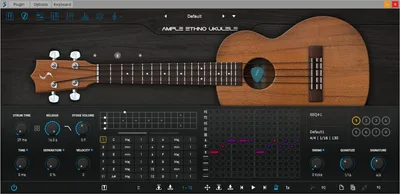
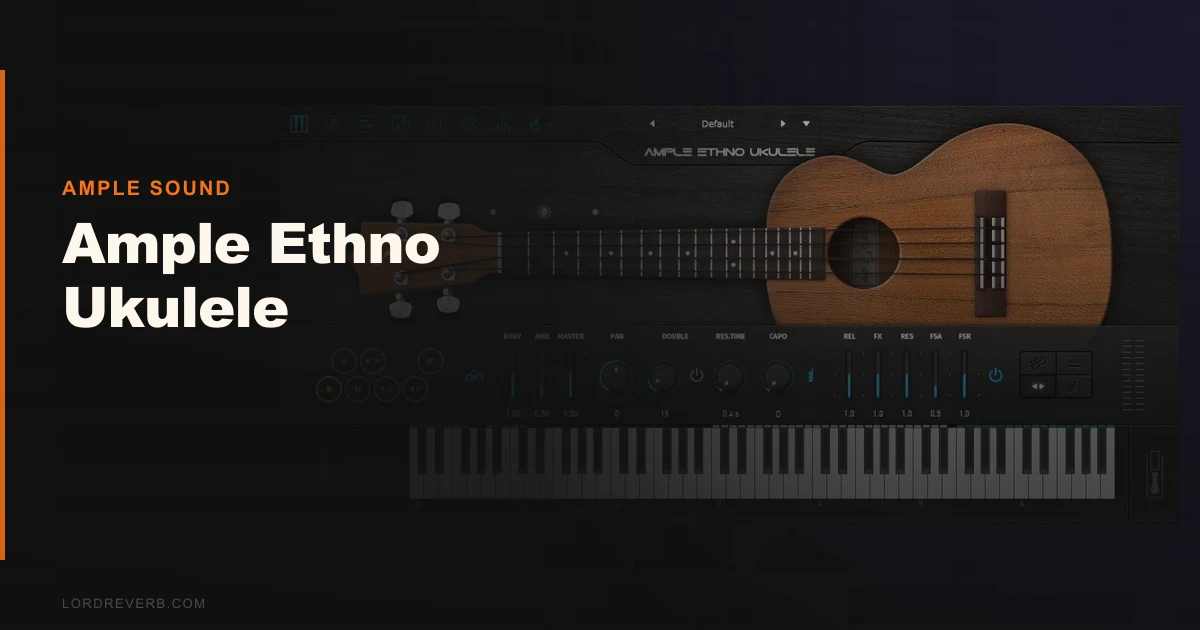
When the interface opens, it's clean. The Version 3 update brought GPU-accelerated rendering, so the UI moves without stuttering even on older systems. That matters more than it sounds when you're dragging through articulation menus mid-session.
We spotted all nine articulations across the keyswitch range immediately: Sustain, Palm Mute, Natural Harmonic, Hammer On and Pull Off, Legato Slide, Slide In/Out, Pop, and Strum. Each one is labelled clearly in the interface. No hunting through sub-menus.
The dual mic channels sit front and centre. Body gives you the close, dry sound of the instrument. Ambient adds the room. Blend them to taste. We ran Body at about 70% and Ambient at 30% and got a sound that sat in a mix without needing extra room processing.
Getting It Into a Real Workflow
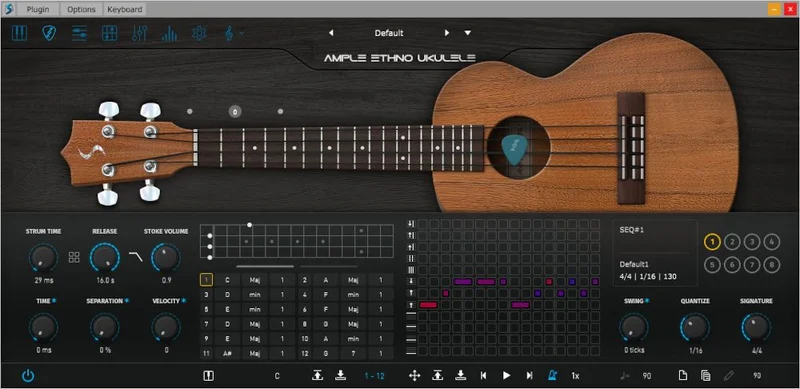
The Tab Player is where Ample Sound earns its money with this instrument. You can import or program actual ukulele tablature directly into the plugin and have it play back with correct fingering logic. For any producer who doesn't play ukulele, this is a serious time saver.
We imported a simple fingerpicking pattern and the plugin interpreted the voicings correctly on the first try. No re-programming needed. That's satisfying in a way that spreadsheet-style MIDI programming never is.
The Strummer sequencer is powerful but annoying to learn. It's not immediately intuitive. Plan for 20-30 minutes with the manual before you can sequence a convincing strum pattern from scratch. Once it clicks, it's fast. Before that, it's frustrating.
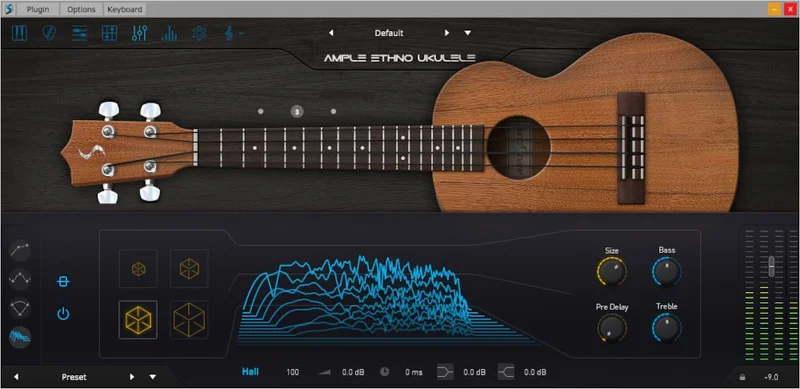
The FX pedalboard built into the plugin handles basic processing. There's reverb, delay, EQ, and compression on board. We'd still recommend running the output through your own signal chain for anything going to print, but the onboard FX let you audition sounds quickly without touching your DAW's insert chain.
VST3 support arrived with Version 3. We had zero compatibility issues in both Logic Pro via AU and Reaper via VST3. AAX worked without a problem in Pro Tools 2025.
What It's Genuinely Good At
The Kamaka HF-3 source recording is the core reason to buy this plugin. The Kamaka is a Hawaiian-built instrument with a tighter, more focused tone than the cheap soprano ukuleles most sample libraries record. You can hear the difference immediately on single-note lines.
We ran a melodic lead line using the Natural Harmonic articulation. The overtone ring was clean and the decay felt natural rather than looped. Harmonics on cheaper virtual ukuleles sound synthetic. These don't.
The Low G configuration adds real versatility. Standard ukulele tuning uses a high G string, which gives that characteristic bright, happy sound. Low G restrings it like a small guitar, adding warmth in the lower register. Having both available in one library, without buying a second instrument, is genuinely useful for ethnic and world music production contexts.
The nine articulations cover nearly every technique a real player would use. Palm Mute and Pop are the ones we reach for most often when we need rhythmic ukulele that sits in a dense mix without fighting the midrange.
CPU usage is light. No measurable impact on our session with 40+ other tracks running.
The Rough Edges
The pricing history is a little confusing. It launched at one price, had an intro at a lower price, saw a V3 intro at yet another price, and the current price is shown on this page. You're not losing anything by waiting for a sale, and Ample Sound does run them.
The Strummer learning curve is a real barrier. Ample Sound's guitar plugins use the same Strummer system, so if you've used AGM or AGML before, you're fine. If this is your first Ample Sound instrument, budget time to learn it. The manual is thorough but dense.
We wish there were more round-robin variations on the Sustain articulation. On repeated single notes in a fast passage, the repetition becomes audible. It's not terrible, but a real player would have more natural variation between picks.
Competitive context is thin. There's almost nothing else at this quality level for virtual ukulele, which means Ample Sound has limited incentive to update aggressively. V4 updates in 2026 have been quiet. We'd love to see expanded round-robins and a dedicated strumming preset library.
Who This Is Really For
- ✅ Buy if you produce commercial music, podcast themes, or film scores that need a convincing solo ukulele several times per year.
- ✅ Buy if you already own other Ample Sound instruments and know how the Strummer and Tab Player work.
- ✅ Buy if you need Low G and High G configurations in one library without double-dipping on cost.
- ❌ Skip if you only need a background ukulele strum a few times per year. A cheaper, simpler library will do.
- ❌ Skip if you're a beginner who doesn't want to spend time learning a sequencer. The learning curve will kill your session momentum.
- ❌ Skip if you record live players. There's no sample library that replaces a good session player on a close-miked Kamaka. This is for when that's not an option.
For more context on how sample-based instruments fit into your broader production setup, see our guide to drum machine sampler plugins for an idea of how far sampler technology has come across the board.
Score Breakdown
| Category | Score | Notes |
|---|---|---|
| Sound Quality | 4.5/5 | Kamaka HF-3 source is the best-recorded ukulele sample we've heard in a plugin |
| Value for Money | 3.8/5 | Solid if you use it regularly; hard to justify for occasional use |
| Ease of Use | 3.3/5 | Strummer sequencer is powerful but has a real learning curve |
| Features | 4.0/5 | 9 articulations, dual mic channels, Tab Player, and Strummer cover serious ground |
| CPU Efficiency | 4.5/5 | Light footprint, no issues in sessions with 40+ other instruments |
| Overall | 4.1/5 | The best virtual ukulele available, with a workflow learning curve you need to factor in |
Alternatives to Consider
If Ample Ethno Ukulele isn't the right fit, here are three honest alternatives.
Toontrack EZkeys Ukulele (if it exists in your workflow): Toontrack's approach is more pattern-based and less articulation-driven. It's faster to get a result but less flexible for solo lines. Works better for songwriters than for composers needing expressive leads. See our virtual instrument plugin reviews for comparisons.
Native Instruments Session Guitarist series: Not ukulele-specific, but if you're producing folk or acoustic content broadly, the Session Guitarist instruments use a similar pattern-based approach and may serve your whole production rather than just one instrument slot. Check our Native Instruments plugin reviews for our take on that range.
A real ukulele: We're serious. A decent concert ukulele runs more than $119 new. Close-mic it with whatever you have. If ukulele is a recurring need in your work, owning the instrument pays back quickly and sounds more natural than any sample library on repeated notes. The Ample Ethno Ukulele wins when you need ukulele fast and can't record one. If you have time to record, record.
For producers building out a full virtual instrument collection, our best virtual instruments for producers in 2026 covers the full picture.
The Bottom Line
If you need a virtual ukulele for professional work, Ample Ethno Ukulele is the one to buy. The Kamaka HF-3 source recordings are clean, the nine articulations handle real-world playing scenarios, and the dual mic channels give you enough tonal control to avoid heavy post-processing.
Check amplesound.net for current pricing before you buy. It's moved around since launch and sales do happen.
Skip it if ukulele shows up in your sessions twice a year. At that frequency, a cheaper, simpler library makes more sense. And skip it if you're not willing to spend time learning the Strummer. It rewards the work, but it does require it.
For everyone else: this is the virtual ukulele we'd buy ourselves. We have.
Frequently Asked Questions
What ukulele was sampled for Ample Ethno Ukulele?
Ample Sound recorded a Kamaka HF-3 concert ukulele for this library. The Kamaka HF-3 is a Hawaiian-built instrument known for its focused, warm tone. Recordings were captured at 44.1 kHz and 24-bit depth. Both High G and Low G string configurations were sampled, giving you two tonal characters in a single plugin.
Does Ample Ethno Ukulele work in Logic Pro and Pro Tools?
Yes. The plugin runs as AU in Logic Pro, VST3 in DAWs like Reaper and Cubase, and AAX in Pro Tools. We tested AU and VST3 without compatibility issues. Version 3 added VST3 support, so if you're running an older version, update before loading it into a VST3-only host.
How many articulations does Ample Ethno Ukulele have?
Nine articulations, all switchable via keyswitches: Sustain, Palm Mute, Natural Harmonic, Hammer On and Pull Off, Legato Slide, Slide In/Out, Pop, and Strum. Each articulation is also accessible directly in the interface. You don't need to memorise keyswitch positions to use them, though doing so speeds up live playing considerably.
Is there a free trial for Ample Ethno Ukulele?
No free trial is available. Ample Sound doesn't offer demo versions of Ample Ethno Ukulele. We'd recommend watching recorded demos of the Strummer and Tab Player in use before buying, specifically to assess whether the workflow fits how you produce. The sound quality is not the risk here. The workflow learning curve is.