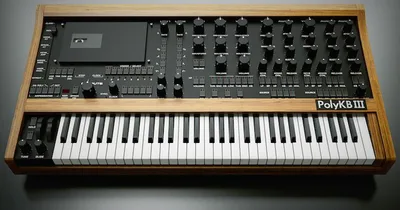
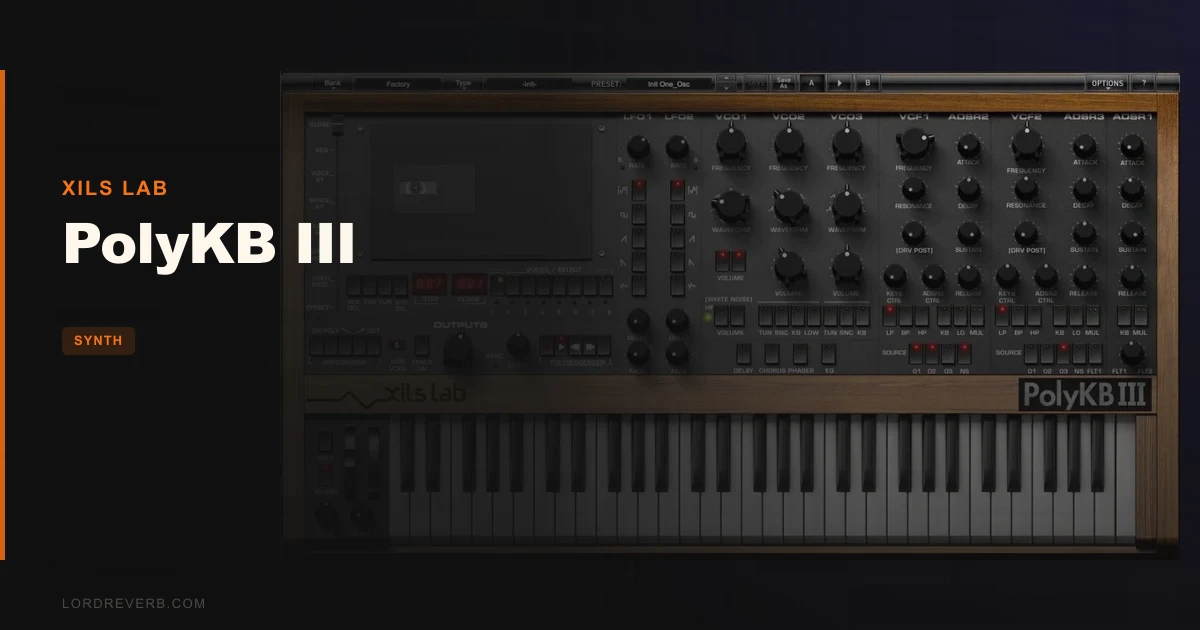
The obvious doubt with PolyKB III is whether it's just nostalgia bait: a plugin selling you the story of a synth almost nobody owned. It's not. The RSF PolyKobol 2 had roughly 30 units ever built, which means XILS Lab wasn't recreating something people remembered. They were recreating something people imagined. And that freed them to make something genuinely strange and useful, rather than a faithful clone of a beloved machine.
PolyKB III is priced at $199. It's built for sound designers, film composers, and any producer who's bored of pulling up the same handful of virtual analog synths and getting the same palette back.
If you write lush pads, evolving sequences, or textural leads, and you want something that moves differently from a Repro-5 or a Prophet V clone, this is worth your time. If you want quick bread-and-butter patches with minimal menu-diving, it probably isn't.
Does It Actually Deliver the RSF Sound?
XILS Lab has been working on PolyKobol emulations for years. PolyKB III is the third generation, and it shows in the build depth.
The foundation is three continuously morphing oscillators. Most analog emulations give you a waveform selector. PolyKB III gives you a continuous sweep from triangle through saw through double-saw to square to pulse, and any modulation source can drive that sweep in real time. That's not a feature you'll find in most competitors. It's the reason the oscillators here sound restless and alive in a way that static-waveform synths don't.
Reviewers consistently report that the filters are where the plugin earns its price. Two 4-pole multimode self-oscillating filters with XILS Lab's 0df technology, cascadeable in series or parallel, each with its own dedicated envelope. That's a genuinely unusual configuration. We've loaded patches that run both filters in series and the resonance behavior gets satisfyingly weird in the high-Q range without the brittle edge you get from some filter models.
The short answer: yes, it delivers.
Where It Shines
The morphing oscillators are the headline feature and they live up to it. We loaded an init patch, set LFO 1 to slowly sweep oscillator 1's morph parameter from triangle to pulse, and within 30 seconds had a pad that breathed in a way we've rarely heard from an ITB instrument. The movement wasn't a filter sweep or a tremolo. It was the actual waveform character changing. That's a different texture entirely.
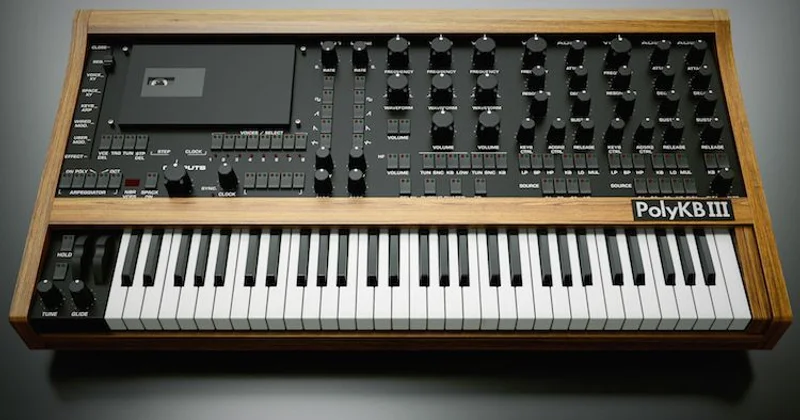
The per-voice modulation system is clever in a way that took us time to fully appreciate. The Voice XY pad places up to 16 voices as moveable balls in a 2D space, with horizontal and vertical axes each mapped to separate synthesis parameters. We set X to control filter 1 cutoff and Y to control oscillator 2 level. Playing a chord triggered voices at different positions, which meant every note in that chord had a distinct filter character. No chorus or unison trick replicates that. It's organic in the literal sense: each voice is genuinely different.
CPU load is also a genuine strength. With 16-voice polyphony active, full modulation routing engaged, and the on-board effects running, we saw load sitting comfortably under 8% on a mid-tier 2024 machine. For a synth this architecturally complex, that's impressive. You can stack instances without worrying.
The 128-step poly-sequencer pulling double duty as a modulation source is something we love. Route it to filter balance between the two VCFs and you get rhythmic timbral shifting that no LFO can reproduce cleanly.
Where It Falls Short
The UI is frustrating. Not ugly, just dense in the wrong places.
The step modulator is the worst offender. Four lines of up to 128 steps, each assignable to up to four destinations via the user matrix. The power is real. But finding your way around it the first few sessions is genuinely annoying. Users keep running into the same problem: understanding that the poly-sequencer and the step modulator are separate engines takes longer than it should. The manual explains it. The interface doesn't.
The Voice XY pad is similarly counterintuitive on first contact. Moving the balls manually is satisfying once you know what you're doing. Getting to that point takes reading, not experimenting.
There's also no standalone mode. That's a real limitation for any producer who wants to use this in a live rig without running a full DAW instance. For studio work it's a non-issue. For live use, it rules the plugin out entirely.
The vintage effects are fine. Chorus, phaser, delay, and EQ all have character. But the EQ especially feels like an afterthought compared to the synthesis engine behind it.
How It Stacks Up Against Real Competition
The fairest comparison is u-he Repro-5, which targets a different hardware origin (the Sequential Prophet-5) but competes for the same buyer: someone who wants serious virtual analog with deep sound design potential.
Repro-5 wins on UI clarity. Every parameter is where you expect it. Its filter is among the best in any software synth. But it doesn't morph oscillators continuously, and its modulation routing is more conventional. If you want the familiar Prophet character with excellent filter behavior, Repro-5 is the stronger pick.
PolyKB III wins on movement. The oscillator morphing, the per-voice XY modulation, and the Space XY spatializer combine to give sounds a dimensionality that Repro-5 doesn't attempt. For pads, evolving textures, and poly-sequenced material, PolyKB III does things Repro-5 simply can't.
Against Arturia's MiniFreak V, PolyKB III is warmer and more sonically coherent in the analog register, but MiniFreak V wins on synthesis variety with its digital oscillator options. Different tools for different jobs.
Against Arturia SEM V, PolyKB III is the more ambitious instrument by a wide margin. SEM V is a character piece. PolyKB III is a full production synth.
Is the Price Fair?
At $199 full retail, this is a harder sell against established competition. But XILS Lab runs sales regularly, and reviewers report bundle pricing that drops the per-instrument cost significantly. If you catch it on promotion, it's an easy yes.
At full price, it depends on what you need. If the oscillator morphing and per-voice modulation directly serve the music you're making, $199 is fair. If you'd use 20% of what it offers, there are simpler synths at lower prices that won't leave features collecting dust.
The inclusion of PolyKB II in the bundle adds genuine value. It's not just a legacy version. Users report it as a useful complement with its own distinct character.
Specs & Technical Details
| Developer | XILS Lab |
| Price | $199 |
| Plugin Format | VST / VST3 / AU / AAX |
| OS Support | Mac OS X 10.8+ (64-bit) / Windows 7, 8, 10 (32 & 64-bit) |
| Activation | XILS Lab license manager |
| CPU Usage | Light to medium |
| Trial Available | Yes (demo available) |
| Version Reviewed | PolyKB III (v3) |
| Polyphony | Up to 16 voices |
| Oscillators | 3 morphing + 1 noise |
| Filters | 2 x 4-pole multimode self-oscillating (0df) |
| Envelopes | 3 loopable ADSR |
| LFOs | 2 syncable + 1 Sample & Hold |
| Sequencer | 128-step polyphonic sequencer / 4x128 step modulator |
| Effects | Chorus, Phaser, Delay, EQ |
| Standalone | No |
Score Breakdown
| Category | Score | Notes |
|---|---|---|
| Sound Quality | 4.5/5 | Oscillator morphing and dual-filter routing produce genuinely distinctive character |
| Value for Money | 4.0/5 | Full price is steep but sale pricing makes it a strong buy |
| Ease of Use | 3.5/5 | Step modulator and matrix require real time investment before they click |
| Features | 4.5/5 | Per-voice XY, 128-step poly-sequencer, and dual 0df filters are a formidable combination |
| CPU Efficiency | 4.5/5 | Runs light for this level of synthesis complexity; stackable without concern |
| Overall | 4.3/5 | A deep, distinctive virtual analog that rewards patience; not a beginner's first synth |
Alternatives to Consider
If you want a cleaner UI with excellent filter modeling, u-he Repro-5 is the benchmark. It won't morph oscillators or give you per-voice spatial placement, but it's easier to dial in fast and the sound is outstanding.
For something with more synthesis variety beyond the analog palette, Arturia MiniFreak V brings digital oscillator modes alongside analog-modeled filtering. More flexible, less focused on the "warm analog" specific character.
If you want analog character with minimal complexity, Arturia SEM V is a leaner, more immediate option. Less modulation depth, but you're up and running in five minutes rather than fifty.
For a completely different flavor of synthesis that still sits in the "unusual and underrated" bracket, check out AudioThing SX1000, which approaches Italian synth emulation from a different angle with its own distinct character.
And if you're building out a broader sound design toolkit, Applied Acoustics Chromaphone 3 covers percussion and acoustic body synthesis territory that PolyKB III doesn't touch at all.
PolyKB III is worth $199 if you make pads, evolving sequences, or complex poly textures and you're tired of every analog emulation sounding the same. It's wrong for you if you need fast, simple patch creation, a standalone mode for live use, or a plug-and-play workflow. The oscillator morphing alone is worth the price of admission for the right producer. For everyone else, the learning curve is real, and the alternatives are strong.
Frequently Asked Questions
What is the RSF PolyKobol 2 and why does it matter for PolyKB III?
The RSF PolyKobol 2 was a French polyphonic synthesizer built in the late 1970s. Fewer than 30 units were ever manufactured, making it one of the rarest hardware synths in existence. Artists including Jean-Michel Jarre and Vangelis used RSF instruments. XILS Lab's PolyKB III emulates the PolyKobol 2's core architecture, particularly its continuously morphing oscillators, which were a unique feature not found in contemporary hardware.
How does the oscillator morphing actually work in practice?
Each of the three oscillators can sweep continuously through a waveform range: triangle, saw, double-saw, square, and pulse. Any modulation source in the synth, including LFOs, envelopes, or the step modulator, can drive that sweep in real time. This means the oscillator's timbral character is never static. It's a fundamentally different behavior from a synth that switches between discrete waveforms.
Is PolyKB III suitable for beginners?
Honestly, not as a first synth. The core oscillator and filter architecture is learnable, but the step modulator, user modulation matrix, and per-voice XY systems are deep and require genuine study. If you've spent real time with synths like Massive, Serum, or even a hardware analog, you'll navigate PolyKB III. If you're brand new to synthesis, start somewhere with a cleaner interface and come back to this one later.
Does PolyKB III come with PolyKB II included?
Yes. The bundle includes PolyKB II as a companion instrument. Users report that PolyKB II has its own distinct character and is worth keeping installed alongside PolyKB III, rather than treating it as a redundant legacy version. The two instruments share a lineage but behave differently enough that both earn their place in a signal chain.