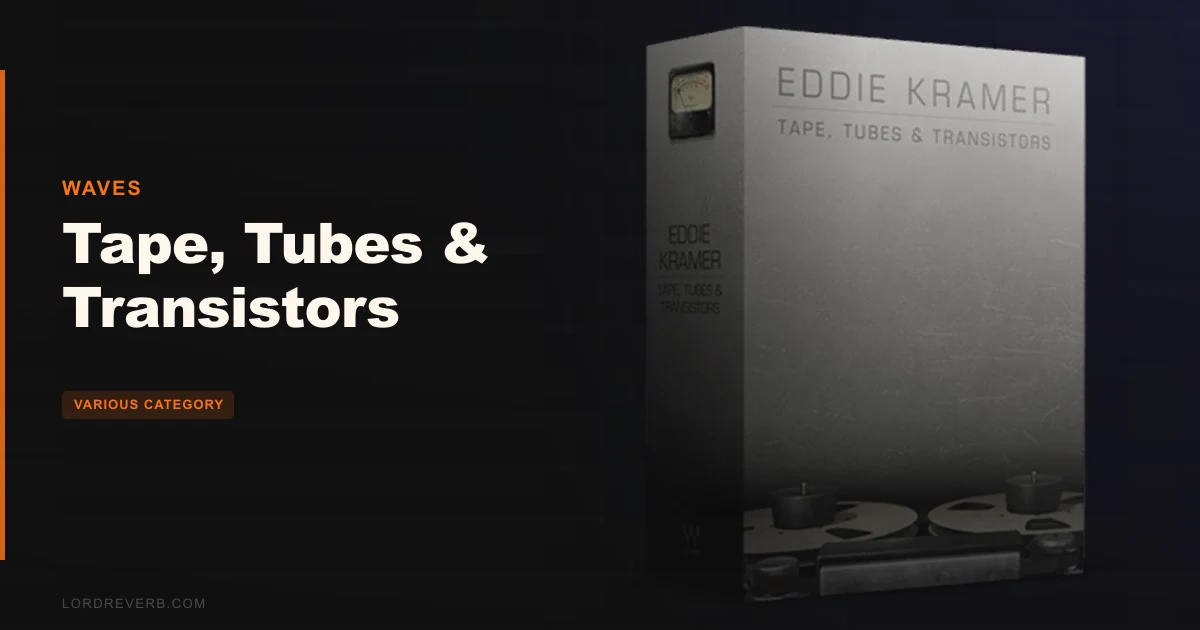
The Waves Tape, Tubes & Transistors bundle is a genuinely clever piece of kit for the price, and at $69.99 it's one of the more honest value propositions in Waves' catalogue. Three plugins. One signal chain. The Olympic Studios path that ran from Helios console to Pye compressor to Ampex tape, the exact chain that shaped early Led Zeppelin, Hendrix at his peak, and the Stones' rawer records. If you want that character ITB without hunting down three separate purchases, this bundle earns its place in the session. It's not perfect. There are real workflow annoyances that reviewers and owners flag consistently. But at $69.99, you'd struggle to replicate this level of historically grounded modeling for less.
What You're Actually Getting
Three plugins. All modeled on the Olympic Studios signal chain, built in close collaboration with Eddie Kramer, who was actually in those rooms.
The Kramer HLS Channel models the Helios console from the Rolling Stones' mobile recording truck. That console is responsible for a specific top-end clarity and low-end weight that's hard to fake with a generic EQ.
The Kramer Master Tape models the Ampex 350 with 351 electronics. You get tape speed, bias, and the option to include analog imperfections. It works as a tape saturation plugin and as an echo unit depending on how far you push the delay parameters.
The Kramer PIE Compressor is the Pye compressor. Owners report it's musical in a way that's annoying to describe precisely: the bus narrows and then opens up, bass gets focused, the top end settles.
All three run on Mac (macOS Monterey 12 through Sequoia 15) and PC (Windows 10 or later), in VST, AU, and AAX formats.
The Good
Start with the PIE. Owners consistently report the same thing: put it on the master bus and something shifts. The developer says it captures fat low end and high-end presence, and the user reports back that claim up. Bass gets weight. Highs stop competing. Reviewers describe a 3D quality appearing on the master bus that wasn't there before.
It also works on individual sources. Load it on a bass bus and push the ratio. The compression is, as one owner put it, "quite noisy but super musical." That noise isn't a flaw for this kind of processing. It's part of the character.
The HLS Channel's LF section is genuinely brilliant for kick drums. Owners describe it as "deadly for adding weight and impact." That's not marketing language. That's the Helios doing what the Helios did in 1971.
Master Tape's echo functionality is a satisfying surprise. Dial it toward crystalline and you get a clean, musical slap. Push the bias warmer and it gets murky in a way that sits behind a vocal without fighting it.
The collaboration with Eddie Kramer isn't a branding exercise either. It's the difference between a modeled console and a modeled console someone actually used to make those records. That specificity matters for analog modeling plugins.
The Not-So-Good
The Master Tape zipper noise issue is real and frustrating. Change the delay time while audio is passing through and you get an audible artifact. This isn't catastrophic, but it means you can't automate the delay live without a workaround. Annoying. Set it and leave it.
The HLS EQ has fixed bandwidth. You can't adjust the Q. That's a deliberate modeling choice because the original hardware worked that way, but it means you can't use the HLS Channel for surgical frequency work. If you need to notch a resonance at 1.2 kHz with a tight Q, reach for a different EQ. The HLS is a tone-shaping tool, not a correction tool.
CPU load with multiple instances is a real concern. Running three instances of HLS across a session, plus Master Tape on the bus, adds up. Reviewers flag this. It won't ruin a modern machine, but you'll feel it before you run out of tracks.
And honestly? The graphic interface can be divisive. Some producers love the vintage look. Others find it adds visual weight without adding clarity.
Compared to the Alternatives
Slate Digital's virtual tape machine and analog summing plugins are the most direct comparison. Users who've gone both directions describe them as roughly on par with the Waves bundle in terms of tape character. Slate's subscription model is a different financial logic entirely, though. Worth comparing if you're not already in Slate's ecosystem.
For the channel strip side, Plugin Alliance's vintage console emulations get recommended alongside Waves consistently. If the HLS Channel's fixed EQ bandwidth frustrates you, Plugin Alliance has options with more surgical flexibility.
FabFilter and iZotope don't compete directly on vintage character, but users who've moved away from Waves cite pricing models and integration as reasons. If you're already deep in FabFilter's FabFilter Pro-Q review and iZotope's world, this bundle adds something those don't: historical specificity and tape behavior on the master bus.
Nothing at $69.99 gives you the Helios, the Pye, and the Ampex as a unified chain. That's a real differentiator.
Who Should Buy This
- ✅ Buy if you track rock, blues, or classic soul and want the Olympic Studios signal chain ready to drop on any bus in your session.
- ✅ Buy if the PIE Compressor on the master bus sounds like the missing piece in your mix. Load it on a rough mix and push the output. Check the low end.
- ✅ Buy if you want tape echo functionality that ranges from studio-clean slap to murky, saturated wash, all inside one plugin.
- ❌ Skip if you need a surgical channel EQ. The HLS won't give you adjustable bandwidth. Full stop.
- ❌ Skip if you automate delay time in real time. The zipper noise issue is a workflow blocker in that specific scenario.
- ❌ Skip if you're already running a heavy session on a mid-range machine. Multiple instances will cost you headroom you may not have.
Specs & Technical Details
| Developer | Waves |
| Price | $69.99 |
| Plugin Format | VST / AU / AAX |
| OS Support | Mac (macOS Monterey 12, Ventura 13, Sonoma 14, Sequoia 15) / Windows 10+ |
| Activation | Waves License Center |
| CPU Usage | Medium to heavy with multiple instances |
| Trial Available | Check Waves website |
| Version Reviewed | N/A |
Score Breakdown
| Category | Score | Notes |
|---|---|---|
| Sound Quality | 4.5/5 | Historically grounded modeling with real character on the master bus |
| Value for Money | 4.0/5 | Three plugins, one signal chain, a famous engineer's fingerprint: fair deal at this price |
| Ease of Use | 3.5/5 | Simple controls, but the fixed EQ and zipper noise issue limit real-time flexibility |
| Features | 4.0/5 | Tape, console, and compression covered; imperfections mode is a satisfying touch |
| CPU Efficiency | 3.0/5 | Multiple instances get heavy; plan your instance count before committing to a mix |
| Overall | 4.0/5 | A focused, credible vintage chain that earns its place on the master bus |
Alternatives to Consider
If the fixed bandwidth EQ is a dealbreaker, look at Slate Digital Virtual Console Collection. It covers console saturation and character without locking you out of surgical corrections, and the modeling quality is described as on par with Waves by producers who've used both.
For tape specifically, best tape saturation plugins covers a range of options including Slate's Virtual Tape Machines. If you only need the tape layer and already have compressors and EQs you love, buying the full bundle may be unnecessary.
Plugin Alliance's vintage channel strip offerings are worth a look if you're building an analog-character chain piece by piece and want adjustable bandwidth at each stage. Their Neve and API-style models give you more EQ flexibility than the HLS Channel does.
The Verdict
At $69.99, this is a genuinely good bundle if you know what you're buying. You're not buying a flexible, modern channel strip. You're buying a specific room, a specific chain, and a specific engineer's approach to it. The PIE on the master bus is the star. The HLS is excellent for tone-shaping on sources where the fixed bandwidth won't get in your way. Master Tape adds the tape layer that ties it together, zipper noise and all.
If you're making music that has no business being compared to Hendrix or Led Zeppelin, you'll still find uses for this. The PIE alone justifies a long look.
But if you need surgical EQ, real-time delay automation, or CPU headroom to spare, this isn't the bundle. That's not a failure of design. It's honest to what it is. The Helios console wasn't built for surgical corrections either.
Know what you're chasing. Then decide.
Related reviews: Q-Series Invader Bundle Still Beats Amp Sims in 2026 · Manny Marroquin Signature Series vs Stacked Chains
Frequently Asked Questions
What does the Tape, Tubes & Transistors bundle actually include?
Three plugins: the Kramer HLS Channel (Helios console), the Kramer Master Tape (Ampex 350 with 351 electronics), and the Kramer PIE Compressor (Pye buss compressor). All three are modeled on the Olympic Studios signal chain in collaboration with producer Eddie Kramer, who used the original hardware on sessions with Led Zeppelin, Hendrix, and the Rolling Stones.
Is the HLS Channel good for corrective EQ work?
No. The HLS EQ has fixed bandwidth with no user-adjustable Q. It's a tone-shaping tool built to behave like the original Helios hardware. If you need to notch a narrow resonance or apply precise surgical corrections, you'll want a separate EQ in your signal chain. The HLS works best for broad tonal color and the low-end weight the Helios console is known for.
What's the zipper noise issue with Master Tape?
When you change the delay time on Master Tape while audio is passing through, it produces an audible step artifact. It's not a subtle thing. This means you can't automate the delay parameter in real time without hearing the artifact. The workaround is to set your delay time before the audio starts, or bypass the plugin during any delay change. Check the current version before buying, as Waves has updated the bundle since the original release.
How does the PIE Compressor work on the master bus?
Owners report that the PIE on the master bus produces a cohesion that's hard to replicate with transparent modern compressors. The low end focuses, the high end settles, and the whole mix takes on what reviewers describe as a 3D quality. It is, as users note, noisy by modern standards. That noise is part of the character, not a defect. If you're after a clean, transparent master bus compressor, this isn't it. If you want a vintage buss with attitude, try it last in your master bus chain before you reach for anything else.