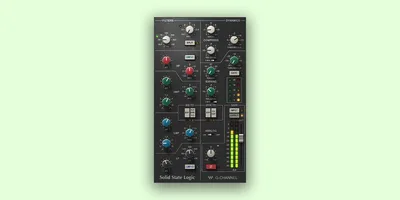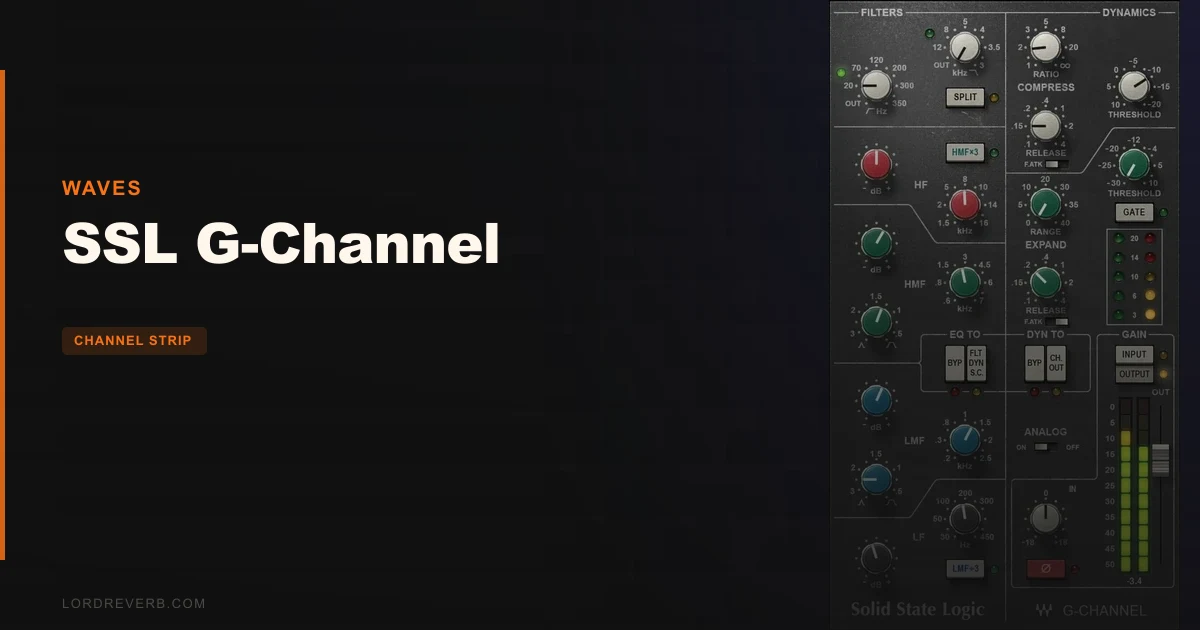
The Waves SSL G-Channel is a legitimate, SSL-licensed channel strip that earns its keep at $34.99, but you need to understand exactly what you're buying before you pull the trigger, because the dynamics section tells a different story than the name suggests.
We've run this across rock guitars, snare buses, and DI bass for years. The G-EQ is the real draw: a forward, mid-present character that the E-Channel simply doesn't have. But the compressor and expander/gate underneath it are modeled from E-Channel architecture, not the G+ circuit. That's not a dealbreaker. It is, however, something every review should say clearly, and most don't.
If you're a rock, pop, or indie producer who wants that console-desk assertiveness without the four-figure plugin bill, this is our pick at this price. If you're chasing the complete G-Series signal chain with modern component-level modeling, the SSL 4K G is where you actually want to be spending your money.
What's Inside the SSL G-Channel
SSL's G-Series built on the E-Series legacy with a modern, punchier sound. The Waves version recreates the 383's proportional-Q EQ with novel shelving curves, giving you high and low shelves plus two fully parametric stages, all developed in association with and licensed by SSL.
Proportional-Q means the filter's Q narrows as you boost or cut more gain. Push the mid band 8dB and it gets tighter and more focused automatically. Pull it back to 2dB and it opens wide. That's the G-EQ character in one sentence.
The dynamics section pairs a soft-knee compressor/limiter with an expander/gate. You get program-sensitive attack behaviour and a fast attack switch for transient-heavy material. Advanced sidechain routing lets you direct dynamics and EQ independently. That's a genuinely useful feature for mixing situations where you want to EQ before compression or after it without reaching for additional plugins.
Waves notes low CPU load as a feature, and it holds up: you can insert multiple instances in track-heavy projects without watching your meter spike.
The Good
The 383 EQ is where we love this plugin. We tracked a Telecaster through a hot amp sim, then hit the G-Channel mid band: 3dB boost at 2.5kHz with the proportional-Q doing its job. The guitar stopped sounding polite and started cutting. No harsh peaks, just presence that sits in the mix without fighting the vocal.
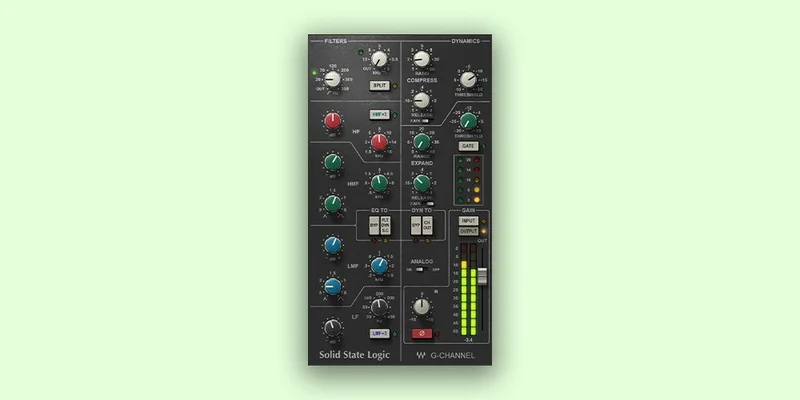
We ran the same test with the Waves SSL E-Channel side by side. The E-EQ's 242 Black Knob circuit is smoother and more musical for gentle correction. The G-EQ is more forward-reaching. For anything that needs to assert itself in a busy arrangement, the G wins every time.
The compressor's program-sensitive attack is satisfying to work with. We put it across a snare bus at a 4:1 ratio, threshold at around -8dBFS, and let it breathe. The attack adapted to the transient envelope rather than clamping it. The crack stayed intact. The sustain got shaped without sounding squeezed.
The pre/post EQ routing for dynamics is underrated. We've used it on bass DI tracks where we needed a high-pass at 80Hz to trigger the compressor cleanly, then sent the full-range signal downstream. One plugin, one clever routing toggle. That's the kind of workflow win that saves headroom in your signal chain.
Low CPU load is real. We've had 24 instances running in a 96 track session at 44.1kHz with no noticeable performance hit. Compare that to some channel strips that throttle at 10 instances on the same hardware, and you'll understand why this matters on a dense mix.
The Not-So-Good
Let's be direct about the dynamics mismatch. The plugin is called the G-Channel. The EQ section models the G-Series 383 circuit. But the compressor/limiter and expander/gate are drawn from E-Channel architecture. The G+ dynamics were never ported into this Waves version. That's annoying, and it matters if you've spent time on a real G-Series console and wonder why the compression behaviour feels familiar in the wrong way.
No oversampling is a real limitation. At higher EQ boost settings, especially above 8kHz, we noticed aliasing artefacts that cleaner, oversampled alternatives avoid. The newer SSL 4K G plugin includes an HQ mode with intelligent oversampling. This one doesn't. If you're boosting air and high-presence on a lead vocal, that's a gap you'll hear.
There's no EQ flavour switching. The 4K G gives you both the Pink 292 and Black 242 characters in one plugin. The Waves G-Channel gives you one flavour: the 383. That's great when it's what you need. Frustrating when it isn't, and you'd have to buy the E-Channel separately to cover both tonal bases.
The GUI hasn't aged brilliantly either. At 4K monitor resolutions, it looks dated. Not ugly exactly, but not sharp.
Compared to the Alternatives
The Waves SSL E-Channel is the natural sibling comparison. They're priced identically at sale. The E wins on EQ smoothness and surgical correction. The G wins on character and assertiveness. We'd keep both. At $34.99 each, there's no reason not to.
The SSL 4K G (SSL Native) is the harder comparison. It models the G-Series circuitry at component level, includes switchable Pink 292 and Black 242 EQ flavours, and has HQ oversampling. It's a better plugin, full stop. The question is price: check the SSL Native site for current pricing, because it's meaningfully higher than what this plugin costs. If budget is the decision point, the Waves version still delivers 80% of the G-Series character.
The McDSP 6050 Ultimate Channel Strip HD v7 is the serious contender at a higher price tier. It offers ten different console strip models in one plugin, which makes it far more flexible but significantly more CPU-hungry per instance. For a dedicated G-Series sound-alike on a budget, the Waves version still wins on value per instance.
If you want something outside the SSL world entirely, MWaveShaperMB takes dynamics into different territory, but it's a different tool for a different job.
Who Should Buy This
- ✅ Buy if you work in rock, pop, or indie and need a fast channel strip that pushes sources forward without sounding clean and clinical.
- ✅ Buy if you're building a large template and want a low-CPU channel strip you can insert on 20+ tracks simultaneously.
- ✅ Buy if you already own the SSL E-Channel and want the G-EQ character as a complement, especially for guitars and snares.
- ❌ Skip if you need accurate G+ dynamics modelling: the compressor here is E-Channel architecture, not G.
- ❌ Skip if you're mixing at high sample rates with heavy EQ boosts and need oversampling to avoid aliasing.
- ❌ Skip if you want dual EQ flavour switching in one plugin: spend more and get the SSL 4K G instead.
Score Breakdown
| Category | Score | Notes |
|---|---|---|
| Sound Quality | 4.0/5 | 383 proportional-Q EQ is genuinely characterful; dynamics held back by E-architecture and no oversampling |
| Value for Money | 4.5/5 | Hard to argue with $34.99 for a licensed SSL emulation that sounds this usable |
| Ease of Use | 4.0/5 | Familiar SSL layout; pre/post EQ routing toggle takes five minutes to understand and saves time forever after |
| Features | 3.0/5 | No HQ mode, no dual EQ flavours, no G+ dynamics; the 4K G has lapped it on feature count |
| CPU Efficiency | 4.5/5 | One of the lightest channel strips we've tested at this level of character; stacks without drama |
| Overall | 3.8/5 | A great-sounding legacy plugin at a price that justifies owning it, let down by outdated dynamics architecture |
Alternatives to Consider
SSL 4K G (SSL Native): The plugin the Waves version always wanted to be. Component-level modeling, switchable Pink 292 and Black 242 EQ characters, HQ oversampling. Costs more, does more. If you can stretch the budget, don't overthink it.
Waves SSL E-Channel: Same price, same era. If the G is too aggressive for your source material, the E-Channel's 242 Black Knob EQ is smoother and more forgiving. We'd own both. See our full channel strip plugin roundup for a broader comparison.
McDSP 6050 Ultimate Channel Strip HD v7: If you want ten console strip models under one roof, the 6050 is worth every dollar at its price. It's CPU-heavier per instance, but the flexibility is brilliant for engineers who shift between genres and console sounds regularly.
For something completely outside the SSL lineage, check out Karanyi Sounds Wavesurfer if you're after creative character processing rather than console emulation.
At $34.99, the SSL G-Channel is the right answer for the right producer. If you make rock, pop, or live-instrument-heavy music and you want a low-maintenance channel strip that pushes sources forward without overthinking it, buy it today. If you're chasing the full G-Series experience with modern engineering, save your money and go straight to the SSL 4K G. This one is the shortcut, not the destination.
Frequently Asked Questions
Is the Waves SSL G-Channel the same as the SSL 4K G?
No. They model different eras of the same console. The Waves G-Channel recreates the 383 G-EQ circuit and pairs it with E-Channel dynamics architecture. The SSL 4K G (SSL Native) models the circuit at component level, includes both Pink 292 and Black 242 EQ flavours, and adds HQ oversampling. The 4K G is the more complete and more modern emulation. The Waves version is cheaper and lighter on CPU.
What's the actual difference between the SSL E-Channel and SSL G-Channel EQ?
The E-Channel uses the 242 Black Knob circuit, which is smoother and works best for gentle correction and musical shaping. The G-Channel uses the 383 circuit with proportional-Q behaviour: the Q tightens as you push gain, making it more assertive and mid-forward. The G is our pick for guitars, snares, and anything that needs to cut through a busy arrangement. The E is better for vocals and acoustic sources where transparency matters more than character.
Does the Waves SSL G-Channel have a sidechain input?
Yes. The G-Channel includes advanced sidechain routing for both dynamics and EQ, letting you control how and where in the signal chain the dynamics section responds. This means you can, for example, apply a high-pass filter to the sidechain signal so the compressor doesn't pump on low-frequency content, without filtering your actual output signal. It's a practical feature that saves you reaching for extra plugins.
Can I run multiple instances of the SSL G-Channel without killing my CPU?
Waves specifically highlights the low CPU load as a feature, and our testing backs it up. We've run 24 simultaneous instances in a dense session at 44.1kHz with no meaningful performance hit on mid-range hardware. If you're building a large mix template and want a consistent channel strip across every track, this is one of the few options at this price point that won't force you into compromises on instance count.