
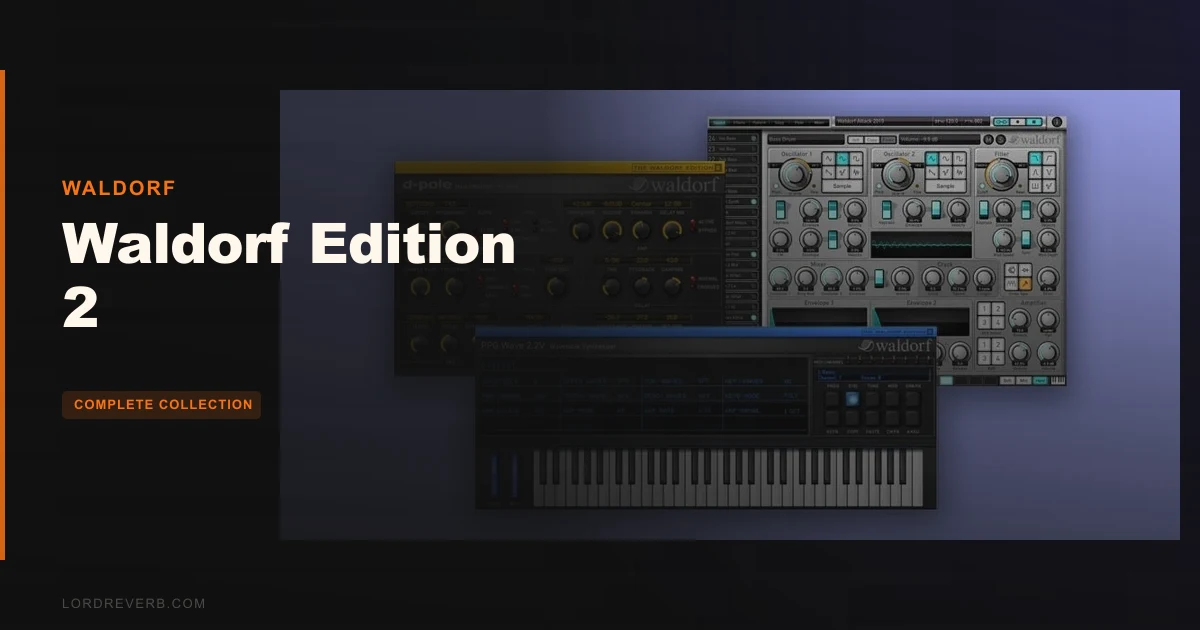
Waldorf Edition 2 is a three-plugin bundle containing the PPG Wave 2.2V synthesizer, the Attack percussion synth, and the D-Pole filter, available at $69.99. It's built for producers who want that specific mid-'80s digital-analog hybrid sound: wavetable tones with grit, drum synthesis that goes well past sample replacement, and a filter plugin that can push a signal to the edge of self-destruction.
Quick verdict: At $69.99 for three plugins with genuine depth, the value case is real. But the bundle ships with bugs that owners notice quickly. Sample-loading in Attack breaks. Parameter lag in the GUI is frustrating. If you're after a polished, set-and-forget experience, this isn't it. If you're willing to work around some instability to get sounds you can't easily get elsewhere, it earns its place in the rack.
What's Actually Inside This Bundle
Three plugins. Different jobs. Worth knowing what each one is before you load any of them.
PPG Wave 2.2V is a software model of the legendary PPG Wave 2.3, the wavetable synthesizer that shaped sounds from the early 1980s. It carries 32 wavetables with 64 waveforms each and over 700 presets. It runs 8-part multitimbral with up to 64 voices per instance and offers 2 stereo outputs. There's a synced arpeggiator built in.
Attack is a percussion synthesizer: 36 kits, 24 sounds per kit, over 850 sounds total. Each sound runs 2 oscillators with frequency modulation and ring modulation available. Six filter types go all the way to self-oscillation. Overdrive hits up to 52dB. The effects chain covers Delay, EQ, Drive, Phaser, Flanger, Chorus, and Reverb. Six stereo outputs, up to 64 voices, and Attack also handles polyphonic bass and lead synthesis using virtual analog.
D-Pole is the filter plugin. Five types: Low Pass, Band Pass, High Pass, Notch, and Resonator. Slopes at 12dB or 24dB per octave. Resonance goes to self-oscillation. Overdrive up to 52dB. Ring modulation and sample rate reduction are both on board. The LFO runs past 7000Hz and syncs to tempo or audio. The delay maxes at 2000ms and also syncs to tempo.
All three got a resizable GUI in this version. Owners call it smooth for workflow. That's the list.
Where This Lands In A Real Session
Picture this: you're building a track that needs to sit somewhere between cold digital and warm analog. Straight sample libraries aren't doing it. The drums sound fine but not designed. The synth patches feel borrowed. You want the texture of hardware you don't own.
That's the session where Edition 2 makes sense. You'd load PPG Wave 2.2V on a lead or pad channel and start scanning wavetables. The 8-part multitimbral setup means you can run it across multiple MIDI channels from a single instance, which is genuinely useful if you're tight on CPU budget. Two stereo outputs give you routing options for separate processing in your DAW.
Attack sits on your drum bus or on individual MIDI tracks. The six stereo outputs let you route kick, snare, and percussion to separate channels for individual compression and EQ. You design sounds in real time: change oscillator FM depth, sweep the filter, push the overdrive. Everything computes live, so you hear parameter changes immediately.
D-Pole drops into any insert slot as a send effect or a straight processor. Push the LFO past a few hundred Hz and it starts behaving like a sideband modulator. At 7000Hz it's closer to ring mod territory than traditional LFO. That 2000ms tempo-synced delay on board means you don't always need a separate delay plugin in the chain.
One hard requirement: check your Pro Tools version before you buy. Pro Tools 2023.9 is currently unsupported on both Windows and macOS. Pro Tools 2023.3 works on macOS but only in Rosetta mode. No standalone versions exist, and there's no demo. You're buying without a test drive.
What It's Genuinely Good At
The PPG Wave 2.2V is the centerpiece, and for good reason. Wavetable synthesis with 64 waveforms per table produces harmonic movement that static oscillators simply can't replicate. If you love it, nothing else gives it to you this cheaply.
The multitimbral engine is legitimately useful. Eight parts, one instance, 64 voices. For layered arrangements that need to breathe, that headroom matters.
Attack is underrated. Owners who dig into it consistently report that it goes places most drum synths don't. The combination of FM between the 2 oscillators, ring modulation, and 52dB of overdrive gives you territory from clean tuned percussion through to completely destroyed industrial hits. The self-oscillating filters push resonance into the kind of pitched drone you'd normally need a dedicated synth for. That's clever design in a dedicated drum tool.
The 6 stereo outputs in Attack are a practical win. Route your kick to output 1, snare to output 2, and you're treating them as individual channels in your DAW. No bus splitting tricks needed.
D-Pole's LFO going past 7000Hz is the spec that owners don't always notice at first. That's audio-rate modulation. Put it on a resonant bandpass and you're generating sidebands. It's unconventional for a filter plugin. Satisfying when it works.
The Rough Edges
Here's where the honest part starts.
Attack's sample-loading breaks. Multiple owners report it. You load samples, they stop working, you reload. That's not a minor quirk in a percussion synth: it interrupts the session, it breaks creative flow, and it's the kind of bug that should have been fixed before the release shipped.
The GUI parameter lag is annoying in a different way. On a plugin this focused on hands-on sound design, it creates a frustrating disconnect between what you do and what you see.
Some owners report PPG Wave outputting a very quiet signal and describe the tone as weak or plasticky. That's not a universal experience from the reports, but it's frequent enough to be worth knowing. Gain staging into PPG Wave carefully and check your output levels before you commit to a patch.
D-Pole becomes CPU-intensive when you push parameters hard. Self-oscillating resonance at high LFO rates is where it gets hungry. Not a dealbreaker, but watch your CPU meter.
And then there's the Pro Tools 2023.9 problem. Unsupported. No workaround listed. If that's your primary DAW and you're on a recent version, stop here.
One broader complaint from owners deserves a mention: some feel this is the old Waldorf Edition with new bugs rather than real improvements. That's a legitimate grievance if you already owned the previous version and upgraded expecting a meaningfully different product.
Who This Is Really For
- ✅ Buy if you want classic PPG Wave wavetable tones in a more affordable bundle than PPG 3.
- ✅ Buy if you want a percussion synth that goes from TR-808/909-style analog synthesis to custom FM drum design in one plugin.
- ✅ Buy if you're on macOS or Windows and running a DAW that supports VST2, VST3, AU, or AAX (and not Pro Tools 2023.9).
- ❌ Skip if you use Pro Tools 2023.9 on either platform: it's currently not supported.
- ❌ Skip if plugin stability is non-negotiable for you: the Attack sample-loading bug and GUI lag are real.
- ❌ Skip if you need a demo before committing: there isn't one, and there's no standalone mode to test outside a DAW.
Specs & Technical Details
| Developer | Waldorf |
| Price | $69.99 |
| Plugin Format | VST2, VST3, AU, AAX (NKS supported) |
| OS Support | macOS 10.14 or higher (64-bit Intel / Apple Silicon); Windows 7/10/11 (Intel or AMD) |
| Activation | N/A |
| CPU Usage | Medium to heavy (D-Pole becomes CPU-intensive at parameter extremes) |
| Trial Available | No |
| Version Reviewed | N/A |
Score Breakdown
| Category | Score | Notes |
|---|---|---|
| Sound Quality | 3.5/5 | PPG Wave and Attack deliver genuinely distinctive tones; some owners report PPG output as weak or plasticky |
| Value for Money | 4.0/5 | Three plugins together offer strong feature depth if the stability issues don't block your workflow |
| Ease of Use | 3.0/5 | Resizable GUI helps, but parameter lag and sample-loading instability in Attack cost real points |
| Features | 4.0/5 | 32 wavetables, 850+ percussion sounds, audio-rate LFO in D-Pole: the feature list punches above the price |
| CPU Efficiency | 3.0/5 | D-Pole gets hungry at extremes; 64 voices per instance in PPG Wave and Attack can add up fast |
| Overall | 3.5/5 | Genuinely capable bundle held back by stability issues that shouldn't exist at launch |
Alternatives to Consider
Microtonic is worth a look if Attack's instability worries you and drum synthesis is your main goal. It's a dedicated drum synth with a strong reputation for reliability and its own distinct sound design approach.
Tremor is another drum machine alternative that competes in a similar space. If rhythmic variety and sequencing depth matter more to you than raw synthesis power, it's worth comparing directly against Attack's feature set.
PPG 3 is the higher-end Waldorf option for wavetable work and sits at nearly 3x the bundle price. If PPG Wave 2.2V is the main draw for you and you want a more complete, supported experience, it's the obvious next step up.
Drumatic 4 is a drum machine alternative that owners mention as gaining ground in this space. If you want a lighter-weight drum synthesis option without the full bundle commitment, it's worth checking.
The Final Call
Waldorf Edition 2 is a bundle with a real identity problem. The components are genuinely interesting: a faithful PPG Wave model with serious wavetable depth, a percussion synth that goes from TR-808 territory to full FM destruction, and a filter plugin with audio-rate LFO that most producers haven't fully explored. At $69.99, the price-to-feature ratio is hard to argue with on paper.
But paper doesn't break your session. Attack's sample-loading does. The GUI lag does. And if you're on Pro Tools 2023.9, nothing in this bundle works at all right now.
Buy it if you're chasing that PPG wavetable sound and want a capable percussion synth alongside it, and you're on a compatible DAW. Set your expectations: this is a tool that rewards patience and manual sound design, not one that behaves perfectly out of the box.
If you need stability above everything else, let someone else do the beta testing.
Frequently Asked Questions
Does Waldorf Edition 2 work with Pro Tools?
Partially. Pro Tools 2023.3 works on macOS but only in Rosetta mode. Pro Tools 2023.9 is currently unsupported on both Windows and macOS. If you're on a recent Pro Tools version, check Waldorf's compatibility list before purchasing.
Is there a free trial or demo version of Waldorf Edition 2?
No. There's no demo version and no standalone mode for any of the three plugins. You'll need a host DAW to run them, and you're committing to the purchase without a test run. Factor that into the decision.
Can Attack be used for melodic synthesis, not just drums?
Yes. Attack handles polyphonic bass and lead sounds using virtual analog synthesis. The 2 oscillators per sound with FM and ring modulation, combined with 6 filter types, give it real range beyond percussion. Several owners use it exactly this way.
How does PPG Wave 2.2V compare to the original hardware?
Waldorf models it after the PPG Wave 2.3, and the developer describes it as an accurate model of that instrument. It carries 32 wavetables with 64 waveforms each and over 700 sounds. Owners report PPG Wave sometimes outputs a very quiet signal and can sound weak and plasticky, so check your gain staging and output levels carefully.
What formats does Waldorf Edition 2 support on Apple Silicon Macs?
On macOS, all three plugins support VST2, VST3, AU, and AAX formats with NKS support. Apple Silicon Macs are supported natively. macOS 10.14 or higher is required, on a 64-bit Intel or Apple Silicon machine.