
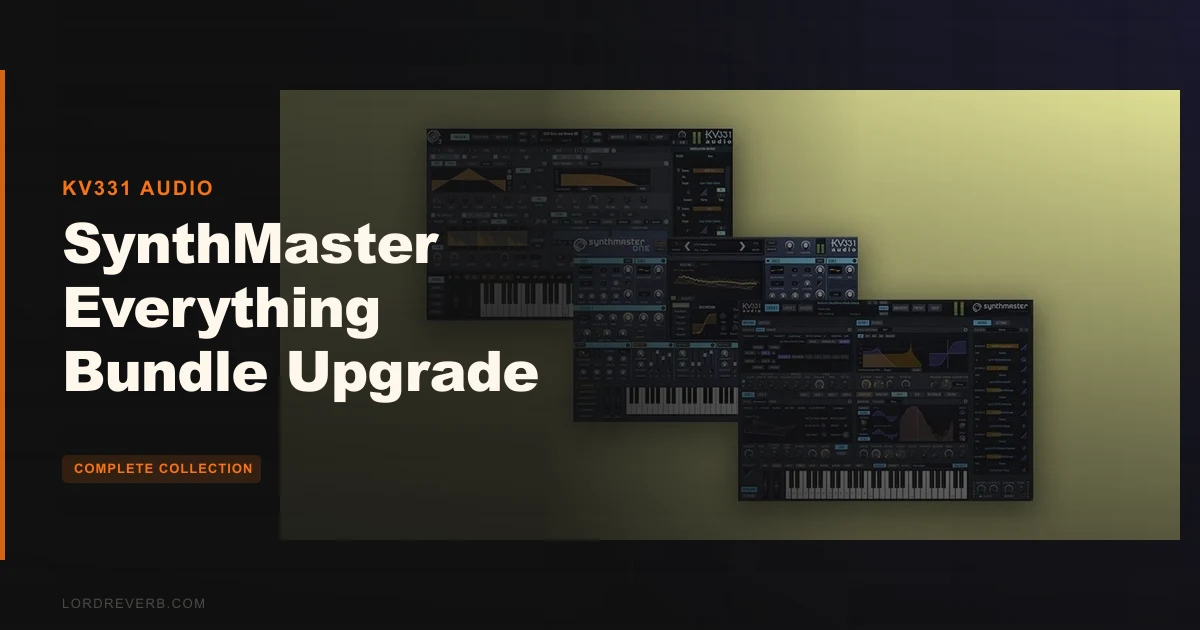
If you own SynthMaster 2 and you're wondering whether the Everything Bundle Upgrade is worth $79, the honest answer is: it depends entirely on how deep you actually want to go. This upgrade hands you SynthMaster 3, SynthMaster One, 7,200+ presets across all versions and 52 expansion packs, plus every future preset bank KV331 Audio releases. That's a legitimate offer. But SynthMaster 3 is a genuinely complex instrument with a dense interface, a history of crashes during heavy editing, and documentation that hasn't kept up with the product. If you're a preset browser who wants more sounds and a few new synthesis engines to explore, this is a satisfying step up. If you're the kind of producer who needs to get inside a synth and rewire it from scratch, be ready for some frustration before the payoff arrives.
What You're Actually Upgrading To
The core of this upgrade is SynthMaster 3. Where SynthMaster 2 gave you a capable semi-modular synth, SynthMaster 3 pushes the architecture to 16 layers per instance, with up to 16 modules and 32 modulation sources per layer.
The synthesis engine is the headline. SynthMaster 3 covers VAnalog, Additive, Vector, Wavetable, Granular, Phase Modulation, Phase Distortion, Frequency Modulation, Pulse Width Modulation, Ring Modulation, Physical Modeling and SFZ Sample Playback. That's 12 distinct synthesis modes accessible from the same instrument.
Generator modules include the Basic Oscillator, Additive Oscillator, Vector Oscillator, Wavetable Oscillator, VAnalog Oscillator, Granular Oscillator and Modulator. Effect modules cover Digital Filter, VAnalog Filter, State Variable Filter, Ladder Filter, Diode Ladder Filter, Bite Filter, Comb Filter, Phaser Filter, Formant Filter and Waveshaper. That's ten filter types in one synth. Some producers will love this. Others will find the choice paralysing.
SynthMaster 3 also reads presets from both SynthMaster One and SynthMaster 2. Your existing library carries forward without manual conversion. That matters if you've built sessions around SM2 patches.
Beyond SM3, the bundle includes SynthMaster One and SynthMaster 2 as separate instruments. You're not replacing your SM2 install. You're adding to it, which means your existing projects stay intact from day one.
Who Qualifies for This Upgrade
This upgrade path requires existing ownership of SynthMaster 2. That's the only gate. If you own SM2, you qualify. If you don't, you'd need to look at the full bundle pricing rather than this upgrade SKU.
The 7,200+ presets span SynthMaster 1, 2, 3 and 52 expansion packs. The 900 new SM3 factory presets were designed by Arksun, Aiyn Zahev, BigTone, Cipryan Bot, Davide Puxeddu, Demis Hellen, Gercek Dorman, NatLife, New Loops, Nori Ubukata, Selcuk Ergen, Xenos Soundworks, XTD and Yuli Yolo. That's a wide range of patch designers with different specialisms, which shows in the variety of the library.
The "all future preset banks" clause is a real differentiator. KV331 ships expansion packs consistently, so locking that in at the upgrade price has genuine long-term value if you stay in the SynthMaster ecosystem.
The Synthesis Engines, One by One
VAnalog Oscillator
The VAnalog Oscillator runs up to 16 voices and gives each voice its own spread parameters: volume, pan, detune, symmetry, x morph and y morph. You get 2 morphable wave shapes and a sub oscillator with a quality oversampling parameter.
Push the detune spread wide and the unison thickens fast. Keep the symmetry parameter near centre for clean analogue-style waves, then drag it off-axis and the waveshape distorts in ways that feel like hardware quirk rather than digital precision. That's the point of the VAnalog engine.
The oversampling parameter on the sub oscillator is worth understanding. Higher oversampling cleans up aliasing on the sub, but it costs CPU. Dial it in relative to how complex your layer stack is getting.
Granular Oscillator
This is the engine that separates SynthMaster 3 from most synths at this price. The Granular Oscillator runs up to 16 voices with up to 32 grains each, and it applies granular synthesis on a single sample, multisample or wavetable. That last option is relatively unusual and opens up textures you can't get from sample-only granular engines.
Each grain has individual randomization for volume, pan, detune, position, grain length, grain start time and playback direction. Load a vocal sample, set position randomization high and reverse playback on a subset of grains. What comes out the other side sits somewhere between a choir and a smear of breath. Useful for pads, disturbing for sound design, depending on what you need.
The 32-grains-per-voice figure matters. Thinner granular engines create a recognisable digital shimmer when grain count is low. At 32 grains per voice, the texture fills in and blends more naturally.
Wavetable Oscillator and the Wavetable Editor
The Wavetable Editor supports exported frames between 2 and 256. That's a wide enough range to cover simple morphing waveforms at the low end and complex evolving tables at the high end.
Import your own frames, draw them in, or use factory wavetables as starting points. The integration with the broader modulation system means wavetable position is a first-class modulation target. Route a Multistage Envelope to wavetable position and you get a sound that evolves through its full table over the course of a note, not just at the attack.
Additive and Vector Oscillators
Additive synthesis in SynthMaster 3 means you're building timbres from harmonic partials. It's the engine that takes the most time to learn but rewards patience with sounds that no other method produces cleanly.
The Vector Oscillator lets you blend between multiple wave sources using an X/Y position, which you can automate or modulate. If you've used vector synthesis anywhere before, the workflow maps closely. The difference here is that modulation depth is controllable per source and the whole thing sits inside SM3's larger modulation matrix.
Phase Modulation, Phase Distortion and FM
Three related but distinct approaches to operator-style synthesis. Phase Modulation and Phase Distortion are both available as synthesis modes, alongside traditional Frequency Modulation. The practical difference between them is in how harmonics stack and how the timbre responds to envelope changes on the modulator.
It operates within the layer/module architecture. What you get is FM as one mode among twelve, applied through the oscillator and modulation routing system rather than a dedicated FM signal path.
Filters: Ten Options and Why That's Both Great and Annoying
Nine filter types is a lot. The variety is legitimate: each one has a genuinely different character and use case. But navigating between them inside a dense interface while also managing 16 layers and 32 modulation sources per layer gets overwhelming fast.
The Ladder Filter and Diode Ladder Filter are the analogue-style workhorses. The Ladder tracks closely to classic Moog-style rolloff behaviour. Use the Diode version when you want slightly more grit in the resonance.
The Formant Filter is a highlight. It uses a parallel bank of filters to produce vowel sounds with a morph parameter that moves between an initial vowel and a final vowel. Assign an envelope or LFO to the morph and you get talking bass lines or animated pads without reaching for a separate formant plugin.
The Phaser Filter uses multiple allpass filters mixed with the input, applied per voice. This matters. Phasing per voice rather than on the stereo output creates a wider, less obvious modulation. It's not an effect send. It's baked into the voice architecture.
The Comb Filter and Bite Filter cover the more aggressive end. The Bite Filter adds edge and presence. The Comb Filter is best for metallic and pitched resonance effects, Karplus-Strong territory if you're routing it right.
The Waveshaper and Distortion Types
The Waveshaper effect module covers 11 distortion types: Soft Tanh, Soft ATan, Heavy, Fuzz, Fold Sine, Fold Tri, Fold Round, Rectify Full, Rectify Half, Clip and Bitcrush.
Soft Tanh and Soft ATan are the transparent saturation options. Push either and the sound thickens without obvious harmonic addition until you're well into gain territory. Fuzz and Heavy are the aggressive choices. Fold Sine and the other wavefold variants are where SynthMaster 3 goes into West Coast synthesis territory. Fold a simple sine and the timbre multiplies in a way that feels almost organic compared to hard clipping.
Rectify Full and Rectify Half change the waveshape's symmetry. This adds even harmonics. Use it going into a low-pass filter and you get a thicker, more harmonically complex source for the filter to work on.
Bitcrush is here for lo-fi and industrial applications. It's functional, not spectacular. If you need dedicated lo-fi processing, it'll do the job, but it's not the reason to buy this synth.
Modulation: The Noise LFO and the Scaler
Standard modulation sources cover ADSR Envelope, Multistage Envelope, LFO, Step LFO and Noise LFO. The Noise LFO is worth calling out specifically. It generates five noise types: white, pink, brown, violet and blue.
The noise colour choice matters for modulation purposes, not just audio. White noise modulating pitch produces equal randomness at all frequencies. Brown noise modulates more slowly at higher rates, creating a smoother wander. Pink noise sits between them. Applying these to filter cutoff or grain position rather than raw audio opens up randomised movement that sounds less mechanical than a standard LFO with rate jitter.
The Scaler is the clever one. It accepts another modulation source as its input and functions as a waveshaper for the modulation signal itself. Route your LFO into a Scaler set to Fold Sine and the LFO output is reshaped before it hits its target. This is modulation-of-modulation without requiring an FM-style operator architecture. Sound designers will find this satisfying to work with.
32 modulation sources per layer means you can build dense modulation networks before the architecture limits you. Whether you can keep track of all 32 is a different problem, one the interface doesn't help with.
The Arpeggiator, Sequencer and Three Views
Each layer gets its own arpeggiator and sequencer. Both support random values for trigger, hold and slide parameters. Stacking sequencers across layers with different step counts and random trigger probabilities produces polyrhythmic patterns that evolve without automation.
SynthMaster 3 provides three editing views: Layer View, Track View and Mix View. Layer View is where the deep synthesis work happens. Track View handles per-layer playback and sequencing. Mix View is for level balancing across layers.
The three-view system makes sense on paper. In practice, switching between views to manage a complex 16-layer patch becomes a workflow snag. Some parameters feel buried one layer deeper than they should be, and the interface's density doesn't help. This is an area where owners report genuine frustration.
The Preset Library: 7,200+ Patches and the Problem of Scale
7,200 presets sounds like a dream until you're four hours in and you still haven't found the pad sound you need. The browser organisation is functional but the library scale works against casual browsing. You need to know what you're looking for or be prepared to invest real time.
The 900 SM3 factory presets are strong. The range shows: Arksun and Aiyn Zahev's contributions tend toward the complex and evolving, NatLife and New Loops bring more commercial-ready patches, and Xenos Soundworks and XTD push into more experimental territory. The variety is genuine.
The backward compatibility with SynthMaster One and SM2 presets means your existing library loads without conversion. If you've accumulated SM2 patches over years, those all carry into SM3 and benefit from whatever new processing you route around them.
But owners report that some presets load with changed sound character compared to the original. That's a real limitation. If a specific SM2 preset is embedded in a finished project, verify it loads correctly in SM3 before you rely on it in a live session.
Stability and Support: The Honest Part
This is where the balanced verdict earns its place. Random crashes during in-depth editing sessions are a documented owner experience. Data loss from crashes during wavetable editing or complex modulation routing is a real risk. Save often. Save compulsively. That shouldn't need saying about a professional tool, but with SynthMaster 3 it does.
Users also report wavetable reload bugs and preset instability, where a preset loads differently on subsequent opens. For composition and sound design sessions where preset consistency matters, this is frustrating rather than merely inconvenient.
Support response times are reportedly slow. The manual documentation is outdated and doesn't cover SM3's deeper features adequately. Tutorial resources for complex tasks like vocoder operation are insufficient by user accounts.
None of this is unusual for a deeply complex instrument at this price. But it's not trivial either. If your workflow depends on stability above all else, the current state of SM3 gives legitimate reason to hesitate.
Who This Is For, Broken Down
The Sound Designer
You want granular synthesis, waveshaping, formant filtering and FM-style modulation in one tool. SynthMaster 3 covers all of that at $79 with a modulation architecture deep enough to keep you occupied for months. The Scaler, the per-voice Phaser Filter and the Granular Oscillator's per-grain randomization are genuinely clever design choices that reward experimentation.
The crashes and interface density are annoying, but sound designers tend to be patient with complex tools. If you're building a library or designing for picture, this is worth exploring. Buy it.
The Working Producer on a Deadline
You need to load a preset, dial it in quickly, and move on. SynthMaster 3's preset library is enormous, but the interface won't get out of your way fast enough for deadline work. The crashes make it risky for critical sessions.
If your workflow is primarily preset-based with light editing, you'll get value from the library depth. If you need a synth that's fast and reliable under pressure, this is a harder sell. Proceed with caution.
The Existing SynthMaster 2 Owner
Your existing presets carry forward. The upgrade price gives you SM3's 12 synthesis modes, SM One, 7,200 patches and all future KV331 preset banks for $79. That's a lot of content and capability for the investment.
The question is whether you'll actually use SM3's deeper features. If SM2 already does what you need and you mostly use it for presets, the upgrade is a preset expansion with a new synth engine attached. Still good value, but not transformative. If you've hit SM2's ceiling and wanted more synthesis options, this is the right next step. Buy it, but save often.
The Beginner Producer
Honestly? This is the wrong starting point. The interface is dense, the documentation is outdated, and the tutorial resources are thin for complex features. 7,200 presets sounds appealing, but the learning curve on SM3's deeper architecture requires real synthesis knowledge to get the most from it. Wait until you're comfortable with a simpler instrument first.
Who Should Skip It
Skip this if stability is non-negotiable in your workflow. The crash reports and wavetable bugs are documented owner experiences, not edge cases. If you're running live or delivering finals under a fixed deadline, an unstable instrument is a liability.
Skip it if you're new to synthesis. The interface is non-scalable and dense. There are better learning tools at any price. SynthMaster 3's complexity rewards experience, not patience from scratch.
Skip it if you're comparing against tools with a stronger single-synthesis identity. Some alternatives like Serum are noted as having a more distinctive voice for specific sound design tasks. SynthMaster 3 is wide rather than focused. If you need the best wavetable synth or the best granular synth specifically, there are more specialised options. SynthMaster 3 is the choice when you want most synthesis types in one place.
And skip it if you don't already own SynthMaster 2. This is an upgrade path, not a standalone purchase.
The Verdict
The SynthMaster Everything Bundle Upgrade is a genuinely wide-ranging offer that covers more synthesis ground than most producers will ever fully explore. The combination of 12 synthesis modes, 16-layer architecture, 32 modulation sources per layer and 7,200+ presets at $79 for existing SM2 owners is hard to argue with on paper.
What keeps it from scoring higher is real: crashes during complex editing, preset instability, an interface that resists you when you need it most, and documentation that hasn't caught up with the instrument. These aren't minor complaints. They affect daily workflow.
The score of 3.5 reflects a tool that is brilliant in ambition and frustrating in execution. Sound designers and deeply curious producers will find it worth every frustration. Working producers who need reliability first should approach it knowing what they're accepting. SynthMaster 3 is the kind of instrument you either fall in love with or return to later, once the bugs are ironed out.
Specs & Technical Details
| Developer | KV331 Audio |
| Price | $79 |
| Plugin Format | VST2 / VST3 / AU / AAX |
| OS Support | N/A |
| Activation | N/A |
| CPU Usage | N/A |
| Trial Available | N/A |
| Version Reviewed | N/A |
Score Breakdown
| Category | Score | Notes |
|---|---|---|
| Sound Quality | 4.0/5 | Reviewers describe the sounds as fantastic across multiple synthesis types; some artifacts reported in pads |
| Value for Money | 4.0/5 | 12 synthesis modes, 7,200+ presets and future banks included for a single upgrade price |
| Ease of Use | 2.5/5 | Dense, non-scalable interface with insufficient tutorials for complex features |
| Features | 4.5/5 | 16 layers, 9 filter types, 12 synthesis modes and deep per-layer modulation architecture |
| CPU Efficiency | N/A/5 | No CPU data available from current sources |
| Overall | 3.5/5 | Ambitious and capable but undermined by stability issues and a learning curve the documentation doesn't support |
Alternatives to Consider
Serum (Xfer Records): Reviewers note Serum has a more distinctive voice for wavetable work. The interface is cleaner, the wavetable editor is more approachable, and the preset ecosystem is vast. If you want one synth that does wavetable extremely well rather than twelve synthesis types at a moderate level each, Serum is the cleaner choice.
Phase Plant (Kilohearts): Compared as a synthesis alternative. Phase Plant's modular approach covers similar ground to SynthMaster 3's layer architecture but with a more transparent signal flow. If the visual routing clarity matters to you, Phase Plant gives you a cleaner map of what's happening in your signal chain.
Spectrasonics Omnisphere 2: Compared for broader sonic scope. Omnisphere's sample library depth goes well beyond what SynthMaster's SFZ playback engine offers, and its interface is more immediately navigable at the preset level. It's a different category of investment, but if your priority is variety of sound sources and you're willing to pay more, the comparison is worth making.
Predator 2 (Rob Papen): Noted as an alternative synthesis option. More focused in scope than SynthMaster 3 but with a reputation for reliability and a more accessible workflow. If the SM3 interface density concerns you, Predator 2 is worth auditing before committing.
SynthMaster 3 sits in its own position among these because no single one of them covers twelve synthesis types in one instrument. The tradeoff is the interface and stability you give up to get there.
If you've hit the ceiling of SynthMaster 2 and you want more synthesis territory without buying multiple instruments, the Everything Bundle Upgrade at $79 is the logical next move. If you're still comfortable in SM2 and your sessions aren't craving granular or additive synthesis, there's no urgency. The upgrade will still be there when you need it, and hopefully some of the bugs will be ironed out by then.
Frequently Asked Questions
Do I need to uninstall SynthMaster 2 to use the Everything Bundle Upgrade?
No. The Everything Bundle includes SynthMaster One, SynthMaster 2 and SynthMaster 3 as separate instruments. Your SM2 installation stays intact and your existing projects continue to run on it. SynthMaster 3 is added alongside SM2, not in place of it.
Will my existing SynthMaster 2 presets work in SynthMaster 3?
SynthMaster 3 is designed to read SynthMaster One and SynthMaster 2 presets natively. However, owners report that some presets load with changed sound character compared to the original SM2 version. It's worth verifying critical patches load correctly before relying on them in finished projects.
How many presets come with this upgrade?
The bundle includes more than 7,200 presets spanning SynthMaster 1, 2 and 3 across 52 expansion packs. SynthMaster 3 itself ships with 900 new factory presets designed by thirteen different patch designers. The upgrade also includes all future preset banks released by KV331 Audio.
Is SynthMaster 3 stable enough for professional use?
Owner reports include random crashes during in-depth editing and wavetable reload bugs. This is a documented concern rather than an isolated complaint. Many producers use it successfully for composition and sound design, but saving frequently is strongly advised. For live performance or final delivery sessions, the stability reports are worth factoring into your decision.
What's the difference between this upgrade and buying SynthMaster 3 on its own?
The Everything Bundle Upgrade gives you SynthMaster 3, SynthMaster One, SynthMaster 2 (which you already own), all 52 current expansion packs with 7,200+ total presets, and all future KV331 preset banks. Buying SM3 on its own would give you the instrument and its 900 factory presets without the full expansion library or the ongoing future-bank clause. The upgrade path is the better value for existing SM2 owners who want the full library.