If you own Softube Volume 5 and you're wondering whether Volume 6 at $129 is worth the jump, the honest answer is: it depends entirely on which of the 31 new plugins you'd actually open. For producers who need the Marshall amp suite or the FET Compressor Mk II and don't already have them separately, the upgrade earns its price. For everyone else, the value math gets uncomfortable fast, and the discount structure makes it worse.
Volume 6 is an upgrade bundle. You can't buy it cold. You need to already be in the Softube ecosystem, specifically on Volume 5, before you qualify.
What lands well here is real: the compressor trio is clever, the Marshall suite is a full collection rather than a sampler, and the Weiss EQ MP is a light-CPU Weiss that most producers could actually run on every channel. What doesn't land: the pricing logic penalises exactly the customers who've been most loyal, and the missing Bus Processor has annoyed more than a few owners who assumed it would carry over.
This review is for Volume 5 owners deciding whether to upgrade. If that's you, read the value section before you click buy.
What You're Actually Getting
Volume 6 brings 31 effects and six instruments into your existing Softube library. It's not a standalone purchase. It sits on top of what you already own from Volume 5.
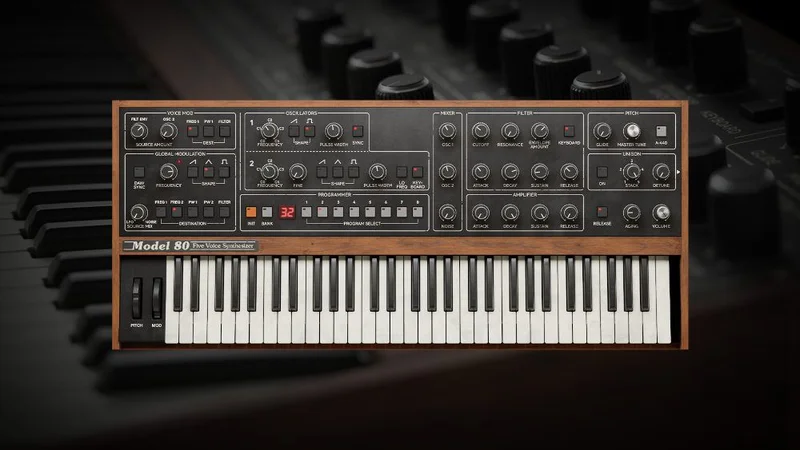
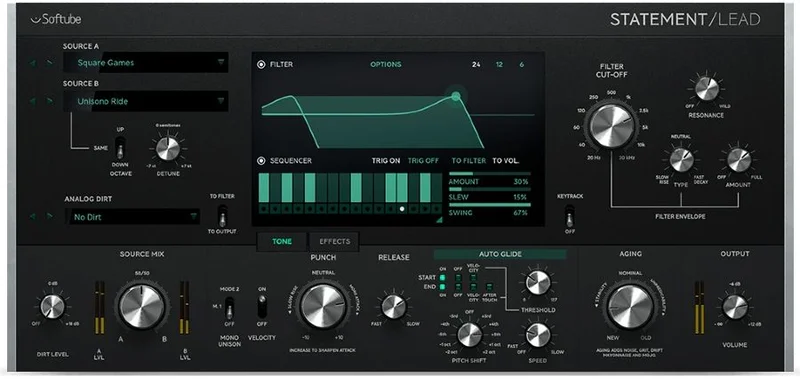
The headline tools fall into three categories: compressors, amp suites, and instruments. The compressor trio covers FET, OPTO, and VCA gain reduction styles, each built around specific hardware references. The amp side adds Vintage, Metal, Bass, and Marshall suites to Amp Room. The instruments include the Model 84 polyphonic synthesizer and the Statement Lead, which draws from recordings of rare synth hardware.
Beyond those, you get Wasted Space for intentional digital degradation, the Drawmer S73 multi-band compressor, the Weiss EQ MP, the American Class A channel strip, the British Class A console emulation, the Acoustic Feedback guitar simulation, and the Dirty Tape saturation processor from Swedish distortion developers.
The bundle supports AU, VST, VST3, and AAX on both macOS and Windows. Copy protection runs through iLok with 3 simultaneous activations. That's the full scope.
Who Qualifies and What That Means
You need to be an existing Softube Volume 5 customer. That's the entry condition. No Volume 5, no upgrade path.
The discount applied to your upgrade price is calculated from your most expensive existing Softube plugin only. If you've built up a library over several years buying individual Softube titles, that history counts for nothing beyond the single highest-priced item. Owners have reported upgrade prices ranging from $129 depending on account history, with some feeling the range is inconsistent across accounts. That inconsistency is frustrating, and Softube hasn't made the calculation transparent enough for customers to predict what they'll see before they log in.
Some users have also hit login and pricing access issues on the site, which adds friction to what should be a simple checkout. If you're buying, check your account dashboard first and make sure your pricing reflects your Volume 5 ownership before you proceed.
The Value Case: Where It Holds and Where It Breaks
At $129, the upgrade price is defensible if you use a generous slice of what's included. The FET Compressor Mk II alone, sold separately, would likely cost a meaningful portion of that. Add the full Marshall amp suite, the Weiss EQ MP, and the Drawmer S73, and the bundle math starts working in your favour.
The problem is that many Volume 5 owners already have some of this content in individual plugin form. If you bought the FET Compressor or the British Class A separately, you're paying upgrade pricing for tools you already own. The discount logic doesn't account for overlap.
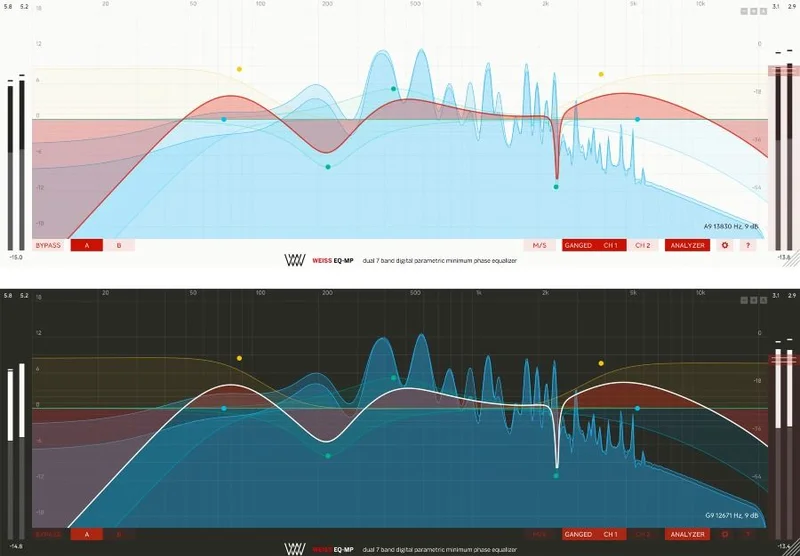
The Weiss EQ MP is probably the sleeper value here. Seven bands, based on the minimum phase algorithm of the Weiss EQ1, with low latency and light CPU load. That's a Weiss that you can actually put on 12 channels without watching your CPU meter climb. For mastering-adjacent work and mix bus use, it's the kind of quiet workhorse you'll open daily.
The American Class A channel strip draws strong praise from owners, though the description that keeps coming up is "bold and forward-pushing" rather than transparent. Load it on a vocal and you're committing to a sound. That's not a flaw, but it's information: this isn't a neutral processor. If your sessions need something that pushes forward with character, it delivers. If you need a clean surgical strip, look elsewhere in the bundle.
Honestly? The Bus Processor gap is the most frustrating part of the value conversation. Owners expected it. It's not there. For anyone who bought Volume 5 partly for bus work, that absence stings at upgrade pricing.
The Compressor Trio in Detail
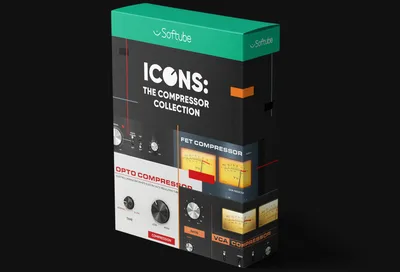
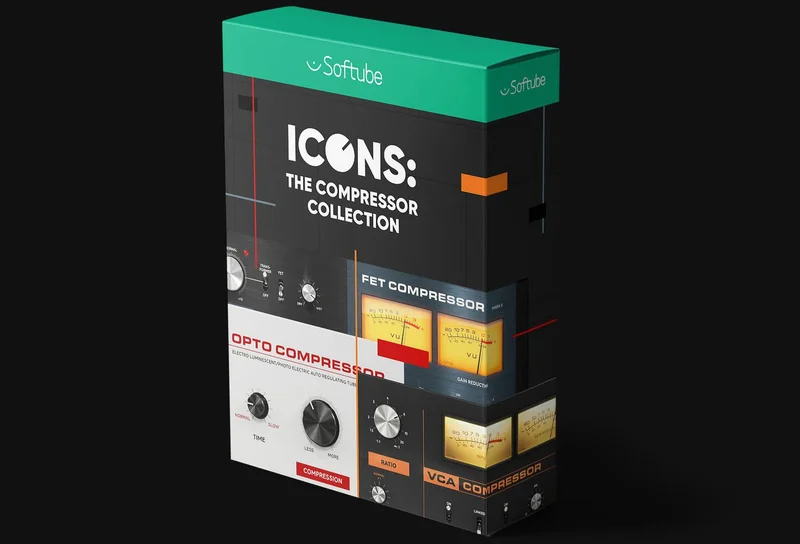
Three compressors. Three different gain reduction approaches. Each one built around a specific hardware reference.
The FET Compressor Mk II is the fastest of the three: 20-microsecond attack time, FET gain reduction stage, Class A solid-state amplifiers, and both input and output transformers in the signal chain. Push the Drive control and the top end gets gritty in a way that suits aggressive rock or dense hip-hop bus work. The All-buttons-in mode, also called British mode, is modelled authentically and changes the character noticeably, compressing harder and colouring more. If you've ever put a real 1176 in British mode and loved the controlled chaos, this is the version of that ITB.
All three compressors share a consistent feature set: Drive, Stereo Link, Sidechain section, High Frequency Make-up, and Dry/Wet for parallel compression without a second routing path. That Dry/Wet control is worth noting on every one of them. You can run the VCA Compressor at heavy settings and blend back 40% dry to get New York compression without sending to a parallel bus.
The OPTO Compressor models an early-60s T4 Opto Cell original. The tube distortion character is subtle: you're not reaching for it as a saturation tool, but it adds a kind of slow, slightly woolly density that suits acoustic instruments and vocals where you want compression that doesn't announce itself. Set a slow release and let a full-mix acoustic guitar sit in the mix without fighting the vocal.
The VCA Compressor uses RMS level detection and feed-forward gain reduction. That combination tends toward clinical efficiency: it clamps gain fast and predictably. The character is drier than the other two, which makes it the right choice for drum buses and bass where you want control without added colour.
Amp Room Suites: The Marshall Addition Is the Real Story
Four amp suites land in Amp Room: Vintage, Metal, Bass, and Marshall. Each is a collection rather than a single amp.
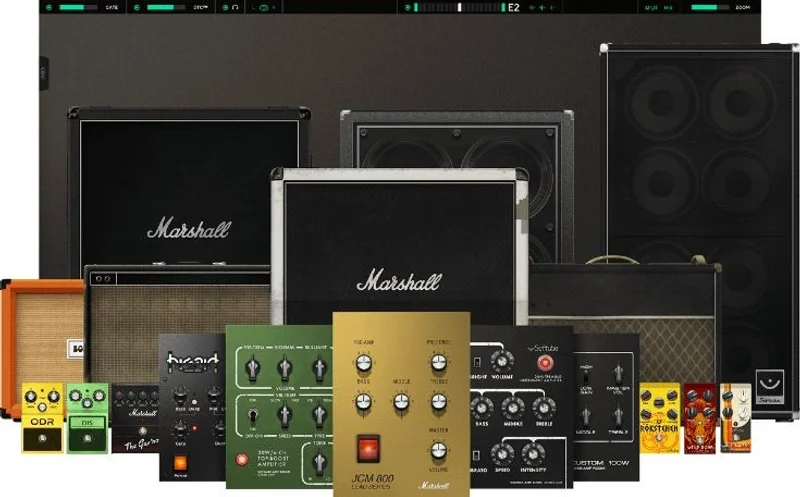
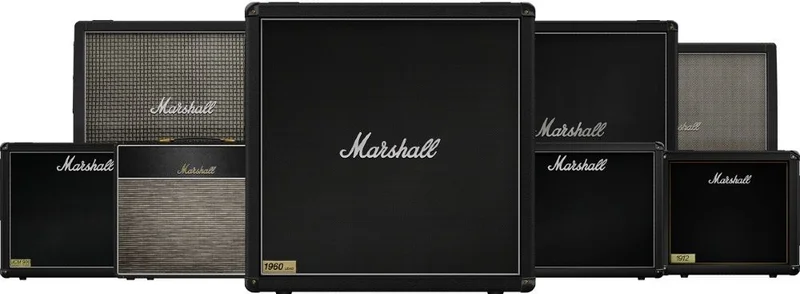
The Marshall suite is the most complete of them. You get the Plexi Super Lead 1959, Silver Jubilee 2555, JMP 2203, Bluesbreaker 1962, and JCM800 Lead Series, all with Marshall cabinets that have moveable microphone positions. Add the Guv'nor pedal and studio effects and you have a full Marshall signal chain from clean to saturated. These amps appear on hit records from Queen, Nirvana, and David Bowie. That's the developer's claim and it's consistent with what these amps actually are.
The Metal suite goes elsewhere: Vildsint 50W 6L6, Higain 100W 6L6, American Mainstayer 100W, the JCM800 again in this context, plus dedicated pedals, cabinets, and effects. If you're tracking anything from modern metal to heavy rock, that combination covers ground that the Vintage suite won't.
The Bass suite gives you Bass Standard Line V8, Supernova Parallel Channel 300W, and The Cardinal 100W. Bass amp simulation in Amp Room tends to be an afterthought in many bundles. Having three distinct options here, including a parallel-channel model, is useful for anyone tracking bass direct.
Instruments and Sound Design Tools
The Model 84 is a six-voice polyphonic synthesizer with two poly modes and proper voice allocation. It ships in three versions: a standalone instrument plugin, a chorus version for Amp Room, and seven Modular modules. The poly modes handle voice stealing differently, which matters when you're playing dense chords and need predictable behaviour from the top of the range downward.
Push the Model 84 into its Amp Room chorus version and you're routing the synth directly into the amp simulation chain. That's a workflow shortcut that works well for producing layered synth-guitar textures without parallel track management.
The Statement Lead is worth a paragraph of its own. It's built from recordings of rare and expensive hardware synths, with built-in effects, and it works both as a native instrument plugin and as Modular modules. If you're building cinematic lead lines or electronic textures that need to feel expensive without sounding like a preset pack, this is what you'd load first.
Wasted Space is the opposite impulse: intentional aliasing artifacts and distortion, available as a native plugin, a Modular module, and an Amp Room module. It sounds ugly on purpose. Load it on a synth pad and push it hard and the top end breaks apart in ways that feel alive rather than broken. The Amp Room module version means you can route any instrument through it inside the amp chain.
The Acoustic Feedback uses physical modelling to simulate guitar feedback. The Feedback knob controls onset and intensity. The Tolerance switch changes how the model responds to your playing. It responds to vibratos, bends, slides, and tremolos, and it's compatible with MIDI foot controls. Load it on a guitar part and play a held note at the bridge position. It doesn't sound like a sample. It behaves like feedback.
The Dirty Tape adds tape saturation from Swedish distortion developers with four sections: Tape, Tape Echoes, Harmonics, and a Saturation Knob. Tape Echoes is the section most producers will reach for first: it's the difference between a thin saturation plugin and one that has a spatial quality to it.
Who Should Skip This Upgrade
If you've already bought the FET Compressor, the British Class A, or any of the amp suites individually, the bundle overlap makes the value case weak. You're paying upgrade pricing for tools you already have.
If your sessions run large, the CPU situation deserves a serious look. Single-track use is reportedly reasonable. But put the FET Compressor on 20 channels, load the Weiss EQ MP on eight more, run the Marshall suite on two guitar buses, and your CPU meter will tell a different story. For producers running dense mix sessions on older machines, the accumulation becomes a real problem.
The American Class A's forward-pushing character is a reason to skip for some. If your productions lean heavily on transparent processing where you need the signal to stay neutral through the channel strip, the American Class A will push against that. It's not a problem with the plugin. It's a mismatch.
The Verdict
Volume 6 is a clever bundle with real tools inside it. The FET Compressor Mk II is a satisfying workhorse, the Marshall suite is comprehensive, and the Weiss EQ MP delivers the kind of transparent, low-latency processing that fits seamlessly into mixing workflows. But the upgrade pricing structure is a mess, the discount logic is opaque, and loyal customers with deep Softube libraries are getting the worst deal in the room.
At $129, the upgrade makes sense for a Volume 5 owner who values the Marshall amp suite or the full compressor trio. If that's you, it earns its price. If you've already picked off the best individual plugins, or if you're running large sessions on a mid-range machine, hold off. The bundle's limits will bother you more than the tools will satisfy you.
Specs & Technical Details
| Developer | Softube |
| Price | $129 |
| Plugin Format | AU / VST / VST3 / AAX |
| OS Support | macOS / Windows |
| Activation | iLok (3 simultaneous activations) |
| CPU Usage | Light on single tracks; accumulates across large sessions |
| Trial Available | N/A |
| Version Reviewed | N/A |
Score Breakdown
| Category | Score | Notes |
|---|---|---|
| Sound Quality | 3.5/5 | FET Compressor Mk II and Weiss EQ MP are strong; American Class A emphasizes bold, forward-pushing sonics |
| Value for Money | 2.0/5 | Upgrade discount calculated from single most expensive plugin; penalises loyal multi-plugin owners |
| Ease of Use | 3.0/5 | Console 1 integration is satisfying; website login and pricing access issues add friction |
| Features | 3.5/5 | 31 effects and six instruments with broad coverage, but Bus Processor is absent |
| CPU Efficiency | 2.5/5 | Reasonable per track but compounds quickly across dense sessions |
| Overall | 2.8/5 | Real tools let down by opaque pricing and gaps that loyal buyers will notice |
If you're a Volume 5 owner who's been holding off on the Marshall suite and the compressor trio, the upgrade at $129 closes that gap in one move. If you've already bought the best parts individually, or if you run sessions heavy enough that CPU accumulation is a known problem, this is the kind of purchase you'll regret within a month. Know which category you're in before you open your account dashboard.
Frequently Asked Questions
Do I need to own Volume 5 to buy the Volume 6 upgrade?
Yes. Volume 6 is an upgrade bundle for existing Softube Volume 5 customers. It's not available as a standalone purchase. If you don't already own Volume 5, you'd need to look at Softube's full bundle options instead.
How is the upgrade discount calculated?
Softube calculates the discount based on the most expensive single plugin you already own in your Softube library. Other plugins you've purchased separately don't factor into the discount. This means customers with large individual plugin libraries often receive the same discount as someone who owns a single entry-level title, which owners have flagged as frustrating.
Is the Bus Processor included in Volume 6?
No. The Bus Processor is not included in Volume 6. This has been a consistent point of disappointment among owners who expected it to be part of the upgrade. There's no workaround for this within the bundle itself.
What copy protection does Volume 6 use?
Volume 6 uses iLok copy protection with 3 simultaneous activations allowed. You'll need an iLok account to manage your activations. Check Softube's current system requirements to confirm before purchasing.
Will Volume 6 run on large sessions without CPU problems?
Single-track CPU usage is reported as reasonable, but the load accumulates noticeably when you run multiple instances across a full session. If you work with dense mix templates or large track counts, you may find the compressors and amp simulations compound into a CPU bottleneck. How severe that is depends on your machine and your session architecture.
What DAWs are compatible with Volume 6?
Volume 6 supports AU, VST, VST3, and AAX plugin formats on both macOS and Windows. AU covers Logic Pro and GarageBand. AAX covers Pro Tools. VST and VST3 cover Ableton Live, Cubase, Studio One, Reaper, and most other major DAWs. If your DAW supports any of those formats, Volume 6 will load in it.