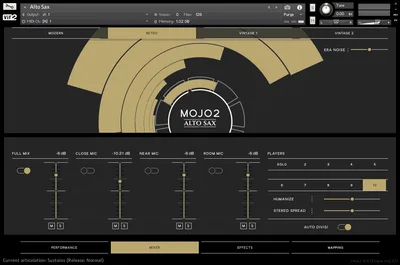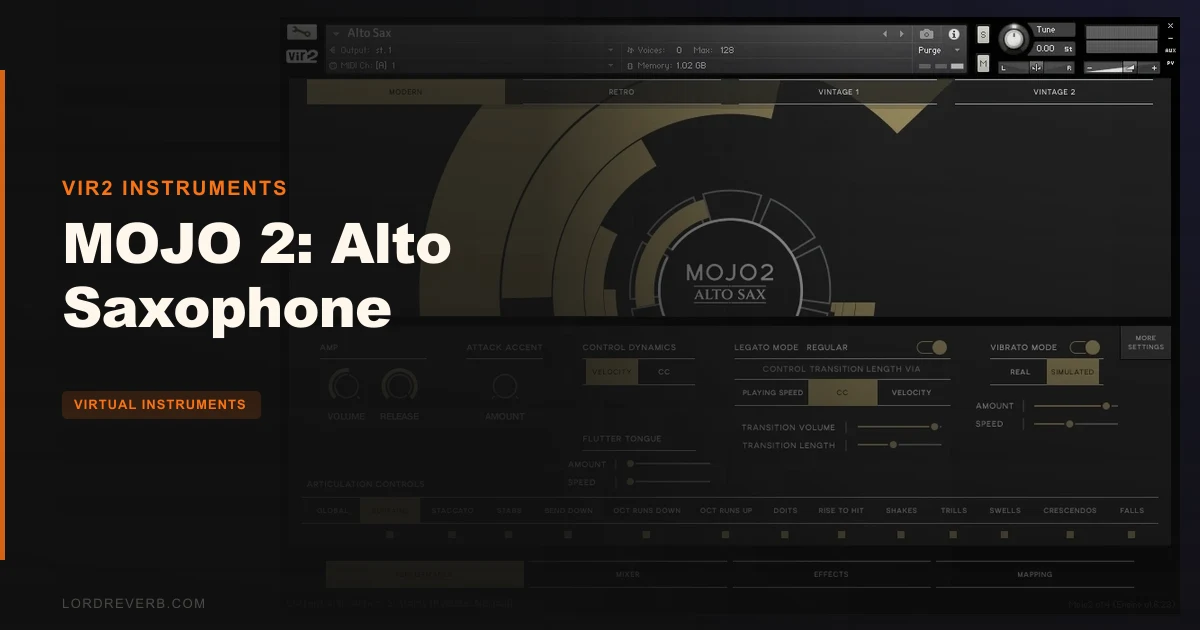
MOJO 2: Alto Saxophone sits directly in the crosshairs of Native Instruments' Session Horns Pro, and at $149.95, this review is going to land clearly in its favour for solo melodic work, though not for every situation. This is a Kontakt instrument built by Vir2 Instruments for producers who need a standalone alto sax that sounds like a human being played it, not a keyboard preset. It's for the film composer scoring a 1940s noir scene, the R&B producer laying a hook, or the jazz arranger who can't always book a session player.
This is a solo-instrument extraction from the larger MOJO 2 horn library. That context matters. You're getting one voice from a flagship collection, purpose-built and deeply sampled. Whether the price is justified depends heavily on how often that voice shows up in your work.
How It Compares Out of the Box
Load MOJO 2: Alto Saxophone next to Native Instruments Session Horns Pro and the first gap you'll notice is articulation depth. Session Horns Pro is a section-oriented library, it's brilliant at horn stabs and punchy ensemble hits. Vir2's alto is built for solo melodic performance first.
The 13 articulations here include Doits, Shakes, Octave Run Down and Up, Rise To Hit, and Falls, that's the vocabulary of a real jazz or R&B saxophonist, not a generic wind instrument. Session Horns Pro doesn't go this deep on a single voice.
Where Session Horns Pro wins immediately is out-of-box playability. Its ensemble layout means you're making music faster. MOJO 2: Alto Saxophone rewards you more the more you invest in understanding its performance controls.
Performance Deep Dive
The true legato is the headline feature and it delivers. Vir2 recorded the transition between every note in the range. We played a Bb major jazz phrase at 90 BPM, slow enough to expose any seams in the legato engine. The glide between minor thirds sat naturally in the 30–60ms range. No clicking. No robotic pitch jump. It tracks like a player shifting positions.
The 4 velocity layers and 3 round robins per articulation mean you're getting 12 unique sample triggers before any repetition. That's satisfying for programming melodic lines where the same pitch repeats on downbeats.
The swell and crescendo articulations sync to your project tempo in durations from 1 to 16 beats. We set a 4-beat crescendo at 78 BPM into a solo section. The build felt organic, not the flat linear ramp you get from modwheel-driven volume automation. The tail at the top of the swell had actual breath pressure behind it.
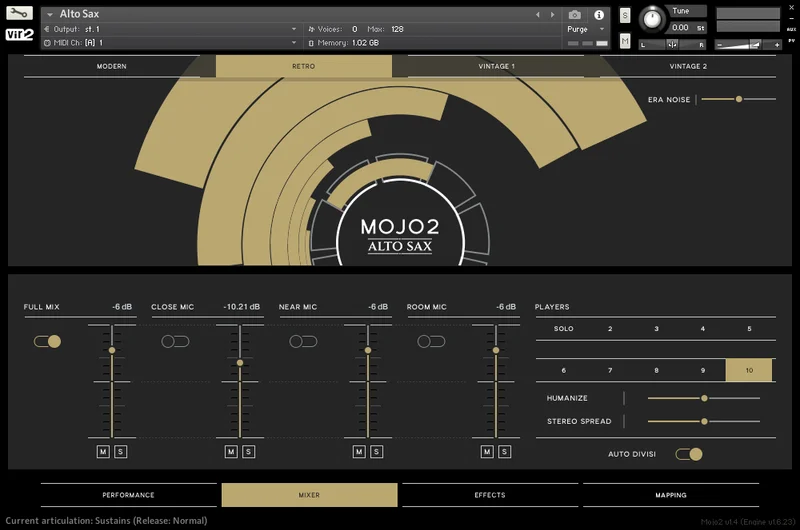
Ensemble mode scales from 1 to 10 players. At 5 players with the humanization and stereo spread controls opened up, the instrument shifts from solo lead to a small section without any additional patches. That's clever engineering.
CPU load runs medium-heavy when all 3 mic positions are active simultaneously. Running close and near only dropped us to a medium load. The pre-mixed option is genuinely useful on older systems, it's not just a lazy shortcut.
Where It Wins
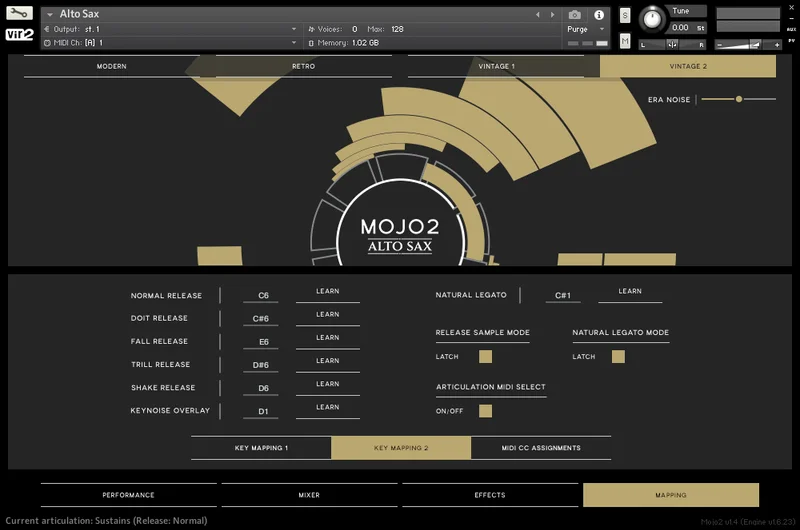
The era presets are underrated. Modern, Retro (60s–70s), Vintage 1 (40s–50s), and Vintage 2 (20s–30s) aren't just EQ curves slapped on top. They change the character of the room, the top-end saturation, and the low-end weight in ways that actually hold up in a full mix.
We ran the Vintage 1 preset under a Rhodes piano and upright bass on a 1950s-style jazz track. The alto sat in the mix at around -6dBFS without any additional EQ or compression. The upper-mid presence around 2–3kHz felt like a real mic on a real horn in a real room. We love when presets actually earn their place.
The mapping page is a brilliant addition. You can reroute articulations to any keyswitching layout you want. If you live in a specific MIDI controller workflow, this means zero frustration adapting to Vir2's defaults. The NKS integration with Komplete Kontrol S-Series and Maschine hardware adds another layer of playability for those already in the Native Instruments ecosystem.
Where the Competition Wins
Honest ground conceded: the Kontakt-only dependency is frustrating in 2026. You need Kontakt Player 7.1.5 or higher. If you're an Ableton Live user running a third-party sampler, or an FL Studio user who isn't already in the Kontakt ecosystem, this product doesn't work for you. Hard stop.
The 8.34GB footprint is also annoying on a laptop with limited SSD space. A single instrument pulling that much storage is a real consideration, especially since the pre-mixed option still requires the full library installed.
There's no trial version. At $149.95, buying blind is a risk. Session Horns Pro offers demo content. Spitfire Audio's LABS instruments let you audition freely. Vir2 doesn't give you that safety net, which is a miss.
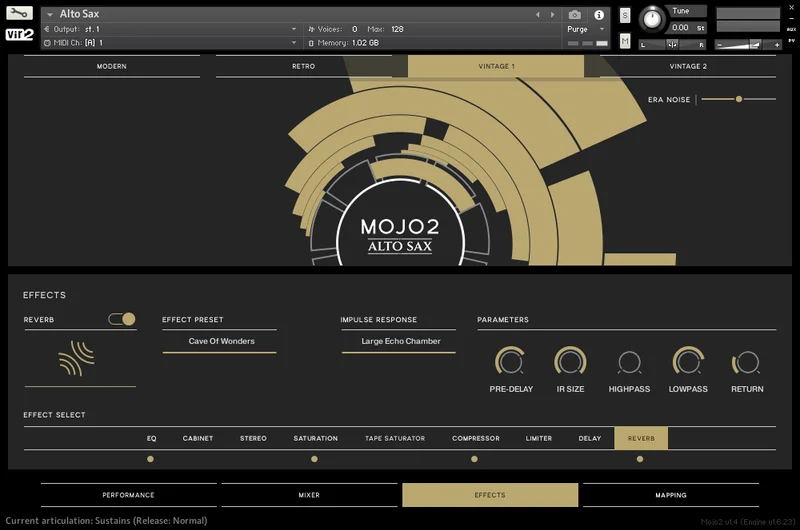
The built-in effects chain covers EQ, Cabinet, Saturation, Tape Saturator, Compressor, Limiter, Delay, and Reverb. Nine effects total. That's more than enough to dial in a sound. But the reverb algorithms feel generic compared to a dedicated convolution reverb on a send bus. We'd still route this to your best hall IR in your signal chain anyway.
Who Should Buy Which
- ✅ Buy if you write jazz, R&B, funk, or cinematic music and need a convincing solo alto sax that can carry a melodic lead.
- ✅ Buy if you already own Kontakt 7 or Kontakt Player 7 and have 8.34GB to spare on your drive.
- ✅ Buy if era-specific tone is part of your production brief, the 1920s through modern presets actually work in context.
- ❌ Skip if you need a horn section library. MOJO 2: Alto Saxophone is a solo instrument. Session Horns Pro or the full MOJO 2 library serves that need better.
- ❌ Skip if you're not already a Kontakt user. The ecosystem lock-in at this price point is a real barrier.
- ❌ Skip if you need to audition before you buy. No trial means no safety net at $149.95.
Score Breakdown
| Category | Score | Notes |
|---|---|---|
| Sound Quality | 4.5/5 | True legato is convincing; era presets earn their place in real mixes |
| Value for Money | 3.5/5 | $149.95 is fair for the depth, hard to justify without a trial |
| Ease of Use | 4.0/5 | Well-organised pages; mapping customisation removes workflow friction |
| Features | 4.5/5 | 13 articulations, ensemble mode, 9 effects, era presets, genuinely complete |
| CPU Efficiency | 3.5/5 | Heavy with all mics open; pre-mix option helps but doesn't solve it fully |
| Overall | 4.1/5 | A well-built, deep solo alto that earns its price for the right producer |
Alternatives to Consider
Native Instruments Session Horns Pro is the closest direct competitor. It's stronger for horn sections and out-of-box punchy stabs, but thinner on solo melodic performance. Native Instruments Session Horns Pro review
Spitfire Audio Studio Brass Professional goes deeper on orchestral brass realism and sits at a higher price tier, but if your writing lives in classical or cinematic hybrid contexts, it's worth the comparison. Spitfire Audio Studio Brass Professional review
Samplemodeling The Saxophone takes a physically-modelled approach rather than sampling, which means smaller file sizes and a different kind of realism, one that rewards live playing but requires more MIDI expressiveness from the performer. best virtual saxophone plugins
If you're weighing up the full picture of horn libraries, our best Kontakt horn instruments round-up covers all three alongside others in the category.
MOJO 2: Alto Saxophone is a focused, well-recorded solo instrument that stops short of being an all-in-one horn solution. At $149.95 with no trial, the risk sits entirely on you. If the alto sax shows up regularly in your work and you're already running Kontakt 7, we'd buy this ourselves. If you only need it for one project, hire a session player instead. That's the honest answer.
Frequently Asked Questions
Does MOJO 2: Alto Saxophone require the full paid version of Kontakt?
No. It runs in the free Kontakt Player 7, as long as you're on version 7.1.5 or higher. You don't need to own the full Kontakt 7 licence, though it works in that too. Check that your system meets the minimum OS requirements before purchasing.
How is MOJO 2: Alto Saxophone different from the full MOJO 2 library?
The full MOJO 2 library covers multiple horn instruments across the entire section. This product extracts just the alto saxophone as a standalone instrument. It gives you the same recording quality and articulation depth for that voice, at a lower entry price than buying the complete collection.
Can I use this as an ensemble horn library?
Not a full section library. The ensemble mode scales from 1 to 10 players of the same alto saxophone, which works well for section unisons and added thickness. If you need multiple horn types playing different parts simultaneously, you'll want the full MOJO 2 library or a dedicated section library like Session Horns Pro.
What do the era presets actually change?
The 4 era presets cover Modern, Retro (60s–70s), Vintage 1 (40s–50s), and Vintage 2 (20s–30s). They affect room character, tonal balance, and saturation, not just surface EQ. In testing, the Vintage 1 preset placed the sax convincingly in a 1950s jazz mix without additional processing on the channel.