Latigo is the right plugin if you need a convincing Latin percussion layer sitting in the top of your mix, and the wrong one if you want to sequence custom rhythms note-by-note.
UJAM built Groovemate Latigo around grooves recorded by Nate Williams, a percussionist known from his work with Jamiroquai. That pedigree shows. The phrases don't feel like a grid. They breathe. But the plugin's phrase-locked architecture is also its ceiling, and whether you hit that ceiling fast depends entirely on how you work.
We put it through a full session: pop production, Afrobeats, Latin jazz, and a lo-fi chill record. Here's exactly what we found.
What You're Actually Getting
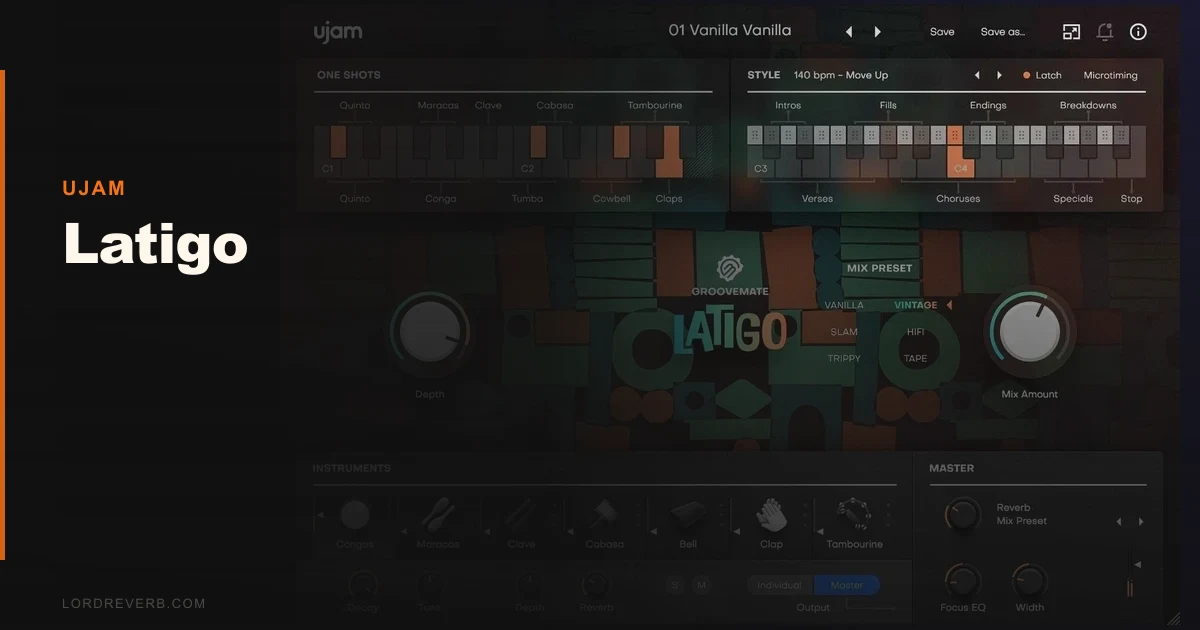
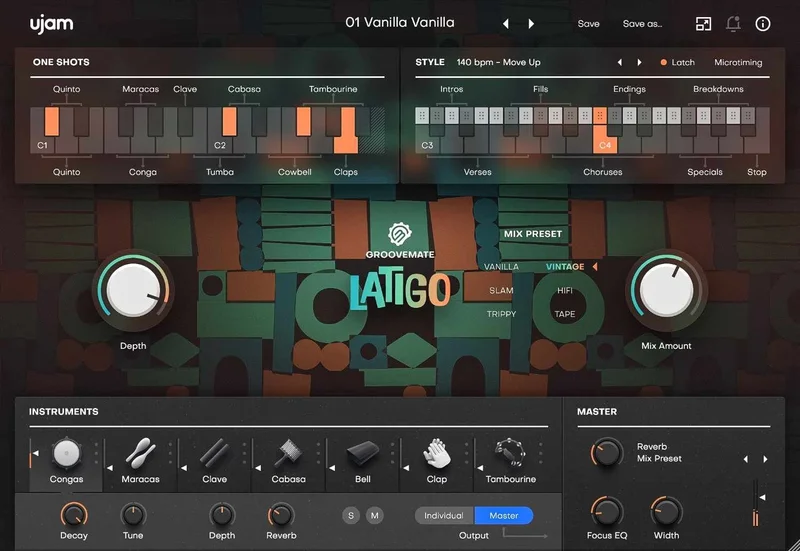
Latigo loads a seven-piece Latin percussion rig: congas, maracas, cabasa, tambourine, claves, cowbells, and claps. That's the full kit. Nothing more.
The phrase library holds 460 performances spread across 20 player styles. Each style captures a different rhythmic personality, from tight clave-forward patterns to loose, shaker-heavy feels.
You trigger phrases via MIDI notes or the browser. Tempo syncs to your DAW. Six mix presets handle the sound character: Vanilla (flat, unprocessed), Slam (compressed and forward), Trippy (heavy FX), Vintage (filtered and warm, meaning roughly 200Hz boosted, high end rolled off above 8kHz), HiFi (wide and clean), and Tape (saturation with slight flutter). A Depth control pushes the kit back in the room or pulls it forward.
Plugin formats: VST2, VST3, AU2, and AAX. Mac and Windows. It works in every major DAW we tried.
The Good
The phrase density is the story here. 460 performances sounds like marketing copy until you spend an afternoon browsing. We loaded the plugin on a 96 BPM pop session with a live drum track already in place.
We dropped a conga phrase from Player Style 7 onto the chorus. It sat behind the snare without competing. We swapped to Style 12 for the verse and the energy dropped naturally. That took about 40 seconds total. No editing. No EQ moves. It just worked.
The Depth control deserves its own mention. Push it past 70% and the percussion pulls back convincingly, like it was recorded six feet from the mic. We ran it at 55% on a Latin jazz track and the congas sounded like they belonged in the room with the piano. Satisfying result with zero extra plugins in the chain.
The Tape preset adds maybe 2-3% harmonic saturation based on how it shapes transients on the conga attack. It doesn't sound digital. That matters when you're printing top-mix percussion to a stem.
CPU load was light. We ran four instances on a 2021 M1 MacBook Pro in Logic Pro without the project going above 18% CPU. That's the kind of efficiency that makes you love a plugin on a heavy session day.
The Not-So-Good
No MIDI export. This is the honest frustration with Latigo and with the Groovemate series generally.
We hit a moment in a salsa-influenced production where we needed a clave pattern that Latigo's library didn't have. The exact phrase we wanted was close. We could hear it in our head. But there's no way to take a Latigo pattern into the piano roll and nudge a 16th note. You're working with what they've programmed, full stop.
For producers who want to treat this like a starting point and customize from there, that's a hard wall.
Seven instruments is also limiting. There's no timbale. No bongo. No güiro. If your track needs a richer percussion rig, you're stacking Latigo with additional plugins, which partially defeats the convenience argument.
The browser UI is functional but slow to navigate when you're auditioning at pace. Clicking through 460 phrases takes time. A keyword filter or mood tag system would cut browsing time by half.
Compared to the Alternatives
Native Instruments' Session Percussionist covers some of this ground. It's MIDI-sequence-based, which means more flexibility, but the Latin-specific groove feel isn't as locked-in as Latigo's Nate Williams performances. You're building rhythms. Latigo gives you fully formed ones.
XLN Audio's Addictive Drums 2 with an Afro-Cuban ADpak gets you closer to a full rig with timbales and bongos included, but it costs more and requires more mixing effort to sit correctly in the top of a track.
The legacy Wizoo Latigo that some producers remember from the mid-2000s is discontinued and no longer runs reliably on current systems. This UJAM version isn't a port. It's a new instrument, rebuilt from scratch. Don't expect the same sound or workflow if you're coming from that era.
For general percussion layering advice, our UJAM SLAP review covers how UJAM's broader instrument approach compares across their catalog.
Who Should Buy This
- ✅ Buy if you produce pop, Afrobeats, Latin pop, or funk and need top-mix percussion that works fast
- ✅ Buy if you want Nate Williams-level groove feel without booking a session player
- ✅ Buy if CPU overhead is a concern and you need a light, reliable plugin for busy templates
- ❌ Skip if you need MIDI-editable percussion patterns you can sequence yourself
- ❌ Skip if your production requires timbales, bongos, or a deeper Latin rig beyond seven instruments
- ❌ Skip if you're on a tight budget and willing to spend time with free Ableton or Logic percussion kits
Score Breakdown
| Category | Score | Notes |
|---|---|---|
| Sound Quality | 4.3/5 | Nate Williams performances feel human; phrase recording quality is clean throughout |
| Value for Money | 3.8/5 | $79 is reasonable, not bargain territory; competitive free options exist |
| Ease of Use | 4.0/5 | Loads and works in under 2 minutes; browser navigation is the only friction |
| Features | 3.5/5 | 460 phrases and 6 presets are strong; no MIDI export and no timbale hurt the score |
| CPU Efficiency | 4.5/5 | One of the lightest percussion plugins we've run at this quality level |
| Overall | 4.1/5 | Brilliant for fast, convincing Latin top-mix percussion; limited for customization-heavy workflows |
Alternatives to Consider
Native Instruments Session Percussionist: More MIDI flexibility, strong groove library, but less Latin-specific than Latigo. Worth it if you want to edit patterns. Check NI's site for current pricing.
XLN Audio Addictive Drums 2 + Afro-Cuban ADpak: More instruments in the rig including timbales and bongos. More mixing work required. Better for producers who want a full drum and percussion solution in one plugin.
UJAM Groovemate ONE: The simpler entry point in the same series. Fewer player styles, smaller phrase count. If you're new to the Groovemate workflow, start there before committing to Latigo's $79. Our UJAM HYPE loyalty upgrade review covers how existing UJAM owners can save on upgrades across the catalog.
If you're already inside the UJAM ecosystem, also check our UJAM SCORE loyalty upgrade review before paying full price for Latigo. You may qualify for a discount.
Latigo earns its place on a session template if Latin percussion is a regular part of your sound. The Nate Williams grooves are the real product here, not the UI or the presets.
At $79 during the introductory window, it's worth it. After the introductory window closes, check the manufacturer's site before buying. If the phrase library doesn't cover your specific rhythmic needs, no mix preset will fix that gap. You'd be better served by a MIDI-sequenced option.
Buy it for what it is: a percussionist on call, not a percussion toolkit.
Frequently Asked Questions
Does Latigo let you export MIDI patterns to your DAW?
No. Latigo is a phrase-based instrument and doesn't support MIDI drag-out or pattern export. You trigger pre-recorded performances via MIDI notes. If you need to edit rhythms in your piano roll, this plugin isn't the right fit. A MIDI-based instrument like Native Instruments Session Percussionist gives you that flexibility instead.
What's the difference between Groovemate ONE and Groovemate Latigo?
Groovemate ONE is the entry-level instrument in UJAM's Groovemate series, with a smaller phrase count and fewer player styles. Latigo is the Latin percussion specialist, with 460 phrase performances across 20 player styles and a seven-piece rig built specifically for that sound. If your productions regularly need Latin percussion, Latigo is the better buy. If you just want occasional hand percussion, ONE costs less.
Is the legacy Wizoo Latigo the same plugin?
No. The Wizoo Latigo from the mid-2000s is discontinued and doesn't run reliably on current operating systems. This UJAM version is a fully new instrument built from scratch. The name carries over, but the architecture, phrase library, and sound design are completely different. Don't expect compatibility with old presets or workflows.
How does the Depth control actually work in Latigo?
Depth pushes the perceived distance of the percussion kit in the stereo field. At lower values, the kit sits close and forward in the mix. As you increase Depth, early reflections and reverb tail increase, pulling the kit back in the room. It's a single macro control rather than a full reverb panel. For top-mix percussion that needs to breathe without a separate reverb plugin, it's the fastest way to dial in placement.