If you already own a paid UJAM product, the BRUTE Loyalty Upgrade is worth it: you get a full rock-focused drum plugin purpose-built to survive alongside distorted guitars, available at $49 as a loyalty reward for being an existing UJAM customer. This isn't a cheap add-on padded with filler kits. It's five specific drum characters, six mix chains, and 713 phrases built around one problem: how do you keep your kick and snare audible when the guitars are trying to eat everything?
Quick verdict: BRUTE earns a 4.0 out of 5. The sound is confident and the workflow is fast. The Smack and Grit controls are genuinely clever design choices, not marketing features. At $49, the value case for existing UJAM owners is hard to argue against. The limit is real though: if you need granular hat programming or deep articulation control, BRUTE will frustrate you before long.
Here's who this is for. You're making rock, punk, stoner, or alternative music. Your guitars are loud. You've bounced a session where the snare disappeared somewhere around bar 16 and you spent forty minutes trying to fix it with EQ. BRUTE is built for that exact problem. Whether it solves it well enough for your workflow is what this review is about.
What You're Upgrading To
BRUTE is a virtual drum plugin with five genre-specific kits, six mix presets that swap complete multi-bus effect chains, and a phrase library of 713 patterns across 31 playing styles. This isn't a general-purpose drum machine. It's a rock specialist.
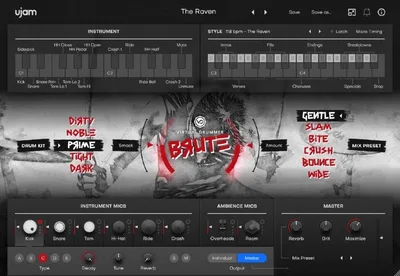
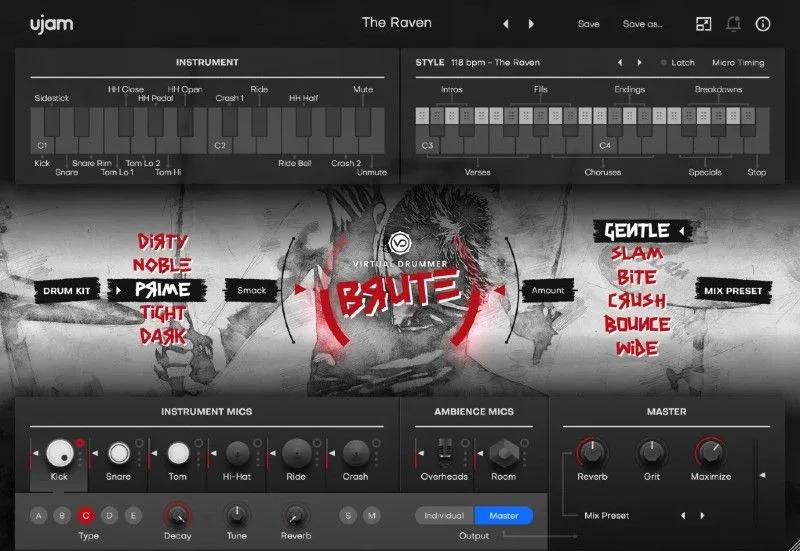
The five kits are named for character, not just sound: DARK, DIRTY, TIGHT, NOBLE, and PRIME. Each one targets a specific corner of the rock spectrum. DARK sits low and slow for stoner and doom styles. DIRTY pushes aggressive double-time energy for punk. TIGHT brings a high-tuned piccolo snare for crossover sounds. NOBLE goes full-bodied and refined for alternative anthems. PRIME is the stadium kit, balanced for maximum presence against big arrangements.
What separates BRUTE from a generic drum plugin is the three-microphone-set approach. The Click/Smack channel uses a vintage Sennheiser MD21, a microphone chosen for attack and transient emphasis. The Grit/Dirt channel uses vintage tube and ribbon overhead microphones, which add the harmonic grit and imperfection that makes rock drums feel recorded, not programmed. The Clean/Nice channel uses modern Schoeps microphones for minimal coloration when you want the kit to sit without imposing.
Those three mic sets don't just change tone. They change the character of every hit. When you blend toward the MD21 signal with the Smack control, attacks sharpen. When you push the Grit channel, the overhead character bleeds in and the kit starts breathing differently. When you pull back to the Schoeps, you get a cleaner, more controlled source that sits easier in dense arrangements.
The Mix Presets extend this further. Swapping from Gentle to Crush doesn't just change EQ. It replaces the entire multi-bus effect chain. That's the difference between adjusting a drum sound and fully reconsidering how the drums are processed. It's a meaningful distinction when you're working fast.
BRUTE also supports MIDI input and outputs audio via VST and AU 2 formats. Routing kick, snare, and instruments to separate channels is possible, and owners flag this as one of the most practically useful things about it: you get proper mix flexibility, not just a stereo output you have to EQ from outside.
Who Qualifies for the Loyalty Upgrade
The BRUTE Loyalty Upgrade is available to anyone who owns any paid UJAM product. That's it. If you've paid for anything in the UJAM catalog before, you're in.
Activation requires an internet connection and your ujam.com email and password. There's no offline workaround. If you're running a studio without reliable internet, plan the authorization step in advance because you won't get past it without a connection.
On the system side, you need Windows 10 or later (64-bit only) or macOS 10.14 through macOS 14 (64-bit only). Minimum 4 GB RAM and 3.1 GB of free disk space. Display resolution needs to hit at least 1280 x 768 pixels. If you're running a 32-bit operating system, this doesn't run. Full stop.
AU 2 format works with Logic Pro X and newer only. If you're on an older version of Logic, VST is your only path in. Check your DAW compatibility before purchasing.
A 30-day free trial is available before you commit. That's a full month with the actual product. If you're on the fence, start there. Don't spend $49 on something you haven't heard in your own session.
The Five Kits: What Each One Actually Does
The kit selection in BRUTE is one of its sharpest features. Too many drum plugins hand you a generic kit and let you rename it "rock" or "vintage" in the preset list. UJAM did something more specific here: each kit in BRUTE has a defined character that corresponds to a real sub-genre.
DARK: For Slow, Heavy, Low-End-First Music
DARK is tuned low. The kick sits in the basement and the snare has weight without sharpness. This is the kit for stoner rock, doom, sludge, anything where tempo sits around 70 to 100 BPM and the groove needs to feel oppressive rather than energetic.
If you're layering DARK under a guitar tuned to drop C or lower, you'll find it locks in without fighting the low mids. The tuning choice matters here more than most producers realize. A kit tuned for punk or crossover brings attack frequencies that clash with low-tuned guitars. DARK is built to complement them instead.
Push the Smack control up on DARK and the attack transient sharpens without brightening the tail. That's useful when your slow tempo risks making the kick feel soft. You get the hit without changing the overall tonality of the kit.
DIRTY: For Aggressive Punk Energy
DIRTY is the most aggressive kit in the set. It's built for double-time punk: fast, confrontational, not trying to sound expensive. The snare cracks, the hat hits are compact, and the whole kit has an edge that doesn't need the Grit control pushed up before it sounds rough.
You put DIRTY under a power-chord punk track and your mix sounds like a decision, not an accident. It's that kind of confident character.
The limit with DIRTY is the hat articulations. Limited articulations across the board is a known constraint of BRUTE, and on a kit this fast, that shows. If you're programming double-time patterns with a lot of hat variation, you'll run into the ceiling sooner than you'd like. The phrases are strong, but variety in hat movement gets repetitive fast.
TIGHT: Piccolo Snare for Crossover Sounds
TIGHT is the most defined sound in the plugin. The piccolo snare is high-tuned and sharp: it cuts through mid-heavy guitar tones where a standard snare disappears. Crossover metal, melodic hardcore, early 2000s post-hardcore, anything in that space benefits from a snare that slaps rather than thuds.
The Smack control does its most noticeable work here. A piccolo snare with MD21 transient emphasis feels almost violent in its clarity. Back it off and the snare softens. That range, from sharp to smooth, is wider on TIGHT than on the other kits because the starting point is already so pronounced.
TIGHT captures a specific era of engineering choices with its high-tuned piccolo snare, making it effective for crossover and post-hardcore styles that benefit from defined attack. It's not nostalgic in a lazy way. The kit just captures a specific era of engineering choices and holds it consistently.
NOBLE: Alternative Anthems and Full-Bodied Rock
NOBLE is the most versatile kit. Full-bodied and refined are the developer's words, and they're accurate in the sense that NOBLE sits in the room with everything rather than forcing itself to the front. The kick has low-end weight without being a sub instrument. The snare has body without being muddy.
For alternative rock in the classic sense, radio-format songs with real dynamic range, NOBLE handles transitions between verse and chorus naturally. Drop the velocity on the phrases and it pulls back. Push into the chorus and the kit opens up.
The Wide mix preset pairs best with NOBLE. Owners building alternative anthems who want stereo width without losing punch will find that combination works without much additional processing.
PRIME: Stadium Rock and Maximum Presence
PRIME is what it sounds like. Balanced, powerful, built for the biggest rooms. The kick has the kind of presence that fills space. The snare sits where it's supposed to: audible at every dynamic level, authoritative without being harsh.
If you're in a session with a guitar player who's stacked four tracks of rhythm guitars with reverb on everything, PRIME is how your drums stay visible in that mix. The Smack control helps, but PRIME's factory tuning already does a lot of the work. The default kick sound gets flagged by owners as one of the things they leave alone because it's already right.
PRIME also responds well to the Slam preset. Garage sound with heavy compression and pumping is exactly what you want if PRIME is your kit and impact is the goal. The combination lands without sounding overworked.
The Smack Control: What It Actually Does to Your Sound
The Smack control is one of the two central mix tools in BRUTE, and it's worth understanding properly because it's not just a transient shaper bolted on as a feature. It's a blend of purpose-recorded microphone signals, specifically the Click/Smack channel using that vintage Sennheiser MD21.
The MD21 is a low-frequency-biased omni mic that picks up physical attack: the beater hitting the drumhead, the stick contacting the skin, the physical impact of each hit. Blending that signal in adds a layer of transient information that modern drum recordings often lose.
When you're working a rock track with guitars sitting in the 200Hz to 4kHz range (which is most of them), the kick drum attack is what tells you the kick is there. The sub gives you feel. The attack gives you information. Pull the Smack control down and your kick feels soft. Push it and the kick cuts without EQ work.
You build a heavy track, stack guitars, and realize the kick has disappeared. That's the moment you reach for Smack. Push it to the right and the kick reappears in the mix without you touching your guitar levels. That's the job it's built for, and it does it.
The snare responds to Smack too. On TIGHT and DIRTY, the piccolo and aggressive snare characters already carry a lot of attack. Add MD21 signal and the snap becomes almost uncomfortably sharp. Back it off on those two kits. On NOBLE and PRIME, Smack gives the snare presence without aggression. That's a useful range.
The Grit Control: Where the Character Lives
Grit is the other half of BRUTE's tonal control, and it's the feature that separates a lifeless programmed kit from one that sounds like it was tracked in a real space.
The Grit/Dirt channel uses vintage tube and ribbon overhead microphones. Tube and ribbon together capture harmonic warmth and high-frequency roll-off that modern condensers don't produce. The result is an overhead sound with texture: imperfect, slightly saturated, with the kind of room information that makes a hit feel three-dimensional.
Push the Grit control up and the overhead character bleeds into the mix. The kit gets dirtier, more organic, less controlled. On DIRTY, this sounds intentional and aggressive. On PRIME, it softens the stadiums edge and adds a vintage quality. On DARK, the vintage tube character pairs with the low tuning in a way that genuinely works for doom and sludge tones.
Pull Grit back toward the Clean/Nice channel and the Schoeps microphones take over. Modern, neutral, accurate. The kit stays present but stops imposing. This is the position for mixing BRUTE under tracks where the drums need to support rather than lead.
Stacking Grit and Smack at high levels simultaneously pushes the kit toward harshness and saturation. That combination of harsh and saturated character can fatigue a mix quickly. Start with one, dial it in, then bring the other carefully. The controls interact.
Six Mix Presets: Full Chain Swaps, Not Just EQ Curves
The Mix Presets in BRUTE are one of the more intelligently designed features in the plugin. When you select a preset, you're not changing an EQ curve or a reverb tail length. You're replacing the entire multi-bus effect chain. That's a meaningful difference.
Six presets: Gentle, Slam, Bite, Crush, Bounce, and Wide. Each one corresponds to a production context, not just a sound character.
Gentle: Ballads and Power Pop
Gentle is BRUTE's quietest processing chain. It's designed for ballads and power pop where the drums need to exist without dominating. The compression is softer, the transients aren't pushed, and the overall level sits back in the mix by design.
You might not think of a drum plugin with DARK or DIRTY kits needing a Gentle preset. But NOBLE with Gentle is a real combination for producers making melodic rock with actual dynamic range. The preset earns its place.
Slam: Garage Sound and Heavy Compression
Slam is where BRUTE gets physical. Heavy compression, pumping, the transient behavior you associate with a garage recording where the overheads are hot and everything is hitting a ceiling. The kick pumps. The snare has a push-back quality.
Pair this with PRIME or DIRTY and you have a drumkit that sounds like it's playing in a room with too many people in it. That's either exactly right or completely wrong for your session. Know which one before you bounce.
Bite: Punk Anthems with Less Bass
Bite drops the bass content and raises the lower mids. The result is a thinner, more aggressive sound that cuts through the frequency range where punk guitars typically live. Less weight in the kick, more presence in the snare, more information in the 200Hz to 800Hz region where vocals and guitars compete.
DIRTY plus Bite is the most aggressive combination in the plugin. If you're making hardcore punk or fast melodic punk and you've never heard your kick sit this clearly in a guitar-heavy mix without extensive EQ, try this combination first before touching anything else in your chain.
Crush: Distortion, Saturation, Tape Machine Character
Crush adds distortion and saturation to the effect chain. The character reference is tape machine processing: harmonic content added to the transients, a slight compression feel from the saturation, and a warmth in the low mids that analog recordings pick up naturally.
This is not a subtle preset. Crush on a drumkit that already has Grit pushed up is a lot of processing. If your guitars are clean or your arrangement has open space, Crush can work brilliantly. In a wall-of-sound mix, it may close up the kit and reduce clarity.
It's satisfying when it works, honestly. The tape character on a DARK or PRIME kit feels like a real engineering choice, not a digital approximation trying to sound analog.
Bounce: Hip-Hop-Inspired Sound Design by Richie Beretta
Bounce is the most unexpected preset in the plugin. Sound design by Richie Beretta, hip-hop-inspired warmth applied to a rock drum plugin. The result is a kit with organic warmth and a groove quality that the other five presets don't have.
Bounce pairs best with NOBLE. The full-bodied kit character plus the hip-hop warmth produces something that lives in the territory between alternative rock and whatever genre sits at the intersection of rock and R&B. It's not for everyone. But it's a brilliant option to have in a rock-focused plugin because it opens the tool to hybrid genre work.
If you're building tracks that blend rock instrumentation with modern beat aesthetics, Bounce is the reason BRUTE stays relevant beyond straight rock sessions.
Wide: Stadium Rock with Subtlety Over Punch
Wide opens the stereo field and trades punch for space. It's designed for stadium rock where the drums are supposed to feel enormous, spread across a wide image, supporting rather than dominating.
Wide softens the transient behavior and expands the overhead image. You gain space and lose some impact. Whether that trade is worth it depends entirely on your track. On a mid-tempo alternative rock anthem with full arrangement, Wide sounds correct. On a fast punk track, it softens the kit too much.
713 Phrases Across 31 Playing Styles
713 phrases is a real number. Not a marketing approximation. BRUTE includes 31 playing styles with 23 phrases each. Owners describe the phrases as "gold-quality," which is high praise but holds up when you consider what they're built for.
The phrase library is structured around rock sub-genres. Each playing style contains 23 phrases offering variations across different drum patterns. That structure means you're not hunting through unrelated patterns. You find the style that fits your track and work within it.
MIDI input is supported, so you can trigger phrases from your keyboard or drum pad controller. If you want to step away from the phrase library entirely and program your own parts, BRUTE handles that. The kit sounds still apply to your own MIDI patterns, so custom programming doesn't mean losing the Smack and Grit controls or the mix preset processing.
Where the phrase library hits its limit is hat variety. Limited hat articulations is a consistent observation from reviewers, and it shows in the phrases. The hat patterns within a playing style don't vary much. Open hat timing, accent positioning, ghost notes on the hat: these aren't well-represented. For punk and stoner rock where hat patterns are simpler by convention, this is manageable. For crossover styles where hat complexity drives the feel, it's genuinely annoying.
If you're programming a track and you need eight bars where the hat changes character over time, moving from closed to open to a half-open accent pattern, the BRUTE library won't give you that variety. You'll feel the constraint.
The Routing Setup: Why Separate Channels Matter
Owners consistently flag the ability to route kick, snare, and instruments to separate channels as one of the most important practical features in BRUTE. It sounds like a basic expectation, but plenty of drum plugins in this price range output to stereo only and leave you processing the whole kit from one fader.
Separate routing changes how you work. Your kick goes to its own channel where you can compress it independently, sidechain it to the bass, and EQ the low end without affecting the snare. Your snare goes somewhere else where you can add room reverb to the body without smearing the kick transient. Overheads, toms, and auxiliary percussion sit apart from the close mics.
You're building a track and the snare reverb tail is washing into the kick on every beat. Without separate routing, your only option is to EQ or gate on the stereo output. With separate routing, you gate the snare channel and solve the problem. That's the difference.
It's not a flashy feature. It's infrastructure. And infrastructure matters more than most producers admit until they're at the end of a mix wondering why everything sounds like soup.
The User Interface: Simple by Design
Owners report that BRUTE's UI requires no manual reading. That's not a backhanded compliment. In a plugin built for rock producers who want drums done fast, a complicated interface is an obstacle, not an asset.
BRUTE is direct. You select your kit. You choose your mix preset. You dial in Smack and Grit. You pick a playing style and browse phrases. That's the workflow. It doesn't hide controls behind menus or require you to understand a routing architecture before you can hear anything.
Most DAW setups clear 1280 without trouble.
The simplicity has a tradeoff. Producers who want per-hit control, velocity layers with individual settings, or complex articulation switching will find BRUTE offers less than more feature-heavy alternatives. The UI isn't hiding depth that exists. The depth isn't there. What you see is what the plugin does.
For the target user, a rock producer who wants drums placed, sounding right, and out of the way in thirty minutes, the simple UI is correct. It's a design choice, not an oversight. Annoying if you want more. Perfect if you don't.
The Limits: What BRUTE Doesn't Do
Let's be direct about the constraints because they're real and they'll matter for some producers.
Limited hat articulations is the most consistent complaint and it's legitimate. If hat variety drives your drum programming, BRUTE will box you in. The library doesn't offer the range of open, semi-open, foot, edge, and accent articulations that more complex drum tools provide. You'll hear the repetition.
The bold sound can overpower a mix. Every kit in BRUTE has a character designed to survive heavy guitars. That's a strength in a dense arrangement. In a sparse or acoustic arrangement, the same character becomes too much. The kits push rather than sit. You can pull this back with the Clean/Nice channel and the Gentle preset, but BRUTE's baseline personality is loud and confident. If your track needs drums that disappear into the arrangement, you're working against the plugin's nature.
Depth of control is lighter than more complex drum tools. No individual hit editing. No velocity layer customization. No drag-and-drop groove editing. Reviewers note this directly, and it's a fair observation. BRUTE is a fast tool, not a deep one.
The 64-bit requirement is non-negotiable. If you're on a legacy 32-bit system, this doesn't install. That's an increasingly rare setup in 2026, but if it applies to you, it's a full stop.
Internet authorization is required. One-time, but it requires an active connection at the point of activation. Authorization is through your ujam.com account, so make sure you have access to that login before you download the installer.
Who Should Skip BRUTE
Skip this if you're making music outside the rock spectrum. BRUTE's kits are tuned for rock sub-genres. The phrases are built around rock feels. The mix presets are optimized for guitar-heavy arrangements. If your work is primarily electronic, hip-hop, jazz, R&B, or pop, you're paying for a philosophy that doesn't serve your sessions. The Bounce preset offers one bridge to adjacent genres, but it's one preset in a six-option chain. It's not enough to make BRUTE a general-purpose tool.
Skip this if hat programming variety is central to your workflow. The limited articulations aren't something you work around with clever processing. They're a fixed constraint of the library. If you're the type of producer who spends time crafting hat patterns with accents, ghost notes, and rhythmic variation, BRUTE's phrase library will feel like a wall.
Skip this if you want deep per-hit control. BRUTE is not a drum editor. It's a drum placement tool. The workflow is: choose a kit, choose a preset, choose a phrase, and commit. If you want to go in after and adjust individual hit velocities, change tuning per drum, or modify the envelope of a single snare hit, this plugin doesn't offer that.
Skip this if you don't own a paid UJAM product. The Loyalty Upgrade pricing assumes existing ownership. Without that, the value calculation is different, and this review is built around the loyalty upgrade path specifically.
Three Scenarios Where BRUTE Earns Its Place
You're tracking a stoner rock demo. The guitars are tuned down, slow tempo, and everything below 200Hz feels like mud. You pull up DARK, push Smack to about 60%, bring Grit up to 40%, and run the Crush preset. The kick reappears in the arrangement without touching your guitar DI levels. The snare has just enough tape saturation to feel recorded rather than placed. That's what BRUTE is for.
You're scoring a punk track fast, deadline in two hours. You open DIRTY, hit the Bite preset, scroll to a double-time playing style, and cycle through phrases until you find one that locks to the tempo. You're not programming. You're choosing. In fifteen minutes, the drums are placed and you're back to guitars. That speed is the entire value proposition for working producers.
You've stacked a huge alternative rock arrangement: four guitar tracks, keys, bass, vocals, and you realize the drums have no air. Everything is fighting in the same frequency space. You switch NOBLE to the Wide preset, pull Smack back slightly, and blend Grit to the midpoint. The kit opens up stereo-wise and stops competing. Your arrangement breathes again. BRUTE solved that problem without you reaching for a third-party drum processor.
The Value Case for Existing UJAM Owners
At $49 as a loyalty upgrade, BRUTE is asking a specific question: do you make rock music, and do you want drums that work fast in heavy arrangements? If yes, the answer is straightforward.
The value of BRUTE isn't in its depth. It's in the specificity of its design choices. Five kits built for real rock sub-genres. Three distinct microphone sets that give you tonal control without plugin stacking. Six full-chain mix presets that replace workflows you'd otherwise spend hours building. These aren't generic features with rock marketing copy. They're specific engineering decisions aimed at a specific problem.
The 30-day free trial removes the risk. You can hear every kit and every preset against your real sessions before spending anything. If BRUTE's character fits your music, you'll know within a session. If it doesn't, you'll know equally fast. Take the trial seriously. It's a real evaluation window, not a crippled demo.
Owners describe the phrases as gold-quality and the UI as immediately intuitive. Those aren't words people use about tools they don't trust. The sound inspires confidence, which in a drum plugin, matters more than most specs.
The Verdict
BRUTE is a confident, specific tool for a specific producer. It doesn't try to do everything, and that's why what it does works as well as it does. The Smack and Grit controls are clever solutions to real mixing problems. The kit characters are genuine, not renamed copies of each other. The mix presets save real time. At $49 for existing UJAM owners, the ask is reasonable for what you receive.
The ceiling is real. Hat articulations are limited. Depth of per-hit control doesn't exist here. The bold character can work against you in the wrong arrangement. These aren't trivial complaints.
But if you're making rock music, you have guitars that are trying to eat your drums, and you want a tool that fights back on the drums' behalf without requiring three hours of programming, BRUTE earns its place in your plugin folder. 4.0 out of 5. Take the 30-day trial before you buy. You'll have an answer by the end of your first session.
Specs & Technical Details
| Developer | UJAM |
| Price | $49 |
| Plugin Format | VST / AU 2 |
| OS Support | Windows 10 or later (64-bit) / macOS 10.14 to macOS 14 (64-bit) |
| Activation | Online authorization via ujam.com account |
| CPU Usage | N/A |
| Trial Available | Yes, 30 days |
| Version Reviewed | N/A |
| Minimum RAM | 4 GB |
| Minimum Disk Space | 3.1 GB |
| Minimum Display | 1280 x 768 px |
| MIDI Support | Yes |
Score Breakdown
| Category | Score | Notes |
|---|---|---|
| Sound Quality | 4.5/5 | Three distinct mic sets give real tonal variety; kits sound purposeful and confident in heavy mixes |
| Value for Money | 4.0/5 | Loyalty pricing makes the ask easy for existing UJAM owners; 30-day trial removes the risk |
| Ease of Use | 4.5/5 | Owners report no manual needed; simple workflow from kit selection to placed drums |
| Features | 3.5/5 | Smack, Grit, and six full-chain presets are strong; hat articulations and per-hit control are light |
| CPU Efficiency | N/A | No data available from notes |
| Overall | 4.0/5 | A focused, confident rock drum tool that does its specific job well and knows what it isn't |
The bottom line: if you already own a UJAM product and your sessions involve rock, punk, stoner, or alternative music with heavy guitar arrangements, BRUTE at $49 is not a hard sell. The kits are specific enough to be useful, the workflow is fast enough to stay out of your way, and the Smack and Grit controls solve a real problem without requiring you to understand them deeply to benefit from them. Take the trial. Place a kit against your heaviest guitar track. If you're not convinced in twenty minutes, nothing in this review will change your mind, and that's fine. But most producers in that scenario won't be reaching for the exit.
Frequently Asked Questions
Is BRUTE Loyalty Upgrade available to anyone, or do you need to own a specific UJAM product?
The loyalty upgrade is available to anyone who owns any paid UJAM product. There's no specific title required. If you've purchased anything from UJAM before at full or sale price, you qualify. The upgrade path is confirmed at checkout via your ujam.com account login.
Can BRUTE run without an internet connection after activation?
Initial authorization requires an internet connection through your ujam.com account. Once authorized, check UJAM's documentation for the ongoing connectivity requirement, as this can change with plugin updates. Plan your activation step while you have a reliable connection to avoid delays at the start of a session.
Does BRUTE work in Ableton Live and Pro Tools, or is it Logic-only?
BRUTE supports VST format for broad DAW compatibility, which includes Ableton Live. The AU 2 format is Logic Pro X and newer only. Pro Tools uses AAX format, which BRUTE does not support. Check UJAM's current compatibility list before purchasing if Pro Tools is your primary DAW.
How many drum kits and phrases come with BRUTE?
BRUTE includes five drum kits: DARK, DIRTY, TIGHT, NOBLE, and PRIME. The phrase library contains 713 patterns, organized across 31 playing styles with 23 phrases each. Six mix presets, Gentle, Slam, Bite, Crush, Bounce, and Wide, provide full multi-bus effect chain variation without changing the kit selection.
Is BRUTE suitable for genres outside rock, like hip-hop or pop?
BRUTE is built specifically for rock and its sub-genres. The kits, phrase library, and mix presets are all engineered for guitar-heavy arrangements. The Bounce preset, with hip-hop-inspired sound design by Richie Beretta, offers some crossover appeal. But if your primary output is hip-hop, pop, or electronic music, BRUTE's personality works against rather than for your sessions.
What's the difference between the Smack and Grit controls?
Smack blends in signal from a vintage Sennheiser MD21 microphone, which emphasizes attack transients. It makes kicks and snares cut through dense mixes by adding physical impact information to every hit. Grit crossfades between the Clean/Nice channel (Schoeps modern condensers) and the Grit/Dirt channel (vintage tube and ribbon overheads), adding harmonic character and organic texture. Smack controls clarity. Grit controls personality. They interact, so dial one in before pushing the other.