
Will a bundle of just three bell and mallet instruments feel thin at $19? Not if wobbly, tape-bruised tone is what you’re after, and that’s the whole pitch here.
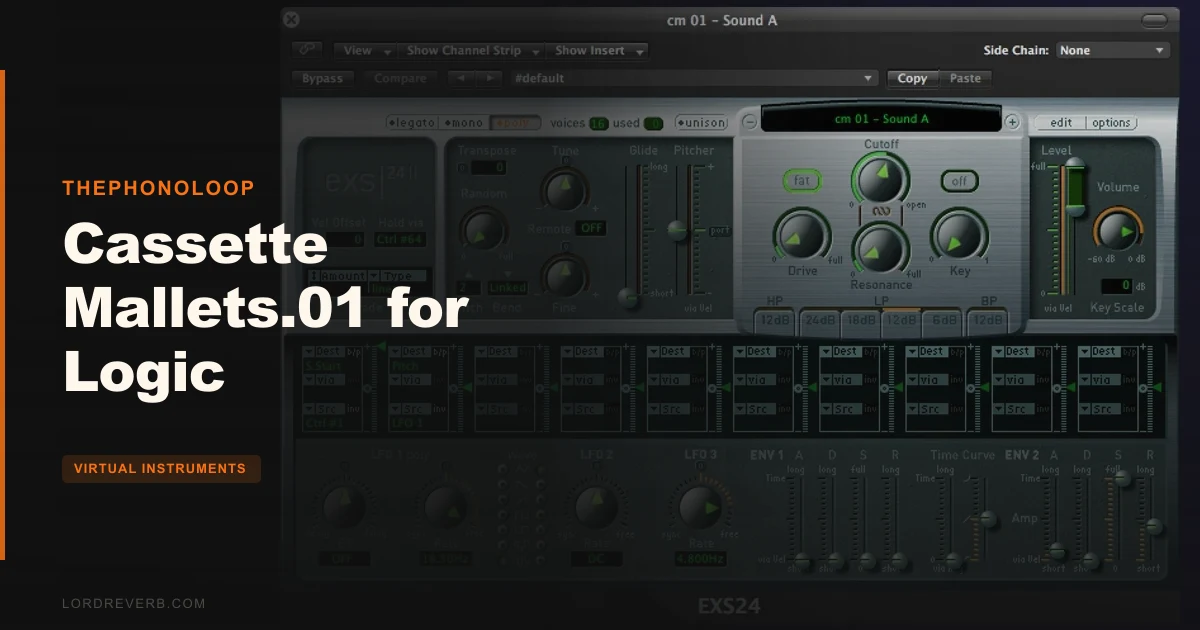
Cassette Mallets.01 is a Logic instrument from THEPHONOLOOP. It records bells and mallets onto cassette through an old, wonky recorder, then wraps the result in a single-page interface.
It’s for you if your tracks need that dusty, slightly out-of-tune glow. It’s wrong for you if you want a pristine glockenspiel that behaves.
We think it’s a smart buy for the right producer. We’ll show you who that is, and who should walk away.
Does a Cassette Mallet Library Actually Deliver?
The promise is simple. Three mallet and bell instruments, recorded on cassette, tuned for vintage lo-fi work.
THEPHONOLOOP built each instrument from the ground up for playability range, and the numbers back that up. You get 442 samples totalling 511 MB, which works out to 147 per instrument plus one noise sample. The pitch range runs E2 to E6, a 49-key span.
Owners report no problems or instabilities running it in Logic Pro 10.6.3 on macOS. They also love the lo-fi sound and the GUI design.
That’s a solid start. The doubt isn’t whether it sounds good. It’s whether three instruments are enough, and the rest of this review answers that.
How Does It Sound and Play?
Each instrument stacks three velocity layers. Hit softly and you get a muted, rounded tap. Dig in and the cassette grit comes forward.
Every instrument also combines physical modeling with FM synthesis. That blend is why a sample library feels alive instead of static.
Simulated round-robin handles repeated notes. Play an ostinato, the same pattern over and over, and the notes don’t machine-gun at you. Ostinato lines are where mallets live, so this matters more than it sounds.
The Octave Down Switch
One button drops the instrument an octave. THEPHONOLOOP says the instruments sound great transposed down, and that’s the right place to lean in.
Pull a bell down an octave and the tape wobble turns slow and moody. It stops sounding like a toy. Underneath a sparse piano line it becomes a pad-like bed.
Mono Mode
Mono mode keeps one note at a time. Use it for melodic lines where overlapping tails would smear.
Play a simple hook with it engaged and you hear the cassette character clearly, with no stacked decay clouding the notes.
What Do the Sound Design Controls Do?
Everything lives on a single page. No tabs, no menu diving. That’s refreshing in an era of plugins that hide controls three clicks deep.
Sample Start
The editable sample start parameter lets you skip past the initial strike. Control it from the GUI or map it to your Mod Wheel.
Skip the attack and the mallet hit vanishes. What’s left is the ringing body of the note, soft and bell-like. Ride the Mod Wheel during a sustained chord and you morph between struck and swelling. We love this one.
Reverse Mode
REV flips the sample. Notes swell up into the hit instead of decaying away.
The presets handle this cleverly. Each sound ships in normal, reverse 100%, 75%, 50% and 25% versions. That’s 15 basic presets right there, and the partial-reverse ones are the sleeper hits. A 50% reverse gives you a half-bloom into the strike that feels like a tape glitch.
Noise Control
Noise can be added and adjusted independently, with filtering parameters to shape it. The developer denoised every note with a high-quality algorithm first, so noise doesn’t stack when you play chords.
That’s the right call. Cassette hiss multiplied across six voices turns into a wall of static. Here you dial the hiss back in only where you want it, and tame it with the filter.
Drift and DSP
Owners report that the drift and DSP effects open up creative sound design. Push drift and pitch wanders like a warped tape. It’s the single most cassette thing in the plugin.
Owners also report that switching the cassette deck can drastically change the sound. Treat that as a feature to audition early, not an afterthought.
What About the Presets?
You get 31 presets for immediate use. Fifteen are the basic normal-and-reverse set covered above. The rest build on them.
Here’s the honest part. A professional review flagged preset redundancy. Some presets share partial similarity in their sounds, and there are identical snapshots between instruments.
That’s annoying. You’ll click through a few presets and hear near-twins. Don’t expect 31 wildly different voices.
Still, redundancy in presets is easy to forgive when the underlying instruments are good. You’ll make your own patches in ten minutes with the sample start and noise controls anyway.
Where Does It Fall Short?
Setup is the first snag. You have to configure the preset folder manually. THEPHONOLOOP provides video documentation, and owners confirm it helps, but it’s not drag-and-drop. Budget ten minutes and a cup of coffee.
Second, the preset overlap we just covered.
Third, scope. Three instruments is three instruments. If you want a full orchestral percussion section, this isn’t it.
Fourth, platform. It needs Logic 9.1.8 or higher and nothing else. If you work in Ableton or Cubase, move on.
Last, evidence is thin in a few places. We found no independent critical reviews for the Logic version specifically. Owner reports on MIDI playability, CPU impact, and stability inside heavy production templates are sparse. If you run 80-track sessions, load it on a test project first and watch your meter.
None of that is a dealbreaker. All of it is worth knowing.
Who Should Buy It?
We’ve split this by user type, because the answer changes.
The Lo-Fi Beatmaker
You live in dusty loops and wobbly textures. This is built for you.
Layer a reversed bell under a drum break and let drift do its thing. Buy it.
The Film and Ambient Composer
You need mood fast. Drop the octave, engage the Mod Wheel on sample start, and sculpt a bed of detuned bells under a scene.
The 49-key range is enough for textural work. Buy it.
The Mixing Engineer
You mostly don’t need instruments. Skip it unless a client asks for a vintage mallet part. If one does, it’s a cheap fix and worth having around.
Wait, and buy only when you need it.
The Orchestral Purist
You want clean, realistic mallet percussion with huge dynamic range. Three velocity layers and cassette grit are the opposite of that.
Skip it.
The Non-Logic Producer
It won’t load. Skip it.
How Does It Stack Up Against the Alternatives?
The closest relatives come from THEPHONOLOOP itself. Cassette Mallets.02 is the newer version, with more cassette decks and an updated interface. If you want more tape variety, that’s the one to look at first.
Cassette Piano.02 and Cassette Keys.01 share the same tape-based sound design. They’re complementary libraries rather than rivals, so you can build a lo-fi palette across all of them.
Then there’s the Mellotron-style approach. This product replaces older Mellotron sounds for people who want that vintage tape feel with mallets and bells instead of choirs and strings.
Our take: Mallets.01 is the focused, cheaper entry. Mallets.02 gives you more decks. Pick .01 if you want the core idea without extra complexity.
Is the Price Fair?
At $19, yes. Easily.
You get 442 samples, three instruments, 31 presets and a one-page interface that rewards tinkering. That’s lunch money for a texture you’d otherwise spend an afternoon faking with tape plugins.
The only real way it disappoints on value is if you never touch lo-fi music. Then no price is right.
For everyone else, $19 is a low-risk pickup.
Specs & Technical Details
| Spec | Detail |
|---|---|
| Developer | THEPHONOLOOP |
| Price | $19 |
| Plugin Format | Logic instrument |
| OS Support | Mac |
| Activation | N/A |
| CPU Usage | N/A |
| Trial Available | N/A |
| Version Reviewed | Cassette Mallets.01 |
| Requirements | Logic 9.1.8 or higher |
| Library Size | 511 MB, 442 samples |
| Instruments | 3 (147 samples each plus 1 noise sample) |
| Velocity Layers | 3 per instrument |
| Pitch Range | E2 to E6 (49 keys) |
| Presets | 31 |
Score Breakdown
| Category | Score | Notes |
|---|---|---|
| Sound Quality | 4.5/5 | Convincing cassette wobble with physical modeling and FM under the hood |
| Value for Money | 4.5/5 | 442 samples and three instruments for $19 |
| Ease of Use | 3.5/5 | One-page GUI is great, manual preset folder setup is not |
| Features | 4.0/5 | Sample start, REV, mono, noise and drift cover the essentials |
| CPU Efficiency | N/A | No reliable owner data on CPU load in big templates |
| Overall | 4.1/5 | A focused, characterful lo-fi mallet library with some preset overlap |
Alternatives to Consider
Cassette Mallets.02
The newer THEPHONOLOOP version, with more cassette decks and an updated interface. Choose it if tape variety matters more than keeping things simple.
Cassette Piano.02
Same tape-based sound design, applied to piano. Pair it with Mallets.01 for a layered lo-fi bed.
Cassette Keys.01
Another complementary library in the same family. Good if you want keys that match the mallets’ worn-tape tone.
Final Verdict: Buy or Skip?
Buy it if you’re a Logic user who wants bells and mallets with real tape damage, and you can live with a ten-minute folder setup. At $19, the risk is close to zero.
Skip it if you work outside Logic, or if you need clean, realistic mallet percussion.
Three instruments, one tidy page, and a wobble you can’t fake with a plugin chain. That’s the deal, and it’s a good one.
Frequently Asked Questions
What does Cassette Mallets.01 for Logic require to run?
It needs Logic 9.1.8 or higher. Owners report no problems or instabilities using it in Logic Pro 10.6.3 on macOS. The library weighs 511 MB, so make sure you have the disk space.
How many instruments and samples are included?
You get 3 bell and mallet instruments, with 442 samples in total. That's 147 per instrument plus 1 noise sample. Each instrument has 3 velocity layers.
What is the playable pitch range?
The range runs from E2 to E6, a 49-key span. An octave down switch transposes each instrument down by one octave. THEPHONOLOOP says the instruments sound great when transposed down.
Is setup difficult?
It needs some manual preset folder configuration. THEPHONOLOOP provides video documentation, and owners confirm it helps. Expect it to take a few minutes rather than a one-click install.
Are the 31 presets all different?
Not entirely. A professional review noted preset redundancy, with partial similarity between some sounds and identical snapshots across instruments. Fifteen of the presets are basic normal and reverse versions of each sound.
How is it different from Cassette Mallets.02?
Mallets.02 is the newer version, with more cassette decks and an updated interface. Mallets.01 is the focused entry with three instruments and a single-page GUI. Choose based on how much tape variety you want.