
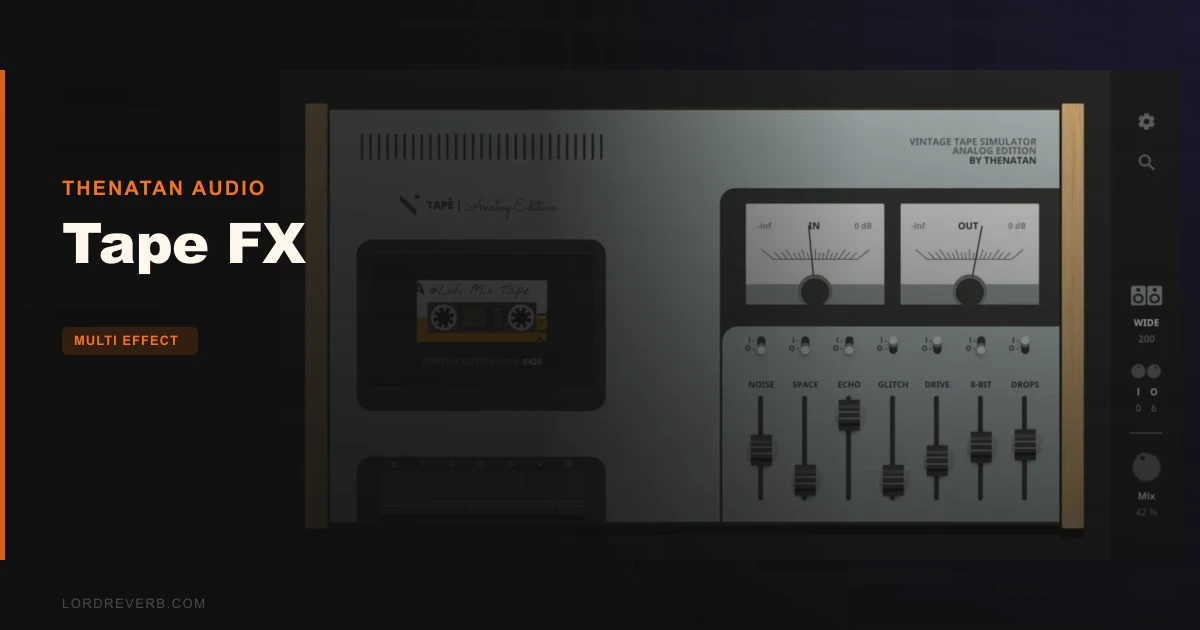
Thenatan Audio says Tape FX is a meticulously-crafted simulator of famous cassettes and cassette players, and for the most part that claim holds up. At $10, it stacks 7 effect units, 6 cassette types, and 70 presets into a single plugin built for producers, mixing engineers, and video post teams who want real cassette texture without hunting across five separate tools to get there.
The honest version: the cassette emulation sounds convincing enough that at least one owner runs it as a default on every mix. The weak spot isn't the sound. It's the thin support history and the single-product-type limitation that will frustrate anyone expecting a general-purpose saturation or reverb tool.
Here's who gets real value from it and who should keep scrolling.
The Claim: A Complete Cassette World in One Plugin
Thenatan positions Tape FX as a full cassette ecosystem, not just a hiss layer. The pitch is a realistic emulation of real-life cassette players, covering everything from classic home recording warmth to lo-fi degradation and signal dropout.
Six cassette types are built in. Cassette I is warm and naturally noisy. Cassette II pushes more low end with a darker tone. Cassette III leans into a boomy bottom. Cassette IV recreates a telephone recorder. Cassette V channels a Walkman with a low-frequency boost. Cassette VI goes further into radio-through-Walkman territory.
All seven effect units sit inside that framing: Noise, Space, Echo, Glitch, Drive, 8-Bit, and Drops. The developer says the interface is eye-catching and user-friendly. Owners confirm it. The GUI replicates a vintage cassette player layout, and navigating it feels intuitive even on first contact.
What Holds Up
The combination of effect units is where Tape FX earns its price. You don't get just noise and saturation. You get a full signal chain: drop in the Noise module, layer the Space reverb, sync the Echo to your DAW tempo, then let the Drops module make the virtual tape stick and catch up. That layering is what gives the cassette effect its body.
The Noise module deserves its own mention. Nine built-in textures plus HP/LP controls give you tonal shaping from the start. The drag-and-drop custom import pushes it further. Load your own room tone, your own found sound, your own vinyl crackle. That's a satisfying level of control for a plugin at this price point.
Owners report the individual units combine to produce authentic cassette characteristics. One reviewer specifically flags low CPU draw alongside the sound quality. Stack it across multiple tracks in a lo-fi beat session and you won't be watching your CPU meter sweat.
The resizable vector GUI scales cleanly to 200%. On a high-DPI screen it stays sharp. Annoying when plugins go blurry at scale. This one doesn't.
What Doesn't
The review pool is thin. One independent user review doesn't give us enough signal to call this bulletproof across every system. That's not a verdict against the plugin's quality. It's a fact worth sitting with before you drop it into a critical project without testing it first.
Mac compatibility is the bigger flag. Community discussions around Thenatan's older titles mention inconsistent support responsiveness and compatibility concerns on some Mac systems. That history doesn't automatically follow Tape FX into 2026, but if you're on an Apple Silicon machine, verify compatibility before you buy.
The other limitation is scope. Tape FX is built for cassette. The Drive effect adds warmth or full distortion, the 8-Bit crusher runs from 1-bit to 64-bit resolution, but they exist in service of the cassette concept. If you want a general-purpose saturation plugin or a standalone reverb, this isn't it. The tool is honest about what it is. That's not a flaw. But it does cap the use cases.
Preset sharing through the browser is a nice touch.
Who It Suits: Three Clear Scenarios
The lo-fi and hip-hop producer
You're building a beat and you want that tape deck warmth baked in from the start, not added at mastering. Drop Tape FX on the master bus, dial the cassette type to match your vibe, and let the Drops module add random sticking moments for texture that doesn't sound programmed.
This is probably the strongest use case. The 70 presets give you a fast starting point. The cassette types give you a fast character. At $10 you're not hunting for justification. Buy it.
The video and audio post-production editor
You need a scene to sound like it was recorded on a VHS or cassette in 1987. The Cassette IV telephone recorder type is exactly that. The Glitch module adds robotic time-stretching and signal repeats when you want a more degraded tape effect. The Echo syncs to tempo or you can leave it free for post work.
For this workflow, a single-plugin solution at this price is a no-brainer. Buy it.
The mixing engineer looking for a subtle saturation tool
You want to push a vocal track into a warmer space without full cassette colouration. Tape FX can do this. But it's working against its own architecture. If you're after clean saturation with surgical controls, there are purpose-built tools that do it better. This one will feel cluttered for that task.
If you're a mixing engineer who also produces lo-fi material, it earns a place in your signal chain. If lo-fi is never on your tracklist, wait until you have a specific project that calls for it.
The sound designer
The drag-and-drop noise import alone is a clever move for sound designers. Bring in your own textures. Run audio through the 8-Bit crusher from 1-bit up. Use the Glitch unit's robotic stretching on dialogue or foley. This is underrated as a sound design tool and most of the conversation around it is stuck on the lo-fi music angle.
If you work in film, games, or experimental audio, $10 feels ridiculous. Buy it.
The Verdict
Tape FX does what it claims: one plugin, full cassette chain, low CPU, honest price. The sound quality backs the marketing. The limits are real but they're the limits of focus, not failure. Mac compatibility and support responsiveness have been areas of concern in community discussions, worth confirming before committing.
At $10, the risk is low enough that curious producers and post teams can try it without losing sleep. Just confirm your system compatibility first, especially on Mac.
It's not a plugin you'll love every day. But the day you need authentic tape degradation on deadline, you'll be glad it's already in your session.
Specs & Technical Details
| Developer | Thenatan Audio |
| Price | $10 |
| Plugin Format | N/A |
| OS Support | Mac / Windows |
| Activation | N/A |
| CPU Usage | Light (owner-reported) |
| Trial Available | N/A |
| Version Reviewed | N/A |
Score Breakdown
| Category | Score | Notes |
|---|---|---|
| Sound Quality | 4.0/5 | Authentic cassette character across all six types; owners describe the combination of units as genuinely convincing |
| Value for Money | 4.5/5 | Seven effect units, six cassette types, and 70 presets at this price is hard to argue with |
| Ease of Use | 4.5/5 | Cassette-player GUI layout is fast to learn; resizable vector interface stays sharp at any scale |
| Features | 4.0/5 | Custom noise import and 8-Bit bit depth range add real depth; Drops module is a nice touch most rivals skip |
| CPU Efficiency | 4.5/5 | Reviewer-reported low CPU draw; comfortable to stack across multiple tracks |
| Overall | 4.0/5 | A focused, honest tool that earns its place if your work touches lo-fi, tape, or post-production |
If cassette texture is a regular part of your sound, this is one of the more complete single-plugin answers out there. Check your Mac compatibility, grab it at $10, and actually open the Noise module's custom import on day one. That's where the tool gets personal.
Frequently Asked Questions
What effect units are included in Tape FX?
Tape FX includes seven separate effect units: Noise, Space, Echo, Glitch, Drive, 8-Bit, and Drops. Each one handles a different part of the cassette signal chain, from texture and reverb through to saturation, bit crushing, and tape dropout emulation. You can use them individually or layer them for a fuller effect.
Can I import my own noise textures into Tape FX?
Yes. The Noise module supports drag-and-drop custom texture import alongside its nine built-in textures. You can bring in your own room tone, vinyl noise, or any other audio file and blend it with the cassette character using the built-in HP/LP controls. It's one of the more flexible features in the plugin.
Is Tape FX suitable for video post-production work?
It's a solid fit. The Cassette IV type specifically emulates a telephone cassette recorder, which covers a common post-production reference. The Drops module adds realistic tape-sticking artefacts, and the Glitch unit handles robotic signal degradation that works well on dialogue and foley. Sound designers working in film or games will find the custom noise import opens up more creative territory than the lo-fi music use case alone.