HALion 7 is the most complete instrument plugin Steinberg has ever shipped, and if you’re a sound designer or composer who wants one tool that handles sampling, FM synthesis, spectral processing, and physical modelling without switching hosts, it earns its price.
HALion 7 is the most complete instrument plugin Steinberg has ever shipped. At $349.99 full price (with regular sales dropping it much lower), it covers more synthesis ground than any comparable single tool. But it’s not for everyone, and we’ll tell you exactly who should skip it.
The version we’re reviewing is 7.5, released August 2026. That update added MPE support and pushed the spectral synthesis engine deeper. This isn’t a legacy product coasting on a reputation. Steinberg is actively developing it.
What You're Actually Getting
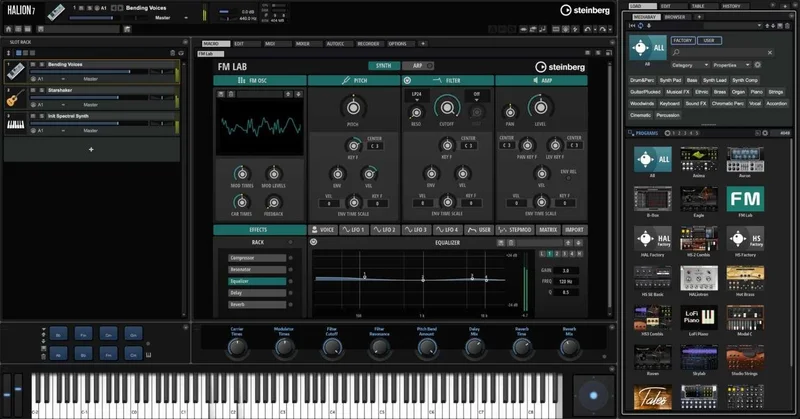
HALion 7 packs six synthesis forms into one plugin. You get a high-performance sample engine, wavetable synthesis, FM Lab (8-operator FM with Yamaha collaboration baked in), granular, spectral resynthesis, and a virtual analog section.
The sample library lands at 37GB. That covers orchestral content, acoustic instruments, synth pads, and the new Tales open-string guitar instrument.
On top of the sound engines, HALion has a full scripting environment (Lua-based) for building your own instruments and UI layouts. The modulation system was redesigned in v7 to make dynamic sound morphing more practical to set up.
Hardware dongle requirement? Gone. Steinberg moved to Steinberg Licensing in v7. That alone cleared one of the biggest complaints about the product.
The Good
The FM Lab is brilliant. We loaded a DX7 patch into it and had full recall without any conversion artifacts. The 8-operator setup with custom algorithm routing lets you build combinations that the original DX7 hardware couldn’t touch. We drew a feedback loop between operators 3 and 6 on a bass patch, cut the output of operator 2 by 12dB, and the result sat in a low-mid register that a standard preset never gets near.
Spectral synthesis in v7.5 is satisfying in a way we didn’t expect. We dropped a vocal sample in, stretched it to 400% without smearing the formants, and used it as a pad layer under a string arrangement. The resynthesis algorithm held the tonal character clean.
The modulation matrix redesign made a real difference. Routing an LFO to FM operator ratio used to require scripting knowledge. Now it’s drag-and-connect.
MPE support in 7.5 means HALion finally talks properly to Roli and similar controllers. Worth noting if that’s part of your signal chain.
The Not-So-Good
The sampling workflow frustrates us. HALion cannot record audio internally. If you want to build a sample instrument from scratch, you record in your DAW, bounce the files, then import them. Annoying.
Drag-and-drop from the host is not supported. You can’t grab an audio clip from Cubase’s timeline and drop it into HALion’s sample zone. That’s a real workflow gap in 2026.
The FM engine is deep, and deep means hard. If you’ve never worked with operator-level FM, the FM Lab UI won’t hand-hold you. There’s no visual waveform preview of what each operator is contributing. You’re working by ear and by number. Experienced FM users will love this. Beginners will close the plugin and come back in six months.
CPU load under complex patches is real. A full orchestral template with multiple HALion instances running heavy reverb tails and spectral layers will push a modern system. Not disqualifying, but plan your freeze tracks.
Compared to the Alternatives
Kontakt 8 is the direct competitor. Native Instruments built a larger third-party library ecosystem. If you need Spitfire, Heavyocity, or Output libraries, those run in Kontakt, not HALion. That’s a concrete disadvantage.
Where HALion wins: the synthesis depth. Kontakt is primarily a sampler with some scripting. HALion is a sampler plus a full FM synth plus spectral processing plus granular in one license. For sound designers who build their own instruments rather than browse preset packs, HALion is the stronger platform.
For pure sample playback, Kontakt 8 review might serve you better if your workflow leans on third-party libraries.
Best sample players for composers 2026 covers this split in more detail if you’re still deciding between platforms.
Serum 2 or Pigments are not direct competitors. They’re synthesis-focused without the sample engine depth. If FM and wavetable synthesis is all you need, those cost less. HALion makes se nse when you need the sample engine too.
Who Should Buy This
✅ Buy if you need one plugin that covers sample playback, FM synthesis, and spectral design without pulling in a second instrument.
✅ Buy if you’re building custom instruments or sound design templates and want Lua scripting plus a professional UI builder.
✅ Buy if you own HALion 6 and can upgrade at a reduced price. That’s a straightforward yes.
❌ Skip if you rely on third-party Kontakt libraries. HALion won’t play them.
❌ Skip if you’re new to synthesis and want a preset browser to learn from. The interface rewards knowledge you may not have yet.
❌ Skip if your primary need is sampling from inside the plugin. The missing record function is a real gap.
Score Breakdown
| Category | Score | Notes |
|---|---|---|
| Sound Quality | 4.5/5 | FM Lab and spectral engine both produce pro-grade results; library content is broad and usable |
| Value for Money | 4.0/5 | Full price is steep, but upgrade pricing and regular sales make it fair |
| Ease of Use | 3.0/5 | Steep learning curve, especially FM Lab and scripting; not a beginner-friendly interface |
| Features | 5.0/5 | Six synthesis forms, MPE, Lua scripting, 37GB library: nothing else in this price bracket matches the scope |
| CPU Efficiency | 3.5/5 | Complex patches with spectral layers and multiple instances demand real resources; plan your template accordingly |
| Overall | 4.3/5 | Extraordinary depth for the right user, but the sampling workflow gaps and learning curve keep it from being universal |
Alternatives to Consider
Native Instruments Kontakt 8 is the ecosystem choice. If you need access to the widest third-party instrument library in the business, Kontakt is where you go. HALion’s synthesis depth is greater, but Kontakt’s catalogue advantage is real. Kontakt 8 vs HALion 7
Steinberg Absolute 7 bundles HALion 7 with Groove Agent, Padshop, Retrologue, and more. If you’re building a full production toolkit inside the Steinberg world, that crossgrade math might work in your favour. Does Absolute 7 Crossgrade From HALion 7 Justify the Cost?
UVI Falcon 3 is the closest philosophical competitor: deep synthesis, scripting, sample engine, modular approach. Worth comparing if you’re not already inside the Steinberg ecosystem.
If you own HALion 6, the upgrade price makes this one of the easier decisions in plugin buying. The dongle removal alone changes day-to-day life with the tool, and FM Lab adds a synthesis dimension the previous version simply didn’t have.
At full price for a new buyer, you need to be honest about whether you’ll use the depth. If you want presets and quick results, HALion 7 will feel like buying a professional mixing desk to make podcast edits.
But if you’re building instruments, designing sounds from operator level up, and want one platform to stay in for years? We’d buy this ourselves.
Frequently Asked Questions
Does HALion 7 still require a USB dongle?
No. Steinberg removed the hardware dongle requirement starting with HALion 7. It now runs on Steinberg Licensing, which is software-based and tied to your Steinberg account. You can activate on multiple machines without carrying a physical key.
Is HALion 7 compatible with DX7 patches?
Yes. The FM Lab engine was developed with Yamaha and supports DX7 and TX81Z patch import. The 8-operator architecture extends what those patches can do, so you're not limited to faithful recreation. You can modify operator routing and feedback in ways the original hardware didn't allow.
Can HALion 7 record audio directly?
No, and this is a real limitation. HALion 7 has no internal audio recording function. To build a sample instrument from your own recordings, you record in your DAW, export the files, and import them manually into HALion's sample zone editor. It works, but it adds steps that competing samplers don't require.
What's new in HALion 7.5 compared to version 7.0?
Version 7.5, released August 2026, added MPE (MIDI Polyphonic Expression) support and deepened the spectral synthesis engine with improved time-stretch and resynthesis algorithms. If you use MPE controllers or work with spectral sound design, 7.5 is a meaningful update rather than a maintenance release.