
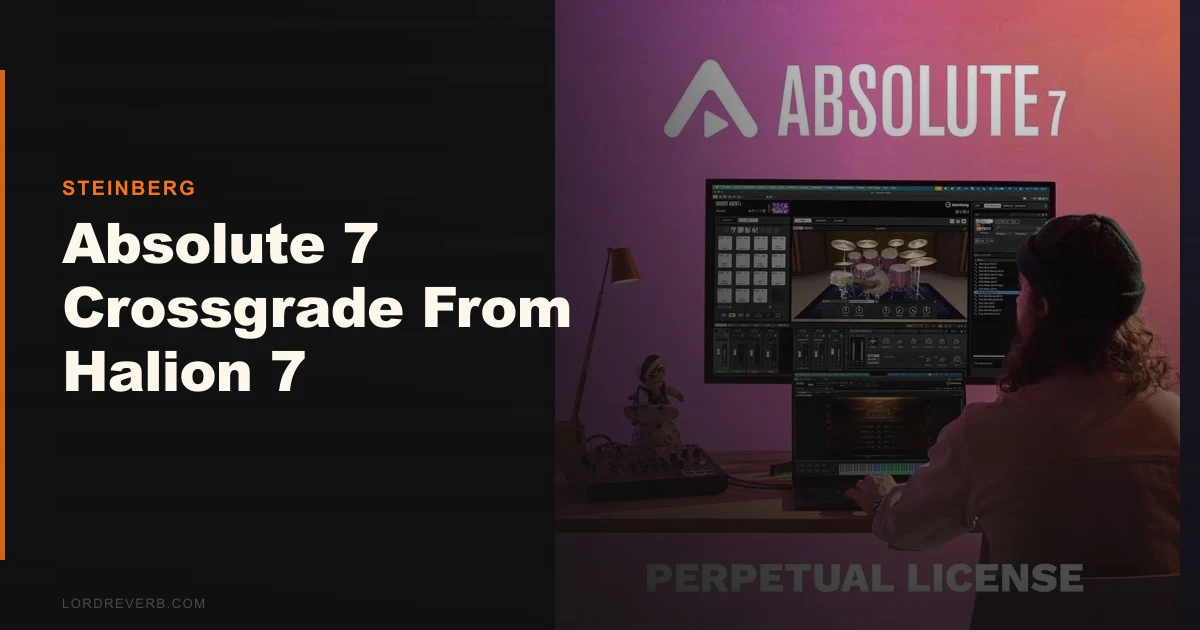
We were three hours into a dense hybrid orchestral session when we loaded up HALion Symphonic Orchestra through the new Absolute 7 bundle and pulled up a solo cello patch. The legato transitions were clean. The bow noise sat where we’d want it, around 3-4kHz, without sounding sampled. But the moment that actually stopped us? Importing a Yamaha Montage FM preset into HALion 7’s new FM Zone. Eight operators, full Yamaha DX/FM-X architecture, running inside our DAW with zero translation loss. That’s the crossgrade pitch in a single moment: you already own HALion 7, and Steinberg wants to sell you 34 more instruments wrapped around it for a price that’s hard to argue with. This review is for HALion 7 owners weighing whether that crossgrade is worth the money.
What You're Actually Getting (and What You're Not)
Absolute 7 is Steinberg’s flagship instrument bundle: 35 instruments, 194GB of sound content, 8,000+ presets. The crossgrade from HALion 7 is $199.99 (check the Steinberg site for current local pricing). You’re not buying HALion 7 again. You’re buying everything around it: Groove Agent 6, HALion Symphonic Orchestra, The Grand 4, Padshop 2, Retrologue 2, Backbone, and newer additions including Amped Elektra, Electric Bass, and the Soundiron-partnered Axe Machina 7-string guitar library.
What it’s not: a deep-sampled orchestral library that competes with Spitfire BBCSO or EastWest Hollywood. HALion Symphonic Orchestra is solid for sketching and hybrid work, but it won’t replace a dedicated orchestral tool if that’s your main output. It’s also not a creative sampler in the way Falcon or Kontakt pushes you toward sound design. Absolute 7 is a production workhorse bundle, not a specialised instrument.
Living With It Day to Day
The install is the first reality check. 194GB across multiple libraries means you’re looking at a long download session through Steinberg Download Assistant. We spread ours across two drives, which the installer handles fine. Give it a full day if your internet isn’t fast.
Once it’s in, the workflow is genuinely satisfying. We used Groove Agent 6’s new acoustic drum sounds on three different sessions in the first week. The 47 new kit sounds sit well without heavy processing: we got a usable hip-hop room sound by pulling the overheads down 4dB and pushing the room mic up about 2dB. Done in minutes.
FM Zone was where we spent the most time. understanding FM synthesis in HALion 7 Loading a Yamaha Montage preset through HALion 7’s import function and then modifying it with FM Zone’s visual envelope display is the kind of workflow we wish had existed ten years ago. Operator levels, feedback routing, and LFO modulation are all visible and editable without diving into a manual. That’s clever design.
The crossgrade eligibility check is where frustration crept in. Steinberg verifies your HALion 7 licence through MySteinberg before issuing the crossgrade price. That verification took us 36 hours. Not a dealbreaker, but annoying when you’re ready to buy.
The Real Trade-Offs
Here’s the honest tension: if you’ve already purchased several Steinberg instruments individually, Groove Agent 6 separately, Padshop 2 as a standalone, the crossgrade math gets complicated. You’re paying for instruments you already own. Steinberg doesn’t offer a custom bundle based on your existing library. You pay for the whole thing.
That said, the content density per dollar at crossgrade pricing is hard to match. For 35 instruments at crossgrade pricing, even if you only actively use 12 of them, this is a reasonable deal if HALion is already your primary sampler.
The other trade-off is CPU. Running three HALion Symphonic Orchestra instances plus Groove Agent 6 on a complex session pushed our CPU to 65-70% on an Apple M2 Max. Not catastrophic, but this bundle is heavy. best plugins for low-latency mixing Freeze tracks liberally.
Axe Machina deserves a specific mention. The 7-string guitar library from Soundiron is one of the better guitar sample libraries we’ve used inside a Steinberg host. Heavy, articulate, and it responds to velocity in a way that doesn’t feel mechanical.
How It Sits Against the Competition
Komplete 15 Ultimate review Native Instruments’ Komplete Ultimate is the obvious comparison. It’s bigger by raw numbers and stronger for cinematic and hybrid EDM work. But if you’re already in the Steinberg ecosystem, the integration argument is real: HALion 7 as your primary instrument engine, with the whole bundle speaking the same language, is a workflow advantage Komplete can’t match inside Cubase.
UVI Falcon 3 review Falcon wins on synthesis depth and modular routing. If sound design is your primary goal, Falcon at its price point beats Absolute 7 for that specific job. Absolute 7 wins on breadth and studio-session practicality.
Omnisphere 3 is richer for atmospheric, cinematic synth work. Absolute 7 is a broader production toolkit. They’re not really the same purchase.
The Verdict
If you own HALion 7 and you’re doing regular session work across multiple genres, this crossgrade is worth the money. You get a production ecosystem that handles drums, piano, orchestra sketching, FM synthesis, and electric instruments without leaving your DAW host. The crossgrade price makes that a reasonable proposition.
If you’re primarily a sound designer who lives in synthesis, skip it. Get Falcon instead. If you rarely leave your existing instrument setup, the 194GB install and 36-hour verification process will annoy you more than the content will reward you.
Score Breakdown
| Category | Score | Notes |
|---|---|---|
| Sound Quality | 4.0/5 | HALion Symphonic Orchestra and Axe Machina punch above their weight; some libraries feel like filler |
| Value for Money | 4.0/5 | A crossgrade for 35 instruments and 194GB is hard to argue with if you use 60% of it |
| Ease of Use | 3.5/5 | FM Zone and Groove Agent are intuitive; crossgrade verification process is a frustrating bottleneck |
| Features | 4.5/5 | FM Zone with Yamaha architecture, Groove Agent 6, Axe Machina, and full orchestral coverage in one licence |
| CPU Efficiency | 3.0/5 | 65-70% CPU on M2 Max under moderate session load; freeze tracks if you run deep |
| Overall | 4.1/5 | Strong production ecosystem for committed Steinberg users; too broad and heavy for everyone else |
Alternatives to Consider
Native Instruments Komplete 15 Ultimate review is the benchmark comparison. Better for cinematic and EDM production depth. Higher total price, but the Kontakt library ecosystem is larger.
UVI Falcon 3 review wins if synthesis and modular sound design are your priority. Narrower scope, deeper engine.
Spectrasonics Omnisphere 3 review is the better call for atmospheric and cinematic synth-forward work. Less practical for drum and live instrument session work.
If you’re already running Cubase or Nuendo and HALion 7 is your daily sampler, none of those alternatives offer the same host-level integration Absolute 7 gives you.
The crossgrade gives you 35 instruments built around the engine you already own. If you use more than a dozen of them regularly, it pays for itself fast. If you’re looking for an excuse to expand a half-used plugin folder, that’s the wrong reason to buy a 194GB bundle.
Frequently Asked Questions
Who qualifies for the Absolute 7 crossgrade from HALion 7?
You need a registered HALion 7 licence on your Steinberg MySteinberg account. Steinberg also offers competitive crossgrades from qualifying third-party instruments including Kontakt, Omnisphere, and Falcon. The verification process runs through MySteinberg and took us 24-36 hours to confirm. Don't expect instant checkout.
Is 194GB of content actually usable, or is most of it filler?
Honest answer: you'll actively use maybe 60-70% of it depending on your genre. HALion Symphonic Orchestra, Groove Agent 6, Amped Elektra, and Axe Machina are the standout libraries. Some of the bundled expansion content feels like padding. The core instruments justify the price on their own.
How does HALion 7's FM Zone compare to a hardware FM synthesiser?
FM Zone uses 8-operator FM architecture co-developed with Yamaha, which means it's directly compatible with Yamaha Montage and MODX preset imports. The operator routing and visual envelope display make it more accessible than the DX7 ever was. It won't replace the analogue feel of hardware, but for ITB FM synthesis with full DAW modulation routing, it's the best option we've had inside HALion.
Does Absolute 7 work with Pro Tools?
Yes. AAX format is supported, and HiDPI display scaling works correctly on Retina and 4K monitors. We didn't encounter any compatibility issues running it as an instrument track inside Pro Tools on macOS. Activation still runs through Steinberg Licensing rather than iLok, so factor that into your studio setup.