The claim you'll hear most about the Alicia Keys Bundle is that it sounds exactly like a real piano. And honestly? For the right genre, at the right register, it mostly does. The string resonance is convincing, the mechanical detail is there, and owners describe moments where the recorded result genuinely fooled people. But "mostly real, in the right context" is a narrower promise than the marketing suggests. At $194, the bundle is two instruments with real limitations, not a universal piano solution. If you work in pop or R&B, it's worth serious attention. If you produce rock, jazz, or anything that needs the piano to punch through a dense mix, you'll probably be frustrated before the first session ends.
What Native Instruments Promises
The pitch is straightforward and specific. Alicia's Keys was sampled from Alicia Keys' personal Yamaha C3 Neo grand piano, the instrument she played on The Element of Freedom. Alicia's Electric Keys was sampled from her personal CP-70 electric grand piano, the one you're hearing on Girl on Fire. That's not a vague "studio-quality recording" claim. That's a named instrument from a named session, with a named record as proof.
The Yamaha C3 Neo itself has a story worth knowing. It was built to celebrate Yamaha's 100th anniversary in 2002, as the top of the Conservatory Collection line. So this isn't just any C3. It's a specific, well-documented piano with a known character.
The bundle promises 17 GB of samples at 12 velocity layers per key. That's a dense capture. Mechanical release noises, finger-on-key sound, sympathetic resonance, authentic sustain pedal behaviour with dynamic string resonance in pedal-down mode. These aren't marketing buzzwords. They're discrete, implementable features, and you can hear each one separately in the interface.
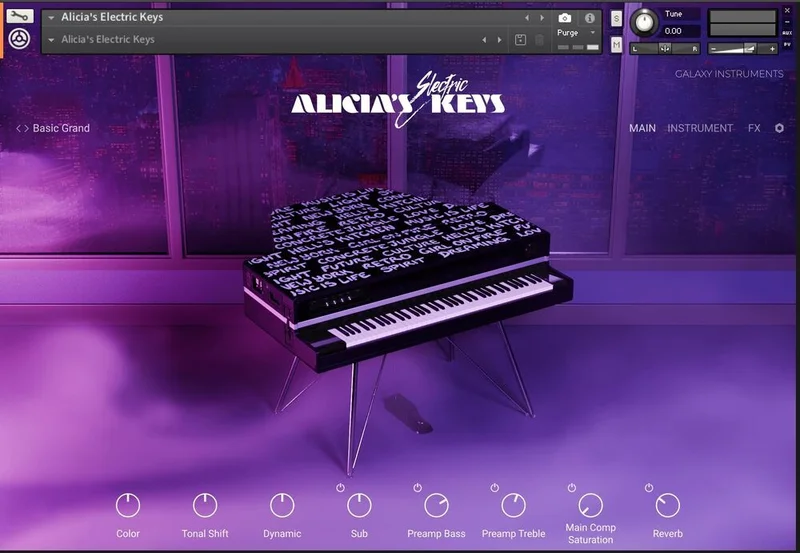
For the Electric Keys, the promise shifts toward texture and flexibility: 70s and 80s aesthetics in a modern engine, Alicia Keys' own custom effect chains, and controls for overtone, punch, and resonance alongside a wide range of preamps, cabinets, and effects. The enhanced browser lets you filter sounds by type, character, and style. That's a genuinely useful workflow feature for producers who build sounds quickly under deadline.
Where the Bundle Earns Its Price
Start with the acoustic grand. Load a mid-register chord, sustain it, and listen to what happens in the decay. The sympathetic resonance system is doing real work. Strings that share harmonic relationships with the notes you played continue to ring in the background, quietly, the way they do on a real instrument. Owners report the convincing string resonance as improved sample detail compared to older Native Instruments piano libraries.
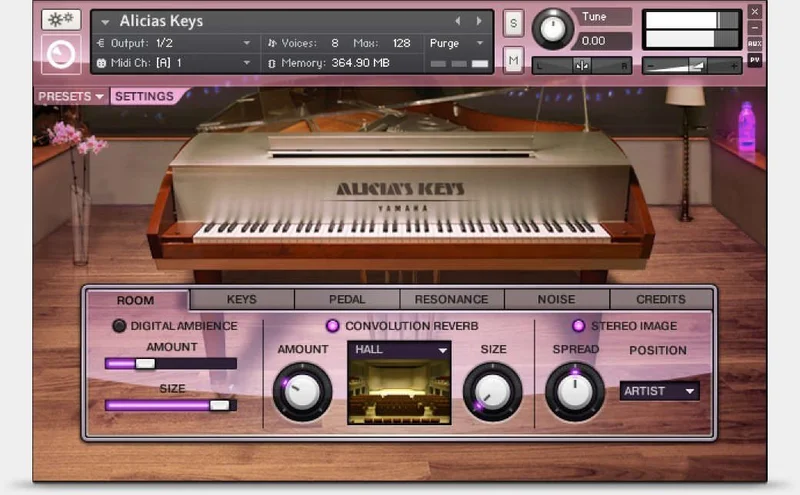
Push the sustain pedal and play a soft passage. The dynamic string resonance in pedal-down mode adds bloom without washing the sound out. It's the kind of behaviour that would have required careful manual automation a few years ago.
The mechanical detail options deserve attention too. If you want the sound of fingers hitting keys, you can dial that in. If you're mixing and need the piano to feel physically present in the room, those small noises add up. For pop ballads or intimate R&B production, that texture is satisfying to work with.
Owners report the realistic sound quality can trick listeners into thinking they hear a real piano, and that the instruments sit better in mixes than earlier versions. That's not a small achievement.
The Electric Keys is a different kind of convincing. The CP-70 has a specific sound: brighter and more percussive than a full grand, with a characteristic metallic sustain. The 70s and 80s character is real in the samples, not bolted on through a preset. When you shape overtone, punch, and resonance, you're genuinely changing how the instrument behaves, not just applying a filter. The included preamps and cabinets add colour in ways that make sense for the source material.
For pop production built around Alicia Keys' aesthetic, this is the most direct route available. The custom effect chains she uses are built in. You're not approximating her sound. You're starting from the same signal chain she used.
Where the Gap Between Claim and Reality Opens Up
Heavy CPU demand. This is the most consistent complaint owners raise, and it's not a fringe issue. Some report lagging and choppy sounds during playback, which is a workflow-killing problem in a live recording session. The bundle requires at minimum 4 GB of RAM, with 6 GB recommended for large Kontakt instruments. If your machine is on the lower end of the system requirements, budget more time for troubleshooting than for playing.
The round-robin problem is worth spelling out. Play an arpeggio quickly and the same velocity-layer sample fires repeatedly in a row. Without round-robin variation, you hear the exact same attack transient, identical each time. It creates a stutter pattern that sounds mechanical in the wrong way. Annoying is the right word for it, because it appears exactly when you're trying to capture a performance feel.
The low octaves present a different issue. Owners report excessive resonance down in the bottom register, where the acoustic grand can get muddy and unfocused rather than deep and authoritative. If your arrangement leans on bass-register left-hand movement, you'll be reaching for a high-pass filter faster than you'd expect.
Compare the low end to what Keyscape delivers and the gap is audible. The weight and depth that makes a piano feel physically large in a mix is harder to find here. The bundle sits best in the mid and upper registers, which is exactly where Alicia Keys' own playing centres. That's not a coincidence. It's a design reflection of the source material, and it's also a real limit for anyone who needs a different kind of piano writing.
Patch variety is thinner than the interface suggests. Most of the customization in Alicia's Keys involves reverb settings and lid position adjustments. These affect space and air, not the fundamental character of the instrument. If you're hoping for dramatically different tonal starting points, the selection is narrower than owners initially expect.
Rock producers will want to know this upfront: the bundle lacks the attack transients needed to cut through dense arrangements with guitars, bass, and drums all fighting for space. Owners report needing significant manual EQ work, and even then, the fundamental character of the instrument doesn't have the aggression the genre calls for.
Who Gets What They Paid For
You're a pop producer working in R&B, soul, or modern chart music. You want Alicia Keys' exact tonal palette without building it from scratch. At $194, the bundle delivers that result with a specificity that generic piano libraries can't match. The instrument is documented, the character is real, and the mid-register performance is convincing enough to hold up on a commercial release. Buy it.
You produce lo-fi, singer-songwriter material, or anything where the piano sits in the mid-range with space around it. The sympathetic resonance and mechanical detail will add warmth and physicality that works beautifully in sparse arrangements. The CPU hit is worth managing. Buy it.
You produce rock. The piano needs to push through a full band. You need attack, low-end weight, and a sound that's slightly aggressive. Skip it. This instrument is built for a different kind of power than the kind rock requires, and EQ alone won't fix the fundamental character gap.
You're a live performer or session player who runs instruments directly from a laptop with limited RAM and an older CPU. The heavy resource demand is a real risk. Wait until you've confirmed your machine handles Kontakt 7 large libraries cleanly before spending $194 on something that might choke mid-take.
You need a full-spectrum piano library for orchestral writing or jazz, where the low register needs to be as convincing as the mid. The excessive low-octave resonance and the depth gap versus alternatives are going to frustrate you. Skip it and look elsewhere.
The Acoustic Grand in Practice
Imagine you're writing a ballad. The chord progression sits in the middle of the keyboard, and you want the instrument to breathe between notes. Play the voicing with the sustain pedal down and let the resonance system do its work. That's where Alicia's Keys is at its best. The bloom is controlled, the decay is musical, and the mechanical noises add presence without sounding forced.
Now move that voicing down two octaves. The low-end resonance starts to pile up. It clouds rather than supports, making it work you shouldn't need to do on a library at this price point.
The 12 velocity layers per key give you genuine dynamic control. Play softly and the instrument whispers. Dig in and it opens up. The transition between layers is smooth enough that most owners don't notice the seams, which is a real benchmark of quality in a sampled instrument.
The Electric Keys in Practice
The CP-70 character is immediately recognisable if you know the instrument. It's not trying to sound like an acoustic piano in a different room. It has its own identity: bright, slightly nasal in the mid-high register, with a sustain that trails off in a way that's distinctly electric.
Use the overtone control to add harmonic complexity above the fundamental. Push the punch control and the attack gets sharper and more percussive. These are genuinely useful parameters, not just filter adjustments dressed up with interesting names. Dial in resonance and you're changing how the body of the instrument colours the sound.
The preamp and cabinet options let you shape from clean and direct to coloured and room-sized. For producers who want the classic Alicia Keys electric sound, the effect chains are already built in. For producers who want to take the CP-70 character somewhere else, the controls give you enough range to get there.
The enhanced browser is clever. Filtering by character and style means you can search for "warm" or "percussive" and get results that make sense. Filtering by character and style provides an efficient way to browse presets.
The Verdict
The Alicia Keys Bundle at $194 is a specialist tool that succeeds at its speciality. The acoustic grand's string resonance, mechanical detail, and mid-register character are genuinely impressive. The electric grand has real identity and flexible sound shaping. Both instruments are grounded in documented, specific sources, which gives them a coherence that generic piano libraries often lack.
The CPU demand is a real risk. The lack of round-robin sampling is a real flaw. The low-end weight gap is a real limit. For pop and R&B producers building in the aesthetic this instrument was made for, those limits are manageable. For anyone else, they're the reason to look at alternatives instead.
This isn't a piano library that earns a shelf spot in every studio. It earns a shelf spot in yours if the sounds it was built to deliver are the sounds your music needs.
Specs & Technical Details
| Developer | Native Instruments |
| Price | $194 |
| Plugin Format | VST3 / AU / AAX (Mac); VST3 / AAA (Windows) |
| OS Support | macOS 12–14 / Windows 10–11 |
| Activation | N/A |
| CPU Usage | Heavy |
| Trial Available | N/A |
| Version Reviewed | Requires Kontakt 7.1.05 or higher |
Score Breakdown
| Category | Score | Notes |
|---|---|---|
| Sound Quality | 4.0/5 | Mid-register is convincing; low-end resonance and lack of round-robin sampling hold it back |
| Value for Money | 3.0/5 | Specialist value for pop and R&B; weaker proposition for broader piano needs |
| Ease of Use | 3.5/5 | Interface is accessible but patch variety is thinner than expected |
| Features | 3.5/5 | Resonance system and mechanical detail are strong; limited fundamental sound variation |
| CPU Efficiency | 2.5/5 | Heavy demand causes real playback issues for owners on lower-spec machines |
| Overall | 3.5/5 | A specialist pop and R&B piano bundle that earns its place for the right producer |
Alternatives to Consider
Keyscape (Spectrasonics) is the comparison owners raise most often when the low-end weight of Alicia's Keys disappoints. It delivers more depth and physicality in the bottom register. It costs significantly more. If your budget allows and you need a piano library that handles the full range convincingly, Keyscape is where most producers end up.
Noire (Native Instruments) is worth considering if you want something from the same developer with a more fully-realised, atmospheric acoustic character. Owners describe it as more immersive and realistic overall. It's a different instrument with its own personality, but if the Alicia Keys aesthetic isn't a core requirement for you, Noire is worth comparing directly.
Grandeur (Native Instruments) is a fuller-sounding option if midrange warmth and realistic grand piano character are your priority over a specific artist's instrument. Owners recommend it for arrangements that need the piano to feel more physically substantial, with a richer midrange character than the Alicia's Keys acoustic delivers.
Synthogy Ivory is positioned as a superior alternative for producers who need a comprehensive, realistic grand piano library across the full register. It's more expensive, but owners who found the low-end limit of the Alicia Keys Bundle frustrating consistently point here as the upgrade worth saving for.
Frequently Asked Questions
Do I need to own the full version of Kontakt to run the Alicia Keys Bundle?
No. The bundle runs on the free Kontakt 7.1.05 Player, so you don't need to purchase the full Kontakt licence separately. You do need version 7.1.05 or higher specifically. If you're running an older version of Kontakt Player, you'll need to update before the instruments load correctly.
Is the Alicia Keys Bundle worth it if I already own a Kontakt piano library?
It depends on what you already have and what you produce. If your existing library covers the full register convincingly and handles dense arrangements, the bundle's specific value is its CP-70 electric grand and the pop-focused aesthetic of the acoustic. If you produce mostly pop and R&B, the character difference is real and worth the investment. If you produce across genres, your existing library is probably more versatile.
Can the Alicia Keys Bundle handle live performance use?
The heavy CPU demand is the main concern for live use. Owners report lagging and choppy playback on machines that don't exceed the recommended specs. If you're performing live, make sure your machine comfortably clears 6 GB of RAM and runs a modern Intel i5 or better, and test the load in a rehearsal environment before you depend on it on stage.