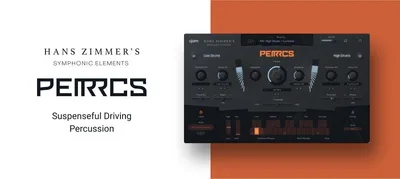
The Hans Zimmer DRUMS and PERRCS Bundle is a phrase-based cinematic percussion instrument that puts 53 drum styles, 74 rhythm styles, and over 1,500 patterns in a 1.4 GB package, priced at $349. It's built for film, trailer, and media composers who need Hans Zimmer's personal collection of Hollywood percussion up and running fast. But here's the tension that follows some buyers home: if you bought this expecting a fully flexible, layer-by-layer percussion toolkit you can sculpt from the ground up, there's a real chance the phrase-based architecture is going to frustrate you before you ever fall in love with it.
That's not a hypothetical complaint. Reviewers have flagged it. The convenience trade-off is real and baked into the design from day one. So before we get into what this bundle does brilliantly, it's worth being direct about who lands on the wrong side of that trade-off, and whether $349 still makes sense once you understand the limits.
Who Ends Up Regretting This Purchase
The buyer who feels stung is almost always a sound designer or advanced orchestral producer who expected something closer to a traditional sample library. If your workflow lives inside custom articulations, hand-placed hits, and meticulous layer control, the phrase-based engine is going to feel like a cage.
Reviewers have said it plainly: the architecture trades flexibility for convenience. That's a design choice, not a flaw, but it matters enormously depending on what you need. If you want to write a seven-hit taiko pattern that lands on your exact grid with your exact velocity curves, you'll be fighting this bundle constantly.
There's also a support concern worth flagging. At least one owner has reported installation failures on Brass and Strings components alongside unresponsive support. If you hit a wall post-purchase and the support ticket goes cold, that's a genuinely frustrating position to be in at this price point.
And if you're a beat producer looking for rhythmic flexibility or loop-chopping material, this bundle isn't that either. The phrase-based system is built around cinematic momentum, not hip-hop or electronic grid work.
What Owners Actually Say
Strip away the marketing, and the user reports land consistently in one place: the material sounds excellent, and getting it into a track takes almost no effort. Owners describe phrases integrating into sessions quickly, with options across the spectrum from subtle textural motion to full cinematic bombast.
The cinematic energy gets mentioned a lot. Owners report that both DRUMS and PERRCS deliver a sense of scale that would normally require a live session and a big recording budget. That's the real pitch, and owners largely confirm it holds up.
PERRCS specifically gets praise for its tempo-locking. Users report phrases snap to project tempo cleanly, and that halftime and double-time adjustments track without the kind of timing drift that makes other phrase-based libraries feel mechanical. MIDI learn capability across all controls is also confirmed by users, which matters if you want to map the bundle's key parameters to a controller for live performance or real-time arrangement.
The complaints split into two camps. First, the flexibility ceiling. Reviewers describe the phrase-based architecture as a convenience system first, and anything beyond the included presets and built-in Finisher and FX tools is effectively outside the product's scope. Second, some installation issues have been reported. For a bundle at $349, that's not a great experience, and the support response in at least one documented case didn't help.
The honest summary from owners: if you're on the right side of the architecture trade-off, this bundle is satisfying and fast. If you're on the wrong side, it's annoying quickly.
What You're Actually Getting Inside the Bundle
Two instruments. DRUMS and PERRCS. They're related but cover different sonic territory, and understanding both is how you get value from the $349 spend.
DRUMS: Phrases, One-Shots, and the Drive Controls
DRUMS ships with 53 playing styles. Each style carries 23 ready-made phrases, which puts the total phrase count at 1,219. That's a genuinely large library of rhythmic material. The instrument types span Surdos, Orchestral Bass Drums, Orchestral Toms, Taikos, Doumbeks, Field Drums, and Snares. Hans Zimmer's personal sample collection is the source, recorded at Remote Control Studios in Hollywood by Boris Salchow.
Beyond the phrases, DRUMS includes 5 one-shot hits and metals per style. Total one-shots across all 53 styles: 265. These sit alongside 300 sound designer presets, which is a large preset library for a percussion instrument at this tier.
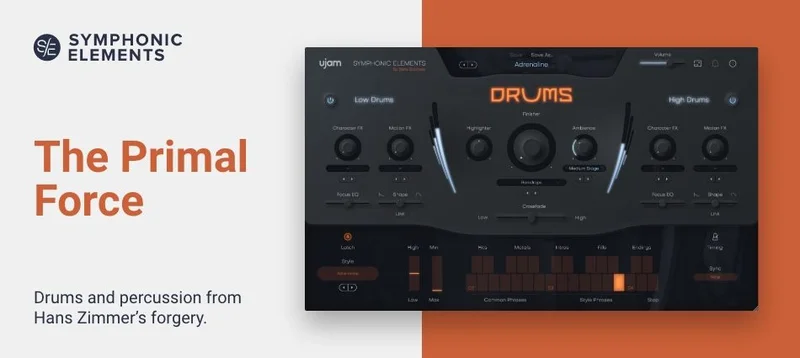
The Crossfade feature is one of the more practical controls inside DRUMS. It splits the instrument into two independent low and high sections, each running separately. Push one section forward while pulling the other back and you're blending the low-end punch of a surdo section against the crack of a field drum layer without committing to a fixed mix.
Imagine you're building a trailer cue and your orchestral low end already has weight, but you need top-end percussive snap. Pull the low section back on DRUMS and push the high section forward. You get the attack without the mass. That's a practical move in a real session, and the Crossfade makes it fast.
The Finisher effect section is the one-knob sound design tool. Single knob, broad tonal shifts. It's not deep synthesis. It's not a full FX chain. But if you want to reshape the character of a phrase without opening another plugin, the Finisher handles it quickly. DRUMS syncs to your DAW's tempo automatically, which keeps phrase playback locked without manual workarounds.
PERRCS: 74 Styles and Layered Motion
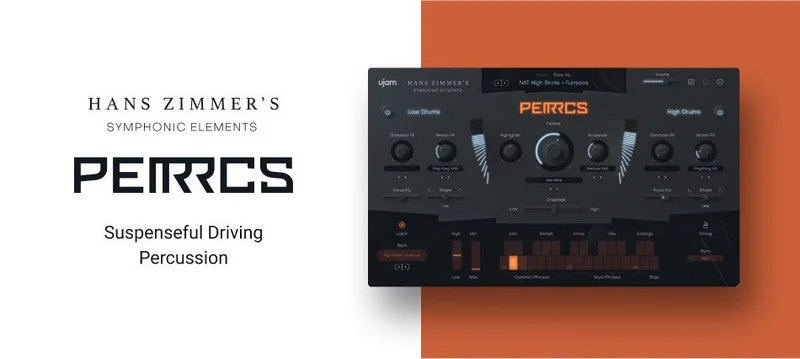
PERRCS is the orchestral texture layer of the bundle. 74 rhythm styles, each with 17 playable phrases, plus intros, fills, endings, and hits built into the architecture. The instrument types here include sticks, shakers, daiko, wood blocks, surdos, drums, triangles, and anvils. It's a wider timbral spread than DRUMS and built to add energy and motion rather than pure rhythmic punch.
The 74 Finisher multi-effect modes inside PERRCS go further than DRUMS's single Finisher control. 29 ambient treatments sit alongside those multi-effect modes, which gives the instrument a wider range of tonal territory. The character can shift from raw and percussive to treated and ambient without leaving the plugin.
Low and High Layer Control inside PERRCS mirrors the Crossfade architecture from DRUMS. Split the instrument into low and high sections, then apply Character, Motion FX, and EQ controls separately to each layer. That's real per-layer shaping. Push the Character control on the low layer for more aggression in the surdos while keeping the high layer's triangles and shakers cleaner. The Motion FX control adds movement and variation to the layer's rhythmic output. The EQ per layer means you're not stuck with a single tonal balance across the whole instrument.
You're composing a tense scene and need the low percussion to feel threatening while the high percussion stays fragile and distant. With PERRCS's layer split, you dial the Character up on the low section and pull the Motion FX on the high section to something slower and more sparse. The two layers create contrast in the same instrument. That kind of setup would take multiple tracks and careful gain staging in a traditional library.
The Sound Design Section in PERRCS combines the Finisher and additional FX into a single destination for reshaping the final output. It's still not a deep modular FX chain. But it's more than a utility polish stage.
Everything in PERRCS locks to tempo and adapts instantly, same as DRUMS. Halftime and double-time are confirmed to track cleanly by owners.
The Bundle Footprint and Installation
1.4 GB total. For a two-instrument bundle built on Hollywood sessions with over 1,500 phrases, that's a small footprint. Drive space is not the concern here. The concern is what happens if installation goes wrong. At least one owner has reported installation failures on components within the UJAM ecosystem, with support that didn't follow up quickly. That's not unique to UJAM as a developer, but at this price it matters.
The Finisher: One Knob, Real Results, Real Limits
Both DRUMS and PERRCS use a Finisher control as the top-level sound design tool. It's a one-knob system, and UJAM's Finisher architecture is known across their plugin lineup for making broad tonal and character changes without requiring deep programming knowledge.
In DRUMS, there's a single Finisher control. Turn it and you're adjusting the effect character of the full instrument output. It's fast and it's useful for quick tonal shifts mid-arrangement. If you want your taiko section to hit harder and darker, the Finisher gets you there in seconds.
In PERRCS, there are 74 Finisher multi-effect modes. That's a significantly wider menu. Each mode is a different character direction, and cycling through them while a phrase plays back is a legitimate creative move. Add the 29 ambient treatments on top and the sonic range of PERRCS is wider than DRUMS by design.
The honest limit: none of this is deep sound design. The Finisher is a preset-driven FX system. You can't dig into the routing, restructure the signal chain, or build your own Finisher mode from scratch. If you need that level of control, you're running DRUMS and PERRCS into your own processing chain and working outside the plugin's native tools. That's fine, and many producers do exactly that. But it means the Sound Design Section is a convenience tool, not a production environment.
Push the Finisher on a Doumbek phrase in DRUMS and you'll feel the difference. It's not subtle. The tone shifts and the texture changes in ways that could genuinely change how a phrase sits in your mix. It's clever design. It's also the ceiling.
The Phrase-Based Architecture: Speed vs. Control
This is the central argument of the whole bundle. The phrase-based system is what makes DRUMS and PERRCS fast. It's also what makes them frustrating for certain producers.
When you load a style in DRUMS, you're accessing 23 pre-built phrases. You pick a phrase, it plays back, it syncs to your session. You're not building the rhythm from individual hits on a grid. The developer's argument is clear: programming realistic percussion tracks from scratch is costly and time-consuming. The phrase library collapses that time cost dramatically.
And they're right. For a composer scoring a trailer against a deadline, jumping between 23 phrases to find the one that creates forward motion in a climactic scene is fast and practical. The cinematic energy owners describe is real. It doesn't take long to get a full, moving percussion bed going.
But you're picking from what exists. If none of the 23 phrases in a style land exactly where your arrangement needs them, you're stuck either making the closest phrase work or switching to a different style entirely. There's no phrase editor inside the bundle. There's no way to add a hit, subtract a beat, or shift the accent within a phrase.
The 1,219 phrases across DRUMS and 74 styles with 17 phrases each in PERRCS give you a large selection. But it's still a selection, not a toolkit for building from zero.
Tempo Sync and DAW Integration
Both instruments sync to your DAW's tempo automatically. This is non-negotiable for a phrase-based percussion library and UJAM delivers it without issues reported across the main drum and percussion components.
PERRCS owners confirm that halftime and double-time settings track cleanly. If your session tempo shifts mid-cue, the phrases follow. That kind of adaptive tempo tracking is what separates a usable cinematic phrase library from a frustrating one.
MIDI learn is confirmed across all controls. If you're running a live performance setup or want to map Character, Motion FX, and Finisher parameters to a hardware controller, the MIDI learn architecture handles it. That's a real workflow plus for composers who perform and record in real time rather than automating everything ITB.
Open PERRCS on a cue, map the Finisher to a knob on your controller, and ride it through the arrangement pass. You can shift the character of the percussion live as the cue plays back and commit to what feels right. That's a satisfying way to work with a phrase-based instrument.
Sound Quality and the Hollywood Pedigree
The source material was recorded at Hans Zimmer's Remote Control Studios and produced by Boris Salchow. These are real credentials, not marketing embellishment. The studio is responsible for scores across decades of major film and media work, and the samples in this bundle reflect that environment.
Owners consistently describe the material as excellent with cinematic energy that requires little effort to land. The phrase library covers a wide dynamic range, from subtle textural movement to full-on cinematic bombast, and both ends of that range are represented in the reports.
The instrument selection inside DRUMS, Surdos, Orchestral Bass Drums, Taikos, Doumbeks, Field Drums, and Snares, covers the core palette of Hollywood cinematic percussion. These aren't generic samples. Surdos carry a specific low-frequency weight. Taikos have that recognizable attack transient and tail. Field drums crack differently from orchestral snares. The specificity is there in the sample content.
PERRCS expands into smaller percussion, sticks, shakers, wood blocks, triangles, and anvils, plus daiko. These are the layers that create motion around the main rhythmic hits. Without them, a cinematic percussion bed can feel heavy and one-dimensional. PERRCS solves that with its own phrase library and the per-layer Character and Motion FX controls.
The Crossfade feature in DRUMS and the Low/High layer split in PERRCS both serve the same function in the mix: letting you balance the weight and presence of the instrument without automating volume on separate tracks. That's good sound design baked into the instrument architecture.
Value for Money at This Price Point
This is the question that sits at the center of the whole review. At $349, is the DRUMS and PERRCS bundle worth it?
The honest answer: for the right producer, yes. For the wrong one, no, and emphatically so.
What you get is two instruments, 1,219 phrases in DRUMS, over 1,200 phrases and patterns in PERRCS, 265 one-shots, 320 PERRCS presets, 300 DRUMS presets, 74 Finisher modes in PERRCS, 29 ambient treatments, all in 1.4 GB. The source material is Hollywood. The production credits are real. The tempo integration works.
What you don't get is the kind of deep sample library flexibility that lets you reprogram every element from scratch. If you've spent time with traditional orchestral percussion libraries built on articulation sets and custom MIDI mapping, the phrase-based approach will feel shallow by comparison. That's a real limitation at any price.
The question isn't whether this bundle is well-made. It is. The question is whether the phrase-based convenience model is what you actually need. If you're a media composer scoring to picture under time pressure, the value case is strong. You're getting Hans Zimmer's personal percussion collection, pre-recorded in a world-class studio, pre-programmed into usable cinematic phrases, with tempo sync and a solid preset library. That would cost a lot more to replicate on a scoring stage.
If you're a sound designer or an advanced orchestral producer who needs raw material and deep control, the value case collapses. You'd get more out of a larger, deeper sample library even if it costs more. The convenience you're paying for here isn't what you need.
The 1.4 GB footprint is genuinely underrated for what's inside. Drive space isn't the investment here. The investment is in whether the phrase architecture matches your workflow.
The Smarter Route If This Isn't Right for You
If you need deep customization, you're looking for a traditional orchestral percussion sample library built on articulation sets, velocity layers, and custom MIDI mapping. Those exist at a range of price points and give you the grid-level control DRUMS and PERRCS deliberately skip.
If you need cinematic energy fast and you're composing to deadlines, the bundle makes the value case cleanly. The alternative is spending session time programming individual hits, which costs more in time than the bundle costs in money, especially at trailer-scoring pace.
If you're budget-limited, check whether DRUMS and PERRCS are available separately. Buying one instrument first to test the phrase-based workflow against your own sessions before committing to the full bundle price is a smarter move than buying both and discovering the architecture doesn't suit you after the return window closes.
Buy or Wait?
Buy if you compose for film, trailer, or media, work to deadlines, and need cinematic percussion with real Hollywood source material that syncs to your DAW instantly. The phrase library is large, the sounds are legitimate, and the Finisher and layer controls give you enough shaping room for most scoring work.
Wait if you're an advanced sound designer, an orchestral producer who programs custom rhythms from scratch, or anyone who needs more than a phrase selection and a one-knob FX system. The architecture will frustrate you before it serves you.
Skip it entirely if you've had installation issues with UJAM products before and don't have confidence in the support response. That's a real risk flagged by real owners.
Specs & Technical Details
| Developer | UJAM |
| Price | $349 |
| Plugin Format | VST3 / AU / AAX |
| OS Support | Mac / Windows |
| Activation | N/A |
| CPU Usage | N/A |
| Trial Available | N/A |
| Version Reviewed | N/A |
| Total Phrases (DRUMS) | 1,219 |
| Total Rhythm Styles (PERRCS) | 74 |
| One-Shot Hits (DRUMS) | 265 |
| Total Presets | 620 (300 DRUMS + 320 PERRCS) |
| Finisher Modes (PERRCS) | 74 multi-effect modes + 29 ambient treatments |
| Bundle Footprint | 1.4 GB |
| DAW Sync | Automatic tempo sync |
| MIDI Learn | Yes (all controls) |
Score Breakdown
| Category | Score | Notes |
|---|---|---|
| Sound Quality | 4.5/5 | Hollywood-recorded source material with genuine cinematic weight across both instruments |
| Value for Money | 3.5/5 | Strong for media composers who need speed; poor value for producers who need deep customization |
| Ease of Use | 4.5/5 | Phrase-based system and Finisher controls make it fast to get results with minimal setup |
| Features | 3.5/5 | Large phrase library and per-layer controls are solid; sound design depth stops at the built-in Finisher |
| CPU Efficiency | N/A | Not reported in available data |
| Overall | 4.0/5 | A well-made cinematic percussion bundle for the right producer, with real limits for the wrong one |
The DRUMS and PERRCS bundle is what it says it is, nothing more and nothing less. If you're a composer who needs to get a cinematic percussion bed moving fast with material that actually came from a Hollywood stage, this bundle earns its place in your template session. If you're a producer who lives in custom MIDI programming and deep sample control, this will collect dust after the first week. The phrase-based system is either the most satisfying thing about it or the most annoying, depending entirely on where you sit. At $349, that's not a small bet. Know which side you're on before you buy.
Frequently Asked Questions
What instruments are included in the DRUMS component of the bundle?
DRUMS includes Surdos, Orchestral Bass Drums, Orchestral Toms, Taikos, Doumbeks, Field Drums, and Snares. These were recorded at Hans Zimmer's Remote Control Studios and produced by Boris Salchow. The instrument selection covers the core palette of Hollywood cinematic percussion across 53 playing styles.
How many phrases and patterns do DRUMS and PERRCS contain in total?
DRUMS contains 1,219 phrases across 53 playing styles, with 23 phrases per style. PERRCS contains 74 rhythm styles, each with 17 playable phrases plus intros, fills, endings, and hits. That puts the total library of rhythmic material well above 1,500 usable patterns across both instruments.
Can you sync DRUMS and PERRCS to your DAW's tempo?
Yes. Both instruments sync automatically to your DAW's tempo. PERRCS users specifically confirm that halftime and double-time settings track cleanly without timing drift. The tempo sync is automatic and requires no manual configuration.
Is the Finisher in PERRCS different from the one in DRUMS?
Yes. DRUMS features a single Finisher control for overall tonal shaping. PERRCS includes 74 Finisher multi-effect modes plus 29 ambient treatments, giving it a significantly wider range of tonal and character options. Both use the same one-knob architecture, but PERRCS's Finisher section has more built-in variety.
Is this bundle suitable for producers who want to build custom percussion arrangements from scratch?
No. The phrase-based architecture selects from pre-built patterns rather than building rhythms hit by hit. Reviewers have described this as a trade-off between convenience and flexibility. If your workflow requires custom MIDI programming and articulation-level control, this bundle will feel restrictive quickly.
Have there been installation issues with this bundle?
At least one owner has reported installation failures on components within the UJAM ecosystem, alongside a slow support response. This isn't a universal report, but it's been documented. If you've had installation issues with UJAM products previously, it's worth checking current support resources before purchasing.