
You're scoring a slow-burn documentary scene, you've exhausted your usual ethnic string patches, and you need something with a lower-register drone that actually sounds like it came from a body of wood and wire rather than a sample CD from 2004. That's the moment the Quijongo Guanacasteco Oscar Jimenez shows up in your search results. At $10.90, it's the kind of library you add without losing sleep, but only if you already own the full retail version of Kontakt 7. This review breaks down who genuinely benefits from it, and who should skip it entirely.
What the Quijongo Actually Is (and What It Isn't)
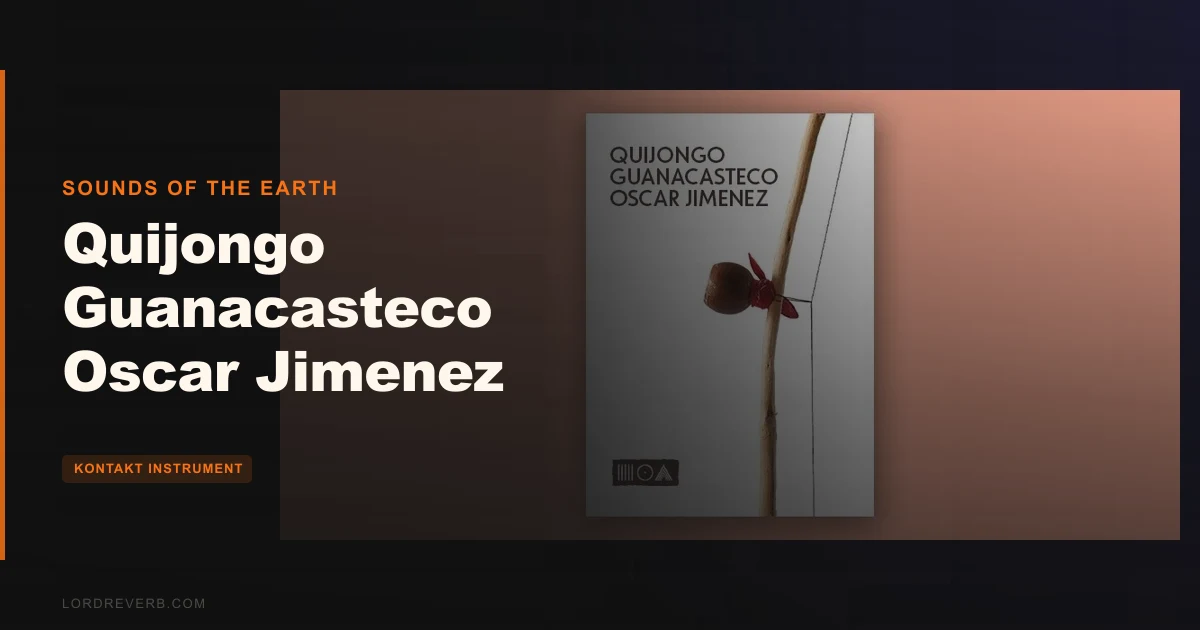
The quijongo is a monocord musical bow of African descent, rooted in Guanacaste, Costa Rica. One string. A resonant gourd. A sound that sits somewhere between a bass thumb piano and a bowed monochord, with a woody fundamental and harmonics that drift in ways a synthesizer can't fake without serious effort.
This library is not a bread-and-butter tool. It won't replace your go-to bass or your orchestral strings. It's a colour instrument, something you reach for when you need texture, atmosphere, or cultural specificity. If you thought this was a versatile multi-timbral library, it isn't. It does one thing, and it does it with focus.
Sounds of the Earth browse Sounds of the Earth libraries built the library around a real instrument played by Oscar Jimenez, which grounds it in a way that synthesised approximations never quite manage.
Where It Fits in Your Session
Picture this: you've got a cue that needs a tonal anchor below your melodic elements, something organic that doesn't read as "Western orchestral". You pull up the Quijongo Guanacasteco, pick your microphone position from the 8 available options, and lay down a sustained note.
The 8 mic options are the most practically useful feature here. Close, room, different capture angles: each one changes how much of the gourd resonance you get versus the string attack. If you want it to sit back in a dense mix, a room mic perspective helps it blend without fighting for space. If you want the attack front and centre, go closer. That kind of control at $10.90 is satisfying in a way that patches with a single static mic position never are.
With 710 sample files spread across the library, Kontakt has enough raw material to produce convincing velocity layers and articulation variation. The 464MB footprint means it loads fast and doesn't crowd your drive best Kontakt libraries under 1GB.
Fit it on a send with a long reverb tail and let it breathe under a string pad. Or run it dry and low in the mix as a tonal sub-texture. It's not a lead instrument. Don't try to make it one.
The Trade-Offs
The honest tension here is between the instrument's specificity and the library's scope. You'll notice the repetition before long if you're writing sustained passages. That's not a dealbreaker for film cues where a single sustained note or two can carry a minute of picture. But if you were hoping for rich melodic articulation across multiple registers, you'll hit the ceiling sooner than you'd like.
The Kontakt 7 full retail requirement is the bigger frustration for some buyers. The free Kontakt player locks you in demo mode after 15 minutes. If you're still on Kontakt 6, this library won't open at all. That's worth confirming before you buy Kontakt 7 vs free Kontakt player explained.
The Pulse installer requirement adds a small but annoying extra step compared to libraries that drop straight into Kontakt's browser. Not a deal-stopper. Just mildly irritating compared to drag-and-drop installs.
At $10.90, the price keeps most of this forgivable. You're not paying orchestral-library money for a mono-string instrument. You're paying roughly what a decent lunch costs for something that might be the most interesting texture in your next score.
Who Should Buy It, Who Should Wait, and Who Should Skip It
The Film and Media Composer
You write cues where cultural authenticity matters. You've been burned by generic "world music" packs that sound like they were recorded in a hotel bathroom. The Quijongo Guanacasteco is specific: one instrument, one tradition, recorded properly with mic options that give you placement control. You'll find a home for it. Buy it.
The Sound Designer
You layer, mangle, pitch-shift, and run things through granular processors. A monocord bow with gourd resonance is brilliant raw material for that workflow. The 710 samples give Kontakt plenty of source to slice and remap. At $10.90 you're barely risking anything. Buy it.
The Bedroom Producer or Beat Maker
You're working in trap, hip-hop, or electronic music and you want unusual textures. There's a real argument for pulling a quijongo sample into a beat for something unexpected. But you'll want to have Kontakt 7 full retail already, and you'll need patience with the narrow articulation range. If you've got Kontakt 7 and you're curious: worth a try. If you're still on the free player: skip it for now.
The Mixing Engineer or Plugin Collector
If you're not composing with sample libraries regularly, this doesn't belong in your toolkit. It's not a processing tool. It won't change how your mixes sound. Hard skip.
The Real Verdict
The Quijongo Guanacasteco Oscar Jimenez is an underrated find for anyone who writes music where sonic identity matters more than flexibility. It's a narrow instrument done properly, not a broad instrument done halfway. The 8 mic options punch above the price point. The Kontakt 7 full retail requirement is the genuine wall: if you're not already there, this library is locked off from you.
It belongs in the "quiet essential" category for world-music composers. Not loud about what it does. Just reliably good at it best world music Kontakt libraries.
Specs & Technical Details
| Developer | Sounds of the Earth |
| Price | $10.90 |
| Plugin Format | Kontakt Instrument (.nki) |
| OS Support | Mac (OSX 10.10 or later) / Windows (7, 8, or 10) |
| Activation | Pulse Installer required |
| CPU Usage | Light (Intel Core 2 Duo / AMD Athlon 64 minimum) |
| Trial Available | N/A |
| Version Reviewed | N/A |
Score Breakdown
| Category | Score | Notes |
|---|---|---|
| Sound Quality | 4.5/5 | A genuinely rare instrument captured with real mic variety; hard to find anything comparable |
| Value for Money | 4.5/5 | Eight mic positions and 710 samples at this price is a love it or leave it calculation that mostly lands on love |
| Ease of Use | 3.5/5 | Pulse installer requirement and Kontakt 7 full retail lock-in add friction before you've played a note |
| Features | 3.5/5 | 8 mic options are clever; 31 source audio files is a thin base for extended composition |
| CPU Efficiency | 4.0/5 | 464MB and a low processor floor means it runs on older machines without complaint |
| Overall | 4.0/5 | A focused, honest library for a specific instrument, priced where it should be |
The Quijongo Guanacasteco is one of those libraries you'll forget you own until the day you desperately need exactly this sound. Then you'll wish you'd learned it sooner. If you've got Kontakt 7 and you write anything cinematic, ethnographic, or textural: it earns its folder.
Related reviews: Velvet Guitars Upgrade from Desolate Guitars · Mosaic Tape
Frequently Asked Questions
Does the Quijongo Guanacasteco Oscar Jimenez work with the free Kontakt player?
No. The free Kontakt player runs this library in demo mode only, which times out after 15 minutes. You need the full retail version of Kontakt 7 or later to use it without restrictions. If you're not sure which version you own, check under Kontakt's About screen before buying.
What is a quijongo and where does it come from?
The quijongo is a monocord musical bow with African roots, associated with the Guanacaste region of Costa Rica. It has a single string and a gourd resonator, producing a low, droning tone with distinctive harmonic movement. It's one of the rarer instruments in the world music sample library space, which is part of what makes this library interesting.
How large is the library and will it affect my system performance?
The total install size is 464MB, which is light by modern Kontakt library standards. The minimum processor requirement is an Intel Core 2 Duo or AMD Athlon 64, so most machines made in the last decade will run it without issues. Don't expect it to stress your CPU.
What does the Pulse installer requirement mean for installation?
Pulse is a download and installation manager that Sounds of the Earth uses to deliver the library files. You'll need to download and run Pulse before the library installs into your Kontakt browser. It's an extra step compared to libraries that install via drag-and-drop, but it's a one-time process and not technically complex.