
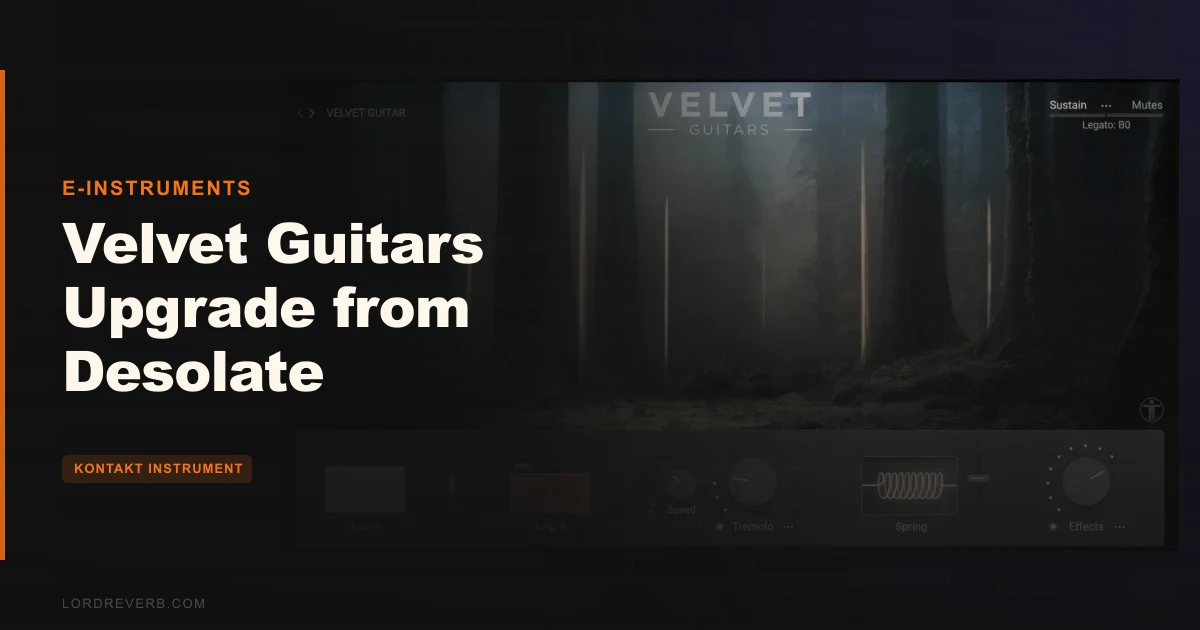
If you own Desolate Guitars and wish you had a warmer, softer version of the same library for cinematic work, Velvet Guitars is exactly that, and the permanent upgrade path at $79 makes it one of the more honest deals in the Kontakt instrument space right now.
This isn't a general-purpose electric guitar library. It's a scoring and sound design tool that happens to use guitar as its source material. The difference matters. Velvet sits where Desolate gets edgy and abrasive. It fills the same compositional gaps that send film composers reaching for sustain pads, ambient textures, and emotive solo lines, but with something that sounds like a real instrument was in the room.
At $79 for Desolate owners, the question isn't whether Velvet sounds good. It does. The question is whether you actually score the kind of cues it's built for. We'll give you enough to answer that honestly.
What You're Actually Getting
Velvet Guitars is a Kontakt 8.5.1 instrument from e-instruments sitting just under 35GB on your drive. Five guitars are captured here, electric and electric-acoustic, running through two vintage amps you can choose between or blend together.
The articulation list is long. Plucks, mutes, dead notes, chords, swells, feedback, harmonics, slides, jazzy octaves, ebow, violin bow textures, lo-fi tape recordings, reversed swells, evolving bowed textures, and textured feedback all live here. There are also genuinely unconventional captures: guitar played with a toothbrush, which produces something that sits between a shaker and a prepared piano.
The mod wheel controls articulation switching and blending. The FX chain uses macro controls tied to guitarist-designed presets. Real spring reverb is baked into the signal chain, not emulated as an afterthought. Tremolo syncs to host. NKS and NKS2 compatibility is confirmed, so if you're running a Komplete Kontrol keyboard, the integration is there.
The upgrade pricing is permanent in both directions. Desolate owners get Velvet at the upgrade price. Velvet owners get Desolate at the same rate. That bidirectional structure is clever, and we appreciate that e-instruments didn't time-limit it.
The Sonic Character in Practice
We loaded the ebow sustain preset and played a slow minor progression at around 60 BPM over a sparse pad. The attack is soft. The sustain blooms rather than plateaus, with subtle harmonic movement that pulls slightly sharp on the upper partials in a way that sounds intentional, not out-of-tune. It sits in a mix without needing high-cut work above 8kHz because the source material is already warm there.
That's the defining quality. Velvet's guitars were recorded with warmth as a design goal, not a side effect. Where Desolate gives you character through grit and tension, Velvet gives you character through softness and organic imperfection.
The bowed textures are a different story. We layered one of the violin bow articulations under a string section mock-up. At low velocities it reads as texture, not guitar. At higher velocities the bow noise comes through clearly, which is exactly what you want if you're building an organic hybrid sound. It doesn't try to hide its source.
The toothbrush articulation sounds ridiculous on paper. It produces a dry, rhythmic scrape with a short decay, somewhere between a guiro and a brushed snare. In a sparse, lo-fi arrangement, it worked. We'd use it on the right cue without hesitation.
The spring reverb adds real-spring character: that metallic shimmer and slight wobble on the tail you don't get from algorithmic plates. We ran a pluck through it at a medium decay setting and the result had that 60s surf rock thickness without needing an additional reverb in the chain.
How Kontakt instruments handle reverb and effects
The Articulation Engine and Mod Wheel Workflow
The mod wheel approach to articulation switching is where Velvet earns its playability score. You're not digging into keyswitches mid-performance. The wheel blends between articulations smoothly, so a pluck can dissolve into a swell without a hard cut.
We found the crossfade behaviour between sustains and mutes clean enough for real-time recording. Setting the wheel at around 60-70% on the MIDI controller produced a hybrid tone we hadn't planned but kept in the session. That's the satisfying kind of happy accident that good instrument design enables.
The chord mode is straightforward. Major or minor selection, triggered from the keyboard. It's not a full chord generator with inversions or tensions. For scoring applications where you want a quick, strummed texture on a single key, it works. For jazz voicing work, you'll be disappointed.
Dead notes and mutes respond to velocity well. Light touches stay dry and percussive. Heavy hits push through with more presence. Reviewers report that the velocity response feels more linear than some competing libraries, which helps when you're automating rather than performing in real time.
The Good
The articulation range is genuinely wider than most guitar libraries we've worked with at this price point. Most instruments at this level give you sustains, mutes, and maybe harmonics. Velvet adds bowed textures, reversed swells, toothbrush scrapes, and lo-fi tape recordings as first-class articulations, not bonus content buried in a separate patch.
The real spring reverb matters more than you'd think. We loaded a competing library's pluck preset and put a spring reverb plugin on it. It sounded fine. We loaded the equivalent Velvet preset with its built-in spring active. The difference is in the attack. Real spring reverb has a slight physical delay and a bloom on the initial transient that a plugin applied after the fact can't replicate cleanly. It's there in the recording, not added afterward.
Two vintage amps that blend together is a smart recording choice. It means you get tonal variation without articulation changes, and blending them in the interface creates mid-points that neither amp hits alone.
NKS2 support is proper integration, not just a logo. Users report that browsing presets from a Komplete Kontrol keyboard works as expected, with parameter mapping displaying correctly on the hardware.
The upgrade pricing structure is underrated. Permanent bidirectional pricing means you're never penalised for buying one library before the other. That's rare.
The Not-So-Good
35GB is a commitment. That's not unusual for a deeply sampled instrument, but if you're on a laptop with a 512GB SSD split between your OS, DAW, and a growing sample library collection, this needs planning before you buy.
Kontakt 8.5.1 is required. Not Kontakt 7. Not the free Kontakt Player. If you're still on an older version because your system is stable and you don't want to touch it, you're blocked. This is e-instruments' call, presumably to access Kontakt 8 features, but it's a hard wall for a portion of potential buyers.
The chord mode limitation is frustrating if you came in expecting harmonic depth. Major or minor, one of two options. No sevenths, no suspended chords, no inversions. For cinematic scoring that's often enough, but it should be disclosed clearly upfront rather than discovered after purchase.
Velvet is intentionally narrow in scope. That's a design choice, not a flaw, but users looking for a library to cover conventional guitar performance, lead lines, rock tones, or clean fingerpicking will be in the wrong place. The name tells you something. The word "velvet" is not doing metaphorical work here.
We also wish the FX macro documentation were deeper. The guitarist-designed presets are useful, but understanding what each macro is actually modulating requires some exploration. A clearer signal flow diagram in the manual would help.
Palm Mute Piano: another unconventional Kontakt instrument worth knowing
Compared to the Alternatives
Strezov Sampling's Afflatus: Intimate Strings and similar hybrid string-guitar libraries sit in adjacent territory, but they approach the sound from the strings side and use guitar as a texture layer. Velvet approaches it the other way: guitar is the instrument, texture is a mode it enters. That's a different workflow and a different sound.
Spitfire Audio's LABS Electric Guitar is free and covers basic clean electric tones well. It's a starting point, not a destination. Velvet is at least two levels deeper in articulation range and significantly more cinematic in intent.
Orange Tree Samples' Evolution series covers conventional electric guitar performance at a high level, with realistic picking, strumming patterns, and legato. If you need that, Evolution is the answer and Velvet isn't even competing. If you need texture, atmosphere, and unconventional articulations for scoring, Evolution doesn't go where Velvet goes.
Desolate Guitars itself is the most relevant comparison. Same developer, same design philosophy, different tonal register. Desolate is grittier, more tense, better for psychological thriller cues and darker ambient work. Velvet is warmer, softer, better for emotional underscore and delicate soundscapes. They are genuinely complementary, not redundant.
Kontakt instruments guide for beginners
Who Should Buy This
- ✅ Buy if you own Desolate Guitars and score emotional, atmospheric, or cinematic music that needs a warmer register.
- ✅ Buy if you produce ambient music and want organic guitar textures that aren't just clean sustains.
- ✅ Buy if you do sound design and want a source library with genuinely unusual articulations: bowed textures, reversed swells, toothbrush scrapes.
- ❌ Skip if you need conventional guitar performance with picking, strumming, and realistic legato.
- ❌ Skip if you're on Kontakt 7 or earlier and not planning to upgrade your installation.
- ❌ Skip if 35GB on your primary drive is a problem you haven't solved yet.
Specs & Technical Details
| Developer | e-instruments |
| Price | $79 |
| Plugin Format | Kontakt Instrument (requires Kontakt 8.5.1 or higher) |
| OS Support | Mac / Windows |
| Activation | Native Instruments Native Access |
| Library Size | Almost 35GB |
| CPU Usage | Medium |
| Trial Available | N/A |
| NKS / NKS2 | Yes |
| Version Reviewed | Kontakt 8.5.1 compatible release |
Score Breakdown
| Category | Score | Notes |
|---|---|---|
| Sound Quality | 4.5/5 | Warm, characterful recordings with real spring reverb that competing libraries skip |
| Value for Money | 4.5/5 | Permanent upgrade pricing is unusually fair for existing Desolate owners |
| Ease of Use | 3.5/5 | Mod wheel workflow is smart but FX macro documentation needs work |
| Features | 4.0/5 | Articulation range is deep; chord mode is shallow and that gap is noticeable |
| CPU Efficiency | 4.0/5 | Medium load, manageable on modern systems, though the 35GB footprint requires planning |
| Overall | 4.2/5 | A brilliant scoring tool for the right composer, wrong product for everyone else |
Alternatives to Consider
Spitfire Audio LABS Electric Guitar is a free starting point for clean electric tones. It's shallow compared to Velvet but costs nothing. Best free Kontakt instruments and sample libraries If you're testing whether electric guitar textures work in your compositions before spending money, start there.
Orange Tree Samples Evolution Electric Guitar is the library to buy if you want realistic guitar performance. Strumming patterns, picking articulations, legato slides: it handles conventional guitar in a way Velvet never tries to. If your sessions need a guitarist in the box, not a texture designer, Evolution is the answer.
Desolate Guitars is the obvious companion and the smartest context for this review. If you don't own Desolate and you're not sure which one to start with, read our full breakdown to understand which tonal register fits your scoring style before committing. Desolate Guitars review The upgrade path runs both ways, so your first purchase doesn't lock you out of the other.
The Verdict
Velvet Guitars is not a bold library. It's a precise one. E-instruments built something with a very specific purpose: warm, emotive, cinematic guitar textures for composers who score feeling rather than action. It delivers that with a 35GB sample set, five real guitars, two real amps, real spring reverb, and an articulation range that includes sounds you won't find in other guitar libraries at this price.
For Desolate owners, the upgrade is a clean call. The permanent pricing at $79 means you're getting a companion library, not a replacement, at a rate that reflects the shared infrastructure rather than treating you as a new customer. That's honest pricing. We respect it.
For everyone else: Velvet is brilliant if you score emotionally understated cues and need your guitar textures to feel organic without sounding like a guitarist showed up. It's the wrong tool if you need performance.
Buy it. Use it on your next underscore session. You'll find articulations you didn't know you needed, and you'll probably keep the toothbrush patch.
Frequently Asked Questions
Do I need to own Desolate Guitars to buy the Velvet Guitars upgrade?
Yes. The upgrade path at $79 is specifically for existing Desolate Guitars owners. If you don't own Desolate, you'll need to purchase Velvet Guitars at the standard price, or consider the bundle that includes both libraries. The upgrade pricing is permanent and runs in both directions, so Velvet owners can also upgrade to Desolate at the equivalent rate.
What version of Kontakt do I need to run Velvet Guitars?
Kontakt 8.5.1 or higher is required. The free Kontakt Player won't work, and neither will Kontakt 7. If you're running an older Kontakt installation and you're not planning to update, you'll need to factor in the cost of a Kontakt upgrade before this library makes sense.
How does Velvet Guitars differ from Desolate Guitars tonally?
Desolate is grittier and more tense, built for darker cinematic applications and psychological tension in scoring. Velvet is warmer and softer, with sustained emotive tones, bowed textures, and a more delicate character. They were designed to complement each other, covering different ends of the same cinematic guitar spectrum rather than overlapping.
Is Velvet Guitars suitable for conventional guitar performance in a pop or rock production?
No, and it shouldn't be used that way. The library's articulations target cinematic and ambient applications: bowed textures, reversed swells, ebow sustains, toothbrush scrapes, and lo-fi tape recordings. If you need realistic picking, strumming, or legato playing for a rock or pop session, look at Orange Tree Samples' Evolution series instead.
How much disk space does Velvet Guitars require?
Almost 35GB. That's in line with other deeply sampled Kontakt instruments, but it's worth checking your drive situation before purchasing. Streaming from an external SSD is a reasonable option if your primary drive is tight. Installation is handled through Native Instruments Native Access.