CineStrings Core is a Kontakt string library recorded at the MGM Scoring Stage at Sony Pictures Studios, built for orchestral film scoring and designed to integrate with the broader CineSymphony series. It lists at $399 and is best suited to composers who write action-driven or high-drama cues where projecting shorts and powerful tutti textures matter more than expressive, nuanced legato lines.
Picture the moment: you've just landed a brief for a trailer. The music editor wants strings that cut through brass and percussion, something aggressive and present, not polished chamber strings sitting behind everything else. You pull up your Kontakt instance, load a spiccato patch, and you need it to sound like a real session, not a bedroom approximation. That's the exact moment CineStrings Core was designed for.
But here's the thing. That moment is narrower than the $399 tag implies, and the bugs in version 2.0 make even that narrow use case harder than it should be. If legato lines are central to your writing, this library is going to frustrate you at a level that's genuinely hard to work around.
What It Is (and What It's Not)
CineStrings Core covers the full string section: 1st Violins, 2nd Violins, Violas, Cellos, and Basses. It was recorded by Dennis Sands at MGM Scoring Stage, Sony Pictures Studios. The room adds a natural projection and weight that's suited to cinematic contexts.
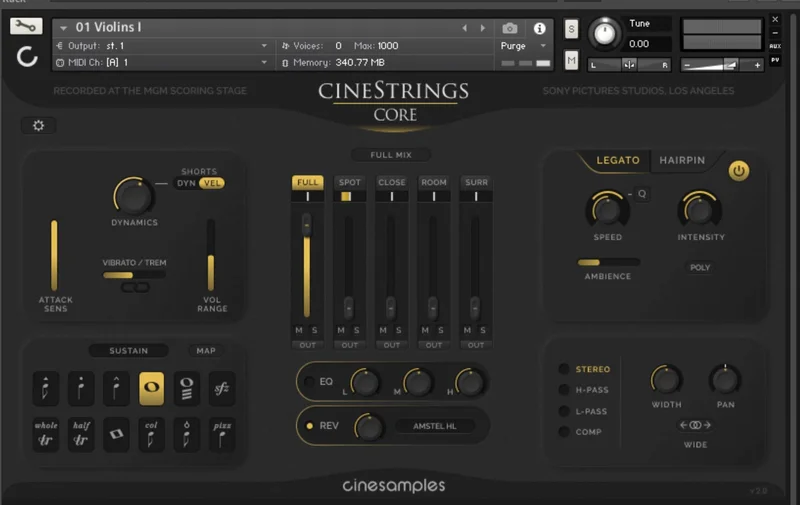
Five microphone positions are available through the Mixer page. Articulations can be switched by velocity, key-switch, or MIDI CC through the Mapping page. The library works inside the free Kontakt Player 6.7.1 or later, which keeps the entry barrier lower than libraries that require the full Kontakt licence.
What it's not: a nuanced tool for slow, tender cues. It's not a go-to for exposed legato writing. And it's not a light load on your system. If your sessions run close to CPU limits already, loading CineStrings Core is going to push you over.
Where It Sits in a Film Scoring Session
You're building a cue that moves fast: an action sequence, a chase, an epic title reveal. You stack your spiccatos on the strings bus, dial in the staccatos for rhythmic movement, and use marcatos for the hits. That's where CineStrings Core is genuinely satisfying to work with. Owners describe the shorts as having wonderful bite that cuts through a mix easily, and that tracks with what the round-robin counts suggest: 7-8 round-robins on spiccato from pp to f, 5-6 on staccato from pp to fff.
Your Mixer page gives you the full mix or four individual microphone positions. Run the full mix when you're mocking up quickly. Dial into individual mics when you need to control the room character more carefully or blend the library into a custom reverb chain.
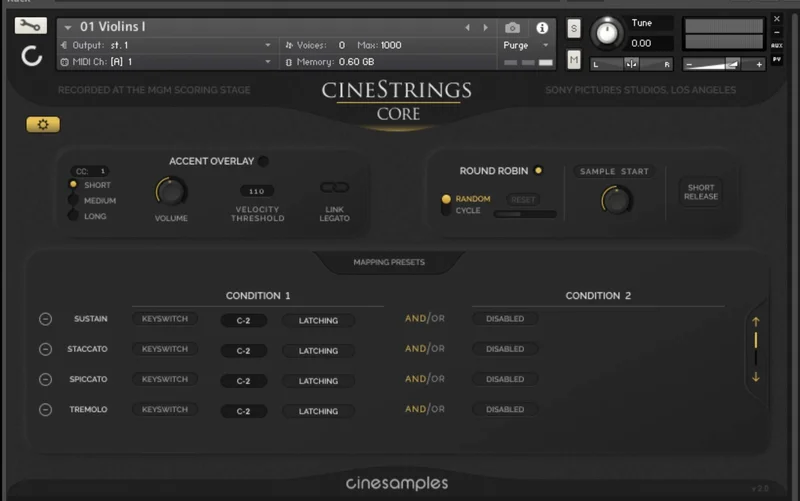
The Mapping page is where you configure articulation switching. Velocity switching, key-switching, or MIDI CC all work, so your existing template logic can stay intact without rebuilding from scratch. For composers with complex Kontakt templates, that flexibility matters.
The Hairpin Creator is a standout feature for automatic swell control. It syncs to your DAW and executes crescendos or decrescendos automatically as you play, no manual CC automation required. When it works, it's the most satisfying thing in this library. You hold a note, the swell happens on its own, and the phrase breathes the way a real section would. The problem is that it doesn't always work. Owners report it sometimes triggers only release tails instead of a full swell, which means what you hear in playback isn't what you expect, and debugging it costs time.
The bow-attack overlay sits on top of sustains and legatos, triggering at hard velocity or via CC. It's a clever piece of design that gives you an aggressive attack transient without switching to a different articulation. In fast writing, that speed is real. In careful writing, it needs attention because it doesn't blend with every dynamic.
The Articulation Library: Where It Earns Its Keep
The sustain section covers non-vibrato, vibrato, and espressivo with dynamic morphing across five dynamics. Tremolos run from p to f, Sul-Pont Tremolos from p to f. Trills come in whole-step and half-step variants. These are well-covered articulations for scoring work.
Pizzicato has 5 round-robins from p to f. Owners describe the pizzicatos as beautiful, and the cellos and basses specifically as sonorous. If you're writing a cue that leans into plucked strings for texture or accent, those sections deliver.
Bartok Pizz lands at 3 round-robins. Col Legno sits at 3-5 round-robins. Harmonic Sustains run p to f. For specialty articulations that often get skimped in mid-range libraries, the coverage here is respectable.
The Sforzando Overlay from p to ff is a smart addition. Use it on accented hits without manually layering a separate patch. It sits cleanly on top and gives the hit shape without breaking your legato patch setup.
Push the mod wheel high and the texture is present and projecting. Bring it low and owners report something less flattering: the sound turns synthy and dull, lacking the depth and detail that a real low-dynamic string section would have. At soft dynamic levels, samples can be scratchy with ambient rumble and fidget noises. That's a real problem if your writing demands both loud drama and quiet intimacy from the same session.
The Trade-Offs
The MGM Scoring Stage acoustics are real and they show. The room gives CineStrings Core an authority that takes more mixing work to fake with libraries recorded in smaller halls. For composers who need that projection baked into the sample, this is a genuine strength.
But the CPU cost for that sound is brutal. Owners report very high CPU usage that hits all cores on multi-core machines. Legatos are specifically singled out: they can bring systems to their knees even in small configurations. The minimum spec is 8 GB RAM, with 16 GB recommended, and 100 GB of drive space for approximately 45 GB of samples. That's a heavy footprint before you've added any other instruments to your session.
The legato issues aren't just a performance problem. Owners report poly-legato malfunctions at velocities over 90, which means fast, loud legato passages can break mid-phrase. Attack pop artifacts appear on sustains. These are workflow-stopping problems, not minor annoyances. Version 2.0 includes GUI and sonic improvements, but it currently carries unresolved bugs including poly-legato malfunctions and attack pop artifacts.
The 2D crossfading on the multi-patch articulations is a smart system when it functions correctly, letting you morph between articulations fluidly. The Settings page gives you advanced vibrato and dynamic control linking for sound design work. These are features worth having. They just don't compensate for broken legatos and attack artifacts in a real session.
Against the Field
Four libraries come up repeatedly when composers are deciding where CineStrings Core sits in the market.
Cinematic Studio Strings is described as more expressive but with less convincing room acoustics. If your writing skews toward slower, more emotional material where legato expressiveness is the priority, Cinematic Studio Strings wins that comparison. CineStrings Core wins on acoustic weight and short articulation aggression.
Spitfire Mural takes the award for best detail and works well for slow and tender cues. If the cue you're writing is intimate and careful, Mural is the better tool. CineStrings Core doesn't compete at that end of the dynamic range.
LASS is known for precise punch and detail. Where CineStrings Core gives you room and projection, LASS gives you surgical control. For composers who need both projection and precision editing, LASS gets closer.
Berlin Strings is more versatile, more tweakable, with close mics and what's described as brilliant 2D morphing between articulations. If budget allows and you want a string library that holds up across a wider range of cue types, Berlin Strings is the stronger long-term investment.
Berlin Strings
More versatile across cue types with better legato performance and 2D articulation morphing
Cinematic Studio Strings
More expressive legato and better suited for slow, tender writing than CineStrings Core
The Real Verdict
CineStrings Core earns its place in one specific setup: a CineSymphony composer who already owns or plans to own CineBrass, CineWinds, and CinePerc, and whose writing leans toward action, trailer, and big dramatic cues where short articulations and room presence carry the session.
For anyone else, the legato bugs, the attack artifacts, the CPU load, and the flat low-dynamic response are hard to justify at $399. The shorts are brilliant. The room is real. But the library's limits are specific and deep enough that buying it without understanding exactly what it's for is a waste of money.
If you're a solo composer building a general-purpose string library, skip this. If you're inside the CineSymphony ecosystem already and need strings that match your brass and winds, understand what you're buying: a library that's strongest in the loud, aggressive half of the dynamic range and needs real work to perform across the full picture.
Specs & Technical Details
| Developer | Cinesamples |
| Price | $399 |
| Plugin Format | Kontakt Instrument (Kontakt Player 6.7.1+ / Komplete Kontrol) |
| OS Support | Mac OS X 10.12 or higher / Windows 7 or later |
| Activation | N/A |
| CPU Usage | Heavy (owners report all cores consumed on multi-core machines) |
| Trial Available | N/A |
| Version Reviewed | 2.0 |
| Sample Size | Approximately 45 GB (100 GB free drive space required) |
| RAM | 8 GB minimum / 16 GB recommended |
Score Breakdown
| Category | Score | Notes |
|---|---|---|
| Sound Quality | 3.5/5 | MGM room projection is real, but sound is flat and synthy at low dynamics |
| Value for Money | 2.5/5 | High price relative to the bug count in v2.0 and narrow usable dynamic range |
| Ease of Use | 2.5/5 | Mapping and Mixer pages are flexible, but legato bugs and artifact troubleshooting cost significant session time |
| Features | 3.5/5 | Hairpin Creator and bow-attack overlay are clever; articulation coverage is wide; bugs undercut the execution |
| CPU Efficiency | 1.5/5 | Owners report all CPU cores consumed even in small configurations; legatos are worst offenders |
| Overall | 2.8/5 | Strong room and shorts, but too many unresolved issues to recommend broadly at this price |
Alternatives to Consider
Cinematic Studio Strings is described as more expressive than CineStrings Core, with legato performance that owners rate more highly for slow and emotionally complex writing. Its acoustic character is different from the MGM stage sound, so it's less convincing on action cues that need raw projection. But if your sessions lean toward anything other than loud, driving music, it handles the range more reliably. The right call for: emotional and narrative scoring.
Spitfire Mural is the choice when detail is the priority. Owners and reviewers describe it as the best in class for capturing fine-grained string texture at soft and moderate dynamics, the range where CineStrings Core loses the plot. It works for slow and tender cues where the low-dynamic response needs to stay musical and three-dimensional. The right call for: intimate, restrained writing where the mod wheel spends most of its time below halfway.
Berlin Strings is more versatile and more tweakable, with close mic options and 2D articulation morphing that owners describe as brilliant. If you're building a string library that needs to cover wide ground across a range of cue types and you want the control to match, Berlin Strings covers more of the picture. The right call for: composers who need one library to do most things well.
Frequently Asked Questions
Does CineStrings Core require the full version of Kontakt?
No. CineStrings Core works with the free Kontakt Player 6.7.1 or later, as well as Komplete Kontrol. You don't need a full Kontakt licence to run it, which keeps the total cost of entry lower than libraries that require the paid version.
What is the Hairpin Creator and does it actually work?
The Hairpin Creator is a DAW-synced feature that automatically generates crescendos or decrescendos as you play, without manual CC programming. Owners describe it as the library's best feature when it functions correctly. The frustrating part: owners also report it sometimes triggers only release tails instead of a full swell, so it needs monitoring in your session rather than set-and-forget use.
How bad is the CPU usage in real sessions?
Heavy. Owners report very high CPU consumption that hits all cores on multi-core machines. Legatos are the worst offenders and can cause performance issues even in small patch configurations. If your session is already running close to CPU limits, CineStrings Core will push it over. A 64-bit DAW is recommended and 16 GB RAM is the practical minimum for comfortable use.
Is CineStrings Core worth buying if I don't own other CineSymphony libraries?
It's a harder sell as a standalone purchase. The library is designed to blend with CineBrass, CineWinds, and CinePerc, and that integration is part of its value proposition. Used alone, its limits are more exposed and you'd be comparing it directly to string libraries built to work independently, some of which handle legatos and low-dynamic detail more reliably.
What articulations does CineStrings Core cover?
The library covers sustains in non-vibrato, vibrato, and espressivo forms with five-dynamic morphing; natural legatos with four-dynamic morphing; spiccato, staccato, marcato, pizzicato, Bartok pizz, col legno, tremolos, Sul-Pont tremolos, whole-step and half-step trills, and harmonic sustains. It also includes a Sforzando Overlay and a bow-attack overlay. Articulation switching can be assigned to velocity, key-switch, or MIDI CC via the Mapping page.