
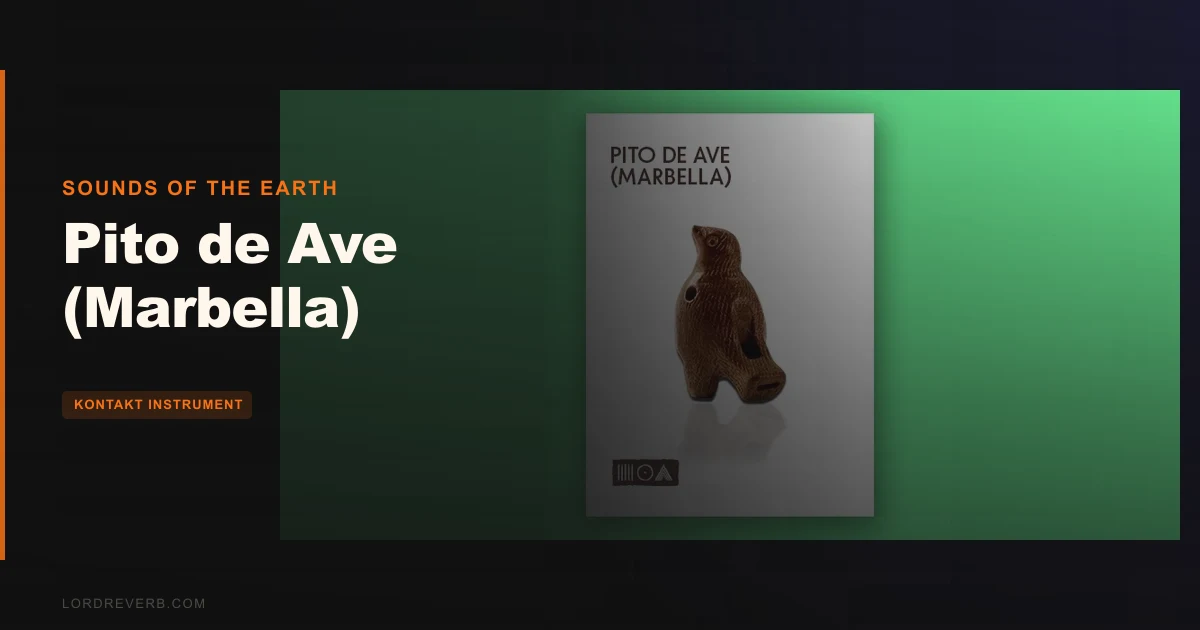
The Pito de Ave (Marbella) by Sounds of the Earth is a Kontakt instrument built around a single, handcrafted bird-shaped clay whistle, and it's one of the most honest-sounding pre-Hispanic aerophones we've loaded into a session. At $9.90, it sits in a category of its own: not a pan-flute pack, not a generic world winds bundle, but one specific object with a voice that no synthesiser is going to replicate convincingly.
We pulled it up on a sparse ambient cue that needed something fragile and organic sitting high in the mix. The whistle landed immediately. Bird-call adjacent, breathy at the edges, with a pitch character that's just slightly uneven in the most human way possible.
This is for composers and producers working in world music, cinematic scoring, or ambient production who need that specific texture. If you need a versatile woodwind library, look elsewhere. If you need this sound, nothing else is this sound.
What This Instrument Actually Is
The Pito de Ave is a zoomorphic clay whistle. Zoomorphic means animal-shaped. This one mimics a bird, dates back to pre-Hispanic traditions, and was handcrafted by Amílkar Palacios in Nosara, Guanacaste, Costa Rica.
It has two finger holes and produces notes that imitate birdsong. That's the design. Sounds of the Earth captured it across 84 audio files, expanded to 1,167 Kontakt sample files, with 8 mic positions baked in.
What it's not: a melodic lead instrument. It's not a folk flute you can run a scale on for a Celtic cue. The pitch range is limited, the timbre is niche, and the expressiveness comes from how you layer and phrase it, not from a wide keyboard range.
Think texture and atmosphere over melody. That's the honest positioning.
Living With It: Setup, Sessions, and Surprises
Installation goes through Pulse, Sounds of the Earth's own installer. It's an extra step that we'd call mildly annoying if you're used to dropping a Kontakt library folder straight in. It works, but it adds friction. Budget five minutes.
You'll need full Kontakt 7 or later. Not the free Kontakt Player. This is a hard requirement and it catches people out. If you're on an older version or only have the Player, this won't run properly. Check your version before you buy.
Once it's loaded, the 8 mic options are where the instrument opens up. We ran the close mic for a dry, intimate whistle sitting just above the noise floor of silence. Then we tried a room blend. The character shifted completely. Close mic is brittle and present. The room mics add air without muddying the pitch.
332MB is a light footprint. It loads fast. CPU draw is negligible. We ran three instances on a thin scoring template without any spiking. That's satisfying when you're building a layered ambient bed and want to stack textures.
The one workflow snag: the pitch ceiling is exactly what the physical instrument produces. We hit a moment on a cue where we needed the whistle a minor sixth higher than its top note. Pitching it up in Kontakt introduced artefacts. The instrument sounds like itself in its native range and starts to fight you outside of it.
The Trade-Offs You Should Know About
The 1,167 sample files packed into 332MB tells you something about the recording methodology. That's a high file-to-size ratio, which suggests Sounds of the Earth captured variations, round-robins, and articulation differences without oversampling into bloat. Smart work.
But the trade-off is narrow application. This whistle does one thing. It does it brilliantly, but you're not going to reach for it on a hip-hop drum bounce or a dense rock mix. It's a tool for a specific drawer.
The 8 mic options give you real creative latitude within that narrow application. That's the counterweight. You can go dry and folkloric, or wide and cinematic, without leaving the instrument. That flexibility adds value to what could otherwise feel like a one-trick library.
The Pulse installer requirement is the most frustrating part of the experience. It's not broken. It just adds a layer of dependency we'd rather not have. Once installed, it's done. But first-time setup on a fresh machine requires Pulse to be running, which isn't obvious from the product listing.
At $9.90, none of these trade-offs feel like deal-breakers. They'd matter more at ten times the price.
Against the Field: What Else Competes Here
There isn't a clean competitor doing exactly this. Most world winds libraries bundle dozens of instruments together. The Pito de Ave (Marbella) is deliberately singular.
Native Instruments' Komplete bundles include some world percussion and wind textures, but they're broader and built for variety rather than depth on a single instrument. If you need a toolkit, that's the direction. If you need this specific voice, the toolkit won't have it.
Spitfire Audio's LABS series has released free world instruments with similar organic character. Some of those sit in adjacent sonic territory. But the pre-Hispanic specificity of the Pito de Ave and the 8-mic flexibility aren't matched in the LABS catalogue.
The closest comparison in the Sounds of the Earth family is their Udu instrument. We've tested it. The Udu is percussive and low; the Pito de Ave is melodic and high. They layer beautifully together. If you want both ends of the spectrum from this developer, that pairing works. See our Sounds of the Earth Udu Review for details on that instrument.
The Real Verdict
The Pito de Ave (Marbella) does what it promises. One handcrafted pre-Hispanic bird whistle, captured with care, delivered with 8 mic options and enough sample depth to feel alive in a mix.
At $9.90, the ask is low enough that the narrow application stops being a barrier. You're not paying specialist-library money for a specialist sound. You're paying almost nothing for something you genuinely cannot fake with a synth.
Skip it if you want a versatile wind instrument library. Skip it if you're on free Kontakt Player only. Buy it if you need this exact voice in your palette, because nothing else sounds like this.
Specs & Technical Details
| Developer | Sounds of the Earth |
| Price | $9.90 |
| Plugin Format | Kontakt Instrument (.nki) |
| OS Support | macOS 10.10 or later / Windows 7, 8, 10 |
| Activation | Pulse Installer |
| CPU Usage | Light |
| Trial Available | N/A |
| Version Reviewed | N/A |
| Sample Files | 1,167 Kontakt sample files / 84 audio files |
| Mic Options | 8 |
| Library Size | 332MB |
| Kontakt Requirement | Full Retail Kontakt 7 or later (free Player not supported) |
Score Breakdown
| Category | Score | Notes |
|---|---|---|
| Sound Quality | 4.5/5 | Handcrafted source and careful recording produce a genuinely authentic result |
| Value for Money | 4.5/5 | At $9.90, the ask is nearly impossible to argue with for what you get |
| Ease of Use | 3.5/5 | Pulse installer and Kontakt 7 requirement add friction before you hear a note |
| Features | 3.5/5 | 8 mic options are clever; the narrow pitch range and single instrument limit the score |
| CPU Efficiency | 4.5/5 | 332MB, light CPU draw, multiple instances ran without issue |
| Overall | 4.0/5 | A niche instrument done with real craft, priced so low the specialisation barely matters |
Alternatives to Consider
If you want more breadth from the same developer, start with the Sounds of the Earth Udu Review. It sits at the percussive, low-end opposite of the Pito de Ave, and the two instruments layer into something genuinely interesting for world and cinematic work.
For a broader introduction to how Kontakt instruments work before committing to specialist libraries like this, our Kontakt Instruments Guide: 5 Things Beginners Must Know covers the essentials. Worth reading if the Kontakt 7 requirement caught you off-guard.
If you're drawn to unusual, single-purpose Kontakt instruments with organic character, the Palm Mute Piano Review is another instrument that commits fully to one sound. Different sonic world entirely, but the same philosophy of depth over breadth.
For competitors outside this site: Spitfire LABS offers free world-adjacent textures worth exploring before spending anything. Native Instruments Komplete covers world winds in broader bundles if variety matters more than specificity.
None of them sound like the Pito de Ave. That's the honest answer.
If your sessions need a pre-Hispanic bird whistle that sounds like a pre-Hispanic bird whistle, buy this at $9.90 and stop looking. If you need a flexible wind library, keep looking.
Related reviews: AEON Collection · Velvet Guitars Upgrade from Desolate Guitars
Frequently Asked Questions
Does the Pito de Ave (Marbella) work with the free Kontakt Player?
No. This is one of the most important things to check before buying. The free Kontakt Player will run the instrument in demo mode only, which means it'll time out after 15 minutes. You need the full retail version of Kontakt 7 or later to use it properly. If you're not sure which version you have, check your Native Access account before purchasing.
What kind of music is the Pito de Ave (Marbella) actually useful for?
It works best in cinematic scoring, ambient production, and world music compositions where you need an authentic pre-Hispanic aerophone texture. It's a high-pitched, breathy bird-whistle character. Think sparse, atmospheric cues rather than melodic leads. Producers working in folk, ritualistic, or indigenous-inspired music will find it fits naturally; producers looking for a versatile woodwind instrument won't.
What does the Pulse installer requirement mean for my workflow?
Pulse is Sounds of the Earth's own installation system. You'll need to download and run it to install the library correctly. It's not complicated, but it is an extra dependency beyond just dropping files into your Kontakt library folder. Once the library is installed, you don't need Pulse running during sessions. It only affects the initial setup.
Is 332MB a reasonable size for this type of Kontakt instrument?
Yes. For a library containing 1,167 sample files across 8 mic positions, 332MB is a light footprint. It loads quickly and draws very little CPU during playback. You can run multiple instances without strain on most modern systems. For context, many single-instrument Kontakt libraries with far fewer samples run significantly larger. The size here reflects efficient recording and sensible compression, not a lack of content.