The AEON Collection is Heavyocity's flagship Kontakt instrument bundle combining 725+ presets of hybrid melodic and rhythmic content into a single library built for cinematic, electronic, and hybrid composition.
We loaded the Melodic component on a Thursday afternoon with a TV trailer cue on the clock and forty minutes to find something that actually cut through. We pulled up a preset called from the Organic category, dropped it on a sparse string bed, and it locked in immediately. Dense harmonic bloom, the kind that fills the upper-mids between 3kHz and 6kHz without needing a brightening EQ pass. That part took four minutes. The frustrating part came later: we wanted to strip that same preset back to its dry source to try it in a different context, and the interface simply wouldn't let us get that deep. We kept running into walls where the sound was brilliant but the bones weren't ours to expose.
That tension, between the library's undeniable quality and its curated, opinionated nature, defines everything about the AEON Collection. At $399, it earns your attention. But it doesn't earn a blank recommendation.
What Is AEON Collection and Who Is It Really For?
The AEON Collection is two instruments sold together: AEON Melodic and AEON Rhythmic. They're both built in Kontakt, both run in the free Kontakt 5 Player, and together they total 28GB uncompressed (14GB on disk in lossless compression) with 10,100+ samples at 24-bit/48kHz.
AEON Melodic holds 315 presets across 130+ organic sounds, 160+ synth and hybrid patches, and 39 signature AEON Hits. AEON Rhythmic adds 315 single loop presets, 9 tonal loop menus, 46 loop arp presets, and 43 three-loop combo presets, totalling 400+ presets in that component alone.
It's not a general-purpose sample library. It's not a traditional orchestral tool. This is a purpose-built weapon for composers working in film trailers, TV drama, game audio, and contemporary cinematic electronic music. If that's your world, the case for AEON is strong. If you're producing R&B, funk, or jazz-adjacent music, it's wrong for you. Full stop.
The library exists at the intersection of acoustic instruments and aggressive synthesis. Heavyocity recorded traditional and ethnic instruments, blended them with modular analog synth rigs, and layered the results into hybrid presets that don't sound like anything in a stock Kontakt library.
Living With AEON: Setup, Interface, and Daily Workflow
Setup is download-only. No physical media, no installer disc. You pull it through Native Access, which works cleanly in 2026 on both Mac and PC. The 14GB compressed footprint is a reasonable ask for what you get.
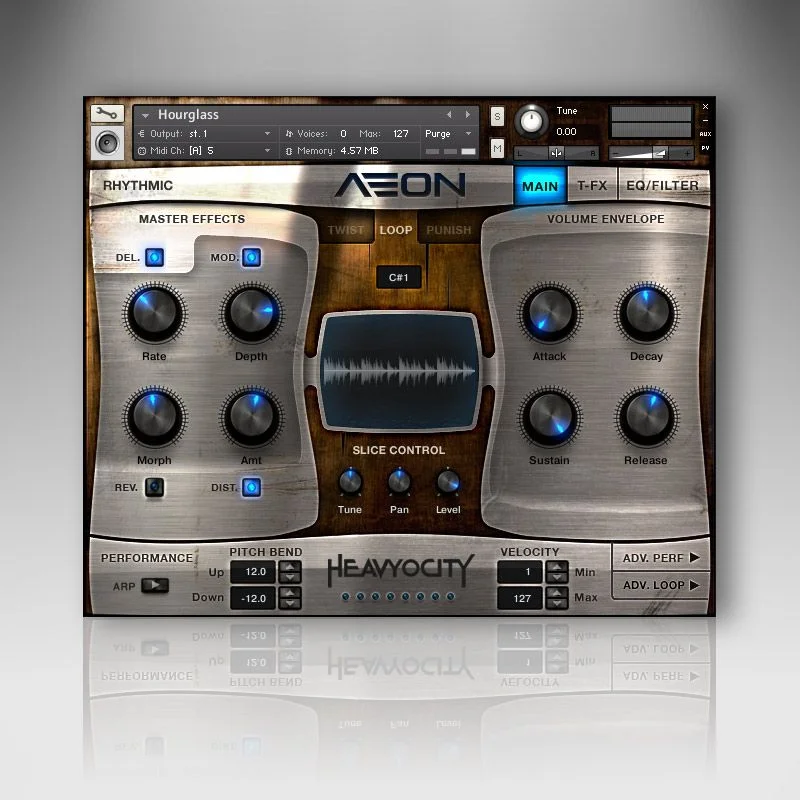
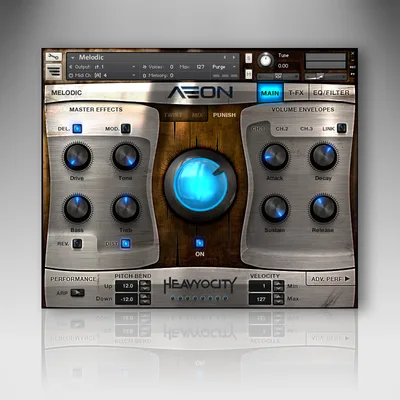
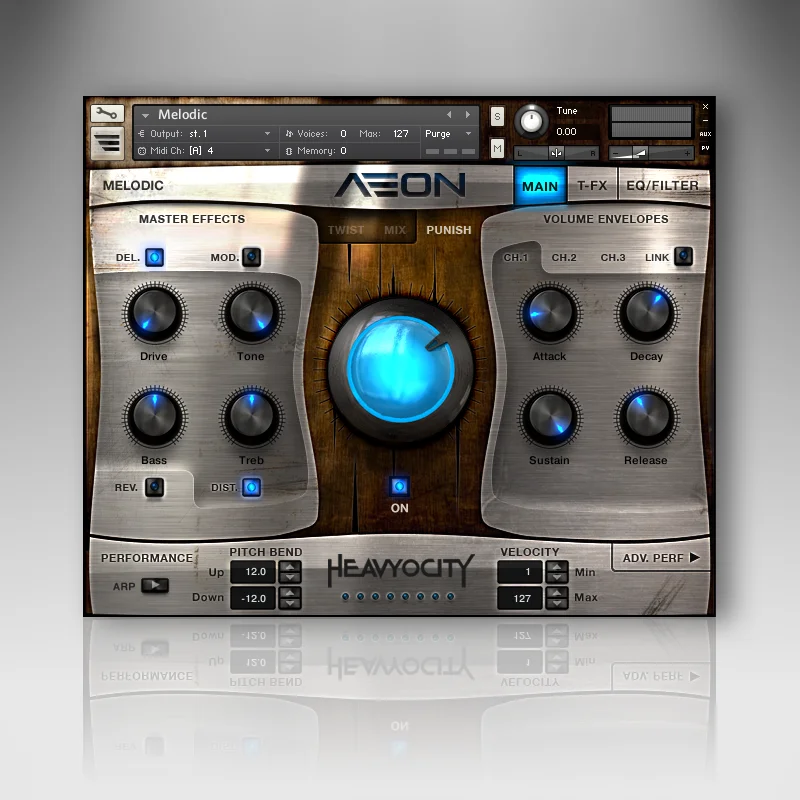
The Kontakt interface runs across three tabbed pages: Main, EQ/Filter, and Trigger FX. You meet the Main page first. It's where you play sounds, adjust layers, access the arpeggiator in Melodic, and trigger the Loop Mutator in Rhythmic. Clean layout. Nothing feels buried.
The EQ/Filter page gives you per-instrument shaping. You've got filter controls with cutoff and resonance, plus a basic EQ section that handles low-shelf, high-shelf, and a parametric mid band. It's enough to dial in a preset without reaching for your DAW channel strip, which we appreciated during fast sessions.
The Trigger FX page is where the library gets genuinely clever. You get a step sequencer-style system that gates, stutters, arpeggiate, and rhythmically chops your sound in tempo-synced patterns. We ran a long, sustained string-synth hybrid through a 16-step Trigger FX pattern at 1/16th resolution and what came out sounded like a sequenced modular rig. The pattern locked to our DAW tempo immediately. Satisfying.
AEON Rhythmic's Loop Mutator is the other headline feature. You pull a single loop preset, and instead of accepting the original slice order, you rearrange the loop's segments via MIDI drag-and-drop. We rearranged a dark cinematic loop over about eight minutes and produced something that didn't share a single recognisable phrase with the source. It's a legitimate composition tool, not a gimmick.
Heavyocity also includes a Twist modulation control and Punish saturation on certain presets. Twist handles LFO-driven modulation routed to pitch, filter, or amplitude. Punish pushes saturation and harmonic distortion into the signal. These aren't deep synthesis modules. They're performance-oriented macro controls that change character fast.
One genuine annoyance: preset browsing inside Kontakt is still slower than it should be in 2026. Loading a new NKI takes two to four seconds per preset, which adds up in an exploratory session. Reviewers consistently flag this, and we agree: it's friction you feel during creative momentum.
Where AEON Genuinely Delivers
The sound quality is the honest headline. Heavyocity's recording chain produced 24-bit/48kHz samples with real depth. The low-end on the synth bass patches is full without being muddy: the sub content sits between 40Hz and 80Hz with harmonic weight in the 100Hz to 200Hz range that gives it body in a mix without fighting your kick. We checked this with a spectrum analyser. It held up.
The organic instrument blends are genuinely beautiful. Heavyocity layered ethnic strings, breathy woodwinds, and pitched percussion with analog synthesis to create sounds that don't read as "library music" to a trained ear. A suspense cue we built using the Organic Melodic section took less processing than almost anything we'd built from scratch. Two passes of subtle compression, a light high-pass at 60Hz, and it was done.
AEON Hits deserve a mention. The 39 signature hits are massive, cinematic transients: pitched impacts that carry both punch and tone. They layer with loop content from Rhythmic to create that recognisable "hybrid trailer" bed without requiring you to build it from individual elements.
The arpeggiator in Melodic is another underrated strength. It's not a simple up-down-random sequencer. You set note length, rate, velocity patterns, and swing. We built a 32-step melodic phrase using a solo ethnic string preset that held up as a lead motif. It took twelve minutes from blank project to exportable loop.
The Trade-Offs You Need to Know Before Buying
Here's the honest part. The thing that makes AEON sound immediately impressive is the same thing that limits it: everything is heavily processed before it reaches you.
Heavyocity's philosophy is to deliver finished sounds, not raw ingredients. That's a legitimate choice. But it means that when you try to bend a preset outside its intended sonic context, it fights you. The dry source samples are mostly inaccessible. The layering architecture shows you knobs but not the wiring behind them.
Users keep running into this wall: a preset that sounds perfect in a trailer context becomes unmalleable when they need something slightly different. Reviewers describe reaching for the deeper editing functions and finding them locked off by design. We hit the same frustration. You can shape, but you can't sculpt.
Compare this to a more open-architecture tool like Omnisphere, where you can load your own audio into the synthesis engine. AEON doesn't offer that. The presets are the product. If your workflow demands source-level flexibility, this will annoy you.
There's also a genre ceiling. AEON's character is cinematic, dark, and hybrid-electronic. It's not warm in the vintage sense. It's not funky. It doesn't swing the way a live instrument library would. Every preset has a signature Heavyocity sheen: heavy processing, dramatic presence, designed impact. That's a feature for some producers. It's a limitation for others.
The $399 price point compounds the issue. If you only need the Melodic or the Rhythmic component, you can buy them separately. The collection is the value play only if you genuinely need both. Don't pay full price for half the library.
Against the Field: How AEON Stacks Up
Omnisphere 2 is the most frequent comparison. Omnisphere is broader, covers more sonic territory, and lets you load your own audio for synthesis. It wins for pure versatility and long-term creative range. AEON wins for instant cinematic impact and pre-designed hybrid sounds that need no additional synthesis knowledge to deploy.
The Heavyocity Keys and Synth Bundle sits in a different territory within the same brand, leaning toward playable keyboard instruments rather than cinematic design. If you need expressive melodic instruments without the trailer DNA, that bundle is worth comparing before committing to AEON.
Native Instruments' Komplete suite, particularly the cinematic and hybrid content in Komplete Ultimate, covers adjacent ground at a different investment structure. Komplete is broader but less opinionated. AEON is narrower but more immediately usable for a specific job.
For loop-based cinematic work specifically, AEON Rhythmic has few direct competitors at this quality level. The Loop Mutator is genuinely differentiated. Most competing loop libraries give you static audio files. AEON gives you a system for re-composing loops inside the instrument.
We'd also point you toward Vocalise 3 Review if vocal texture matters in your workflow. It's Heavyocity's same design philosophy applied to the human voice, and it pairs with AEON's melodic content well.
The Real Verdict
AEON Collection is a brilliant tool for one specific job. If you're writing for film, TV drama, or games, and you need hybrid cinematic sounds that sit in a mix without a week of processing, this library earns its place in your signal chain.
It's wrong for you if you need source-level control, genre flexibility outside cinematic/electronic territory, or if your budget doesn't justify owning both components. It's also wrong if you expect Omnisphere-level synthesis depth at the same price.
We'd buy it for a dedicated cinematic rig. We wouldn't make it the only tool in that rig.
Specs & Technical Details
| Developer | Heavyocity |
| Price | $399 |
| Plugin Format | VST / AU / AAX (Kontakt-powered; standalone via Kontakt Player) |
| OS Support | Mac (OS X 10.10+) / Windows 7+ (32/64-bit) |
| Activation | Native Access / NKS |
| CPU Usage | Medium to heavy depending on preset layering and Trigger FX load |
| Trial Available | No |
| Version Reviewed | AEON Collection (Kontakt 5.5.1.451 or higher required) |
| Library Size | 28 GB uncompressed / 14 GB lossless compressed on disk |
| Sample Quality | 24-bit / 48kHz |
| Total Samples | 10,100+ |
| Total Presets | 725+ NKIs |
| Requires Kontakt | Free Kontakt 5 Player compatible |
Score Breakdown
| Category | Score | Notes |
|---|---|---|
| Sound Quality | 4.8/5 | 24-bit/48kHz samples with genuine analog character; best-in-class for cinematic hybrid content |
| Value for Money | 3.5/5 | Strong if you need both components; weaker if your work only suits one half of the library |
| Ease of Use | 4.0/5 | Three-tab interface is clean; preset loading lag and deep-edit restrictions cost points |
| Features | 4.2/5 | Loop Mutator, Trigger FX, and Arpeggiator are genuine differentiators; synthesis depth is limited |
| CPU Efficiency | 3.5/5 | Medium-to-heavy load under complex presets; Trigger FX sequences push usage higher |
| Overall | 4.1/5 | Outstanding sound quality and cinematic workflow tools, held back by limited source-level control |
Alternatives to Consider
Omnisphere 2 (Spectrasonics): Broader synthesis architecture, deeper modulation, and the ability to import your own audio. Compare Kontakt instruments vs synth-based samplers for a breakdown of when each approach wins. Omnisphere takes longer to master but gives you more long-term range.
Native Instruments Komplete Ultimate: Covers cinematic, hybrid, orchestral, and electronic territory across dozens of instruments. More content, more flexibility. Less immediately deployable than AEON for a specific cinematic cue.
Heavyocity Vocalise 3: If vocal texture is part of your sound design palette, Vocalise 3 Review covers Heavyocity's vocal library in detail. It layers well with AEON Melodic for hybrid cinematic beds.
Loot Audio Palm Mute Piano: A completely different direction, but if you want a Kontakt instrument with more source-level character and less production polish, Palm Mute Piano Review shows what a more exposed sample design philosophy looks like.
And if you're still deciding between Heavyocity products specifically, Heavyocity Keys and Synth Bundle review covers the alternative if playable keyboard sounds matter more than loop-based composition tools.
The AEON Collection is the kind of library you keep loading for three years after you buy it, and the kind you resent every time it stops you from getting somewhere it wasn't designed to go. At $399, it pays for itself on the right projects fast. On the wrong projects, it collects dust. Know your use case before you commit. We'd call it essential for dedicated cinematic composers and a thoughtful skip for everyone else.
Frequently Asked Questions
Does the AEON Collection require a full paid version of Kontakt?
No. Both AEON Melodic and AEON Rhythmic run in the free Kontakt 5 Player (version 5.5.1.451 or higher). You don't need a paid Kontakt license to run the library. You do need to activate through Native Access.
Can I buy AEON Melodic and AEON Rhythmic separately?
Yes. Heavyocity sells both components individually. The AEON Collection bundles them together. If your workflow is purely melodic-instrument-based or purely loop-based, buying separately may give you better value than the full collection.
Is AEON Collection good for beginners?
It's accessible at the preset level: load a patch and play. But the price point and cinematic focus make it a specialist tool rather than a first purchase. Beginners would benefit more from a general-purpose Kontakt library before investing in a specialised collection like AEON. Check our Kontakt instruments beginner guide before committing.
How does AEON Rhythmic's Loop Mutator actually work?
The Loop Mutator slices a loop into segments and lets you rearrange those slices via MIDI drag-and-drop directly in your DAW. You're not editing audio files. You're sequencing the playback order of the loop's components inside the Kontakt instrument. This lets you produce unique variations from a single source loop without any external audio editing.
Does AEON Collection work with NKS-compatible controllers?
Yes. AEON is NKS compatible, which means it integrates with Native Instruments Komplete Kontrol keyboards and Maschine hardware. Preset browsing, parameter mapping, and light guide support all function through the NKS standard. For trailer composers using hardware controllers in a live session context, this is a practical workflow advantage.