If you're weighing Mars Symphonic Men's Choir against Spitfire's Albion or East West's Voices of the Empire, here's where this review lands: Mars wins on articulation depth and solo content, loses on modern GUI polish, and sits in a price bracket that makes it genuinely hard to dismiss. At $399, it's one of the most complete male choral libraries you can buy inside Kontakt, built on SF Symphony Chorus and SF Opera singers recorded over 10 days in a real concert hall. It's built for film and TV composers who need Slavonic liturgical weight or Latin gravitas on a deadline, not bedroom producers looking for a quick choir pad.
How It Compares Out of the Box
The first comparison most composers reach for is East West's Hollywood Choirs. Hollywood Choirs has a slicker interface and a word-builder that feels more modern. Mars predates it, but the articulation count here is staggering in a way that still gives current libraries a run for their money.
Spitfire's Shevannai and their orchestral choir content lean cinematic-ambient. Mars goes the opposite direction: liturgical, specific, and formal in character. If you want Slavonic chant energy for a war epic or a religious ceremony scene, Mars delivers that without needing to layer three libraries to get there.
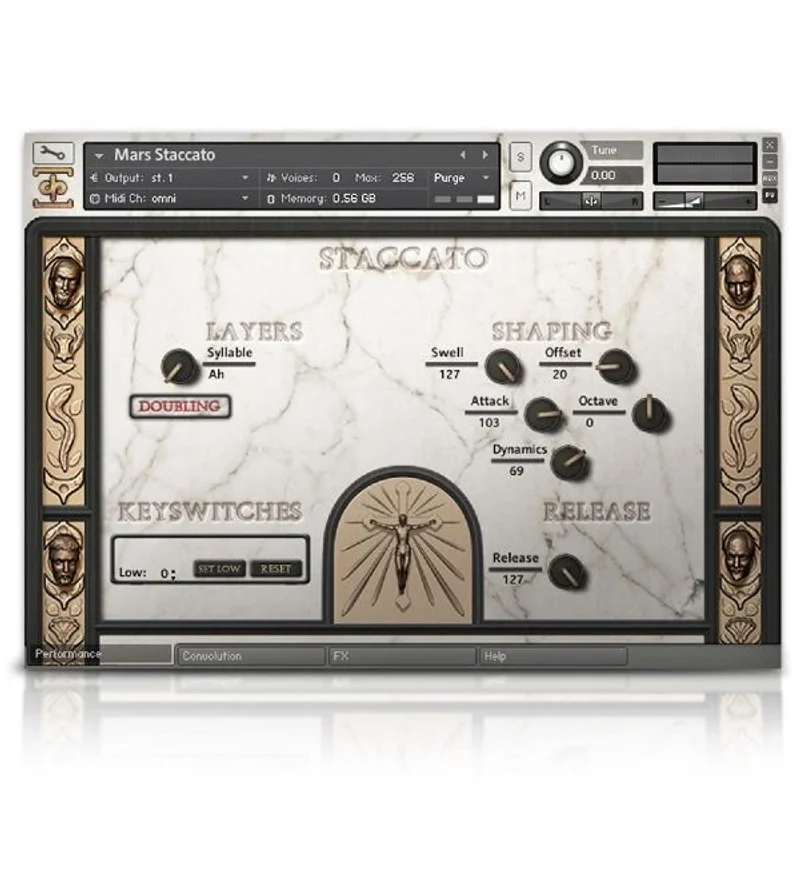
Where the first-load experience stings slightly is the interface age. The Kontakt 5 presets look dated next to 2025-era releases. That's cosmetic, not functional, but it shapes the first impression. Reviewers tend to get past it once the audio loads. So did we.
What's Actually Inside This Library
Mars ships with 16,091 samples across 17.9 GB installed. That's uncompressed 24-bit/48kHz PCM wav, which means no lossy encoding cutting corners on the high-frequency shimmer of a real hall space.
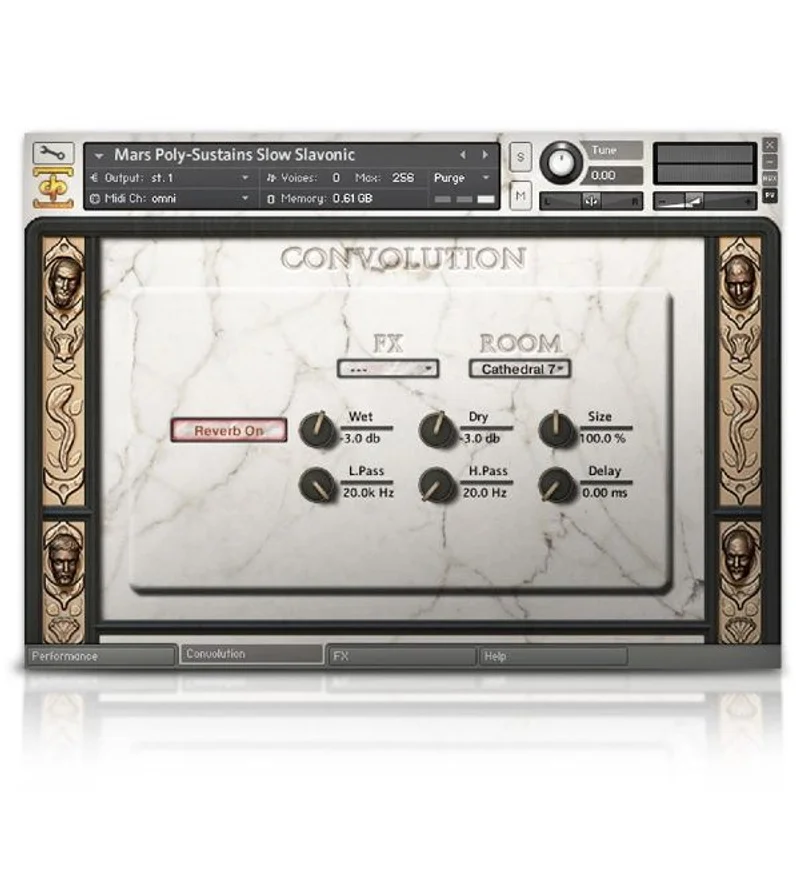
The preset count is significant. You get 220 Kontakt 4.2 nki core instruments plus 73 nkm multis, and a separate set of 74 Kontakt 5.1 nki advanced presets plus 36 nkm multis. The Kontakt 5 set unlocks tempo-synching for the poly-sustain presets and time-stretching on the choral effects. That's not a minor addition: being able to stretch a cluster or a choral sweep to fit your scene without tuning artifacts is a real production tool.
Two mic positions: stage and hall. Both are composite blends from 10 Neumann large-diaphragm microphones, with wide pairs placed at distances from 1 to 25 meters. You're not tweaking individual mic feeds. You're working with two already-mastered stereo images. That's a workflow decision we'd have made differently, but it keeps load times manageable and avoids the phase nightmare of mixing raw close-and-far feeds on a deadline.
The recording venue is Montclair Presbyterian Church in the Oakland Hills. It has natural reverb that sits behind the samples without swamping them. Every preset also ships with convolution impulses built in, so you're not starting from a dry, anechoic result that needs three reverb plugins to sound like a real space.
The Marcato Builder: Where Mars Earns Its Money
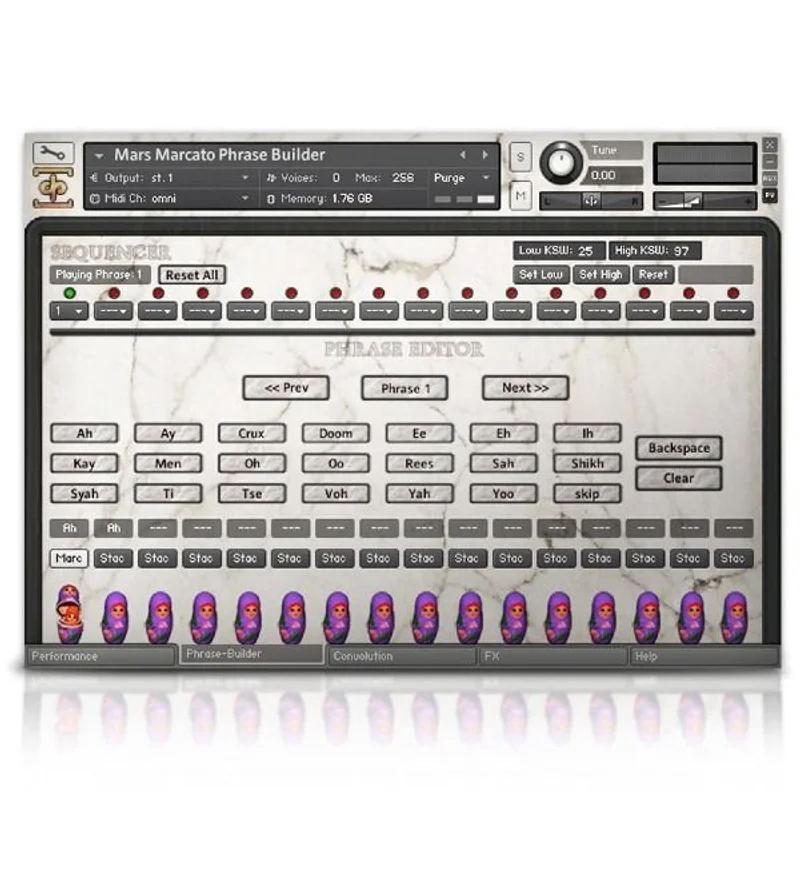
This is the feature that separates Mars from a static sample playback library. The Marcato Builder lets you construct words syllable by syllable using 7 major vowel sustain types, each with multiple variants.
The total pool: 42 independently selectable attack syllables and 42 release sounds. Each has independent round-robin cycling and automation-ready controls. That means you can build a phrase, automate the syllable changes across your timeline, and get something that resembles a real choir moving through text, not just a repeated "ahhh" with velocity variation.
There's also a Combined Marcato/Staccato Phrase Builder on top of that. You can save presets within it and store up to 16 user-created sequences, then cycle through them or keyswitch between them during playback. That's a production workflow, not just a sample selector.
We mapped a four-bar phrase using the Phrase Builder on a mock cathedral scene: slow entry on a Slavonic vowel, marcato attack on bar three, staccato punctuation on bar four. The keyswitch held clean. The round-robin on the marcatos kept the repetition from sounding mechanical. That moment was satisfying in a way that a lot of choir libraries at this price point can't replicate.
The marcato count across the library: 42 with round-robin. Staccatos: 26 with round-robin. These aren't thin one-shot banks. They're real velocity-layered, round-robined articulations with the kind of depth you need when a director asks for a revision and you need to rebuild the phrase from scratch in 20 minutes.
True Legato, Poly-Sustains, and the Vowel Content
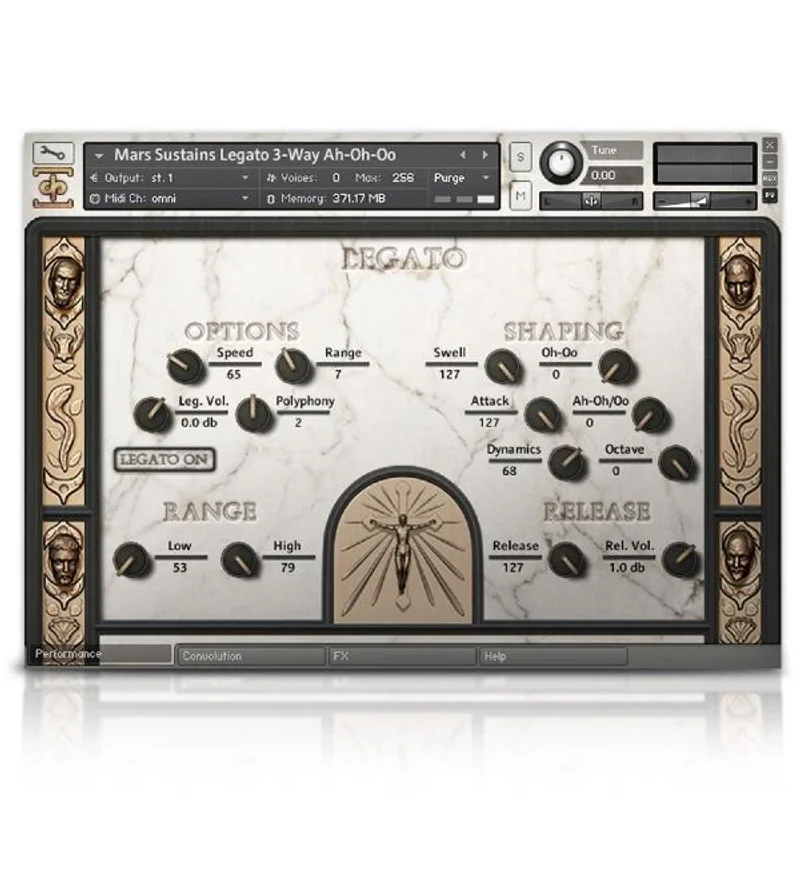
True legato covers 5 vowels: Ah, Oo (piano), Oo (forte), Oh, and Mm. That last one, the humming Mm, is underrated. It's the thing you reach for in a minor-key dramatic underscore when you want breath without text.
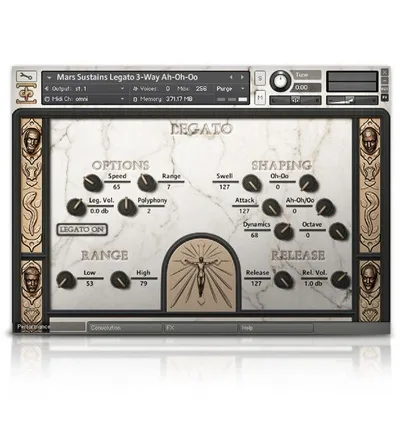
The legato speed control inside the Kontakt 5 presets lets you dial from tight chromatic movement to slow portamento. Pull it toward portamento on a bass soloist moving a tritone and the result is the kind of low, slow glide that normally requires a dedicated phrase sample. It doesn't sound artificial at moderate interval distances.
All sustaining articulations include 3-part polyphonic pseudo-legato. That applies across vowel sustains, fast and slow poly-sustains, and the soloist content. It's not the same as true legato. But it means your sustained chords don't sound like a sample playing in parallel with no connection between notes. There's logic holding the voicing together.
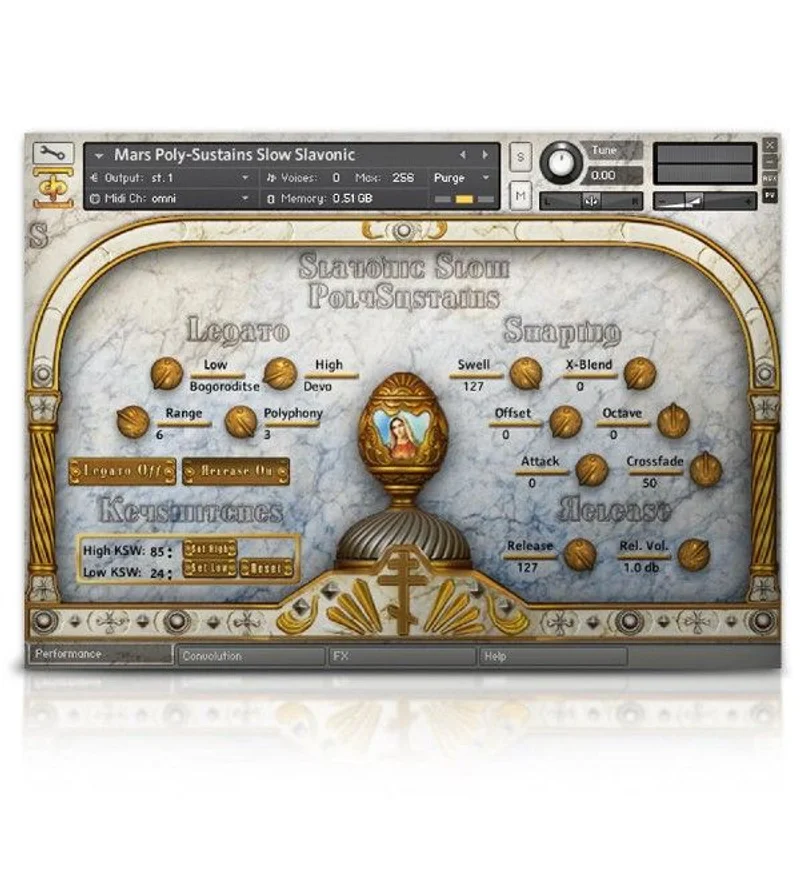
The poly-sustain content is extensive. Slavonic slow (100bpm): 12 presets. Slavonic fast (140bpm): 11. Latin slow (100bpm): 11. Latin fast (140bpm): 7. Then there's 14 "Gregorian" melodic extended slow poly-sustains at 70bpm in 3/4 timing, each with atonal droning versions. And 14 Latin whisper slow poly-sustains.
Those whisper sustains are the sleeper feature. We loaded the Latin whisper set for a scene that needed ambient choral breath, something felt rather than heard. The result sat 8 to 10dB below the main orchestral bed and gave the scene a presence it lacked without adding mix weight. That's a specific thing this library does that's genuinely hard to find elsewhere at this price.
The Three Soloists: Bass and Tenors
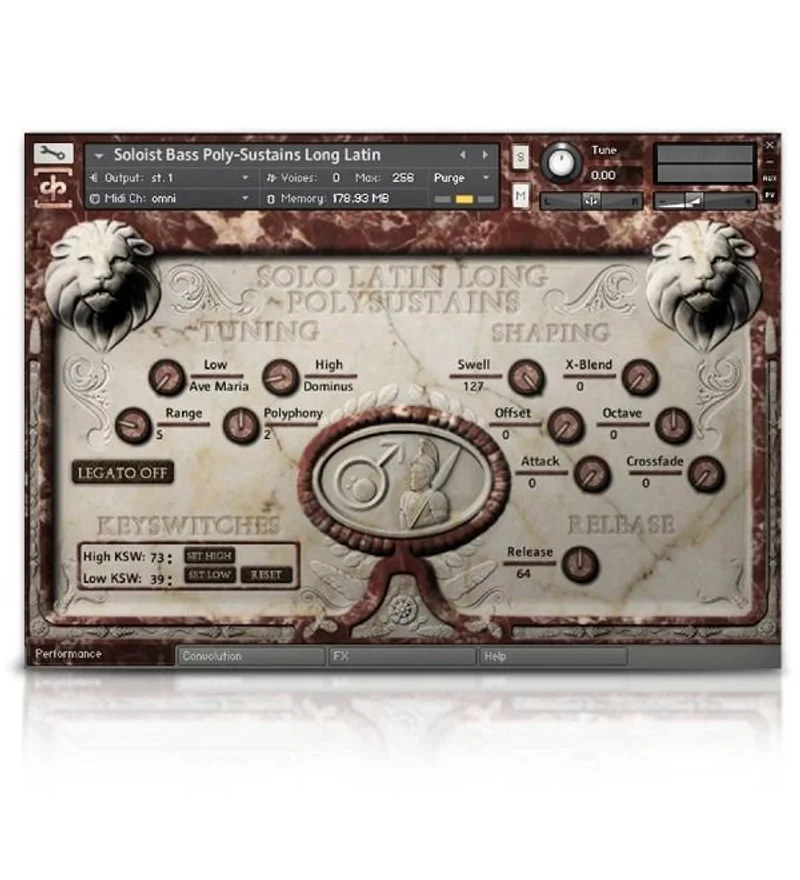
Most choir libraries sell you a chorus and call it done. Mars includes three soloists: one master bass and two tenor soloists, all singing in both Slavonic and Latin. The articulation set for the soloists mirrors the ensemble in important ways.
The bass gets 23 staccato syllables. The two tenors share 24 between them. Each soloist has slow poly-sustains (10 standard), melodic poly-sustains with time-stretching support, and full phrase content including choral effects and emotional solo phrases.
We placed the bass soloist at the front of a simple string arrangement, with the full chorus pulled back about 12dB in the mix. The bass vowel sustains tracked the melody line cleanly. There was a slight inconsistency in the vibrato character between adjacent notes on wide intervals, wider than a fifth, which reviewers have mentioned too. Annoying when you're trying to hold a smooth melodic line. Not a dealbreaker.
The two tenors work better in unison or stacked than as distinct characters. They're not individually differentiated enough for dialogue-style composition. But as a unison tenor presence against the bass, the blend is convincing.
Where It Wins
The Slavonic content. Nothing at this price point covers Russian liturgical vocabulary with this level of articulation detail. If your cue calls for Orthodox church weight, this is the fastest path there.
The polysustain depth across both languages is something competing libraries at this tier don't match. You're getting slow, fast, whisper, Gregorian, and atonal variants of the Latin and Slavonic vowel content. That's composition flexibility, not just more samples.
The bonus Ambiences, Drones, Textures, and FX content is the kind of thing that saves a session at midnight when you need a transition element and have no time to build one from scratch. It's not the headline feature, but it's the one we've seen working composers quietly rely on.
Pairing Mars with Soundiron's Venus Symphonic Women's Choir gives you the full Olympus Choral Collection, which is available as a bundle. If you're building a choral toolkit for the long term, that pairing makes the per-library price feel sharper than buying either in isolation.
Where the Competition Wins
Modern GUI design. East West and Spitfire have spent years updating their interfaces. Mars looks like a library built for Kontakt 5 because it was. The controls work, but the visual layout can slow down a first-time user who's used to current-gen plugin design.
Individual microphone mixing. If you want to blend close, mid, and far perspectives yourself, Mars doesn't offer that. The composite positions are well-crafted, but you're trusting Soundiron's mix decisions rather than making your own. Some composers find that freeing. Others find it frustrating. We'd have liked the option.
System specs transparency is a gap. There's no published CPU benchmark or streaming rate data from Soundiron for modern machines. Running 17.9 GB of sample content on a slow spindle drive will cause streaming gaps. An SSD is not optional here. It's required, and the product page is underspecific about that.
Who Should Buy Which
- ✅ Buy if you score for film or TV and need convincing Slavonic or Latin choral content fast.
- ✅ Buy if you already own the full retail version of Kontakt and want a choir library with legato, marcato building, and soloists in one package.
- ✅ Buy if you're planning to pair it with Venus as part of the full Olympus Choral Collection.
- ❌ Skip if you only have the free Kontakt Player. Mars will run in demo mode only. That's not a workaround. It's a wall.
- ❌ Skip if you need a contemporary pop choir or gospel choir sound. Mars is formal, classical, and liturgical in character.
- ❌ Skip if you need individual mic positioning control. The two composite positions are your ceiling.
Specs & Technical Details
| Developer | Soundiron |
| Price | $399 |
| Plugin Format | Kontakt Instrument (NKI/NKM) |
| OS Support | Mac (10.6+) / Windows (XP+) |
| Activation | Serial number via Native Instruments Service Center |
| Kontakt Requirement | Full retail Kontakt 5.1+ (Kontakt Player not supported) |
| Install Size | 17.9 GB |
| Sample Count | 16,091 samples |
| Sample Resolution | 24-bit / 48kHz uncompressed PCM WAV |
| Preset Count | 220 Kontakt 4.2 NKI + 74 Kontakt 5.1 NKI / 73+36 NKM multis |
| CPU Usage | Medium to heavy (SSD strongly recommended) |
| Trial Available | No (demo mode only via free Kontakt Player) |
| Version Reviewed | Kontakt 5.1 preset set |
Score Breakdown
| Category | Score | Notes |
|---|---|---|
| Sound Quality | 4.5/5 | SF Symphony and Opera singers recorded at a real church acoustic. Hard to fault the source material. |
| Value for Money | 4.5/5 | 30 voices, 3 soloists, two languages, legato, marcato building. The content-to-price ratio is strong. |
| Ease of Use | 3.5/5 | Marcato Builder has a learning curve; dated interface slows first sessions. |
| Features | 4.5/5 | Articulation depth, poly-sustain variants, and the Phrase Builder are ahead of the price point. |
| CPU Efficiency | 3.5/5 | 17.9 GB demands fast storage; no published streaming benchmarks to set expectations. |
| Overall | 4.3/5 | A deep, musically serious choir library that rewards the time investment. |
Alternatives to Consider
Soundiron Venus Symphonic Women's Choir is the obvious companion. Soundiron choral library overview If you're building a full SATB choral setup, buying Mars and Venus together as the Olympus Choral Collection is the smarter move than buying either alone.
East West Hollywood Choirs is the modern competitor with a more polished interface and a word-builder that some composers find more intuitive. It's also subscription-based via Composer Cloud, which changes the cost model entirely. If you hate subscriptions, that's a hard no. If you're already in the East West ecosystem, it's worth comparing directly.
Spitfire Audio's choral content, spread across Albion and their orchestral series, leans more ambient and cinematic than liturgical. Kontakt instruments guide for film composers If your work is more textural underscoring than formal choir writing, Spitfire's approach may fit the workflow better than Mars's articulation-heavy structure.
If you're newer to Kontakt instruments and want to understand the format before committing to a 17.9 GB library, 5 things beginners must know about Kontakt instruments is a solid starting point before you spend anything.
Also worth noting: Soundiron's own catalog has depth beyond choir content. Ancient Greek Compendium review Their instrument design philosophy across libraries is consistent, which matters when you're committing to a developer long-term.
The Honest Verdict
Mars Symphonic Men's Choir is not the newest, the prettiest, or the easiest choir library in Kontakt. It is, by an uncomfortable margin, one of the most complete.
The Slavonic content alone is worth serious attention if you score anything with Orthodox or Eastern European liturgical character. The Marcato Builder and Phrase Builder reward composers who put in the time. The soloists add a dimension most competitors at this price point don't bother to include properly.
The caveats are real. You need the full retail Kontakt. You need an SSD. You need patience with the interface on day one.
At $399, it's the choir library we'd buy for serious scoring work. If you're a bedroom producer who wants a quick "choir sound," skip it. There are cheaper, simpler options. But if you're writing for picture and you need a men's ensemble that can carry a scene without sounding like a preset, Mars is the one.
The whisper Latin sustains will still be in your template six months from now. That's the test that matters.
Frequently Asked Questions
Does Mars Symphonic Men's Choir work with the free Kontakt Player?
No, not fully. The free Kontakt Player runs Mars in demo mode only, which limits playback time and functionality significantly. You need the full retail version of Native Instruments Kontakt 5.1 or later to access the complete library. This is a firm requirement, not a soft recommendation.
What languages does Mars Symphonic Men's Choir include?
Mars covers two languages: Slavonic (Russian liturgical) and Latin. Both the full 30-voice chorus and the three soloists sing in both languages. The Slavonic content covers Orthodox liturgical text patterns, while the Latin content includes Gregorian-style melodic sustains and whisper variants. Pure vowel content is also included across both languages.
How large is the Mars Symphonic Men's Choir download?
The installed library is 17.9 GB of 24-bit/48kHz uncompressed PCM wav files. An SSD is strongly recommended for streaming performance. Running it from a traditional spinning hard drive will likely cause audio dropouts during playback of complex polysustain or legato passages.
Can Mars be paired with a women's choir library?
Yes. Soundiron built Mars as the first library in their Olympus Choral Collection, with Venus Symphonic Women's Choir as the companion library. Buying both gives you a full mixed-voice SATB choral setup within a consistent recording environment, same venue, same mic philosophy, same articulation architecture. The Olympus bundle pricing makes that pairing worth calculating before buying either separately.
What makes the Marcato Builder different from a standard sample switcher?
The Marcato Builder lets you construct choral words syllable by syllable from a pool of 42 attack syllables and 42 release sounds, across 7 vowel sustain types with multiple variants each. All syllables have independent round-robin cycling and are automation-ready, so you can map syllable changes across your DAW timeline. The Combined Phrase Builder on top of that lets you save and keyswitch between up to 16 user sequences during playback.