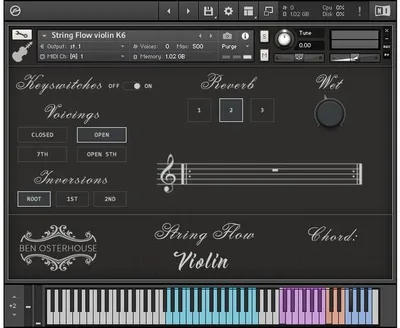
String Flow Violin does one thing: it rolls a bow across multiple strings to create energetic, chordal string textures you can't easily fake with any other library. If that sounds hyper-specific, it is. That's the whole point.
The Session That Made Us Pay Attention
We were finishing a Celtic-adjacent underscore cue. The legato strings sat fine. The pizzicato felt too polite. We needed something that moved, something with the physical drag of a bow catching multiple strings at once.
We loaded String Flow Violin. We hit a white key in harmony mode. The patch rolled through a chord with real bow weight behind it, the kind of swipe that sounds like a fiddler leaning into a downstroke mid-reel. We stayed in that session for two more hours.
That was the moment we understood what Ben Osterhouse built here. It's not a string library. It's a very specific gesture, recorded well, made easy to play.
String Flow Violin is built for composers who already have strings covered and need movement, texture, and rhythmic drive that standard kontakt string libraries simply don't offer. At $49 standalone, it's aimed at professionals and serious semi-pros. Beginners without a core string library should look elsewhere first.
What It Actually Does (and What It Won't)
String Flow Violin captures a single recorded technique: rolling the bow across strings in an energetic, chordal sweep. That's it. Ben Osterhouse built a Kontakt engine around that technique with two playback modes.
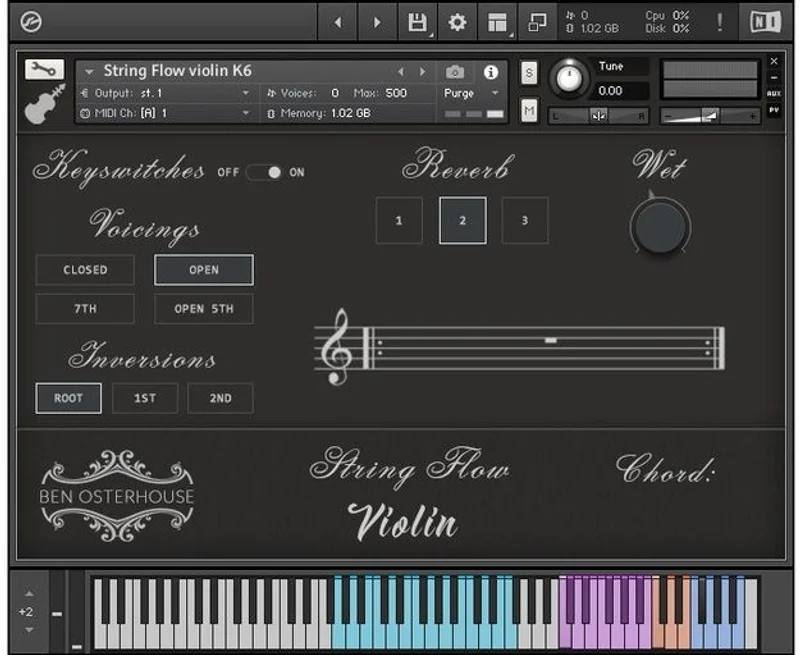
In harmony mode, you play white keys only. The engine maps your note to the nearest musically sensible chord voicing automatically. You can't play a wrong note. Annoying if you want full control; brilliant if you're sketching quickly.
In direct chord recording mode, you get more hands-on control over exactly which chord gets triggered. It takes a few minutes to understand the routing, but it's not complicated once you've clicked through it.
What it won't do: sustains, legato lines, pizzicato, tremolo, col legno, or anything that resembles a full string library. If you buy this expecting Spitfire Chamber Strings, you'll be frustrated and you'll deserve to be. The listing is honest about its scope.
Living With It in a Real Workflow
Setup is straightforward if you already run Kontakt. Install, point your Kontakt browser at the library, load the NKI. Under two minutes.
The 870 MB footprint is small enough that we left it permanently loaded in our template. It doesn't fight for RAM the way larger orchestral libraries do. CPU usage is light. We ran three instances simultaneously on a cue with no throttling on an M2 Mac.
The harmony mode took about 15 minutes to fully trust. At first, we kept second-guessing which chord it would pick. After an hour of use, we stopped fighting it. The voicing choices are idiomatic. Osterhouse clearly played this through musically, not just technically.
One quirk we noticed: the velocity response rewards harder playing. Soft velocities produce a nice soft roll, but the character of the instrument really opens up above velocity 90. We set up a MIDI clip with a slight velocity push on our controller and it immediately felt more alive.
The biggest workflow snag is the Kontakt dependency. Full Kontakt 5.8.1 or higher is mandatory. No Kontakt Player support. If you're on the free player, this is a hard wall. That's not a deal-breaker for most working composers, but it's worth knowing before you buy.
We also tested it inside a dense orchestral template running 40+ Kontakt instances. No crashes, no increased load times beyond what you'd expect from adding any additional Kontakt instrument.
The Trade-Offs Worth Talking About
The thing we love most about String Flow Violin is exactly what limits it. The singularity of focus means it excels at its one job in a way that a "do everything" library never could. These samples have weight and physical realism because Osterhouse wasn't trying to cover every articulation. Every sample was recorded in service of this one gesture.
But that focus becomes a real constraint in longer compositional arcs. We used it across a 4-minute cue and found ourselves reaching for it in specific moments, not as a continuous presence. It's seasoning, not a main dish. Some composers will hate that limitation. Others will love the specificity.
The harmony mode is satisfying for speed but frustrating if you need to hit an unconventional voicing. In those moments, direct chord mode saves you, but it requires a bit more setup time. Not a dealbreaker. Just a thing to know.
The bundle pricing is where the real value sits. The String Flow Collection, including Cello and Viola versions, occasionally goes on sale. That's three specialized instruments at a deep discount off the regular price. At that point, you're building a complete rolling-bow ensemble for a low price per instrument. We'd buy that without hesitation.
Against the Field
The closest alternatives aren't obvious competitors. They're workarounds.
Spitfire LABS and the ir free string offerings give you sustains and some textural patches. None of them capture this rolling bow technique. Spitfire wins for breath and space. String Flow wins for movement and grit.
ProjectSAM's Symphobia series has ensemble swells and cluster textures that serve a similar spatial role in a mix. Symphobia is bigger, more expensive, and more orchestral. String Flow is smaller, cheaper, and more folk and chamber-friendly.
Soundiron's Hopkin Instrumentarium weird string textures and experimental timbres heads in a completely different direction toward experimental and prepared string sounds. If you want strange over idiomatic, that's the path. String Flow stays in conventional musical territory, just underserved conventional territory.
Nothing we've tested does the rolling bow thing better in this price bracket. That's a real statement.
The Real Verdict
Buy String Flow Violin if you already have a core string library and find yourself forcing legato patches to do rhythmic work they weren't built for.
Skip it if you're building your first string setup. You need sustains, legato, and spiccato before you need this. String Flow belongs in round two of your library build, not round one.
At $49 standalone, it's priced fairly for what it does. At bundle pricing, it's a steal. This is a tool for composers who know exactly what they're missing. If you don't know what rolling bow texture sounds like in a mix yet, get some experience first, then come back.
Score Breakdown
| Category | Score | Notes |
|---|---|---|
| Sound Quality | 4.3/5 | Physical bow realism is strong; higher velocities sound especially convincing |
| Value for Money | 4.3/5 | $49 is fair; bundle pricing for three instruments is outstanding. |
| Ease of Use | 4.0/5 | Harmony mode is instant; direct chord mode takes 15-20 minutes to internalize |
| Features | 3.0/5 | Two modes, one technique, deep within its lane, very narrow lane |
| CPU Efficiency | 4.5/5 | 870 MB, light CPU, runs alongside heavy orchestral templates without complaint |
| Overall | 4.1/5 | Brilliant at one specific thing; score reflects scope, not quality |
Alternatives to Consider
If you want experimental string textures beyond conventional playing techniques, Soundiron's Hopkin Instrumentarium goes deep into prepared and unconventional string sounds. We reviewed it at length: Hopkin Instrumentarium Alt Alt review.
For a full Kontakt string library that handles sustains, legato, and articulations, look at best Kontakt string libraries 2026 before spending money on texture tools like String Flow.
If you want rhythmic string movement with more control over articulation, Spitfire Studio Strings review offers a broader palette at a higher price point. It's a main course. String Flow is the seasoning.
None of those alternatives replace what String Flow does. If you need rolling bow chordal texture, there's no workaround that sounds as natural. That's a real gap in the market, and Osterhouse filled it cleanly.
The last thing we'll say: a library this focused either fits your workflow exactly or it doesn't. There's no middle ground. If it fits, $49 will feel like nothing six months from now.
Frequently Asked Questions
Does String Flow Violin work with the free Kontakt Player?
No. This is a hard incompatibility. String Flow Violin requires the full version of Kontakt 5.8.1 or higher. If you're running the free Kontakt Player that comes bundled with other libraries, this instrument won't load. You'll need a paid Kontakt license before purchasing.
Can I use String Flow Violin as my only string library?
We'd say no. String Flow captures one technique: rolling bow chordal sweeps. It has no sustains, no legato patches, no pizzicato, and no individual articulation control. It's built to sit alongside a core string library, not replace one. Buy your main strings first.
Is the String Flow Collection bundle worth it over the standalone violin?
When the bundle is on sale, absolutely yes. You get Cello and Viola versions alongside the Violin, which means you can build a full rolling-bow ensemble texture across the string family. Three instruments for less than one is a straightforward decision. Check the developer's site for current bundle pricing, as discounts vary.
How does harmony mode actually work in practice?
In harmony mode, you play white keys only. The Kontakt engine maps each note to the nearest musically sensible chord voicing and triggers the rolling bow sample for that chord. You can't land on a dissonant or unmusical voicing. It's designed for fast sketching where you want idiomatic results without programming every chord manually. For more control, you switch to direct chord recording mode.