
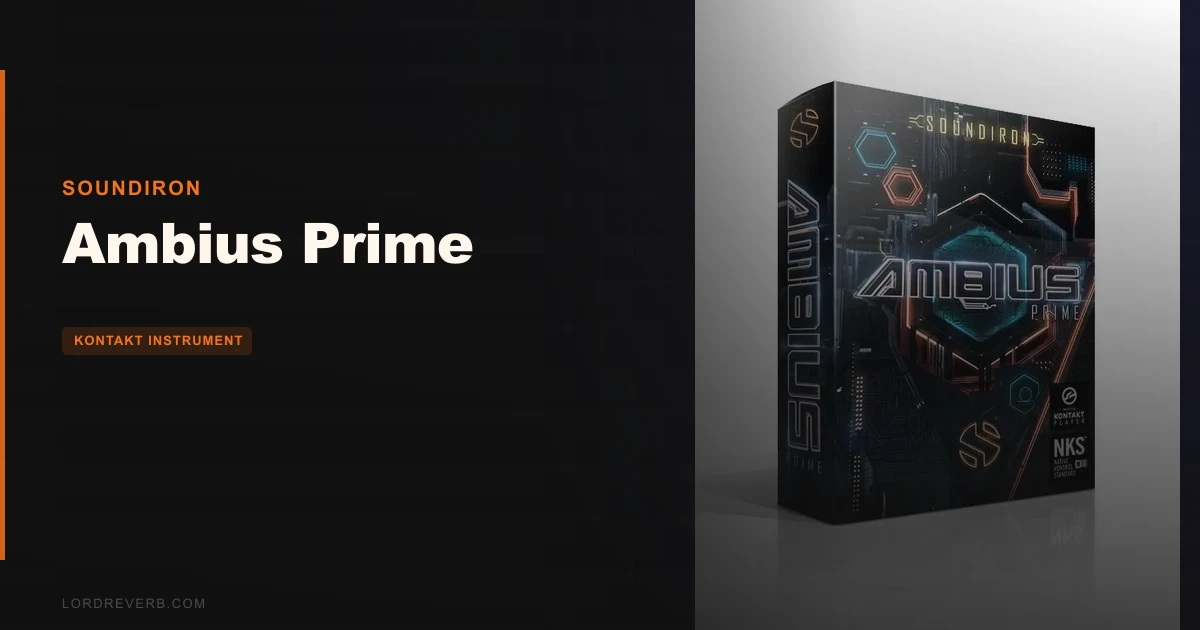
If you bought Ambius Prime expecting to open the Kontakt browser, see hundreds of patches neatly lined up, and start pulling sounds into your session inside five minutes, you probably felt shortchanged. And honestly? That feeling makes sense. Three NKI files in the browser for $149 looks like a thin return. The frustration is real, but it's almost entirely a presentation problem, not a content problem. Behind those three instrument banks live thousands of unique presets, a modulation engine that can genuinely surprise you, and 119 custom convolution reverb IRs. This is Soundiron's Ambius Prime: a bundle of all three Ambius libraries in a single Kontakt instrument, built for film and game composers, sound designers, and electronic producers who live in the abstract end of the frequency spectrum. Whether it deserves a place in your signal chain depends almost entirely on how you work.
Who Ends Up Regretting This
The buyer most likely to feel buyer's regret is the producer who wants a fast, preset-driven workflow. If you need to grab a patch, drop it on a track, and move on, the edit-mode snapshot system is going to frustrate you every single time.
You open the Kontakt browser. You see three files. Your first thought is that something went wrong during installation. Nothing went wrong. The hundreds of factory presets are sitting in edit-mode snapshots, not in the browser proper, and getting to them requires a workflow adjustment.
If you're a composer who scores to picture and needs to dial in an unsettling texture at 2 a.m. without a manual open, the learning curve here is real. Annoying, in fact. Not insurmountable, but real.
Equally, if you're hoping for hybrid organic-plus-synthesizer sounds, know upfront that every source recording in Ambius Prime is organic. No synthesizers were used. That's a design choice, not a gap, but it is a hard limit.
What Owners Actually Say
The recurring theme from owners is exceptional creative satisfaction once you get past the browser issue. That's not spin. The complaints are consistent and specific, and so is the praise.
Owners single out a preset called 'Shiversparkle' as menacing, otherworldly pulsing.
Then there's 'The Shakes'. Owners describe it as subversive and ear-shredding. If you want something unsettling under a horror cue or a tense game sequence, that's the preset owners point to.
The Arpeggiator gets specific praise too. On presets like 'Filter Slide', it produces percussive, rhythmic sequences that land somewhere in 1950s Radiophonic Workshop territory. That's a niche compliment, but it's a precise one. If that aesthetic means anything to you, it's a meaningful signal.
Owners say the sample offset knob on each layer greatly extends the library's sound diversity.
The consistent complaint: the layer mixing interface makes you scroll through 9 of 16 edit pages to reach the fourth layer's volume control. That's genuinely clunky.
What You Actually Get
Three libraries bundled as one: Ambius 1: Transmissions, Ambius 2: Systematik, and Ambius 3: Expanse. That's 3,107 samples, 9.15 GB installed, sourced from 12.2 GB of WAV files compressed to 24-bit / 48kHz NCW format.
Ambius 1 alone covers twelve category banks: EVP, Industrium, Panorganic, Rictus, Root Canal, Swarming, Winds, Parachestral, Re-choral, Transmusical, Dig, and Tuned. That's a wide spread of sources.
Ambius 3: Expanse brings over 1,000 new sound sources and guest sound design from eight contributors including Spencer Nunamaker and Marie-Anne Fischer. The developer says it leans harder into rhythmic elements and driving lead patches compared to the first two libraries.
100 Factory Master Presets ship with the bundle. The Intelligent Random button generates new presets on demand, so you're never short of starting points.
Each layer gives you Volume, Attack, Release, Offset, Pitch, Pan, Modulation routing, and Filter settings. The XY Pad is assignable and animatable, with routing to individual layer mixes. The Mod Panel lets you build custom parameter chains.
The FX Rack carries 18 effect modules: Delay, Distortion, EQ, and Convolution among them. Those 119 convolution reverb IRs span Cathedral, Chamber, Large Room, Small Room, Hallways, Underground, Outdoors, Long FX, and Short FX categories. That's a complete spatial toolkit built into the instrument itself.
It works with Kontakt Player version 5.6.8 or higher, so no full Kontakt license is needed. Compatible with Komplete Kontrol and S-Series keyboards. Supports VST, AU, and AAX. Minimum spec is a Dual Core CPU with 3+ GB RAM, Windows 7 or higher, or OSX 10.10 or higher.
The Three Scenarios That Reveal What This Is
You're scoring a tense scene and need texture fast
Load one of the Ambius 1 Swarming patches and let the assignable XY Pad animation run. For underscore work, built-in movement can keep a cue from feeling static.
If the animation makes the patch too restless for your scene, owners report that disabling the XY Pad motion reveals more generally usable material underneath the modulation. That's a useful trick when a complex preset is too restless.
You want to design something genuinely new
Start with the sample offset knob on any layer, which owners say greatly extends sound diversity. Add a modulation chain from the Mod Panel, route it to pitch on layer two, and pull in one of the Underground convolution IRs from the FX Rack.
This is where Ambius Prime shows its sound design potential. It's not a preset-and-go tool. It's a source engine.
You're a producer working ITB and need something to sit under a lead
Pull one of the Expanse patches that leans rhythmic, bring the Attack up on layer one to soften the transient, and use the built-in EQ to carve out room under the lead.
Every source here is an organic recording, which is a sonic character rather than a limitation.
The Modulation Engine in Practice
Soundiron calls it the Ouroboros engine. The name matters less than what it does: it takes organic field recordings and instrument samples and turns them into playable synth patches with real modulation depth.
Each of the four layers has its own Modulation routing section. The XY Pad has layer mix routing assignment, so you can use pad position or animation to blend between layers. You're blending sources dynamically.
The Mod Panel extends this further with custom routing chains. That gives a patch more ways to respond to how you play. Owners report considerable sound design potential.
Where it falls short is ergonomics. Scrolling through 9 of 16 edit pages to find one volume control is not a workflow. It's an obstacle course.
The FX Rack and the Built-In Reverb Library
18 effect modules is a lot. Delay and Distortion are obvious inclusions for this kind of tool. The EQ lets you shape each patch before it hits your DAW, which saves a plugin slot in your chain.
The convolution reverb is the other draw: 119 custom IR samples across 10 categories, and Underground and Long FX are the ones to audition first.
Who Should Actually Buy This
Film and game composers
Buy it. The developer pitches it as perfect for film and game composers, and the depth of texture plus built-in convolution reverb is why. The browser presentation is frustrating, but the edit-mode workflow is a one-time adjustment once you know where the presets live.
Sound designers
Buy it. The sample offset knob alone gives you a tool for generating variation without leaving the instrument. Combine that with the Mod Panel routing and the XY Pad animation and you have a design environment, not just a playback engine. The developer says it uses only organic field and instrument recordings, no synthesizers.
Electronic producers
Wait, or try to hear it first. The developer pitches it as a powerful synthesis engine for electronic producers, but the edit-mode snapshot system and the layer scrolling add workflow overhead for a fast production session. If you're willing to spend an afternoon learning the interface, the payoff is there. If you want to drop patches into tracks and move on, it's the wrong tool.
Beginners
Skip it for now. Not because the sounds aren't good, but because the interface rewards people who already understand Kontakt's edit-mode architecture. Come back to it when you've spent time with simpler Kontakt instruments and the snapshot workflow feels natural.
Buy or Wait?
At $149 for three libraries totalling 9.15 GB of organic sample content, an 18-module FX Rack, and 119 custom convolution IRs, Ambius Prime gives you a lot to work with. The presentation is genuinely annoying. The layer navigation is clunky. Neither of those is a reason to skip it if you score to picture or design sound for a living.
It's wrong for producers who need fast patch access or a clean browser workflow. It's right for anyone willing to learn an instrument rather than just play presets. Owners report exceptional creative satisfaction once they get to the sounds.
Specs & Technical Details
| Developer | Soundiron |
| Price | $149 |
| Plugin Format | VST / AU / AAX (via Kontakt) |
| OS Support | Windows 7 or higher / OSX 10.10 or higher |
| Activation | N/A |
| CPU Usage | N/A |
| Trial Available | N/A |
| Version Reviewed | 1.0 |
| Sample Depth | 24-bit / 48kHz NCW (lossless compressed) |
| Installed Size | 9.15 GB (12.2 GB WAV source) |
| Sample Count | 3,107 |
| Kontakt Player Compatible | Yes (5.6.8 or higher, free) |
| Minimum CPU | Dual Core |
| Minimum RAM | 3 GB |
Score Breakdown
| Category | Score | Notes |
|---|---|---|
| Sound Quality | 4.5/5 | Owners report exceptional creative satisfaction and considerable sound design potential |
| Value for Money | 4.5/5 | Three libraries, 119 reverb IRs, and a full modulation engine for a single purchase price |
| Ease of Use | 3.5/5 | Browser shows only 3 NKI files; edit-mode snapshot workflow adds real friction |
| Features | 4.5/5 | XY Pad, Mod Panel, 18-module FX Rack, and Intelligent Random cover serious ground |
| CPU Efficiency | N/A | Not verifiable from available data |
| Overall | 4.3/5 | Deep and satisfying: the interface friction is real but the content earns it |
Ambius Prime is the kind of library that rewards patience and penalises impatience. The sounds are brilliant when you find them. The process of finding them is occasionally ridiculous. If you score, design, or produce music that lives in the abstract and the atmospheric, at $149 it's a deep package of organic texture. The producers who'll love it know who they are. The ones who'll hate it usually figure that out at the browser.
Frequently Asked Questions
Do I need the full version of Kontakt to run Ambius Prime?
No. Ambius Prime works with the free Kontakt Player at version 5.6.8 or higher. You don't need a full Kontakt license. It's also compatible with Komplete Kontrol and S-Series keyboards if those are part of your setup.
Why does my browser only show three files after installing Ambius Prime?
That's by design, not a bug. Ambius Prime ships three NKI instrument banks, and those are what appear in the Kontakt browser. The hundreds of factory presets and patches live inside those instruments as edit-mode snapshots. You access them through Kontakt's edit mode rather than the main browser, which is an ergonomic quirk that can catch you off guard on first load.
Is Ambius Prime suitable for beginners to Kontakt?
It can work for beginners, but the interface is easier to navigate if you already understand how Kontakt's edit-mode snapshot system works. The layer controls require scrolling through multiple edit pages, and the patch access workflow isn't immediately obvious. Spending time with simpler Kontakt instruments first will make the Ambius Prime experience considerably less frustrating.
What makes Ambius 3: Expanse different from the first two libraries in the bundle?
Ambius 3: Expanse contains over 1,000 brand new sound sources and features guest sound design from eight contributors. The developer describes it as leaning harder into rhythmic elements and driving lead patches compared to the more textural, atmospheric focus of Ambius 1: Transmissions and Ambius 2: Systematik. If you need movement and pulse rather than static beds, Expanse is where to start.