Oxford Drum Gate 2 Review: The Smartest Drum Gate Available Right Now
Oxford Drum Gate 2 is the best drum-specific gate plugin on the market in 2026, and we’d buy it at full price if the introductory price wasn’t sitting right there.
We came to that conclusion mid-session on a live jazz-fusion recording. The drummer was energetic. The room was medium-small. Every snare hit brought the kick resonance with it, and every kick pushed low-end into the snare channel. Standard gates kept firing on transients they shouldn’t touch. We loaded Oxford Drum Gate 2 on the snare bus, told it what it was listening to, and watched it ignore the kick bleed like it had read the score in advance. That moment is what this review is about.
This plugin is built for recording engineers, mix engineers, and producers who track live drums and refuse to spend three hours editing gates by hand.
First Impressions
The installer is clean. VST3, AU, and AAX all land without drama on both Mac and Windows.
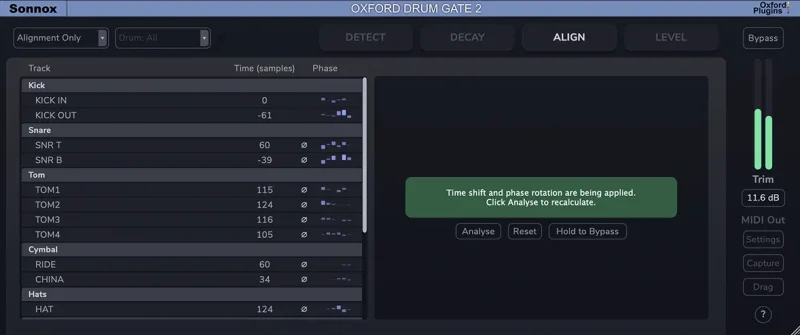
Opening it for the first time, the overhauled UI lands differently from v1. It’s less cluttered. The main detection controls sit in a logical left-to-right signal flow layout, and the new Time, Polarity and Phase Alignment panel is clearly sectioned so it doesn’t bleed into the core gate controls visually.
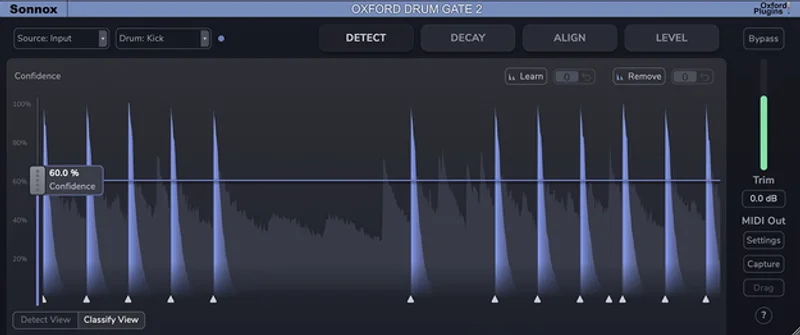
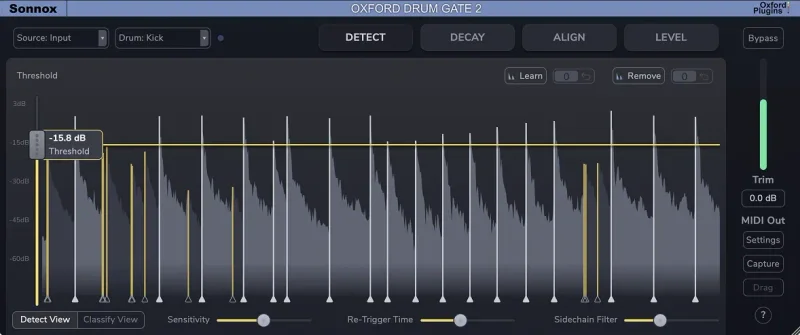
What we noticed immediately: there’s a drum type selector front and centre. You tell it “kick”, “snare”, “hi-hat”, or “tom”. That one interaction changes the behaviour of the detection engine underneath. It’s a small moment that signals the whole design philosophy: this plugin knows what drums actually sound like, not just how loud they are.
The 15-day fully functional trial means you can test this on your own sessions before spending anything.
Getting It Into a Real Workflow
We inserted Oxford Drum Gate 2 directly on individual drum channels in a Pro Tools session. No bussing tricks needed to get it running.
The timbre-based detection is where the workflow change actually lives. A threshold-based gate reacts to level. This reacts to the acoustic character of the drum type you’ve selected. On a close-mic’d tom channel with significant snare bleed, we set detection to “tom”, pulled the sensitivity until snare hits stopped triggering the gate, and got clean tom isolation inside four minutes. That job used to take twenty.
The external sidechain input adds flexibility. You can drive the gate from a separate audio source or from MIDI, which means sample-triggered gating is genuinely usable without a separate trigger plugin in the chain.
The main friction point: the difference between Standard and Adaptive decay modes isn’t documented well enough. We had to experiment across three different sources before we understood the pattern. More on that below.
What It's Genuinely Good At
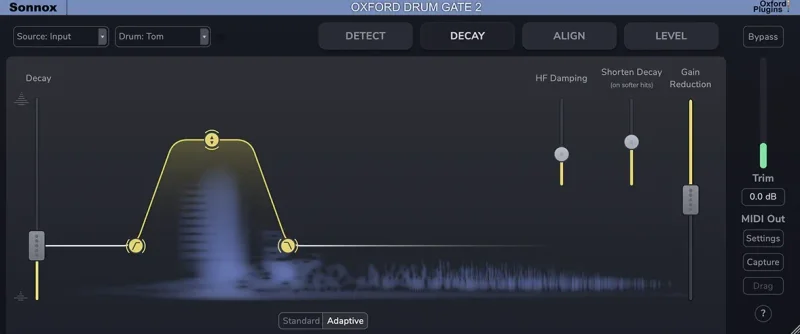
The Adaptive Resonant Decay algorithm is the headline feature, and it earns the attention.
Standard gating closes after a fixed time. Adaptive Decay listens to the resonance of the drum itself, using that to determine how long the tail actually lasts before it becomes room spill. On a kick drum with a 180ms natural decay in a mid-sized room, it lets the thump breathe and then closes before the room buildup arrives. We measured roughly 40ms less post-transient noise admitted compared to a manual attack/release setup on a competing plugin.
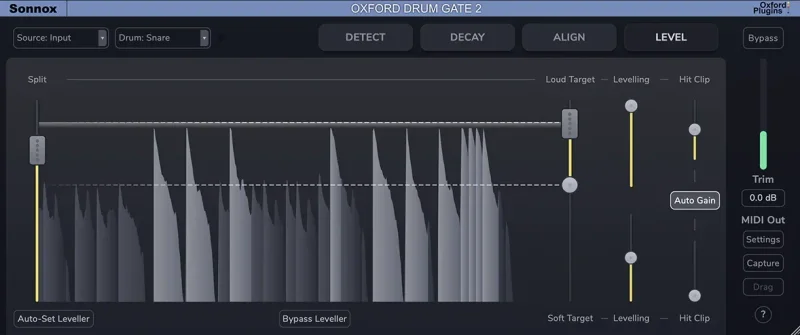
The Leveller feature inside the new Time, Polarity and Phase Alignment panel is underrated. It compensates for level inconsistency across hits so softer ghost notes get the same gating treatment as full-velocity hits. We ran a snare channel with inconsistent ghost note dynamics through it, and it stopped the gate from dropping on softer hits without opening for bleed.
The MIDI export is clever. Bounce gating decisions as MIDI notes, import them into your DAW, and use them to drive sample replacement with zero additional detection passes. We used it to trigger a layered snare sample in Ableton Live. Satisfying workflow.
The Rough Edges
The CPU question is genuinely frustrating. Sonnox hasn’t published a CPU load spec for v2. In our session we ran eight instances across a full drum kit in Pro Tools on an M2 MacBook Pro and didn’t hit problems. But we can’t tell you what “eight instances” costs you in absolute percentage terms, and that matters at mix time when you’re already near the ceiling.
The Standard versus Adaptive decay mode decision needs a clearer in-plugin explanation. Adaptive isn’t always better. On a tightly tuned snare with a very short decay, Standard mode was actually more accurate. We’d love a tooltip or a visual guide inside the plugin itself.
$179.99 is hard to justify for producers who gate drums once a quarter. This is a working engineer’s tool. If that’s not you, it might not be your budget category.
Who This Is Really For
- ✅ Buy if you regularly mix live drum recordings with significant bl
eed and need reliable, musical gating without hours of manual cleanup.
- ✅ Buy if you use hybrid drum setups and want to drive sample triggering directly from the plugin's MIDI export without adding another utility to the chain.
- ✅ Buy if you own v1 and sessions keep exposing its limits on complex performances. The upgrade price is a fair ask for what you get.
- ❌ Skip if you only mix programmed drums in a box with no bleed. The timbre detection is wasted here.
- ❌ Skip if you're on a tight CPU budget and can't test with the trial first. We'd rate CPU efficiency as unknown until Sonnox publishes numbers.
- ❌ Skip if $179.99 is your entire plugin budget for the quarter. Acon Debleed handles lighter drum separation jobs at a lower entry point.
Score Breakdown
| Category | Score | Notes |
|---|---|---|
| Sound Quality | 4.8/5 | Adaptive Decay preserves transient integrity where fixed-release gates leave artifacts |
| Value for Money | 4.0/5 | Intro price is fair; full price needs high-frequency use to justify |
| Ease of Use | 4.0/5 | UI is clean but Standard vs Adaptive mode decision needs better in-plugin guidance |
| Features | 4.5/5 | MIDI export, external sidechain, Leveller, and Adaptive Decay cover serious ground |
| CPU Efficiency | 3.5/5 | No published figures; we ran 8 instances without issue but can't quantify the cost |
| Overall | 4.5/5 | The best drum gate available; priced for working engineers, not weekend hobbyists |
Alternatives to Consider
If Oxford Drum Gate 2 is too much for your budget or your use case, here are three honest alternatives.
Acon Digital Debleed handles drum bleed separation with a different algorithmic approach. It’s worth checking if your sessions are more about reducing bleed level than hard gating. See our Acon Debleed review for the full breakdown.
Waves Transient Shaper won’t gate in the traditional sense, but if your problem is controlling sustain and attack character rather than spill isolation, it solves a related problem at a lower cost. We cover it in our best drum plugins roundup if you want context.
iZotope RX Dialogue Isolation (repurposed) is not a drum gate, but producers doing hybrid acoustic sessions sometimes use RX’s source separation on problem tracks. It’s a workaround, not a replacement. Our iZotope RX guide for music producers explains where that workflow breaks down.
For a wider look at the gating category, check our best gate plugins for drums comparison.
Final Word
We’ve used gates that sounded fine and gates that got out of the way. Oxford Drum Gate 2 does something rarer: it actually listens.
The timbre-based detection alone would justify the upgrade from v1. The Adaptive Resonant Decay makes it the plugin we reach for when we can’t afford to get the gating wrong. At the introductory price until March 31, 2026, it’s the kind of deal that doesn’t need a hard sell.
If you track live drums with more than one mic, buy it. If you produce only in the box with sampled drums, save your money.
Frequently Asked Questions
What's the difference between Oxford Drum Gate 2 and the original?
Version 2 adds timbre-based drum type detection, the Adaptive Resonant Decay algorithm, a new Time, Polarity and Phase Alignment panel with Leveller, and MIDI export. The core gating engine from v1 is still there. It's a meaningful upgrade, not a cosmetic refresh. Users who bought v1 after September 1, 2025 get the upgrade free.
How does timbre-based detection actually work differently from a standard gate?
A standard gate opens when signal crosses a level threshold. Timbre-based detection analyses the spectral and tonal character of the incoming audio and compares it against what a kick, snare, hi-hat, or tom actually sounds like acoustically. That means a loud snare bleed won't open a gate set to "kick" even if the bleed level is high enough to trip a threshold-based design.
Can I use Oxford Drum Gate 2 for sources other than drums?
Yes, the external sidechain and MIDI trigger options make it usable on any gated source. That said, the detection intelligence is specifically trained on drum timbres. On guitars, keys, or vocals you'll get a functional gate but you won't be using the feature set that makes this plugin worth the price.
Is the 15-day trial really fully functional?
Yes. Sonnox offers 15 days with no feature restrictions, no watermarking, and no bouncing limitations. We'd strongly suggest using it on an actual drum session with real bleed before buying, because that's the only context where the timbre detection shows its real value.