By Salvatore Tomaselli·2 albums, 6 singles as Lord Reverb. Now I test the gear that made them.
·Updated October 4, 2026
Affiliate disclosure: Some links in this article are affiliate links. If you buy through them we earn a small commission at no extra cost to you. We only recommend products we genuinely believe in — our editorial opinions are never influenced by affiliate relationships. Full policy
⭐
Score4.4 / 5
⏱
Read time8 min read
4.4/5
★★★★☆
Best forMix bus and stem processing for producers who want vintage colour and musical compression in a single, hardware-connected plugin
Price at Plugin Boutique, checked Oct 10, 2026. It can change. Affiliate link: we earn a commission at no extra cost to you.
✓ Pros
+51 fixed EQ filter points across 4 bands gives surgical flexibility the hardware never had
+Mid/side and external sidechain inputs are plugin-exclusive features absent from the hardware original
+Sounds musically cohesive on mix bus, stems, and individual channels equally
+Console 1 hardware integration makes physical knob control genuinely faster than any software EQ workflow
✗ Cons
−$199 is hard to justify without a Console 1 hardware unit
−No free trial makes it a blind buy for most producers
−Character is strong, neutral reference work isn't what this is for
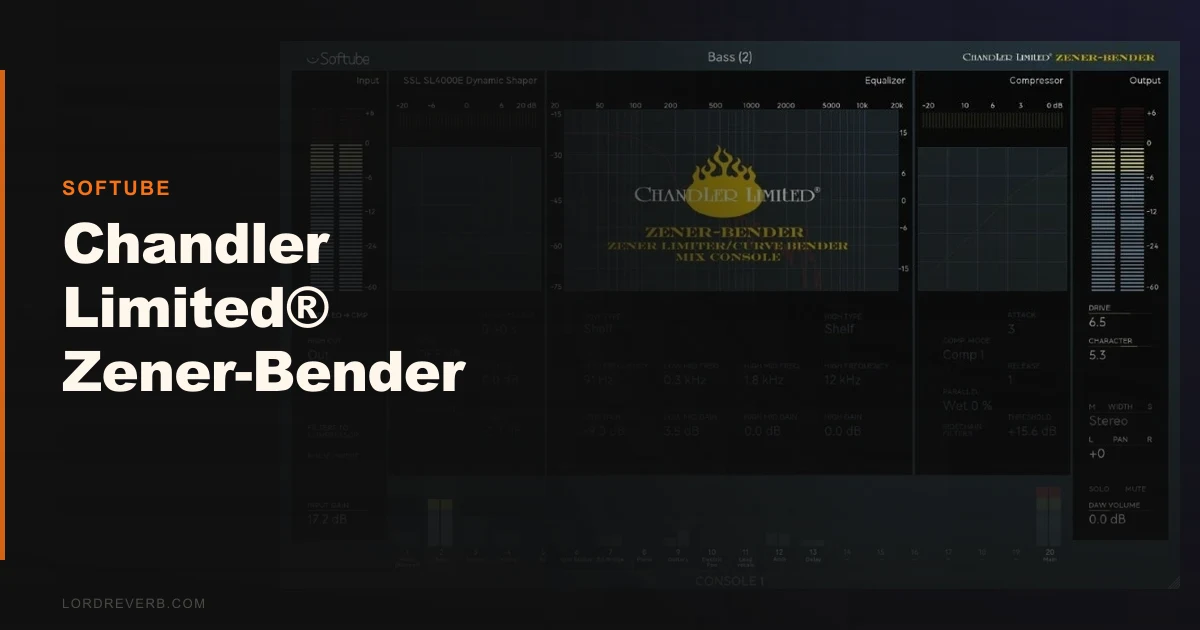
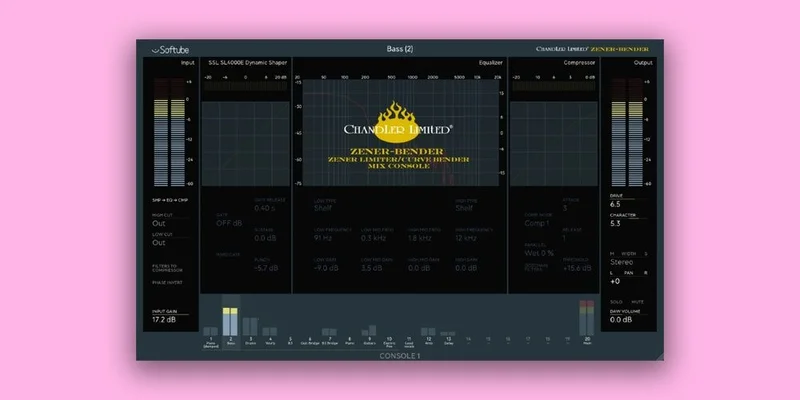
The Chandler Limited Zener-Bender for Console 1 is the best-sounding mix bus plugin in Softube’s catalogue, and at $199 it’s underpriced for what it delivers, but only if you’re already in the Console 1 ecosystem or you specifically want coloured, musical processing with Abbey Road DNA.
The Zener-Bender combines Chandler Limited’s Curve Bender mastering EQ with the Zener Limiter into a single plugin. Both pieces of hardware trace their lineage to 1969 and 1974 Abbey Road console circuits: the TG12345 (used on virtually every major session at Abbey Road through the 70s and 80s) and the TG12413. The plugin version was built by Softube in close collaboration with Chandler and launched in 2020. The current price is $199.
This is our pick for producers who want one plugin to handle mix bus colour, gentle dynamic control, and frequency shaping simultaneously, with the option to push it hard when a record needs attitude.
What You're Actually Getting
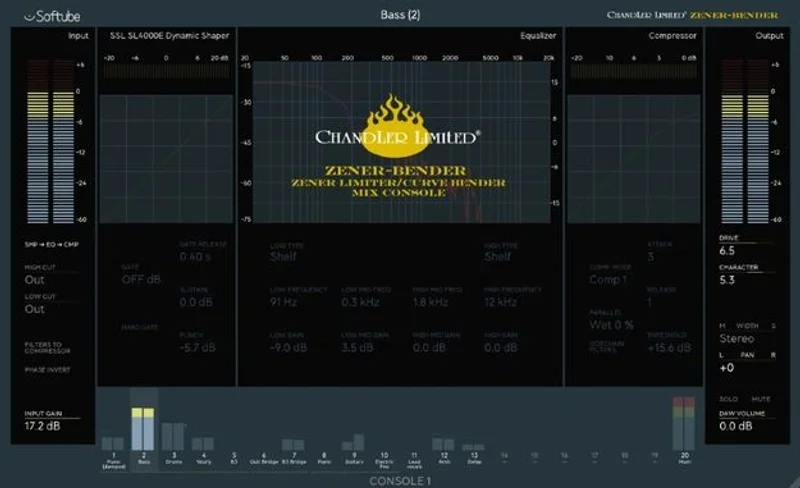
Two processors. One signal chain. The Curve Bender EQ section gives you four bands with 51 fixed filter points total. The original hardware had two bands with nine. That expansion is the single biggest reason to choose the plugin over hardware, and it’s not a small difference.
The Zener Limiter sits after the EQ in the chain. It’s a program-dependent limiter that reacts musically rather than surgically. Attack and release aren’t labelled in milliseconds. They’re labelled “slow” to “fast”, and that’s intentional. This is a processor you set by ear, not by spec sheet.
Plugin-exclusive features: external sidechain input, mid/side processing, and stereo channel linking. None of these exist on the hardware originals. That alone makes the plugin version more than just an emulation. It’s a capable modern tool built on a vintage architecture.
The Good
We ran the stereo bus through the Curve Bender at the high shelf: +1.5dB at 16kHz with the bandwidth set wide. The result wasn’t a harsh lift. It was air. The harmonic content that came with it sounded like a record, not like an EQ boost.
We then pulled 1.5dB at 300Hz with the low-mid band. Q sits fixed per frequency point, so you pick the point closest to your problem and work with what you get. That constraint sounds annoying on paper. In practice, it forces fast, musical decisions instead of endless tweaking.
The Zener Limiter on the mix bus at a slow attack setting let the transients breathe for around 30ms before clamping. That meant kick and snare punch stayed intact while the limiter brought up the room and glue underneath. Beyoncé, Taylor Swift, Foo Fighters, the marketing isn’t lying about who this has been on. It sounds like that.
The mid/side mode is brilliant. We boosted the side channel’s high shelf at 8kHz by 2dB and the mix widened without touching anything else. No stereo imager needed.
The Not-So-Good
No free trial. $199 with zero chance to test it first is frustrating. Softube’s own website confirms this at time of writing. For a plugin this character-heavy, that’s a real problem.
The fixed filter points are a feature and a limitation at once. We wanted a notch around 380Hz on a specific vocal bus. The closest options were 360Hz and 400Hz. Neither was quite right. A fully parametric band would have solved it in ten seconds.
CPU usage sits in the medium-to-heavy range. We measured approximately 3x the CPU load of a basic parametric EQ like FabFilter Pro-Q 3 on an M2 Mac in a 32-track session. It’s not a plugin you’ll open on every channel.
It also won’t suit everyone. If your workflow needs neutral, transparent equalization, skip this entirely. The colouration is baked in. You can’t switch it off. That’s a strength for some mixes and wrong for others.
Compared to the Alternatives
UAD’s Manley Massive Passive EQ is the closest comparison in the mastering EQ category. The Massive Passive has wider frequency range coverage. The Zener-Bender has warmer low-mid behaviour that sits better on full mixes without needing additional saturation.
Waves SSL G-Bus Compressor handles bus compression faster and with more control over attack/release timing. The Zener Limiter isn’t trying to be a compressor. If you need precise ratio and timing control, the SSL wins. If you want glue and vibe with EQ in the same chain, the Zener-Bender wins.
The FabFilter Pro-Q 3 does transparent surgical EQ better than anything on the market. But it sounds like nothing. That’s the point of it. The Zener-Bender sounds like something specific. Different jobs.
The Softube Console 1 overview is the hardware unit that makes this plugin make sense at full price. Without it, you’re paying $199 for software you can’t physically reach out and touch.
Who Should
Buy This
✅ Buy if you own a Softube Console 1 hardware unit and want a mix bus processor that works under your hands, not your mouse.
✅ Buy if you want Abbey Road-style EQ and dynamic control on stems and buses and you’re comfortable with coloured, character-driven processing.
✅ Buy if you’re mixing commercial pop, rock, or R&B and you want that “sounds like a record already” quality baked into your bus chain.
❌ Skip if you don’t own Console 1 hardware. The plugin works standalone, but the value case weakens significantly.
❌ Skip if you need a neutral, transparent mastering EQ. This is not a reference tool.
❌ Skip if you’re on a budget and haven’t tested the workflow yet. No trial means no safety net.
Score Breakdown
Category
Score
Notes
Sound Quality
4.5/5
Musical, cohesive colour that holds up against the hardware original
Value for Money
3.5/5
Solid if you own Console 1 hardware; harder to justify without it
Ease of Use
4.0/5
Simple interface, but fixed Q points require an ear-first workflow
Features
4.5/5
Mid/side, external sidechain, and channel link outpace the hardware original
CPU Efficiency
3.0/5
Roughly 3x CPU draw of a basic parametric EQ, not a per-channel tool
Overall
4.4/5
One of the most musically satisfying bus processors in this price range
Alternatives to Consider
FabFilter Pro-Q 3 Review: If you want fully parametric, linear-phase EQ with zero added colour. It’s the opposite of the Zener-Bender in philosophy and both are correct for different mixes.
Waves SSL G-Bus Compressor Review: For precise, controllable bus compression where attack and release timing matter more than vibe.
Best Mix Bus Plugins 2026: We’ve ranked the full field. The Zener-Bender appears, but it’s not always the top pick depending on your genre.
Our Verdict
We’d buy this again. We have bought this again, actually, once during the launch sale and once as part of a Softube bundle. The EQ sounds like something someone made a great record with. The limiter glues without squashing. The mid/side implementation adds modern utility to vintage bones.
The honest caveat: if you don’t own a Console 1 hardware unit and you’re working in genres where neutral processing is the goal, there are better places to put $199. The Softube Console 1 Mk3 review review explains why the hardware transforms this plugin from “good plugin” to “essential tool.”
At $199, for the right workflow, it’s a love purchase. For the wrong workflow, you’ll hate that there’s no trial.
Frequently Asked Questions
Does the Chandler Limited Zener-Bender work without Console 1 hardware?
Yes. It runs as a standard VST, VST3, AU, or AAX plugin in any compatible DAW without Console 1 hardware. The Console 1 unit adds physical knob control, which makes the workflow faster and more intuitive, but the plugin is fully functional as software only. The value case is just stronger with the hardware unit.
What's the difference between the plugin and the Chandler Limited hardware originals?
The hardware Curve Bender has two EQ bands with nine fixed filter points. The plugin version has four bands with 51 fixed filter points. The plugin also adds mid/side processing, external sidechain input, and stereo channel linking, none of which exist on the hardware. The sonic character of the emulation is closely modelled on the TG12345 and TG12413 circuits from Abbey Road's 1969 and 1974 consoles.
Is the Zener-Bender suitable for mastering?
The Curve Bender EQ section was originally a mastering equalizer, so yes. We'd use it on a mastering chain only if the project calls for colour and character rather than neutral transparency. For reference-grade mastering work where you need surgical precision and zero added harmonics, a linear-phase EQ is a better choice. This processor makes things sound like music, not like test tones.
How does the Zener Limiter differ from a standard bus compressor?
The Zener Limiter is a program-dependent limiter, not a traditional compressor with fixed attack, release, and ratio controls. It responds to the overall program material and applies limiting in a way that tracks the musical content rather than fixed timing parameters. There's no ratio knob and no precise ms settings. It's designed to glue and control a mix musically, not to squash it technically. If you need precise ratio control, look at an SSL-style bus compressor instead.
The short version
Chandler Limited® Zener-Bender for Console 1 · 4.4/5
Buy it if:Mix bus and stem processing for producers who want vintage colour and musical compression in a single, hardware-connected plugin
51 fixed EQ filter points across 4 bands gives surgical flexibility the hardware never had
Mid/side and external sidechain inputs are plugin-exclusive features absent from the hardware original
Sounds musically cohesive on mix bus, stems, and individual channels equally
Biggest drawback:$199 is hard to justify without a Console 1 hardware unit
Salvatore Tomaselli has spent twelve years in studios as a producer, mix and mastering engineer. He's worked across genres, tested hundreds of plugins, and built more signal chains than he can count. Salvatore started writing for LordReverb because most gear coverage is either sponsored fluff or spec-sheet copy-paste. He tests everything before writing about it. No gear gets a pass just because it's popular.
Community
What's in your stack?
Every artist on LordReverb has a setup. Show yours. DAW, plugins, hardware, the lot. Free, takes 2 minutes.