Vari-Amp is a character-processing plugin from Rhodes that earns its price, but it is not the plug-and-play tone box the marketing suggests it is.
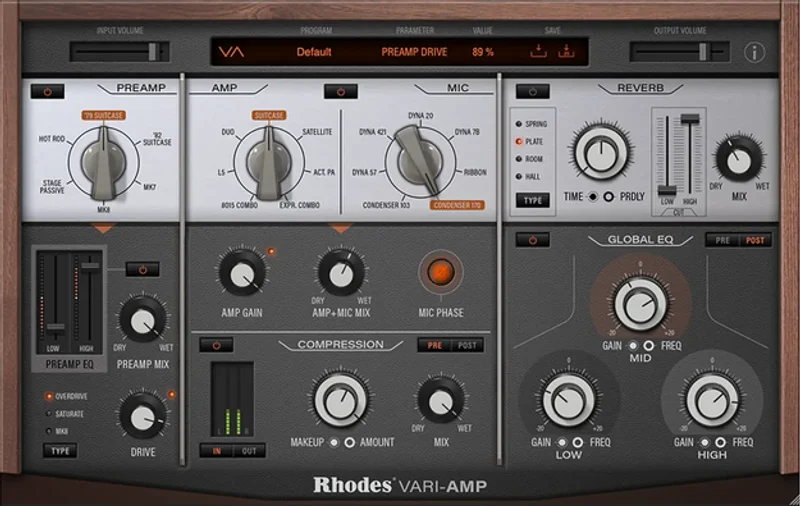
We loaded it on a Juno-106 pad sitting too clean in a soul track. The goal was simple: push some air through it, get some heat, make the synth feel like it was recorded somewhere. We routed the pad through Module A, picked the MK1 '79 Suitcase preamp, paired it with the 8015 Combo amp, and placed a ribbon mic about a metre back.
The difference was immediate. The pad lost its digital flatness. Harmonic content opened up in the 2kHz to 5kHz range, giving the high-mid a presence that hadn't been there before. It wasn't subtle.
We spent three weeks with Vari-Amp across multiple sessions. Here's the honest version of what we found.
What Vari-Amp Actually Is (And Where It Falls Short)
This is not a reverb. Not a standard preamp emulation. Not a saturation plugin with a famous badge on it.
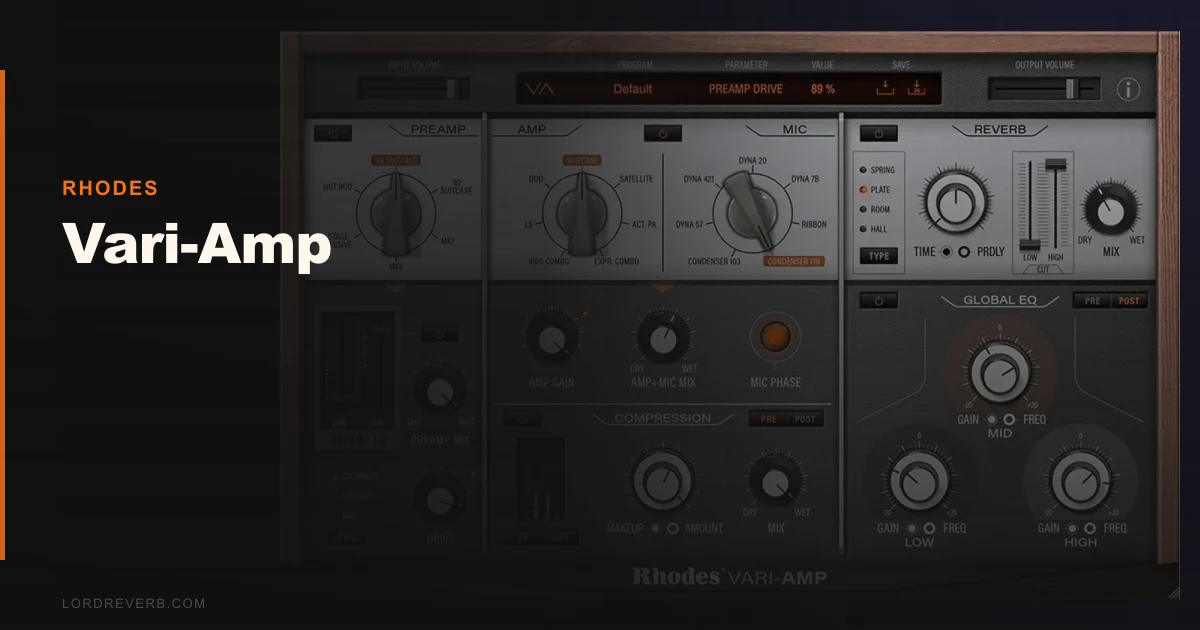
Vari-Amp is a full signal chain simulator built around Rhodes' own hardware history. You get two independent processing modules. Each module chains a preamp (choose from 6, including MK1 '79 Suitcase, Hot Rodded, and MK8), an amplifier (8 options: Duo, 8015 Combo, L5, Rhodes Suitcase Cabinet, Rhodes Satellite, ACT PA, EXPR Combo, and one more), and a microphone (8 types covering dynamic, condenser, and ribbon).
That's a lot of combinations. The math works out to 384 unique chain configurations per module before you touch any knob.
Where it falls short: it's not a mixing workhorse for surgical tasks. Don't reach for it when you need transparent gain staging or clean bus processing. That's not what it's built for. It's built for colour. If you want colour, it delivers.
Living With It: Three Weeks, Multiple Sessions
Setup is painless. VST3, AU, and AAX all installed without issues on macOS 14 and Windows 11. Activation runs through the Rhodes account system online. No iLok, no dongle. That's satisfying.
The dual-module design is where we spent most of our time. Module A and Module B each have independent dry/wet blend, which means you're running a genuine parallel processing rig inside one plugin instance. We used Module A for mid-frequency body on a Wurlitzer sample, and Module B pushed air into the top-end with a condenser mic model. Blend them at 60/40. The result sat in the mix without needing additional EQ.
The Drive circuit across three modes (overdrive, saturation, and a third MK8-based mode) is where the plugin earns real respect. The MK8 drive mode is the one we kept returning to. Push it into a drum bus at around 30% wet: the transients tighten and the room opens up, without obvious distortion artefacts. That's not easy to do. We were genuinely impressed.
One frustration we hit repeatedly: the global EQ and reverb feel tacked on. The reverb has no visible decay time parameter on the main view, which means you're guessing at tail length. For a plugin this deep in its core architecture, that's annoying. It needed more attention.
CPU load is real. Running two instances of Vari-Amp in a 64-track session on an M2 MacBook Pro bumped CPU usage noticeably compared to running two instances of similar character plugins. Not a dealbreaker on modern hardware, but worth knowing if you're stacking it on every track.
The Trade-Offs Worth Thinking About
The breadth of the signal chain is the plugin's biggest strength and its biggest complication. 384 configurations per module sounds exciting until you're 20 minutes in trying to find the right amp pairing and your session is waiting.
There's no per-module preset system. You can save full plugin states, but you can't save "Module A: MK8 + 8015 Combo + ribbon" as a named preset for Module A alone. That's a workflow gap that matters when you're working fast.
The parallel compressor is a clever inclusion. It's not a compressor you'd use as a primary dynamics tool, but blended in at 20-40%, it controls the transient behaviour of the amplified signal in a way that feels analogue rather than clamped. We used it on a Fender Rhodes piano sample and it worked brilliantly. The attack held its shape.
The reverb, though. We wish they'd left it out or done it properly. At its current implementation, it adds wash that's hard to control without automating the dry/wet. It's the one element that feels unfinished.
Against the Field: Where Vari-Amp Wins and Loses
For keyboard-specific character processing, Vari-Amp has no direct competitor with this level of source-authentic modelling. Rhodes built the hardware. That pedigree is real, not marketing.
Against Universal Audio's preamp plugin range, Vari-Amp wins on keyboard-specific tonal authenticity and loses on CPU efficiency and
preset depth. UA’s plugins are better optimised for session work.
Against Softube's amp and cabinet emulations, Vari-Amp's preamp chain is more focused and historically grounded. Softube gives you more amp variety across genres. If you're working primarily on keyboards and synths, Vari-Amp is the better call. If you want a guitar-cab workhorse, go Softube.
Against standard saturation plugins like Decapitator or Satin, Vari-Amp is heavier on CPU and heavier on price. But it does something neither of those does: it places your signal in a physical space, through a physical amp, with a physical mic. That process produces harmonics and mid-range density that saturation-only plugins don't replicate.
The Real Verdict
Vari-Amp is worth picking up if you work with keyboards, synths, or anything that needs to sound like it was recorded through real hardware. The dual-module parallel architecture is clever, the Drive circuit is excellent, and the preamp-to-amp-to-mic chain produces results that sit in a mix without fighting you.
It's wrong for you if you need efficient, stackable character processing across 30 tracks in a dense session. The CPU cost adds up. And if you're looking for a precision tool rather than a tone-shaping tool, skip it. This one has opinions. It wants to colour your sound. Let it, or don't buy it.
Score Breakdown
| Category | Score | Notes |
|---|---|---|
| Sound Quality | 4.3/5 | The preamp-to-amp-to-mic chain produces genuinely convincing analogue density |
| Value for Money | 4.0/5 | The intro price is fair; the full price is harder to justify against UA alternatives. |
| Ease of Use | 3.3/5 | No per-module presets and a vague reverb section slow down real session work |
| Features | 4.0/5 | Dual-module architecture with 384+ chain configurations per module is genuinely deep |
| CPU Efficiency | 3.0/5 | Heavier than comparable single-chain character plugins on the same hardware |
| Overall | 4.1/5 | Strong sound, real heritage, but workflow gaps stop it from being a daily-driver for most |
Alternatives to Consider
If the CPU load is a concern, Universal Audio's Manley preamp emulation gives you character processing with better session optimisation. It's the smarter pick for dense mixes where you're stacking multiple instances.
For straight saturation without the amp-and-mic chain, Soundtoys Decapitator runs leaner and gives you faster dial-in on a single character dimension. Less depth, more speed.
If you're specifically working on electric piano sounds and want preset-driven workflow, Native Instruments' electric piano processing options might suit a faster session flow better. Vari-Amp rewards patience. Not every session has it.
Buy Vari-Amp if keyboards and synths are your primary instruments and you want to run them through something that actually knows what it is talking about. Wait for a sale or skip it if you need lightweight, stack-friendly character processing. The sound is brilliant. The workflow needs another version.
Frequently Asked Questions
Is Vari-Amp only useful for Rhodes electric pianos?
No. We ran it on Juno synths, drum buses, vocal sends, and full mix buses during testing. The preamp-to-amp-to-mic chain adds analogue colour to anything you push through it. That said, the modelling is grounded in Rhodes hardware history, so keyboards and electromechanical instruments tend to respond most naturally to it.
Does Vari-Amp require an iLok or hardware dongle?
No dongle needed. Activation runs through your Rhodes account online. It's one of the cleaner activation systems we've seen on a plugin at this price point. Machine-based licensing with a reasonable number of activations.
How does the dual-module setup actually work in a mix?
Each module runs as an independent signal chain with its own preamp, amp, mic selection, and dry/wet blend. You blend Module A and Module B together at the output. In practice, this means you can run a mid-focused character chain in parallel with a brighter, airier chain and mix them to taste. It's a parallel processing rig inside one plugin instance.
Is Vari-Amp worth the full price after the intro period?
At full price, it is competing directly with established options that offer better CPU efficiency and more mature preset systems. If you catch it at the intro price, the value case is clear. At full price, we'd want to see the per-module preset system and reverb controls improved first. Keep an eye on the Rhodes site for sales.