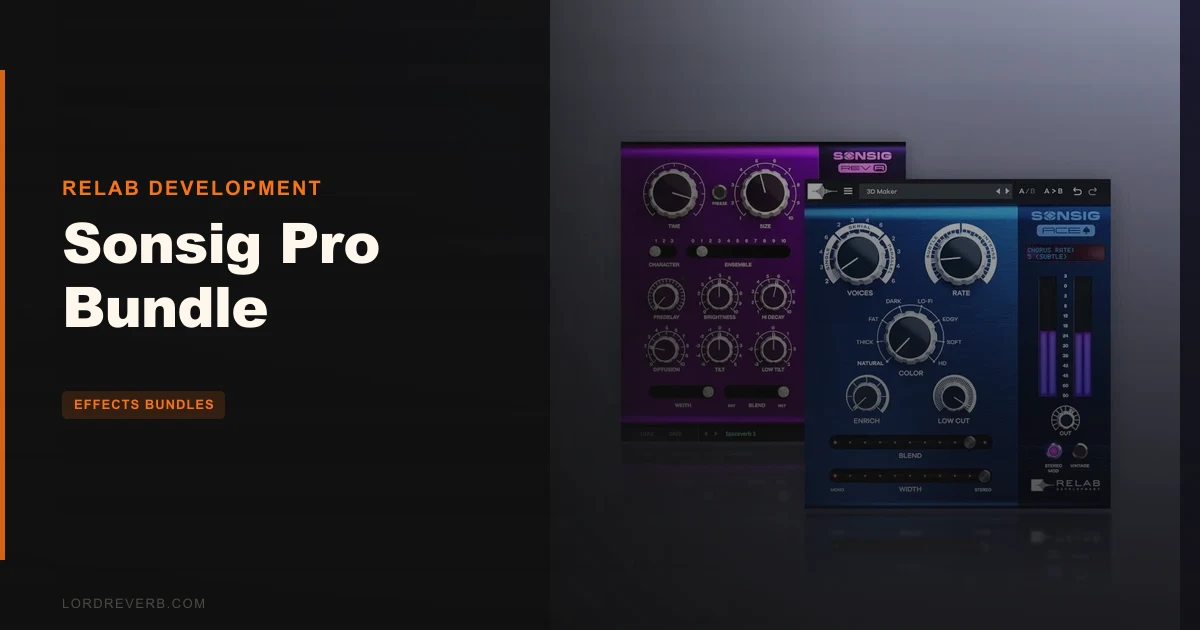
The Sonsig Pro Bundle is a genuinely strong buy at $99: two focused, well-engineered plugins from Relab Development that handle width and depth better than most stock options, and better than several competitors at twice the price. It's built for mix engineers, producers, and composers who want a reliable go-to reverb and a stereo expander that won't detonate mono playback on a phone speaker.
ACE handles dimensional expansion. Rev-A handles the room. Together, they cover the two most common spatial moves in a modern mix. That clarity of purpose is underrated, and we love it.
This is not the bundle for sound designers chasing experimental granular weirdness or beatmakers who need a convolution IR library. But for the producers and engineers who just want their mixes to sound bigger without sounding broken, this is a satisfying answer.
What You're Actually Getting
Two plugins. That's it. No bloat, no eight-plugin stack of things you'll open once.
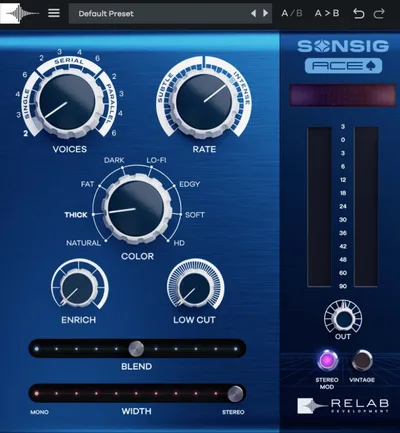
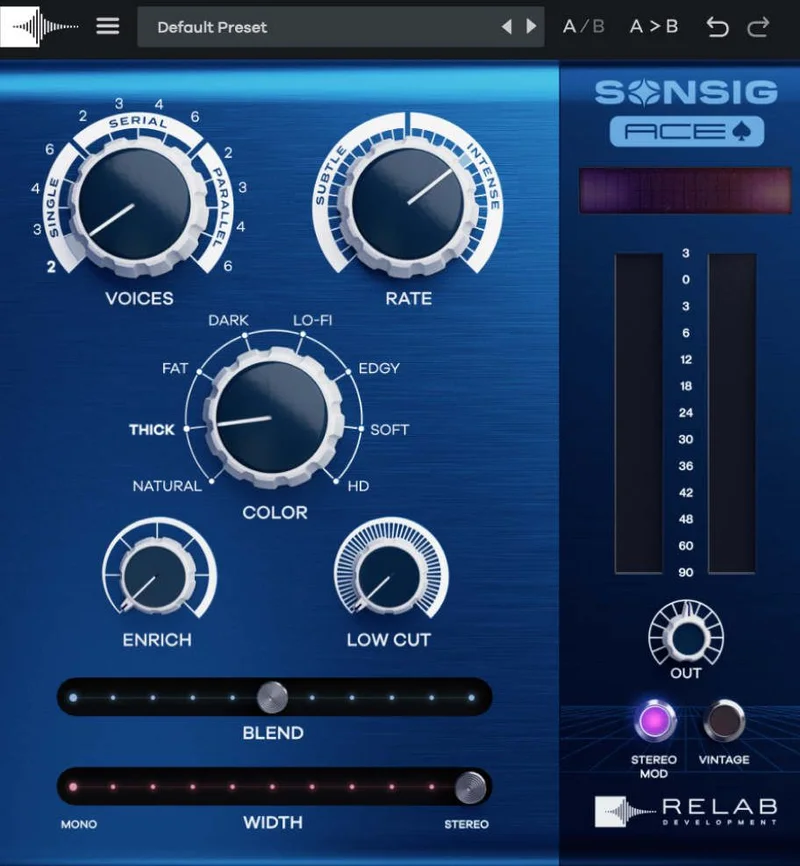
Sonsig ACE is a 12-in-1 dimensional expander built around a multi-voice dual-engine design. It spreads signals across the stereo field using proprietary modulation technology instead of simple delay-based width tricks. The result: no comb filtering, no phase disasters in mono.
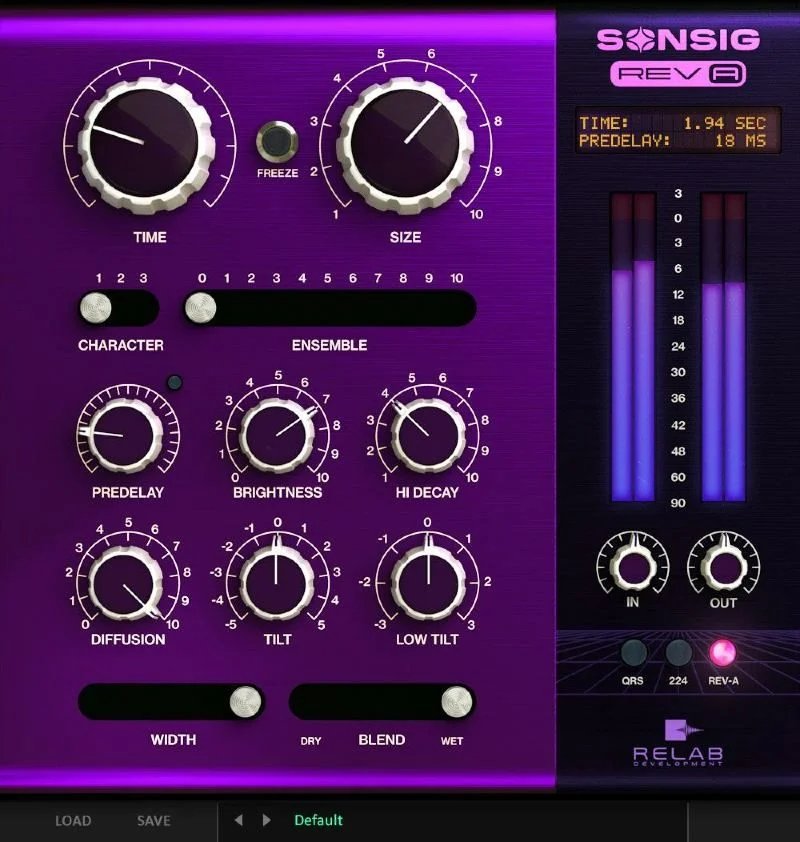
Sonsig Rev-A is a true-stereo algorithmic reverb with 10 distinct size algorithms, from tight booth-sized rooms to hall-length expansions. Controls are menu-free: PreDelay (tempo-lockable), Size, Decay, Width, Diffusion, and a Freeze function for infinite sustain. Rev-A also carries what Relab calls the world's first true in-reverb ensemble chorus, which adds movement to the tail without needing a separate modulation plugin in your signal chain.
Both plugins ship with over 200 presets combined and run on VST3, AU, and AAX. Mac needs OS X 10.15 or above (M1 native). Windows needs 10 or above. Minimum 2GB RAM.
The Good
We ran a dry lead vocal through Rev-A's "Large Hall" size at 2.8 seconds decay, 18ms pre-delay, diffusion at about 60%. The tail bloomed without smearing the consonants. We pulled the pre-delay back to 8ms on a snare send. It hit, decayed, and got out of the way. Both times, no low-mid buildup in the 250–350Hz range that typically muddies up an algorithmic reverb on transient material.
That's what we mean when we say Rev-A sounds clean. Not polite. Not thin. Clean: the tail does its job without dragging mud into your mix.
ACE impressed us on a stacked synth pad that was sitting too narrow in the field. We used the multi-voice engine at moderate depth, with the LFO rate low, around 0.3Hz. The pad spread from roughly 40% width to perceived full stereo. Flipped to mono: nothing collapsed. The centre held. That's the test that cheap width plugins fail every time.
CPU is a genuine strength. Running six instances across a session on an M2 Pro, we sat comfortably under 20% CPU load total. You can stack these without watching your meter spike.
The 200+ preset library is one of the best we've tested in this price range. At least 80% of the Rev-A presets are immediately usable on real material without adjustment. That's rare. Most preset libraries are demo food, not working tools.
The Not-So-Good
iLok. We hate it. We understand why developers use it. We still hate it.
Relab requires a free PACE account and the iLok License Manager installed at activation. No hardware dongle needed, which softens the blow, but it's still friction. If you're on a new machine mid-session, expect 10 minutes of setup before you hear a single reverb tail. Annoying.
ACE's COLOR modes are a real feature that adds tonal character shifts to the modulation engine. The problem: they're not labelled descriptively. You toggle through them and listen. That's fine once you know the plugin, but frustrating in the first week when you're trying to dial in a specific sound fast. A tooltip or a one-word character tag ("dark", "bright", "vintage") would fix this immediately.
There's no trial version available. The 30-day money-back guarantee from Relab mitigates this, but we'd always rather hear a plugin on our material before we commit $99. The blind purchase risk is real for producers who haven't used Relab products before.
The ACE documentation on LFO customisation is also thin. The flexible modulation options are there, but you'll piece together the deeper routing behaviour from experimentation rather than a proper manual.
Compared to the Alternatives
The closest direct competitor on reverb is Verberate Binaural 2 by Acon Digital, which ships with more algorithm types and a binaural processing mode. Verberate wins on raw algorithm variety. Rev-A wins on in-reverb modulation: that built-in ensemble chorus in the tail gives it a character Verberate can't match at the same price without adding a separate send plugin.
On the stereo expansion side, Ozone Imager 2 (free from iZotope) is the obvious comparison for ACE. Ozone Imager is brilliant for basic mid/side work. But it uses delay-based widening, which means mono checks can get ugly on certain material. ACE's dual-engine approach avoids comb filtering entirely. For producers who actually check mono, ACE is the more reliable tool.
TC Electronic's SpaceBlender bundles more reverb flavours but skips the stereo expander component entirely. It's a reverb-only play. If you already own a width tool, SpaceBlender is worth comparing at its price point. If you don't, the Sonsig bundle solves both problems in one purchase for $99.
The honest take: for $99, nothing in this category delivers this combination of clean algorithmic reverb plus artifact-free stereo expansion without compromise on CPU or mono compatibility. That's a narrow but clear win. best reverb plugins for mixing
Who Should Buy This
- ✅ Buy if you need a reliable workhorse reverb and stereo expander that you can leave on every session without CPU anxiety.
- ✅ Buy if you work on orchestral or cinematic material and need tails that move without adding a separate modulation plugin to the chain.
- ✅ Buy if you do a lot of vocal production and want pre-delay and diffusion controls that respond musically without complex menu diving.
- ❌ Skip if you already own FabFilter Pro-R or a premium reverb suite. Rev-A won't move you past what you have.
- ❌ Skip if iLok activation is a dealbreaker in your setup or studio environment.
- ❌ Skip if you're primarily a beatmaker looking for a convolution reverb with IR libraries. Neither plugin goes there. best convolution reverbs for producers
Score Breakdown
| Category | Score | Notes |
|---|---|---|
| Sound Quality | 4.5/5 | Rev-A's tail clarity and ACE's phase-coherent width are both above average for this price tier |
| Value for Money | 4.5/5 | $99 for two genuinely useful plugins with 200+ working presets is a satisfying deal |
| Ease of Use | 3.5/5 | iLok friction at install and unlabelled ACE COLOR modes slow the early learning curve |
| Features | 4.0/5 | 10 Rev-A sizes, in-reverb modulation, customisable LFOs in ACE, and Freeze all stand out; nothing wasted |
| CPU Efficiency | 4.5/5 | Multi-instance use stays well below 20% on M2 Pro, genuinely light |
| Overall | 4.2/5 | A clever, focused bundle that earns its price through honest performance rather than feature bloat |
Alternatives to Consider
Verberate Binaural 2 by Acon Digital is worth looking at if you need binaural reverb output or a wider range of algorithm types than Rev-A's 10 sizes. It's a strong reverb-only plugin. Verberate Binaural 2 review
Ozone Imager 2 by iZotope is free and handles basic stereo widening well. It's not in the same league as ACE for mono safety or modulation depth, but if budget is the primary constraint, it's a genuine starting point. best free stereo widening plugins
FabFilter Pro-R 2 is the reference-class algorithmic reverb at a higher price point. If you need ultimate control over the decay curve and EQ behaviour inside the reverb itself, Pro-R 2 is worth the premium spend. But it doesn't come with a stereo expander, and it costs meaningfully more than the entire Sonsig bundle. FabFilter Pro-R 2 review
If you're building a budget spatial toolkit from scratch, the Sonsig bundle is our first recommendation at $99. Start here. Upgrade if you outgrow it.
$99 for two well-designed, CPU-friendly plugins that do exactly what they say. If the iLok setup is something you can handle in five minutes, this bundle earns its place in the signal chain on day one. If you're on a completely iLok-free studio setup, that friction point might cost more than the $99 in headache. Know yourself.
Frequently Asked Questions
Does the Sonsig Pro Bundle require a hardware iLok dongle?
No hardware dongle is required. Relab Development uses PACE iLok for activation, but you can authorise directly to your computer. You do need a free iLok account and the latest PACE License Manager installed, so factor in 10 minutes for the activation process the first time you set it up.
Can I buy Sonsig ACE and Rev-A separately instead of as a bundle?
Yes. Sonsig ACE is available as a standalone plugin (check Relab's site for current individual pricing). Buying the bundle saves money if you want both tools, so unless you specifically only need the reverb or only need the expander, the bundle is the better value per plugin. If you already own Rev-A, buying ACE standalone makes sense.
Does Sonsig ACE work safely in mono? Will it collapse the stereo field?
This is one of ACE's key engineering strengths. The dual-engine design avoids the delay-based widening that causes comb filtering and mono cancellation. We tested it with mid/side monitoring and a summed mono bus: the centre held, the stereo width disappeared cleanly without destructive artefacts. It's one of the safer wideners we've run through a proper mono check.
Is the Sonsig Pro Bundle good for vocal processing specifically?
Rev-A works very well on vocal sends. The tempo-lockable pre-delay lets you time the reverb onset to your session BPM, which keeps vocals sitting inside the groove rather than washing ahead of the beat. The diffusion control lets you tighten or loosen the tail density depending on whether you're working on a dry pop vocal or a wide choir. ACE adds width to doubled or stacked vocal layers without the flanging artefacts that chorus-based wideners introduce.