Pulsar Audio Analog EQs Bundle: Still Worth It in 2026
By Salvatore Tomaselli·2 albums, 6 singles as Lord Reverb. Now I test the gear that made them.
·Updated October 4, 2026
Affiliate disclosure: Some links in this article are affiliate links. If you buy through them we earn a small commission at no extra cost to you. We only recommend products we genuinely believe in — our editorial opinions are never influenced by affiliate relationships. Full policy
⭐
Score4.3 / 5
⏱
Read time8 min read
4.3/5
★★★★☆
Best forMix and mastering engineers who want distinct-sounding analog EQ character without spending four figures on hardware emulation bundles from bigger names
Price at Plugin Boutique, checked Oct 10, 2026. It can change. Affiliate link: we earn a commission at no extra cost to you.
✓ Pros
+Four genuinely different-sounding EQs with distinct circuit behaviors
+MP-EQ's optional linear-phase frequency realignment is a legitimately clever engineering move
+Bundle pricing makes individual plugin costs embarrassingly low
+CPU performance holds up across multiple instances without throttling sessions
✗ Cons
−Almost no third-party documentation or comparison data to lean on
−GUI scales inconsistently across different screen setups
−Undersells itself with sparse marketing, making it hard to demo-discover
The Pulsar Audio Analog EQs Bundle is one of the most underrated plugin purchases you can make in 2026, and we'd buy it again at full price.
Four hardware emulations. Four genuinely different sonic identities. One bundle that goes on sale often enough that the sale price is closer to what most people actually pay.
We've spent time with each plugin in real sessions, not just A/B shootouts in isolation. Vocal chains, mastering buses, drum rooms. Here's the honest picture.
What You're Actually Getting
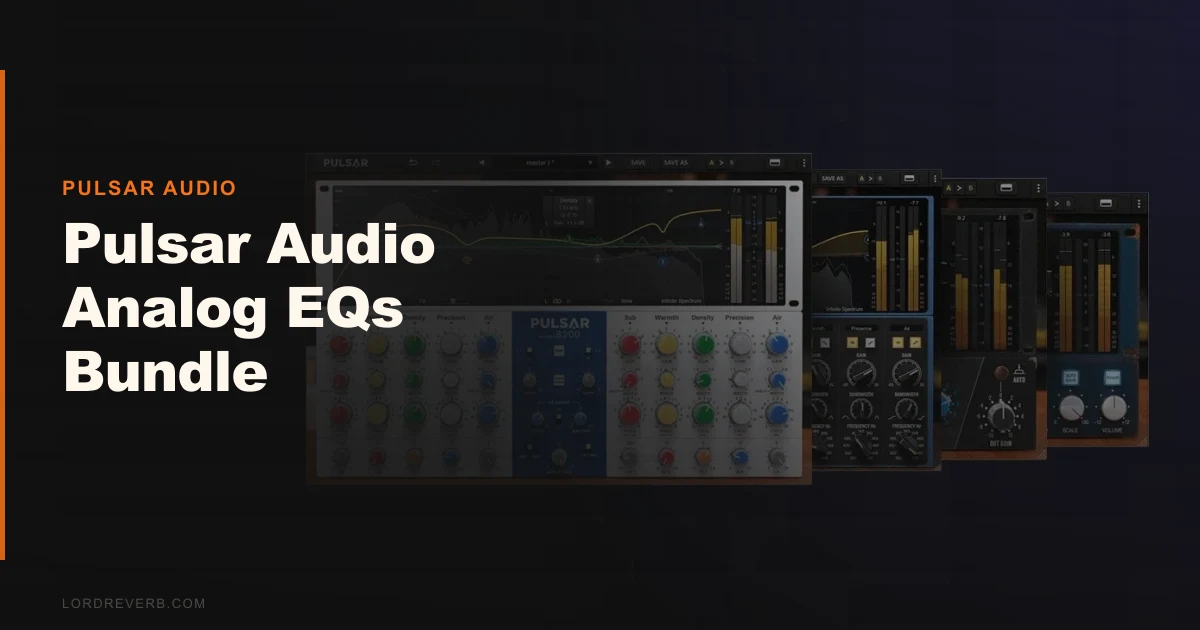
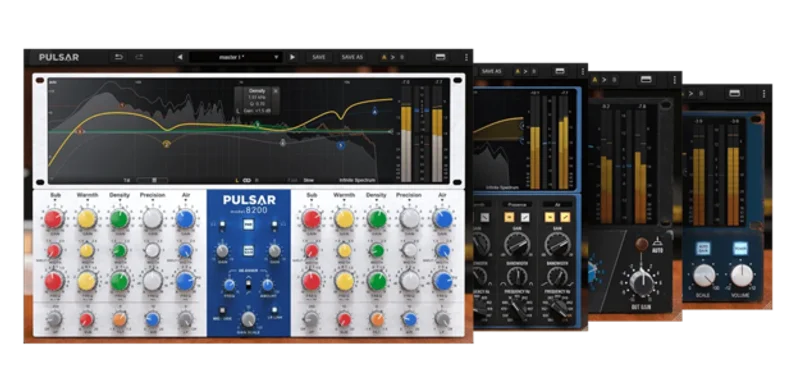
The bundle contains four plugins: Massive (Pultec-style passive EQ), Poseidon (another Pultec topology with different character), 8200 (Class-A recreation of the GML 8200 from the 1980s), and W495 (based on the Neve 1073-adjacent 495 topology).
These aren't four variations on one plugin. They're four different circuit behaviors. Massive and Poseidon share the Pultec parallel design, meaning when you boost and cut at the same frequency, you get the famous Pultec trick where the combination creates a slight loudness boost with a shelf dip. No cumulative tonal correction applied underneath.
The 8200 is the precision tool in the set. Think surgical GML transparency with attitude. The W495 is the one that colors immediately, visibly, pleasantly.
The standout engineering feature lives in the MP-EQ: an optional linear-phase frequency realignment mode that corrects phase artifacts post-processing. That's a real implementation of something that usually costs extra elsewhere.
The Good
We ran a dense mix bus through the W495 and pushed the low shelf at 60Hz by 3dB with a gentle high-shelf cut around 12kHz at 1.5dB. The low end didn't just get louder. It got thicker in a way that changed how the kick and bass sat together. That's the harmonic content talking, not just gain.
The 8200 handled a challenging vocal edit we've been struggling with. There was a 400Hz buildup that was making the chest voice sound boxy. We pulled 2.5dB at 400Hz with a Q of approximately 1.8 and the result was cleaner than comparable moves in FabFilter Pro-Q 4, without the clinical feeling. It just sat better.
CPU load is satisfying. We ran eight simultaneous instances across a 96kHz session in Logic Pro on an M2 MacBook Pro and saw modest CPU hits. Competing emulation bundles from bigger names have brought similar sessions to their knees. Pulsar has clearly optimized here.
The Pultec-style plugins have that parallel topology that makes the EQ moves feel natural. You dial in broad shapes and they don't fight the material. That's not vague praise. It means the filter slopes are gentle enough that heavy boosts don't create audible ringing.
The Not-So-Good
The GUI scaling is annoying. On a standard 1080p monitor it looks fine. On a 4K display with scaling set to 150%, things shift around in ways that feel unfinished. It's not a dealbreaker, but it's frustrating when pricier plugins from competitors handle HiDPI without issue.
Documentation is sparse. If you don't already know what a Pultec EQ does or why the GML 8200 sounds different from an API 550, you'll be Googling your way through the learning curve. Pulsar's website gives you the hardware heritage story but doesn't explain the circuit behavior in plain terms.
We also wish there was a more direct trial path. The demo process requires account creation and some navigation that feels like it's designed by someone who assumed you already wanted it before you heard it. That's not how you win over skeptical engineers.
And there's no official third-party frequency response data published. We'd love to see Pulsar post actual measurements so we can compare circuit behaviors objectively. Right now it's trust-based, which works, but only if you've already bought in.
Compared to the Alternatives
Universal Audio's analog EQ options inside UAD are genuinely brilliant. The Pultec MEQ-5 and EQP-1A emulations are among the best-sounding in the business. But you're locked to UAD hardware or a UA subscription, and individual plugin pricing is brutal.
FabFilter Pro-Q 4 is not a fair comparison. It's a different tool. Pro-Q 4 wins on flexibility, dynamic EQ, and surgical precision. It loses on character. Pulsar wins on character every time. These are complementary purchases, not alternatives.
Waves' Pultec collection has similar price points and covers comparable ground. Our honest take: Pulsar's circuit modeling feels more alive in the parallel topology zones. The Waves versions sound competent. The Pulsar versions sound like something you'd reach for instinctively.
Plugin Alliance has hardware emulations that are well-regarded. Their Brainworx stuff is excellent. At comparable pricing you're getting less variety than Pulsar's four-plugin sweep. If you want one great SSL channel strip, go Brainworx. If you want four distinct mastering personalities, go Pulsar.
Who Should Buy
This
✅ Buy if you want analog EQ character without paying Universal Audio hardware prices
✅ Buy if your current EQ workflow is all surgical and you're missing tonal warmth (meaning second-harmonic content and gentle high-frequency saturation that FabFilter doesn't add)
✅ Buy if you're mastering and need multiple distinct tonal tools rather than one neutral processor
❌ Skip if you need a comprehensive dynamic EQ or precise multiband control. These are not that.
❌ Skip if you're on a UAD system already and have the Pultec bundle covered. Redundancy you don't need.
❌ Skip if GUI aesthetics matter a lot to you. Pulsar's interfaces are functional, not beautiful.
Score Breakdown
Category
Score
Notes
Sound Quality
4.5/5
Distinct analog behaviors that translate across styles and source material
Value for Money
4.5/5
Four serious emulations for what one UAD plugin costs on sale
Ease of Use
3.5/5
Intuitive if you know analog EQs; steep for newcomers with minimal documentation
Features
4.0/5
Linear-phase option in MP-EQ is genuinely clever; no dynamic EQ mode across the set
CPU Efficiency
4.5/5
Multiple instances run without drama at high sample rates
Overall
4.3/5
Underrated, well-engineered, and worth more than its price suggests
Alternatives to Consider
If you want a single precision EQ that handles both surgical and character work, FabFilter Pro-Q 4 review is still our daily driver for surgical moves. It won't give you Pultec topology magic, but nothing does linear-phase dynamic EQ better.
For Neve-flavored saturation and EQ baked into one channel strip workflow, best Neve-style channel strip plugins covers options that might overlap with the W495's territory at different price points.
If you're deep in mastering and want a broader comparison of passive EQ emulations specifically, best Pultec EQ plugin emulations breaks down how Pulsar's Massive and Poseidon stack up against UAD, Waves, and others side by side.
For engineers who want hardware emulation quality without the learning curve, best analog EQ plugins for beginners might be a better starting point before committing to a bundle.
Here's the thing about Pulsar Audio: they built four excellent plugins and then apparently forgot to tell anyone about them.
On sale, this bundle costs less than a single Universal Audio plugin at full price. The circuit modeling is serious. The CPU efficiency is impressive. The four distinct sonic identities mean you're not buying four versions of the same thing.
The only people who should skip this are engineers who genuinely don't need analog character in their signal chain, or people who already own equivalent UAD coverage and don't want the overlap. Everyone else: buy it when it's on sale and don't look back.
Pulsar could have charged more. We're glad they didn't.
Frequently Asked Questions
Is the Pulsar Audio Analog EQs Bundle worth it at full price?
Yes, but you'll likely never pay full price. Pulsar runs regular sales that bring the bundle down to a lower price. At that price it's an easy recommendation. At full price it's still solid value compared to buying equivalent emulations from Universal Audio or Waves individually, but wait for a sale if you can.
Do I need to know about analog EQs to use this bundle?
Knowing the hardware originals helps. The Pultec boost-and-cut trick on Massive and Poseidon makes more sense if you understand why the parallel topology creates that loudness shelf behavior. That said, the plugins respond intuitively to use by ear. You'll figure out what sounds right quickly, even without the background knowledge.
How does Pulsar Audio's MP-EQ linear-phase mode work?
The standard mode runs the plugin in minimum-phase, which is how the analog hardware behaves. The linear-phase option applies frequency realignment after the EQ processing so phase artifacts are corrected, useful on master buses where cumulative phase shift from multiple processors becomes audible. It's the same output tonally, with a cleaner phase response. Expect some added latency in linear-phase mode.
Can I use the Pulsar Analog EQs Bundle for mixing, or is it just for mastering?
We use it on both. The W495 and 8200 are excellent on individual channels. The 8200 is precise enough for notching problem frequencies on vocals or guitars, and the W495 adds useful harmonic color on drums and bass. The Pultec-style plugins (Massive and Poseidon) are most at home on buses and the master chain, but there's no rule that keeps them off individual tracks.
The short version
Pulsar Audio Analog EQs Bundle · 4.3/5
Buy it if:Mix and mastering engineers who want distinct-sounding analog EQ character without spending four figures on hardware emulation bundles from bigger names
Four genuinely different-sounding EQs with distinct circuit behaviors
MP-EQ's optional linear-phase frequency realignment is a legitimately clever engineering move
Bundle pricing makes individual plugin costs embarrassingly low
Biggest drawback:Almost no third-party documentation or comparison data to lean on
Salvatore Tomaselli has spent twelve years in studios as a producer, mix and mastering engineer. He's worked across genres, tested hundreds of plugins, and built more signal chains than he can count. Salvatore started writing for LordReverb because most gear coverage is either sponsored fluff or spec-sheet copy-paste. He tests everything before writing about it. No gear gets a pass just because it's popular.
Community
What's in your stack?
Every artist on LordReverb has a setup. Show yours. DAW, plugins, hardware, the lot. Free, takes 2 minutes.